ManyChat Bot 2026: What It Is and Where It Breaks

A "ManyChat bot" is a flow-based chatbot you build inside ManyChat to auto-reply on Instagram DMs, Facebook Messenger, WhatsApp, SMS, or email — using if-this-then-that logic, button menus, and a small AI layer for free-text questions. It is not a single product called "the ManyChat bot." It is the automations you create inside the platform, made of triggers (like a comment under a Reel), conditions (tags, custom fields, time of day), and pre-written replies that branch based on what the user clicks.
That definition matters because most of the confusion around ManyChat starts here. People search "manychat bot" expecting a download, a Telegram bot, or a single AI assistant. None of those are real. What's real is a no-code visual flow builder that lets you ship a bot in an afternoon, and a long list of things you can't do with it once your conversations get serious.
TL;DR — ManyChat bot in one screen
| Question | Short answer |
|---|---|
| Is ManyChat a bot? | Not exactly. It's a platform you use to build bots. The bots run inside Instagram, Messenger, WhatsApp, or SMS. |
| What does a ManyChat bot do? | Auto-replies, sends a link, captures an email, books with Calendly, asks button-menu questions, tags users. |
| Is it AI or rules-based? | 95% rules-based (button flows, keywords, tags). A small "AI Step" can answer free-text questions from a knowledge base. |
| Will it get my account banned? | No, on Instagram and Messenger — ManyChat uses official Meta APIs. Yes risk on TikTok-style scrapers (ManyChat doesn't do that). |
| Is there a free ManyChat bot? | Yes — Free plan caps at 25 active contacts/month. Enough to test, not to run. See Is ManyChat free? |
| What's a ManyChat bot good at? | Comment-to-DM, lead magnets, FAQ deflection, list building, simple booking funnels. |
| Where does it fall short? | Real conversations. Once a lead replies "what about [unscripted thing]?", the flow can't keep up. |
| When to switch to AI? | When you're booking sales calls, qualifying leads, or selling anything above $200. See AI setter guide. |
What people mean when they search "ManyChat bot"
The keyword "manychat bot" hides three different intents. They get answered separately below.
- Intent A — "Is ManyChat itself a bot?" No. ManyChat is the editor. The bots are the automations you build with it.
- Intent B — "How does a ManyChat bot work, end-to-end?" A trigger fires (a comment, a keyword in a DM, a click on a button). A flow runs (sequential messages, conditions, buttons). Optional integrations dispatch (email captured to a CRM, Calendly slot proposed, Shopify cart abandoned, etc.).
- Intent C — "How safe is it to run a ManyChat bot on my account?" Safe on Meta-owned channels, because ManyChat is on the Meta partner list and uses the official Graph API. Unsafe in general for any "Instagram bot" that uses browser automation or scraping — but ManyChat doesn't do that.
If you're searching to compare it with a different tool, two adjacent reads cover those: What is ManyChat? for a plain-English platform overview, and ManyChat review for a 30-day test of the product.
How a ManyChat bot is actually built
The mental model is simple: trigger → flow → action.
1. The trigger
A trigger is what wakes the bot up. ManyChat supports about a dozen trigger types per channel. The five most-used ones are:
- A new comment under an Instagram post or Reel containing a keyword (the famous "comment X to get the link" pattern)
- A first DM from a new follower on Instagram or Messenger
- A specific keyword sent by an existing contact (e.g., "PRICES")
- An Instagram Story reply or mention
- A click on a button inside an existing flow
For Messenger, you also have ad-based triggers (Click-to-Messenger ads, Feed comments). For WhatsApp, triggers are usually inbound messages from a Click-to-WhatsApp ad or a typed keyword.
2. The flow
Inside the visual builder, a flow is a tree of nodes. Each node is one of: a text message, an image/video, a quick-reply button row, a condition (if-then), a delay, a tag/custom-field action, an integration step (email, webhook, Calendly), or an "AI Step."
You build by dragging connectors between nodes. The user's path through the tree is determined by the buttons they click, the keywords they type, or the conditions you set (e.g., "tag = newsletter_subscriber").
A simple comment-to-DM flow has 4 nodes: trigger (comment), DM message ("Hey! Here's the link as promised"), button ("Send me the link"), action (open URL + tag). That's it. You can ship it in 10 minutes.
3. The action
Actions are the things the bot does at the end of a flow: tag the contact, set a custom field, send to a CRM via Zapier or another integration, open a URL, propose a Calendly slot, fire a webhook, or hand off to a live human via the Inbox.
Tags and custom fields are how ManyChat segments users for follow-up sequences. They're powerful and limited at the same time: powerful because you can fire conditional flows on them, limited because they're flat — there's no native CRM with stages, scoring, or pipeline views like you'd get in HubSpot.
Channels: where a ManyChat bot actually lives
A ManyChat bot doesn't live on manychat.com. It lives inside the channel it's connected to. Each channel has different capabilities and constraints.
| Channel | What works | Constraints |
|---|---|---|
| Instagram DM | Comment-to-DM, Story replies, keyword triggers, AI Step on free text | 24-hour reply window after last user interaction |
| Facebook Messenger | Click-to-Messenger ads, post comments, broadcasts under Meta tags | Promotional broadcasts only inside the 24h window |
| WhatsApp Business API | Click-to-WhatsApp ads, template messages, two-way chats | Per-conversation Meta fees on top of ManyChat |
| SMS / Email | Drip sequences, transactional triggers | Carrier fees on SMS, deliverability on email |
| TikTok / Telegram | Limited beta on [TikTok comments](/blog/manychat-tiktok), no native Telegram | Don't plan a strategy around them yet |
The channel choice changes the whole strategy. On Instagram, the bot is a comment-funnel and lead magnet machine. On WhatsApp, it's the closest thing to a real two-way conversation tool ManyChat ships — which is also where the per-message Meta fees stack up. The full breakdown of those fees lives in our WhatsApp Business API pricing article.
"Is ManyChat actually AI?" — the honest answer
Mostly no. Adjusting for marketing copy, here's the breakdown of what's actually AI inside a ManyChat bot:
- AI Step (knowledge-base answer) — the user types a free-text question, the AI Step pulls from a small knowledge base you uploaded and replies. This is the only "real" AI in a default ManyChat flow. It works well for FAQs ("What's your refund policy?") and very poorly for sales conversations.
- Intent detection on keywords — light NLP that maps "I want pricing" / "how much" / "what's the cost" to the same trigger. Useful but not conversational.
- Generative replies inside flows — only if you wire it manually via a webhook to OpenAI or Anthropic. ManyChat doesn't do this natively beyond the AI Step.
For a flow with five button paths and a Calendly link at the end, that's plenty. For a real sales conversation where the lead asks unscripted things ("does this work for B2B SaaS?", "I tried something like Drift and hated it, why is yours different?", "what about my specific case in real estate?"), the AI Step is not enough. You need a tool whose default mode is "have a conversation" rather than "follow the buttons."
That's the architectural gap between a ManyChat bot and an AI setter: one runs a flowchart, the other holds a conversation. The flowchart can branch in 5 directions. The conversation can branch in 500.
Where a ManyChat bot is actually great
Despite the gap, ManyChat bots are the right tool for a lot of jobs. Don't write off the platform — the question is matching the use case to the architecture.
Comment-to-DM lead magnets
This is what ManyChat is famous for, and it deserves the reputation. You post a Reel that says "comment 'GUIDE' for my free PDF," set up a 4-node flow, and the bot DMs the link to anyone who comments. We have a full breakdown of the mechanics and conversion benchmarks in Instagram comment-to-DM automation.
For this job, the flow architecture is a feature, not a limitation. There are exactly two states the user can be in (asked / not asked), and the bot handles both perfectly. AI would be overkill.
FAQ deflection
If you get the same 5–10 questions every week ("what time do you open?", "where are you located?", "do you ship internationally?"), an AI Step with a small knowledge base will answer 80% of them in <2 seconds. Pair with quick-reply buttons for the most-asked and you save hours.
List building
Capture an email or phone in DMs, push to Mailchimp / Klaviyo / a webhook. The flow architecture is rock-solid for this — fewer paths means fewer ways to lose the user.
Simple booking funnels
If your booking is "click here for Calendly," ManyChat is fine. The Calendly integration drops a link into the DM, the user picks a slot, you're done. The flow doesn't need to be smart — it just needs to dispatch the link reliably.
Where a ManyChat bot quietly breaks
These are the cases where the tool fights you instead of working for you.
Lead qualification with anything beyond yes/no
Real qualification is fuzzy. A lead says "I'm a personal trainer with about 40 clients but I'm thinking of pivoting to coaching." Is that a fit for your $5K coaching program? A flow can't tell. It needs to ask 4–8 follow-up questions, listen to the texture of the answers, and decide. Flows give you a binary tag — "fit / not fit" — based on whichever button they clicked. That's not qualification, that's tagging.
For depth, the kind that determines whether a lead actually books, conversation length matters more than tagging logic. Our AI DM conversation study — 828K AI-led DM conversations across 391 businesses — found that booking rates climb from under 1% in 1–4 message exchanges to roughly 1 in 3 at 21+ messages. ManyChat flows almost never get past message 5 because the buttons run out.
High-ticket sales conversations
If the lead is paying $1K, $5K, $25K — they want to feel heard before they buy. A flow that says "tap A, B, or C" feels like cold outreach. An AI conversation that asks them about their goal, listens to the constraint, validates the urgency, and then proposes a call feels like a salesperson who knows the product.
This isn't theory. It's the reason high-ticket coaches and consultants who start on ManyChat eventually graduate to an AI sales assistant once their offer crosses the $500 mark.
Free-text replies that don't match a button
The worst experience in a ManyChat bot is when the user types something the flow didn't anticipate, and the bot replies with a fallback message ("Sorry, I didn't get that — please pick from the menu"). That happens a lot more than the flow architect realizes. Every "Sorry I didn't get that" is a lead you just lost.
The AI Step helps a little, but only inside a tightly bounded knowledge base. For genuinely open-ended sales chat, it's not the right primitive.
Stage-aware nurturing
ManyChat tags are flat. A contact is "interested" or "not interested" or "booked" or "ghosted." There's no concept of pipeline stage, lead score, or last-touch decay. If your sales process has more than two states, you'll bolt on Zapier → HubSpot → CRM, and now you have three tools to maintain instead of one.
Manual vs ManyChat bot vs AI setter
The right comparison isn't "ManyChat or no ManyChat." It's "what level of automation does my use case need."
| Dimension | Manual | ManyChat bot | AI setter |
|---|---|---|---|
| Speed to first reply | Hours, sometimes days | Instant | Instant + contextual |
| Handles unscripted questions | Yes | No (falls back to menu) | Yes |
| Books a calendar slot in-chat | Yes (manually) | Sends Calendly link | Proposes 3 slots, books in-chat |
| Lead qualification depth | High but slow | Tag-only / button-only | Conversational, multi-criterion |
| Follow-up after silence | Forgotten ~70% of the time | Static sequence | Context-aware re-engagement |
| Cost (Pro use) | $2K–$4K/mo per setter | ~$15–$70/mo | $97/mo (1,000 messages) |
| Best fit | Custom enterprise sales | Lead magnets, FAQ, list building | Booking sales calls, $200+ offers |
The middle column is what most creators reach for first because it's cheap and visible. The right column is what they reach for once a flow-based bot has plateaued and they realize the next 100 leads need a real conversation, not a better menu.
"Will a ManyChat bot get my account banned?"
This is the most-asked safety question. The short answer is no — for the channels where ManyChat is officially integrated (Instagram, Messenger, WhatsApp Business API). Here's why it matters and what to watch.
Why ManyChat is safe on Meta channels
ManyChat is on Meta's official partner list and connects through the documented Messenger Platform API and Instagram Graph API. Every message it sends goes through Meta's servers, with rate limits and policies enforced at the API layer. There's nothing scrapy or hidden — Meta knows ManyChat is talking to your account because Meta literally issues the access token.
The accounts that get banned for "automation" almost always use a different category of tool: browser-automation bots that log into Instagram on a server somewhere and pretend to be the user. Those violate Meta's terms whether they're free or paid. ManyChat is in a different category — it's a permitted application doing permitted things. We covered the safe-vs-unsafe distinction in detail in our Instagram DM bot breakdown.
What you can still do wrong
Compliance isn't automatic just because the platform is permitted. The fastest ways to draw a flag are:
- Sending the same promotional message to thousands of contacts outside the 24-hour window (Messenger has tighter rules for this than people realize)
- Using a comment-to-DM trigger to send links violating community standards
- Creating a "review-bait" flow that nudges users to leave a 5-star review
- Buying contacts and importing them into a list they didn't opt into
Stay inside the 24-hour reply window for promotional content, get explicit opt-in for ongoing broadcasts, and your bot will be fine for years.
And on WhatsApp specifically
WhatsApp is stricter. Every conversation outside a 24-hour window from the user's last message requires a Meta-approved template, and template-message abuse will get your number's quality rating downgraded fast. If you're going to run a WhatsApp bot, invest 10 minutes reading Meta's quality rating docs before you broadcast anything.
ManyChat bot pricing in 2026
ManyChat's pricing changes the architecture decision. The tiers (verified against our ManyChat pricing breakdown) work in three layers:
- Free — capped at 25 active contacts/month. A bot here is for testing, period.
- Essential — starts around $15/month for 500 contacts, scaling with contact count.
- Pro — starts around $25/month, adds AI Step access, integrations, and team features.
- WhatsApp — Pro tier plus per-conversation Meta fees ($0.005–$0.10 each depending on region and category).
The decision tree is short. If you're under 25 contacts and just testing, the free plan is fine. If you're a small creator with consistent comment-to-DM flows, $15–$30/month is fair. If you're trying to run a sales-call funnel and you're hitting the limits of flow logic, you'll spend more time debugging button branches than the platform saves you.
When ManyChat ISN'T the right bot
Five situations where you should not start with ManyChat — or where you should plan to graduate:
- You're booking sales calls. Flow-based booking ("here's a Calendly link") converts way worse than conversational booking ("here's why I think you'd be a fit, here are 3 slots that work for your timezone").
- Your offer is above $500. High-ticket buyers want to feel heard before they pay. A button menu doesn't hear them.
- Your audience asks unscripted questions. Coaches, consultants, agencies — your DMs are full of "does this work for X?" The fallback message kills the conversation.
- You need lead qualification with more than 2 criteria. Tags and buttons can encode "fit" and "interested." They can't encode "fit AND budget AND timeline AND has-tried-X-before."
- You want one tool, not three. ManyChat + Zapier + CRM is a stack. An AI sales assistant replaces all three for most setups under 1,000 messages/month.
The honest pattern: most creators start on ManyChat for the comment-to-DM mechanic and stay forever for that. They graduate to AI for everything sales-related, and run both side-by-side.
ManyChat bot vs Chatfuel bot vs AI setter
This comes up a lot once people hit the limits of ManyChat. The 30-second answer:
- ManyChat — best Instagram + WhatsApp + Messenger flow builder. Strongest comment-to-DM mechanics. Weakest at conversation.
- Chatfuel — older, originally Messenger-first, now Instagram and WhatsApp. Slightly cheaper at scale but a thinner community. We compare them head-to-head in ManyChat vs Chatfuel and break down Chatfuel pricing separately.
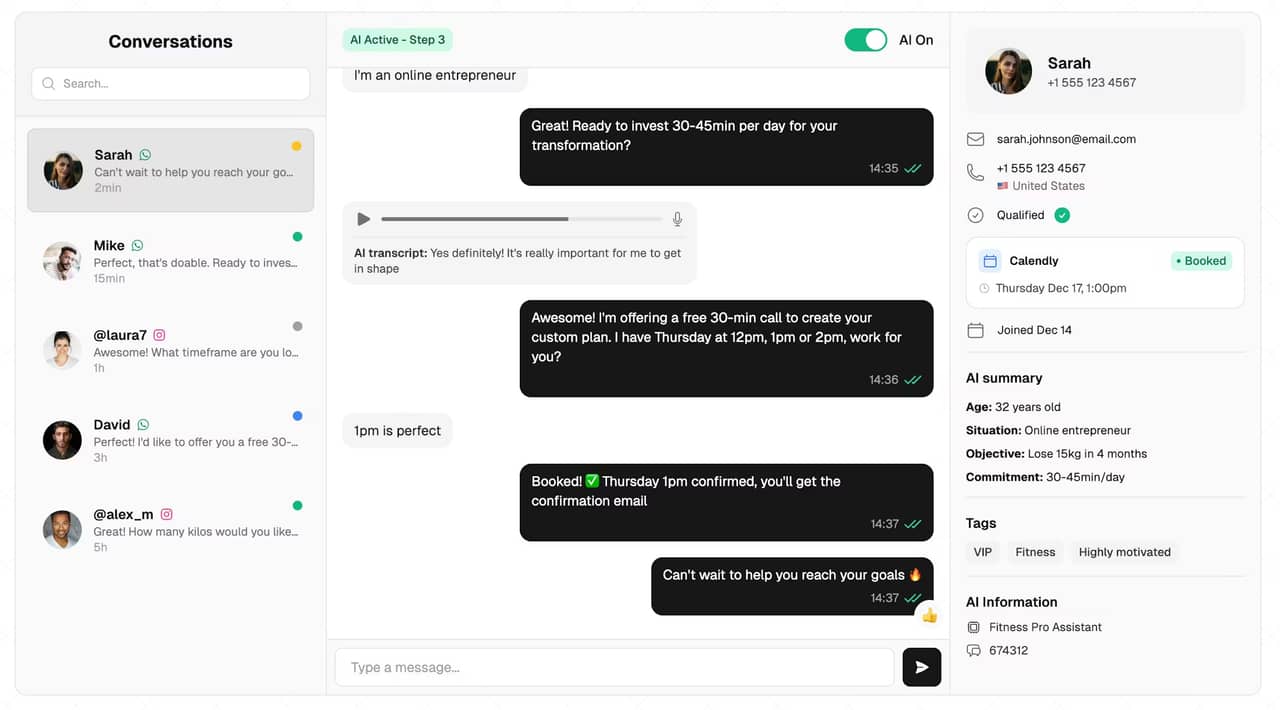
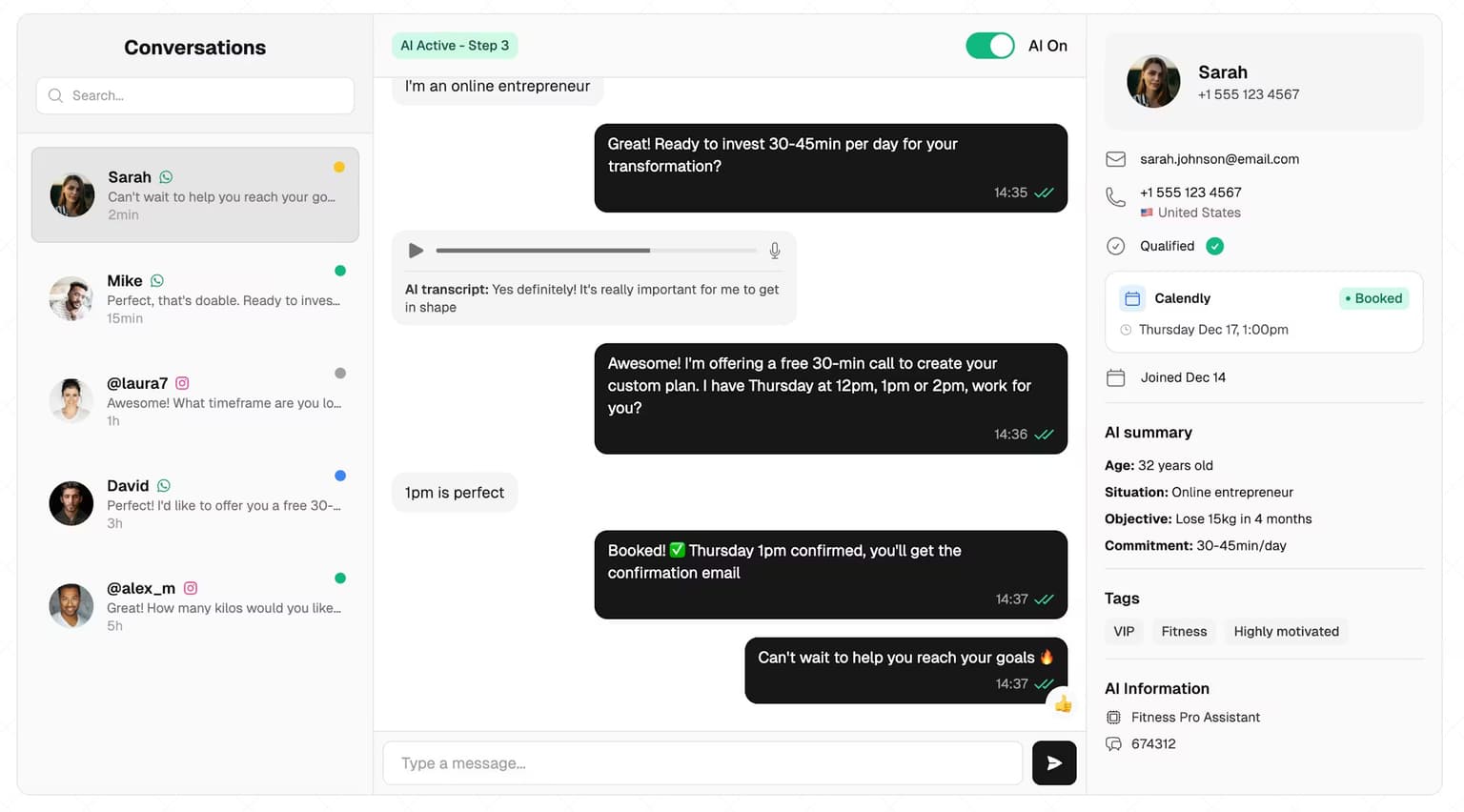
- AI setter (e.g., SetSmart) — different category. Skips the flow builder entirely, runs an LLM-powered conversation, books the call in-chat, follows up automatically, lives on Instagram + WhatsApp + Messenger.
If you want the long version of "I tried ManyChat and need something else," our ManyChat alternatives roundup tests 7 options and ranks them by use case.
Real testimonials — ManyChat bot to AI setter
Théo Riffault, fitness coach: "I started with a ManyChat comment-to-DM bot for my Reels. Worked great for the first month, then I noticed I was losing every lead who asked anything off-script. I switched the qualification + booking to SetSmart and kept ManyChat just for the comment trigger. My booked-call rate went up about 40%."
Mathis Ladoué, agency owner: "We were managing 9 ManyChat accounts for clients. The flow logic became a maintenance nightmare every time a client added a new offer. Migrating the booking flows to an AI setter cut our admin time by something like two-thirds — the AI just understands the offer, no flowchart redraw."
Edouard Clerc, business coach: "I had 40+ tags inside ManyChat to try to track lead stages. None of it worked because the tags were applied by buttons, not by what the lead actually said. The AI tagging based on the conversation finally matched reality."
What stays in ManyChat after you upgrade
If you upgrade to AI for sales, you don't necessarily delete your ManyChat account. The split that works:
- Keep in ManyChat: comment-to-DM triggers, lead magnet delivery, FAQ deflection, list growth, Story-mention auto-reply
- Move to AI: sales conversation, lead qualification, calendar booking, follow-up sequences, multi-criterion tagging
- Either tool: broadcast announcements (depends on volume + segmentation needs)
The handoff from ManyChat to the AI happens at one specific moment: when the user replies to the lead-magnet DM with anything beyond "thanks." That reply is when the conversation starts, and that's when a flow stops being the right tool.
How to evaluate whether a ManyChat bot is enough for you
Five questions to honestly answer before you commit (or before you upgrade):
- What's the average price of what you sell? Below $200 → ManyChat is probably enough. Above $500 → AI conversation almost always beats flows.
- How many unique paths does a buyer take to "yes"? 1–3 → flows are great. 5+ → flows are a maintenance hellscape.
- Do your DMs include a lot of "does this work for my situation?" Yes → AI. No → flows.
- Do you need to book the call in-chat or just send a link? Link → flows. In-chat → AI.
- Can you afford 30+ minutes/week debugging your bot's branches? Yes → flows. No → AI.
Three "yes for AI" answers and you're past ManyChat's sweet spot.
What "ManyChat bot" is NOT
Three quick disambiguations because the term is overloaded:
- Not a Telegram bot. ManyChat doesn't have native Telegram. Searches for "ManyChat Telegram bot" are people looking in the wrong direction.
- Not an APK / app to download. ManyChat is a SaaS — you log in at manychat.com or use the iOS/Android app. There's no standalone "ManyChat bot.exe."
- Not a chatbot you can buy pre-built. Templates exist in the marketplace, but the actual bot is what you build inside your own ManyChat account, connected to your own Instagram/WhatsApp/Messenger.
FAQ
Is ManyChat itself a bot?
No. ManyChat is a no-code platform you use to build bots. The bots themselves run inside Instagram, Facebook Messenger, WhatsApp, or SMS — wherever you've connected ManyChat to.
Can I make a ManyChat bot for free?
Yes — the Free plan supports up to 25 active contacts per month. That's enough to test a flow on your personal account; not enough to run any business that gets more than a couple of new comments per week. Detail in Is ManyChat free?.
Will my Instagram account get banned for using a ManyChat bot?
No. ManyChat is on Meta's official partner list and uses the Instagram Graph API. The bots that get accounts banned use browser automation or scraping — different category, different risk profile. Stay inside Meta's content + frequency rules and you'll be fine.
Is ManyChat AI-powered?
Partially. There's an "AI Step" you can drop into a flow that answers free-text questions from a knowledge base. Most of the platform is still flow-based logic — buttons, tags, conditions. For genuinely conversational AI, look at an AI setter instead.
Can a ManyChat bot book sales calls?
Yes-but-thinly. It can send a Calendly link inside a DM, which is "booking" by the loosest definition. It can't run the conversation that decides whether the lead is qualified or whether they're ready for the call. For in-chat booking with qualification baked in, you need a tool that holds a real conversation.
What's the best alternative to a ManyChat bot?
Depends on the job. For the same flow-builder shape, Chatfuel is the closest peer. For booking sales calls and qualifying leads, an AI setter is a different category and a better fit. Our full comparison list is in ManyChat alternatives.
How much does a ManyChat bot cost in 2026?
Free up to 25 active contacts. Paid plans start around $15/month and scale with contact count. WhatsApp adds per-conversation Meta fees on top — typically $0.005 to $0.10 per conversation, regional. The full breakdown is in ManyChat pricing.
Ready to automate your DMs?
Start your free 7-day trial and let AI handle your lead qualification 24/7.
Try SetSmart free