ManyChat WhatsApp: Honest Review & Real Costs (2026)

Quick answer: Yes, ManyChat works with WhatsApp. It connects through the official WhatsApp Business API, requires the Pro plan ($29/month) or higher, and on top of the subscription you pay Meta's own WhatsApp fees, which since July 1, 2025 are billed per message, not per conversation.
That last part matters, because most guides about ManyChat WhatsApp still describe the old per-conversation model and the old "first 1,000 free" rule, both of which are gone. This review covers what ManyChat can actually do on WhatsApp in 2026, how the setup works, what it really costs under Meta's current per-message pricing, where it hits its limits, and when you need something more capable. If you're weighing the whole category first, start with our WhatsApp chatbot guide.
What Can ManyChat Do on WhatsApp?
ManyChat connects to WhatsApp through the WhatsApp Business API, not the regular WhatsApp Business app (see our WhatsApp Business API pricing breakdown for the full per-message cost picture). Once connected, you can:
1. Send automated messages
Build flow-based message sequences triggered by keywords, user actions, or external events. When someone messages your WhatsApp number, ManyChat can respond with pre-built flows.
2. Broadcast campaigns
Send promotional messages to your WhatsApp subscriber list: product launches, offers, announcements, and re-engagement campaigns. WhatsApp broadcasts get open rates email can only dream of, which is why this is the feature most ManyChat WhatsApp users care about.
3. Keyword triggers
Set up automatic responses when someone sends a specific keyword. For example, if someone texts "PRICING", ManyChat sends your pricing info automatically.
4. Button and list flows
Build interactive conversations with buttons (up to 3 options) and list menus (up to 10 options). These are WhatsApp's native interactive message formats.
5. Collect data
Use flows to capture information: name, email, phone number, preferences. Store it in ManyChat's CRM or sync to external tools via Zapier.
6. Zapier and Make integrations
Connect ManyChat WhatsApp to your CRM, email tool, Google Sheets, and thousands of other apps through Zapier or Make.
How to Set Up ManyChat WhatsApp (Step-by-Step)
Setting up ManyChat for WhatsApp is more involved than Instagram. Here's the process:
Prerequisites
Before you start, you need:
- A ManyChat Pro account ($29/month minimum, WhatsApp isn't available on the Free or Essential plans)
- A Meta Business account (business.facebook.com)
- A phone number for WhatsApp that isn't already registered with the WhatsApp Business app
- A Meta business verification (required for full WhatsApp API access, and it's the first step toward the WhatsApp green tick)
Step 1: Upgrade to ManyChat Pro
WhatsApp integration requires the Pro plan or higher. If you're on Free or Essential, upgrade first.
Step 2: Connect WhatsApp in ManyChat
- Go to Settings, then Channels, then WhatsApp
- Click Connect WhatsApp
- You'll be redirected to Meta's Embedded Signup flow
- Log in with your Facebook account
- Select or create a Meta Business Account
- Select or create a WhatsApp Business Account
- Register your phone number
Step 3: Verify your business
Meta requires business verification to unlock higher messaging limits on the WhatsApp API. This involves:
- Submitting business documents (registration certificate, utility bill, etc.)
- Waiting for Meta's review (typically 1-7 business days)
- Once verified, your messaging limits increase
Step 4: Set up a message template
WhatsApp requires pre-approved message templates for sending the first message to a contact (outbound). Templates must be submitted to Meta for review before use. Approval usually takes minutes to a day.
Template types:
- Marketing templates (promotions, offers)
- Utility templates (order updates, confirmations)
- Authentication templates (verification codes)
Each template must follow Meta's guidelines: no misleading content, proper formatting, and clear opt-out options. The category also decides what the message costs, which we'll get to next.
Step 5: Build your first flow
Once connected, build WhatsApp flows the same way you build Instagram flows in ManyChat, with a drag-and-drop builder combining messages, buttons, conditions, and actions.
Key difference from Instagram: WhatsApp flows support interactive buttons (up to 3) and list messages (up to 10 items), native WhatsApp formats that look cleaner than plain text with emoji options.
ManyChat WhatsApp Pricing in 2026: The Two Cost Layers
ManyChat WhatsApp pricing has two separate cost layers, and most guides only explain the first one.
Layer 1: The ManyChat subscription
ManyChat overhauled its plans on March 2, 2026. WhatsApp now sits on the Pro tier and up:
| Plan | Monthly Cost | Active Contacts | WhatsApp Access |
|---|---|---|---|
| Free | $0 | 25 | No |
| Essential | $14 | 250 | No |
| Pro | $29 | 2,500 | Yes |
| Business | $69 | 7,500 | Yes |
Pricing scales with active contacts per month. On the Business plan, going past 7,500 contacts costs $0.025 per extra contact (monthly billing) or $0.018 (annual); on Pro and below, automations simply stop when you hit the cap. For the full plan-by-plan breakdown, contact overage math, and hidden costs, read our complete ManyChat pricing guide.
Layer 2: Meta's per-message WhatsApp fees
On top of ManyChat's subscription, Meta charges its own WhatsApp fees. These are not ManyChat fees; they apply to any WhatsApp Business API tool.
The big change: on July 1, 2025, Meta switched WhatsApp from per-conversation to per-message billing. You now pay for each delivered template message, and the rate depends on the template category and the recipient's country code:
| Message type | US | Brazil | India | When it's charged |
|---|---|---|---|---|
| Marketing template | $0.025 | ~$0.063 | ~$0.011 | Every delivered message, always |
| Utility template | $0.004 | ~$0.007 | ~$0.001 | Only outside the 24h window |
| Service replies (non-template) | Free | Free | Free | Never charged inside the 24h window |
Rates shown are from Meta's rate cards under the per-message model and can change; always check Meta's current rate card for your markets. Authentication templates (OTP codes) follow similar low per-message rates, and Meta applies volume discounts to utility and authentication messages at high monthly volumes. Marketing messages get no volume discount.
Three rules worth memorizing:
- Everything you send inside the 24-hour customer service window is free, as long as it's a regular message or a utility template. When a lead messages you and your bot replies, that costs nothing.
- The old "first 1,000 free service conversations" cap is gone. Meta made all service conversations free back in November 2024, with no monthly cap.
- Marketing templates are always paid, even inside the 24-hour window. Broadcasts, promos, and re-engagement pushes are where your Meta bill actually comes from.
Real cost examples (US rates)
Solo coach, 500 inbound WhatsApp leads/month:
- ManyChat Pro: $29
- Meta fees (~300 marketing template messages): ~$7.50
- Inbound conversations and replies inside the window: $0
- Total: ~$37/month
Agency, 3,000 WhatsApp leads/month:
- ManyChat Business: $69
- Meta fees (~2,000 marketing template messages): ~$50
- Total: ~$119/month
High-volume, 10,000 WhatsApp leads/month:
- ManyChat Business + contact overages: ~$131
- Meta fees (~7,000 marketing template messages): ~$175
- Total: ~$306/month
At scale, Meta's per-message fees become the dominant cost, not ManyChat's subscription. And if your audience is in Brazil, multiply the marketing line by roughly 2.5x: the same 7,000 marketing messages cost about $440 there.
ManyChat WhatsApp Bot: What It Does Well
Broadcast campaigns
ManyChat's WhatsApp broadcast feature is genuinely good. Send promotional messages to your opted-in subscriber list with high deliverability. For product launches, flash sales, and re-engagement, WhatsApp broadcasts through ManyChat are very effective.
Keyword-triggered auto-replies
Simple keyword-to-response automations work reliably. "PRICING" triggers your pricing info. "HOURS" triggers your business hours. For FAQ-style automation, this is solid.
Interactive buttons and lists
WhatsApp's native button and list formats look clean and professional within ManyChat flows. Up to 3 buttons per message or 10 items in a list, better than plain text options.
E-commerce integrations
If you run a Shopify store, ManyChat's WhatsApp integration handles abandoned cart recovery, order confirmations, and shipping updates well. The structured nature of e-commerce messages (order number, tracking link, product name) fits ManyChat's flow-based approach, and order updates count as utility templates, which are free inside the 24-hour window. For a deeper dive into WhatsApp for online stores, read our WhatsApp for e-commerce guide.
Multi-channel from one dashboard
ManyChat lets you manage Instagram, WhatsApp, Messenger, SMS, and Telegram from one interface. If you use multiple channels, having one flow builder for all of them is convenient.
ManyChat WhatsApp Limitations
Limitation 1: Flow-based conversations only
This is the fundamental issue, same as on Instagram. ManyChat WhatsApp uses button flows and decision trees, not natural language. When a prospect types something unexpected, the bot breaks or sends a fallback.
WhatsApp is a conversational platform. People message like they're texting a friend: "hey I saw ur ad, how does the coaching thing work and do u have spots left?" ManyChat can't understand this. It needs the person to tap a button.
Limitation 2: Complex setup process
Compared to Instagram (one-click connect), WhatsApp setup requires:
- Meta business verification (1-7 days)
- Phone number registration
- Message template approval
- Understanding of template categories and per-message fees
For non-technical users, this setup is a significant barrier.
Limitation 3: Message template requirements
You can't just send any message to WhatsApp contacts. The first outbound message must use a pre-approved template. Templates need Meta approval, have strict formatting rules, and limited customization.
This means you can't spontaneously reach out to a lead with a personalized message; you need a template for that, and every marketing template delivery is billed by Meta.
Limitation 4: The 24-hour conversation window
The WhatsApp Business API has a strict 24-hour window rule: after the last message from the customer, you have 24 hours to respond freely. After that, you can only send pre-approved templates, and a marketing template costs money per message.
So if a prospect goes silent, you can't just follow up with a natural message two days later. You need a paid template, which is exactly why timing follow-ups inside the window matters so much on WhatsApp.
Limitation 5: No in-chat appointment booking
ManyChat cannot check your calendar or book appointments inside WhatsApp. You have to send an external Calendly link. On WhatsApp, where the conversation is flowing naturally, interrupting with "click this external link to book" kills momentum.
Limitation 6: No voice note support
WhatsApp is a voice-first platform. People send voice notes constantly. ManyChat can't send or receive voice messages on WhatsApp. You're missing the format that gets the highest engagement on the platform.
Limitation 7: No AI qualification conversations
ManyChat's AI features add AI-generated responses within a flow, but they can't hold a natural back-and-forth qualification conversation. For coaches and consultants who need to qualify leads on budget, goals, timeline, and fit, button flows don't cut it.
This gap shows in the data. Across 828K AI DM conversations we analyzed, WhatsApp leads who reply qualify at 34%, about 1.9x the rate of Instagram (full breakdown here). WhatsApp leads are unusually high-intent; handing them a button menu instead of a real conversation wastes that intent.
For a complete analysis of ManyChat's strengths and weaknesses across all channels, read our ManyChat review.
ManyChat WhatsApp vs AI WhatsApp Automation
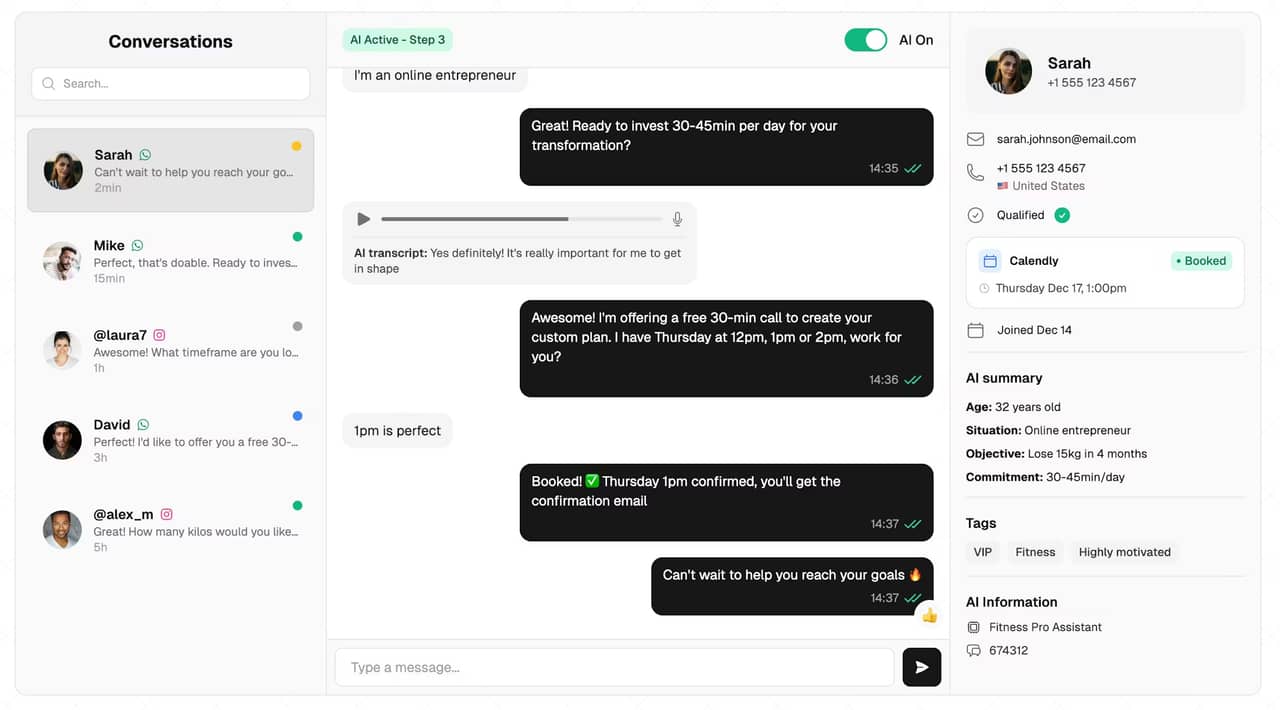
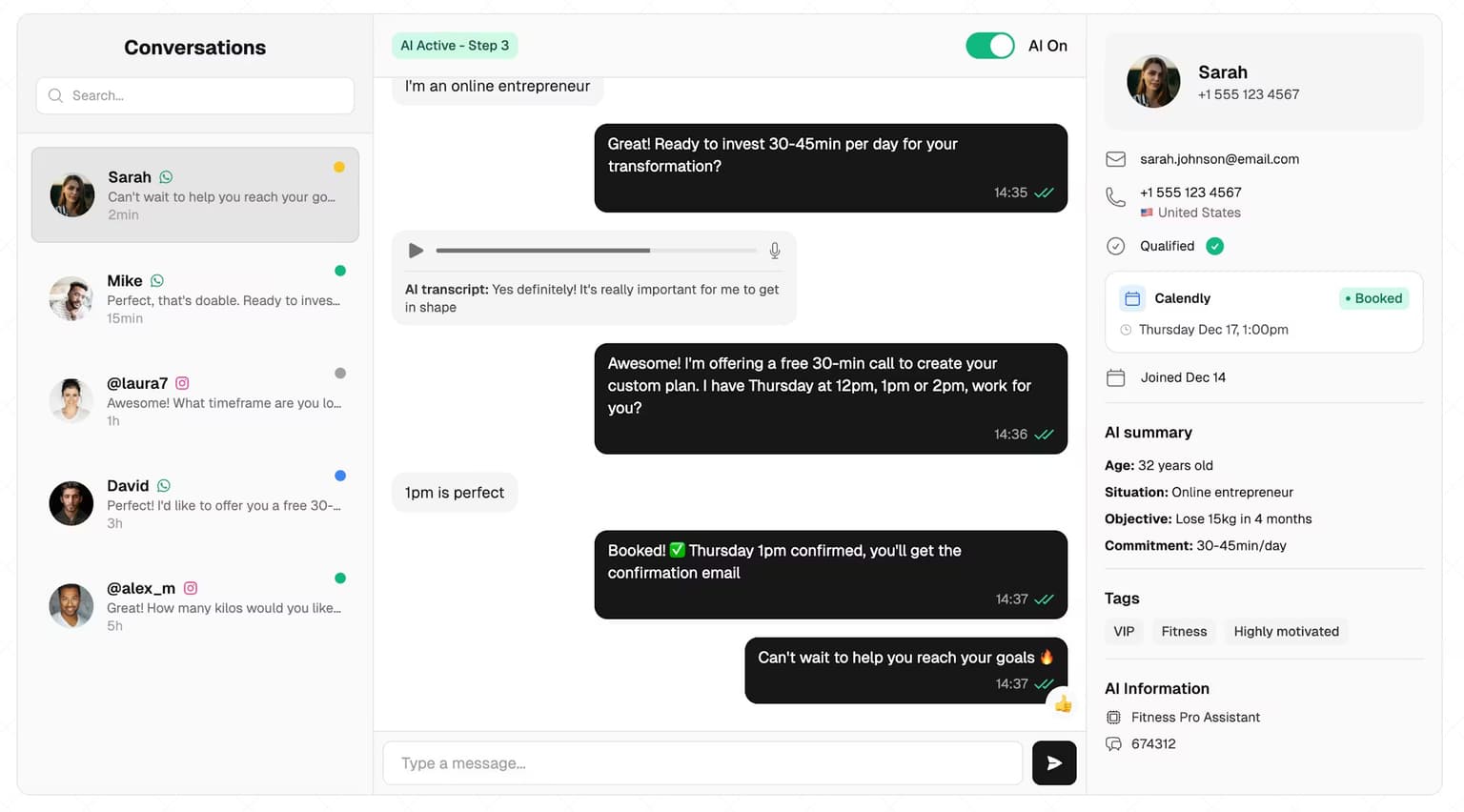
The core question: do you need a WhatsApp chatbot (ManyChat) or a WhatsApp AI setter (SetSmart)?
| Feature | ManyChat WhatsApp | SetSmart WhatsApp |
|---|---|---|
| Conversation type | Flows with buttons | Natural AI conversation |
| Handles free-text replies | Breaks or fallback | Understands and adapts |
| Lead qualification | Button taps and forms | Conversational AI qualification |
| Appointment booking | External Calendly link | In-chat booking |
| Voice notes | Not supported | Send + understand |
| Follow-ups inside 24h window | Manual sequences | Smart follow-ups (4h + 23h, free window) |
| Click-to-WhatsApp ad tracking | Basic | Full referral data per conversation |
| Setup time | Hours (flows + template approval) | Minutes (describe your offer) |
| Broadcasts | Yes, built-in | Via Zapier |
| Starting price | $29/mo + Meta fees | $97/mo + Meta fees |
ManyChat WhatsApp is better for: Broadcast campaigns, e-commerce (Shopify cart recovery), simple keyword auto-replies, and FAQ bots.
AI WhatsApp automation is better for: Lead qualification, sales conversations, appointment booking, coaches and consultants who sell via calls, and anyone running click-to-WhatsApp ads.
For the head-to-head, read SetSmart vs ManyChat, or browse the full ManyChat alternatives guide for more options.
When to Use ManyChat for WhatsApp
ManyChat WhatsApp is the right tool if:
- You need broadcast campaigns to message your subscriber list
- Your use case is e-commerce (order updates, cart recovery, shipping notifications)
- Your conversations are simple and predictable (FAQ, keyword-triggered info)
- You already use ManyChat for Instagram and want one dashboard for both
- Your budget is tight and $29/month + Meta fees is your limit
You need something more powerful if:
- You're a coach, consultant, or agency who qualifies leads and books calls through WhatsApp
- Your prospects send natural messages that don't fit into button menus
- You want in-chat appointment booking instead of sending Calendly links
- You run click-to-WhatsApp ads and need instant AI responses
- You want voice note follow-ups for higher response rates
- You need an AI setter that handles WhatsApp + Instagram + Messenger from one dashboard
For the complete playbook on AI-powered WhatsApp automation, read our WhatsApp automation guide.
How to Switch from ManyChat WhatsApp to AI
If you've outgrown ManyChat's WhatsApp capabilities, switching to SetSmart takes about 15 minutes:
- Sign up for SetSmart: free 7-day trial, then $97/month
- Connect your WhatsApp: same Meta Business API, quick setup since you're already verified
- Describe your offer: tell the AI what you sell, who your ideal client is, and your qualification criteria
- Go live: the AI handles every WhatsApp conversation automatically
You don't need to re-verify with Meta or register a new number. Your existing WhatsApp Business setup transfers directly.
Important: Disconnect ManyChat's WhatsApp integration before activating SetSmart to avoid conflicting automations on the same number.
FAQ
Does ManyChat work with WhatsApp?
Yes. ManyChat supports WhatsApp on the Pro plan ($29/month) and above. It connects through the official WhatsApp Business API and lets you build automated flows, send broadcasts, and set up keyword triggers. However, conversations are flow-based (buttons and menus), not natural AI conversations.
Is ManyChat WhatsApp free?
No. WhatsApp integration requires ManyChat Pro ($29/month) at minimum; the Free and Essential plans don't include WhatsApp. Meta's own per-message fees also apply for template messages, regardless of your ManyChat plan. Replying to inbound messages inside the 24-hour window is free on Meta's side. See is ManyChat free for what the free plan actually includes.
How much does ManyChat WhatsApp cost?
ManyChat Pro starts at $29/month for WhatsApp access. On top of that, Meta bills per delivered template message: $0.025 per marketing message in the US (about $0.063 in Brazil, about $0.011 in India), while replies inside the 24-hour service window are free. A solo coach with 500 leads/month typically lands around $37/month total; at 3,000 leads/month, expect roughly $119/month. Full plan details in our ManyChat pricing guide.
Why is WhatsApp pricing different in Brazil and India?
Meta sets WhatsApp rates per recipient country, so every market has its own rate card. A marketing template that costs $0.025 in the US runs about $0.063 in Brazil and about $0.011 in India, while utility templates in both countries cost a fraction of a cent (and are free inside the 24-hour window). If your audience is Brazilian, marketing broadcasts are one of the more expensive line items; if it's Indian, they're among the cheapest.
How do I set up a ManyChat WhatsApp bot?
You need a ManyChat Pro account, a Meta Business account, and a phone number not already registered on the WhatsApp Business app. In ManyChat, go to Settings, Channels, WhatsApp, Connect. Complete Meta's embedded signup flow, verify your business, register your number, and submit message templates for approval. Setup typically takes 1-3 days including business verification.
Can ManyChat send WhatsApp messages automatically?
Yes, within limits. ManyChat can auto-reply to incoming messages using flows and keyword triggers, free of Meta fees inside the 24-hour window. For outbound messages (contacting someone first, or re-engaging after the window closes), you must use Meta-approved templates, and marketing templates are billed per delivered message.
What's the difference between ManyChat WhatsApp and the WhatsApp Business app?
The WhatsApp Business app is free and manual; you type every reply yourself. ManyChat WhatsApp uses the WhatsApp Business API for automation: automated flows, broadcasts, and integrations. The API requires business verification and carries Meta's per-message fees for templates, but enables automation at scale.
Can I use ManyChat for WhatsApp and Instagram at the same time?
Yes. ManyChat's Pro plan covers Instagram, WhatsApp, and Messenger. You can build separate flows for each channel or create cross-channel automations. This multi-channel support is one of ManyChat's genuine strengths.
Is ManyChat the best WhatsApp bot?
ManyChat is the most popular WhatsApp bot for simple automation: broadcasts, keyword triggers, and e-commerce flows. For sales qualification and call booking, AI-powered tools like SetSmart significantly outperform ManyChat because they hold natural conversations instead of rigid flows. The best tool depends on your use case. See our best AI setters comparison for alternatives.
ManyChat WhatsApp vs SetSmart: which is better?
ManyChat is better for WhatsApp broadcasts and e-commerce automation ($29/mo). SetSmart is better for lead qualification and call booking through natural AI conversation ($97/mo). If you sell via calls (coaching, consulting, agencies), SetSmart books more qualified calls from the same leads. If you need bulk messaging and simple auto-replies, ManyChat works. Full comparison in SetSmart vs ManyChat.
The Bottom Line
ManyChat's WhatsApp integration is solid for what it does: broadcasts, keyword automations, and structured e-commerce flows. If those are your needs, $29/month plus Meta's per-message fees is fair value.
But WhatsApp conversations are inherently natural and unstructured. People text on WhatsApp the way they talk: casual, unpredictable, full of context that button menus can't capture. If your goal is to qualify leads and book calls through WhatsApp, flow-based automation creates friction where AI creates conversation.
The question isn't whether ManyChat works on WhatsApp (it does). The question is whether a flow-based bot matches how your prospects actually communicate on WhatsApp. If they text casually and expect real conversation, you need AI, not buttons.
Ready to automate your DMs?
Start your free 7-day trial and let AI handle your lead qualification 24/7.
Try SetSmart free