WhatsApp Chatbot: Build One That Books Calls 2026

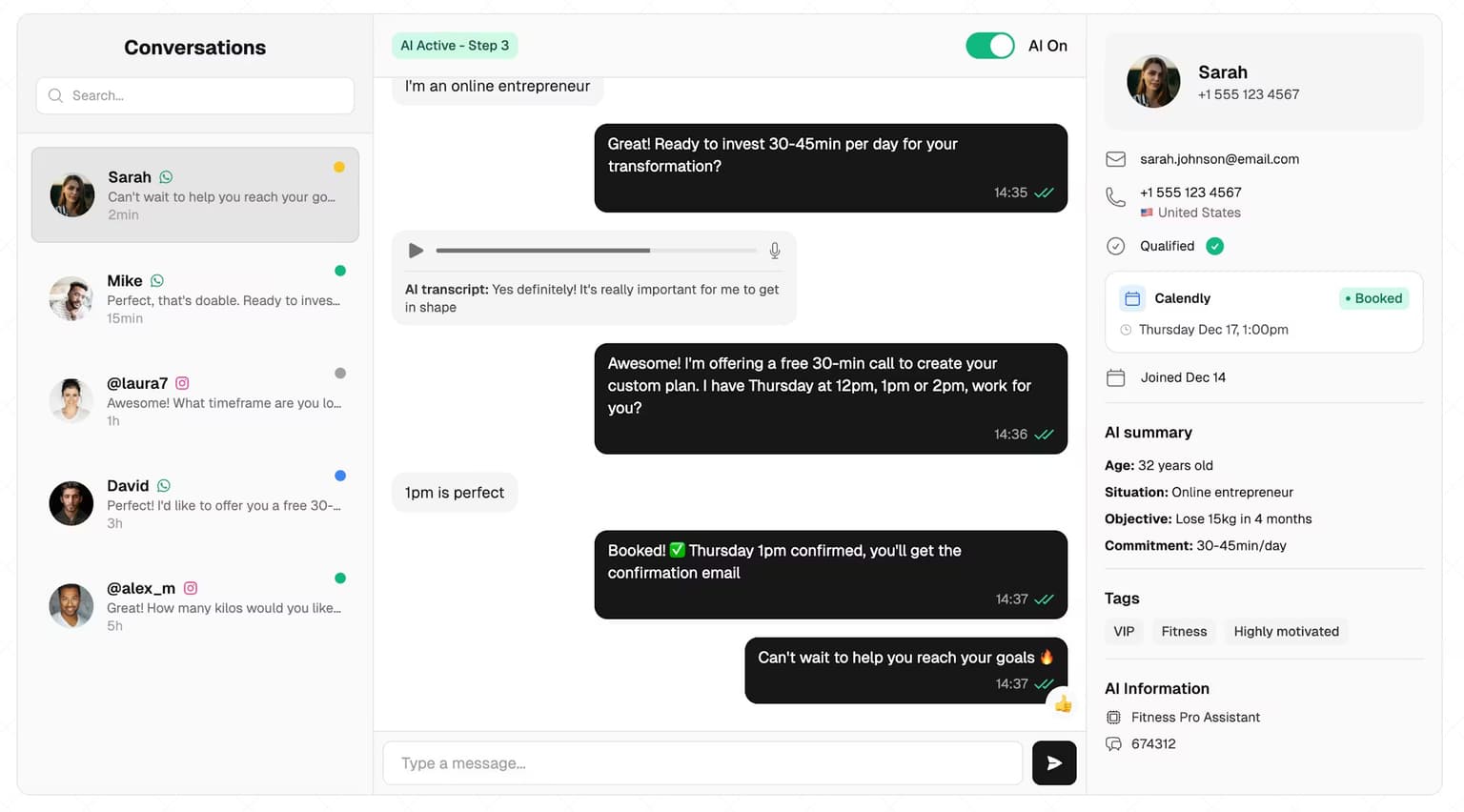
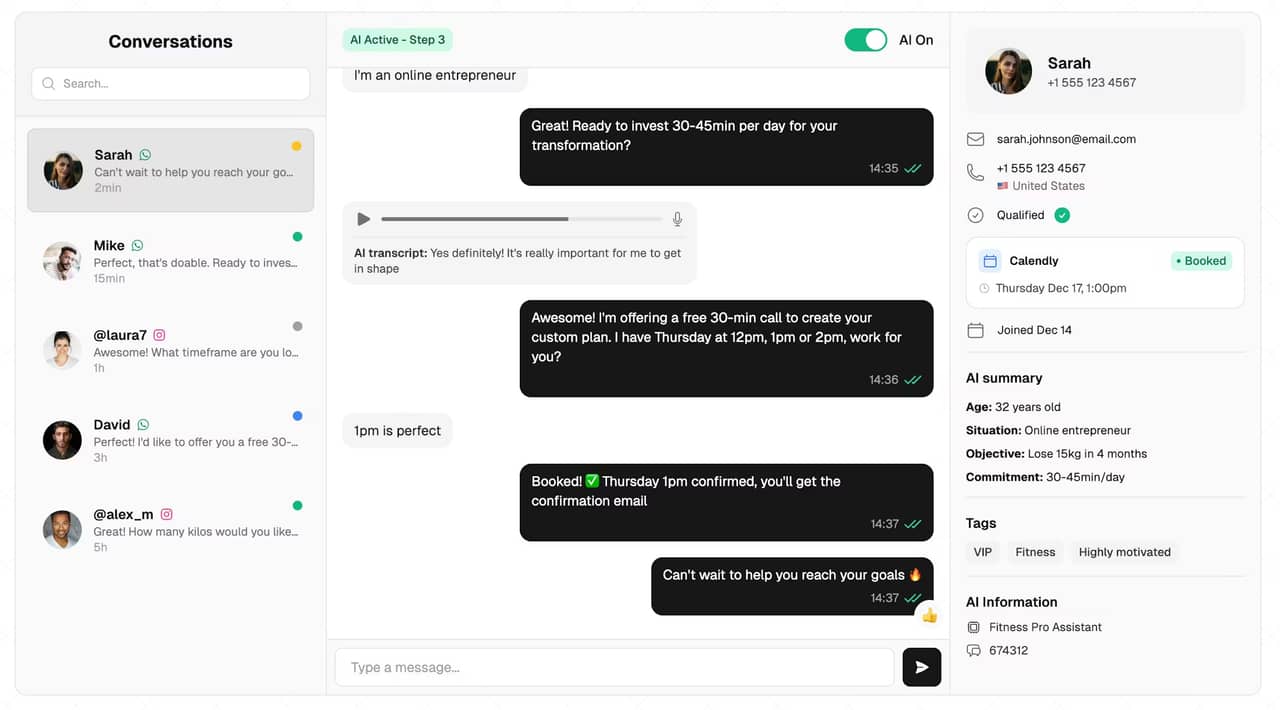
A WhatsApp chatbot is the fastest way to stop losing leads in an inbox you cannot watch 24/7. The question is no longer whether to build one, it is which kind: a simple auto-reply on the free app, or an AI chatbot on the WhatsApp Business API that can hold a real conversation, qualify the lead, and book a sales call while you sleep.
This guide walks through what a WhatsApp chatbot actually is, how it works under the hood, the free and paid routes to set one up, what changed in WhatsApp's 2026 policy, and how coaches, creators, and small teams use one to fill a calendar with qualified calls instead of answering the same five questions all day.
What is a WhatsApp chatbot?
A WhatsApp chatbot is software that automatically reads and replies to messages on a WhatsApp business number. Instead of you typing every answer, the bot handles the conversation: it greets new contacts, answers common questions, asks qualifying questions, and hands off to a human (or a calendar) at the right moment.
There are two broad flavors:
- Rule-based (menu) bots follow a fixed script. The contact taps buttons or sends keywords, and the bot replies with pre-set messages. Predictable, but rigid.
- AI chatbots read the meaning of each message and respond in natural language. They handle phrasing the script-writer never anticipated, stay on-topic, and feel like a real assistant rather than a phone tree.
For a coach or creator, the practical difference is conversion. A menu bot can route a FAQ. An AI chatbot can have the back-and-forth that actually moves someone from "just curious" to "booked a call." This is the same shift that turned generic auto-responders into the AI setter category: software that qualifies and books, not just deflects.
How a WhatsApp chatbot works
Direct answer: a WhatsApp chatbot sits on top of a WhatsApp business number, receives each incoming message through Meta's infrastructure, decides on a reply, and sends it back, all in seconds.
Here is the mechanism, step by step:
- A contact messages your number. That can come from a click-to-WhatsApp ad, a WhatsApp link in your bio, a WhatsApp QR code, or a broadcast reply.
- Meta delivers the message to your connected software (the free Business app, or the Business API through a provider).
- The bot decides what to do. A rule-based bot matches keywords or button taps. An AI bot interprets the message and generates a reply based on your offer, your FAQ, and the conversation so far.
- The reply is sent back to the contact inside WhatsApp, usually within a second or two.
- The bot acts on intent. When someone is qualified and ready, it shares a calendar link, tags the lead, or pings a human to take over.
The piece most people miss is the difference between the free WhatsApp Business app and the WhatsApp Business API. The free app supports basic away messages, greeting messages, and quick replies, useful, but not a true chatbot. A real AI chatbot that runs unattended at scale needs the API, which is what tools connect to behind the scenes. Our WhatsApp automation guide covers that API foundation in detail, and the WhatsApp Business API pricing breakdown explains the conversation-based fees involved.
WhatsApp chatbot vs the free WhatsApp Business app
A lot of "free WhatsApp chatbot" searches are really looking for the automation features inside the free Business app. It is worth being clear about what each can and cannot do.
| Capability | Free Business app | Business API + chatbot |
|---|---|---|
| Greeting and away messages | Yes | Yes |
| Quick replies (saved snippets) | Yes | Yes |
| AI that understands free-text replies | No | Yes |
| Qualify leads and route to a calendar | No | Yes |
| Runs unattended at scale | Limited | Yes |
| Cost | Free | Conversation fees + tool subscription |
The short version: the free app is fine if you just want to tell people your opening hours while you are away. The moment you want the bot to actually handle a conversation, ask qualifying questions, and book a call, you are in API territory.
How to build a WhatsApp chatbot: step by step
You do not need to write code. Here is the sequence we walk new WhatsApp clients through.
Step 1: Choose your setup. If all you need is "we are closed, back at 9am," the free Business app's away message is enough. If you want a bot that qualifies and books, go with the WhatsApp Business API through a tool that handles the technical side for you.
Step 2: Connect a business number. Register a dedicated number through Meta Cloud API or a Business Solution Provider, then complete Meta Business verification. A verified business is also the gateway to the WhatsApp green tick later on.
Step 3: Map the conversation before you automate it. Write the greeting, the three to five qualifying questions (budget, timeline, fit), your common objections and answers, and the exact moment you offer the calendar link. A chatbot is only as good as the flow you give it.
Step 4: Add the AI layer. Connect an AI assistant that reads each reply in context, answers in your tone of voice, and recognizes buying intent. This is what separates a real chatbot from a glorified FAQ. If you want the assistant to also book, point it at your scheduling link and let it confirm the slot in-thread, the same job a human appointment setter does.
Step 5: Test, then launch. Message the bot from a second phone. Run the awkward cases: vague replies, off-topic questions, "how much is it." Confirm the calendar link fires and the lead gets tagged. Only then point your WhatsApp traffic, ads, bio link, broadcasts, at the bot.
If you run promotions, pair the bot with WhatsApp broadcast campaigns so that every reply to a broadcast lands in a conversation the chatbot can carry forward instead of dying in an unread inbox.
What WhatsApp allows in 2026: the policy update you should know
In late 2025, WhatsApp updated its Business API terms to bar general-purpose AI assistants, standalone, do-anything chatbots in the style of a public ChatGPT or Perplexity assistant, from operating on the platform. The change was aimed at providers using WhatsApp as a distribution channel for a general AI product.
What this does not affect: a chatbot that handles your own business conversations. A bot that answers questions about your coaching program, qualifies leads, and books calls is exactly the kind of business messaging WhatsApp is built for. So if you read a headline about "WhatsApp banning AI chatbots," do not panic, it is about general-purpose assistants, not your customer-facing business bot.
The practical takeaway: build a chatbot that is clearly yours, scoped to your offer and your customers, running on a properly verified business number. That stays squarely inside the rules.
WhatsApp chatbot use cases for coaches, creators, and small teams
A WhatsApp chatbot earns its keep when conversation volume outgrows your ability to reply fast. The highest-value uses:
- Instant lead qualification. When an ad or bio link sends someone to WhatsApp, the bot asks the qualifying questions immediately instead of letting the lead cool off. Speed matters more than people think: industry data shows the average business takes around 42 hours to respond, and responding in minutes rather than hours dramatically raises the odds of qualifying a lead. The numbers behind that are in our lead response time statistics.
- Booking sales calls. For high-ticket coaches and consultants, the bot's job is to fill the calendar, not to close. It qualifies, then hands a warm, ready lead a booking link.
- FAQ deflection. Pricing, schedule, format, refund policy, the bot answers instantly so you only step in for real conversations.
- Re-engagement. Paired with broadcasts, the bot follows up with leads who went quiet and restarts stalled threads.
- Ecommerce support. Order status, product questions, and cart recovery, the backbone of a WhatsApp ecommerce setup.
The thread that ties these together is the same one behind a good DM setter: the bot is not there to replace the human relationship, it is there to make sure no lead waits, and that every qualified person gets to the next step.
Best WhatsApp chatbot tools compared
The right tool depends on whether you want a visual flow builder, a true AI conversation layer, or both. A quick, honest comparison of the categories a coach or creator usually evaluates:
| Tool | Best for | AI conversation | Pricing |
|---|---|---|---|
| SetSmart | Qualifying + booking calls from DMs | Native AI setter | Free 7-day trial, then $97/mo (1,000 messages) |
| ManyChat | Visual flow builder, multi-channel | AI add-on | Free plan; paid from $14/mo |
| BSP platforms | Large support teams, ticketing | Varies | Custom / conversation-based |
ManyChat is genuinely strong if you want a drag-and-drop flow builder and you already run Instagram and Messenger from the same place, see our ManyChat WhatsApp breakdown for where it shines. The trade-off is that flow builders are built around buttons and rules; the AI conversation layer is an add-on rather than the core. If your priority is a bot that holds a natural qualifying conversation and books the call, an AI-first Instagram chatbot style tool that also runs on WhatsApp will feel more natural than wiring up flows by hand.
The real job of a WhatsApp chatbot: qualify and book, do not "close"
This is where most WhatsApp chatbot advice goes wrong. A bot should not try to close a high-ticket sale in the chat. For coaches and consultants, the close happens on a call, by a human. The chatbot's job is to fill the calendar with qualified calls.
That framing matters because of how conversations actually convert. Across 828K AI DM conversations we analyzed, the pattern is consistent: most threads die early, and the leads that book are the ones that get carried past the first couple of messages with the right follow-up. In fact, a single, well-timed follow-up roughly doubles booked calls. A chatbot is the only thing that reliably delivers that follow-up to every lead, instantly, without you remembering to.
So design the bot to do three things well: respond in seconds, ask the questions that separate a fit from a tire-kicker, and book the qualified ones onto a call. Leave the actual selling to the call.
"We were leaking leads on WhatsApp every evening. The bot now qualifies and books overnight, and I just show up to the calls." (Mathis Ladoué)
If you are evaluating where this fits in a broader stack, the best AI setters comparison covers how an AI booking layer plugs into the rest of your acquisition.
Common WhatsApp chatbot mistakes to avoid
- Building a wall of menu buttons. If every reply is "press 1, press 2," people drop off. Lead with a real question.
- No human handoff. Always give qualified or frustrated contacts a clean path to a person. A bot that traps people hurts trust.
- Ignoring opt-in rules. Only message contacts who messaged you or opted in. Spammy sends tank your number's quality rating.
- Treating it as a closer. The bot books the call; it does not sell the package in the thread. Confusing the two leads to pushy, low-converting bots.
- Launching without testing edge cases. The vague "how much?" and the off-topic question are where weak bots fall apart. Test them first.
- Forgetting the rest of the funnel. A great bot with no traffic is idle. Feed it with ads, bio links, and broadcasts.
Done right, a WhatsApp chatbot is the difference between a coach who answers DMs at 11pm and one whose calendar simply fills overnight. The mechanics are not complicated, the discipline is in the flow and the follow-up.
FAQ
What is a WhatsApp chatbot?
A WhatsApp chatbot is software that automatically reads and replies to messages on a WhatsApp business number. It can greet contacts, answer FAQs, qualify leads with questions, and share a booking link, either through fixed rules or an AI layer that understands natural language.
Is there a free WhatsApp chatbot?
The free WhatsApp Business app includes basic automation (greeting messages, away messages, quick replies), which covers simple needs at no cost. But a true AI chatbot that holds conversations and books calls runs on the WhatsApp Business API, which has conversation-based fees plus a tool subscription. So "free" gets you auto-replies, not a real chatbot.
How do I create a chatbot on WhatsApp Business?
Connect a business number through Meta Cloud API or a Business Solution Provider, complete Meta Business verification, map your conversation flow (greeting, qualifying questions, booking step), then connect an AI tool that runs it. No coding is required when you use a platform that manages the API for you.
Can I integrate a chatbot with WhatsApp?
Yes. Chatbots integrate with WhatsApp through the WhatsApp Business API. You connect your verified business number to a tool that listens for incoming messages and sends automated replies. The free Business app does not support full third-party chatbot integration, only its own built-in auto-replies.
Does WhatsApp allow AI chatbots in 2026?
Yes, for business use. WhatsApp's late-2025 policy update barred general-purpose AI assistants (standalone, do-anything bots) from the Business API, but business chatbots that handle your own customer conversations, qualifying leads and booking calls, are fully allowed and encouraged.
Should a WhatsApp chatbot close sales?
No. For high-ticket coaches and consultants, the chatbot should qualify leads and book sales calls, not try to close in the chat. The actual close happens on the call, with a human. Framing the bot as a booking layer (not a closer) consistently converts better and feels less pushy.
Ready to automate your DMs?
Start your free 7-day trial and let AI handle your lead qualification 24/7.
Try SetSmart free