WhatsApp Marketing for Coaches: 2026 DM Guide

WhatsApp marketing is one of the highest-intent channels a coach or creator can run, and almost nobody does it well. Most guides treat it like email: build a list, blast broadcasts, hope for clicks. That works for an ecommerce flash sale. It does not work for a coach selling a high-ticket program, where the goal is not a click but a qualified person on a booked sales call.
This guide is written for that reader: the online coach, course creator, or agency owner who runs inbound conversations on WhatsApp and wants more booked calls, not more unread broadcasts. We will cover what WhatsApp marketing actually is, why it converts, the free and API routes, the strategies that work, what it costs, the 2026 rules you must respect, and how to turn the channel into a calendar full of qualified sales calls.
What is WhatsApp marketing?
WhatsApp marketing is the practice of using WhatsApp as a channel to attract, nurture, qualify, and convert leads through one-to-one and one-to-many messaging. In plain terms: you get people to message your business number, then you use a mix of broadcasts and conversational automation to move them toward a sale.
It splits into two distinct motions that most articles blur together:
- Broadcast marketing is one-to-many. You send an approved message (a promotion, a launch, a scheduled webinar reminder) to a list of people who opted in. It is closer to email or SMS.
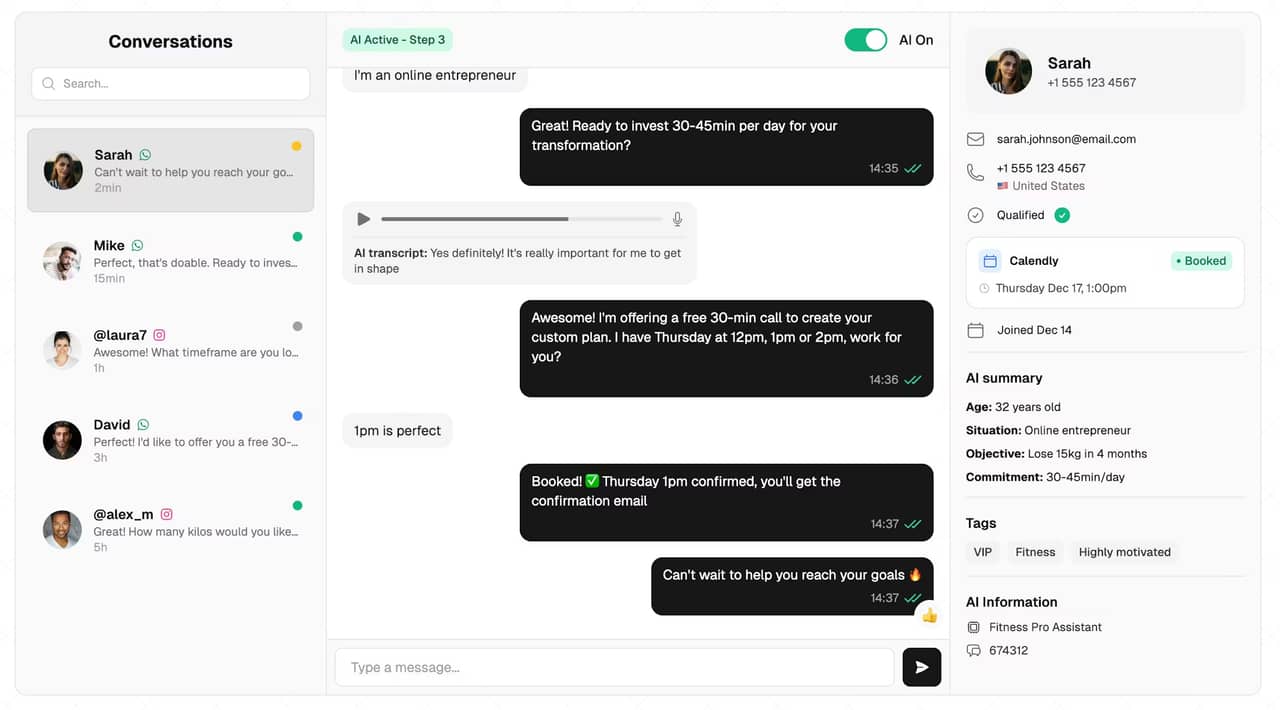
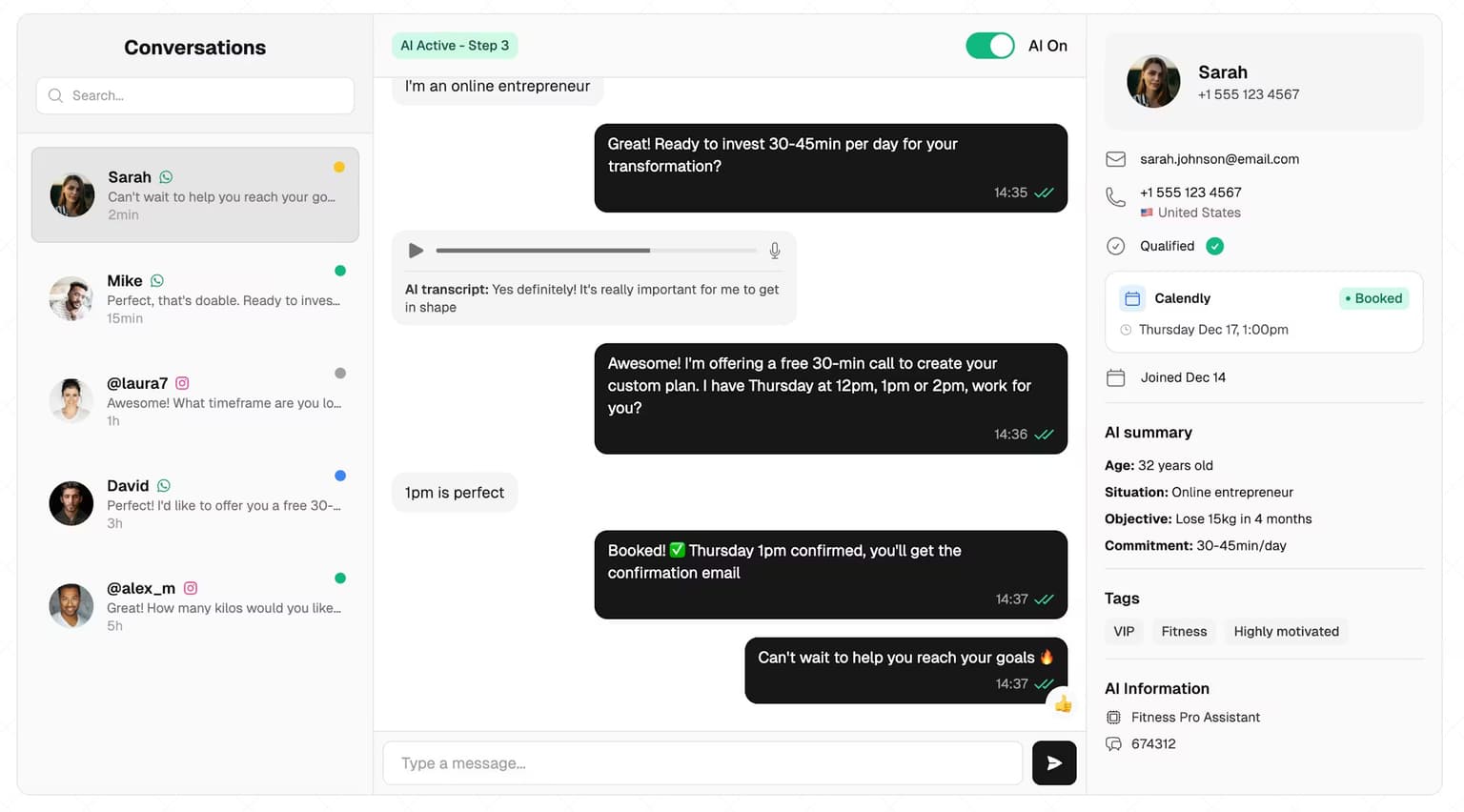
- Conversational marketing is one-to-one. Someone messages you (or replies to a broadcast), and an automated assistant or a human carries a real back-and-forth that answers questions, qualifies the lead, and books the next step.
For a coach, the second motion is where the money is. A broadcast can remind 500 people that your program reopens. But the booked calls come from the conversations that follow, and that is exactly what a good WhatsApp setup is built to handle. If you have only ever used WhatsApp for promotional blasts, you are using half the channel.
Why WhatsApp marketing works (when most channels are getting harder)
Direct answer: WhatsApp combines email-level reach with DM-level intimacy, and the inbox is not yet saturated the way email is.
A few reasons it outperforms for creator-led businesses:
- People actually read it. A WhatsApp message lands as a notification on someone's phone next to messages from their family. Open and reply rates dwarf email, because the channel still feels personal rather than promotional.
- It is a two-way channel by default. Unlike a marketing email, a WhatsApp message invites a reply. That reply is the start of a qualification conversation, not a dead end.
- It is where intent already lives. When a lead clicks a click-to-WhatsApp ad or taps a link in your bio, they are choosing a private conversation. That self-selection means higher intent than a cold form fill.
- Speed compounds. WhatsApp expects fast replies, and fast replies convert. Industry data shows the average business takes around 42 hours to respond to an inbound lead, and the gap between replying in minutes versus hours is enormous. We break the numbers down in our lead response time statistics.
The catch: that intimacy is fragile. Treat WhatsApp like a spam cannon and you torch your sender reputation, your number's quality rating, and the trust that made the channel work. The coaches who win on WhatsApp are the ones who keep it conversational.
WhatsApp Business app vs WhatsApp Business API
Before any strategy, you need the right foundation. There are two ways to run a WhatsApp business presence, and they are very different.
| Capability | Business app (free) | Business API |
|---|---|---|
| Greeting and away messages | Yes | Yes |
| Broadcast to a list | Up to 256 per list | Unlimited (template-based) |
| AI that understands free-text replies | No | Yes |
| Qualify leads and book calls automatically | No | Yes |
| Multiple agents on one number | Limited | Yes |
| Cost | Free | Conversation fees + tool subscription |
The free Business app is fine when you are starting out and replying by hand. The moment you want to broadcast at scale, automate qualification, or have an AI hold conversations while you sleep, you need the API. The mechanics of that foundation are covered in depth in our WhatsApp automation guide, and the WhatsApp Business API pricing breakdown explains the conversation-based fees so you are not surprised by the bill.
The three pillars of WhatsApp marketing
A WhatsApp marketing system has three moving parts. Get all three right and the channel runs itself.
1. List building (opt-in)
You cannot legally or effectively market on WhatsApp to people who never opted in. So the first job is to manufacture opt-ins:
- Click-to-WhatsApp ads on Instagram and Facebook send a paid click straight into a WhatsApp thread, the warmest possible entry point.
- A wa.me link in your Instagram bio, link-in-bio page, or email signature (create one free with our WhatsApp link generator).
- A QR code on slides, lead magnets, or in-person events; our free WhatsApp QR code generator makes one in seconds.
- Website widgets that open a pre-filled WhatsApp chat.
Every one of these turns anonymous attention into a contact you are allowed to message. That permission is the asset.
2. Broadcasts (one-to-many)
Once you have a list, broadcasts let you reach all of them at once: a launch, a webinar reminder, a flash enrollment window, a re-engagement nudge. On the API, broadcasts use pre-approved message templates and respect WhatsApp's category and frequency rules. Used sparingly, they are powerful. Used weekly as a sales firehose, they get you blocked. Our WhatsApp broadcast guide covers how to structure them so replies land in a real conversation instead of a dead inbox.
3. Conversational automation (one-to-one)
This is the pillar most coaches skip, and it is the one that books calls. When someone replies to a broadcast, clicks an ad, or messages your bio link, an AI assistant should pick up instantly: answer the question, ask the qualifying questions, handle the obvious objections, and offer a booking link to the people who are a fit. This is the same capability behind a WhatsApp chatbot and, more broadly, the multi-channel AI setter category: software that qualifies and books rather than just deflects FAQs.
How to do WhatsApp marketing: step by step
You do not need a developer. Here is the sequence that takes a coach from zero to a working WhatsApp system.
Step 1: Set up a business number. Use the free Business app to start, or register a dedicated number on the WhatsApp Business API (through Meta Cloud API or a provider) when you want automation. Complete Meta Business verification; it is also the gateway to the WhatsApp green tick later.
Step 2: Build your opt-in list. Point your click-to-WhatsApp ads, bio link, QR codes, and website widget at the number. Only add people who message you or explicitly consent. Cold-importing a contact list is the fastest way to get banned.
Step 3: Write your templates and flow. Draft the welcome message, your three to five qualifying questions (offer fit, timeline, budget, current situation), your objection answers, and the exact moment you share the calendar link. Prepare any broadcast templates for approval.
Step 4: Add the AI layer. Connect an assistant that reads each reply in context, responds in your tone, recognizes buying intent, and books qualified leads onto your calendar, the same job a human appointment setter does, running 24/7.
Step 5: Measure what matters. Track reply rate, qualification rate, and booked calls per campaign, not how many messages you sent. Then iterate on the questions and follow-ups that produce booked calls.
WhatsApp marketing strategies that actually convert
Beyond the mechanics, here are the plays that work for creator-led businesses:
- Lead magnet to DM. Offer a free guide, audit, or mini-training delivered inside WhatsApp. The delivery message opens a conversation you can qualify from.
- Story and content to keyword. Tell your Instagram audience to message a keyword to your WhatsApp to get something. The automation handles the rest, a natural bridge from your Instagram DM automation into a private channel.
- Webinar and launch reminders. Broadcasts that remind registrants of your automated webinar funnel to show up, then a conversational follow-up for the ones who attended.
- Re-engagement of cold leads. A short, human broadcast to people who went quiet, designed to restart a thread the AI can carry forward.
- Post-call nurture. For leads who booked but did not buy, a sequence that keeps the relationship warm without nagging.
The connective tissue across all of these is follow-up. Most conversations do not convert on the first message; they convert when someone is carried past the awkward middle with a timely nudge. A single, well-timed follow-up doubles booked calls among engaged leads. An automation is the only thing that reliably delivers that follow-up to every lead, every time.
WhatsApp marketing tools compared
The right tool depends on whether you want a visual flow builder, a true AI conversation layer, or a heavy support desk. An honest look at the categories a coach usually evaluates:
| Tool | Best for | AI conversation | Pricing |
|---|---|---|---|
| SetSmart | Qualifying + booking calls from DMs | Native AI setter | Free 7-day trial, then $97/month (1,000 messages) |
| ManyChat | Visual flow builder, multi-channel | AI add-on | Free plan; paid from $14/mo |
| BSP platforms | Large support and ticketing teams | Varies | Custom / conversation-based |
ManyChat is genuinely strong if you want drag-and-drop flows and you already run Instagram and Messenger from one place, see our ManyChat WhatsApp breakdown for where it shines. The trade-off is that flow builders are built around buttons and rules, with AI as an add-on rather than the core. If your priority is an assistant that holds a natural qualifying conversation and books the call, an AI-first tool will feel more natural than wiring up decision trees by hand. Wherever you land, cross-check it against the broader best AI setters comparison.
What WhatsApp marketing costs
There are two cost layers, and confusing them is how people overspend.
- WhatsApp conversation fees are charged by Meta, not your tool. The API prices per 24-hour conversation window, with categories (marketing, utility, service) priced differently by country. Marketing conversations cost the most. The full mechanics are in our WhatsApp Business API pricing guide.
- The software subscription is what you pay your automation tool on top. This ranges from free starter plans to enterprise contracts.
For a coach doing conversational marketing rather than mass broadcasting, the conversation bill stays modest because you are running fewer, higher-quality threads, not blasting tens of thousands of marketing templates. The lesson: optimize for booked calls per conversation, not for raw send volume. A leaner, conversational approach is usually cheaper and converts better than a high-volume broadcast strategy.
WhatsApp marketing rules and compliance in 2026
WhatsApp is strict, and that strictness is what keeps the channel valuable. The non-negotiables:
- Opt-in is mandatory. Only message people who messaged you first or gave explicit consent. No scraped or purchased lists, ever.
- Marketing templates need approval. Promotional broadcasts use pre-approved templates and are subject to per-user frequency limits to curb spam.
- Quality rating governs your reach. Blocks and "not useful" reports drag your number's quality down and can throttle or restrict it. Conversational, wanted messaging protects it.
- General-purpose AI assistants are barred. WhatsApp's late-2025 policy update blocked standalone, do-anything AI bots from the Business API. This does not affect a business assistant that handles your own customer conversations, qualifying leads and booking calls is exactly the messaging WhatsApp is built for.
Stay conversational, stay opted-in, and you stay well inside the rules.
The real goal: qualify and book sales calls, do not "close" in chat
This is where most WhatsApp marketing advice for coaches goes wrong. The temptation is to try to sell the high-ticket program inside the chat. For coaches and consultants, that close happens on a call, with a human. WhatsApp's job is to fill the calendar with qualified sales calls.
That framing matters because of how conversations actually convert. Across 828K real DM conversations we analyzed across Instagram and WhatsApp, the pattern is consistent: most threads die in the first couple of messages, and the leads who book are the ones carried deeper with the right follow-up. On WhatsApp specifically, engaged responders qualify at roughly 34%, far higher than the channel average, because the medium itself invites a real exchange. The job of your marketing system is to start more of those exchanges and never let one stall.
So design the system to do three things well: respond in seconds, ask the questions that separate a fit from a tire-kicker, and book the qualified ones onto a call. The selling happens on the call. The marketing happens in the DM. If you run high-ticket offers, that booking is the handoff to your appointment setter or closer, not something the chat replaces.
"We were drowning in WhatsApp messages after every launch. Now the assistant qualifies and books overnight, and I just show up to calls that are already warm." (Edouard Clerc)
Common WhatsApp marketing mistakes to avoid
- Treating it like email. Broadcasting constantly with no conversation is the fastest path to blocks and a tanked quality rating.
- Buying or scraping numbers. No opt-in means no deliverability and a real risk of a ban.
- All broadcast, no follow-up. The send is the easy part. The booked call comes from the conversation after the reply.
- Trying to close in the chat. The DM qualifies and books; the call closes. Confusing the two creates pushy, low-converting threads.
- No human handoff. Always give qualified or frustrated contacts a clean path to a person.
- Ignoring Instagram. Most coaches' audiences live on Instagram first. Pair WhatsApp with an Instagram chatbot so the two channels feed one pipeline instead of competing.
Done right, WhatsApp marketing is not a broadcast list, it is a qualification engine. The coaches who win are the ones who stop counting sends and start counting booked calls.
FAQ
What is WhatsApp marketing?
WhatsApp marketing is using WhatsApp to attract, nurture, qualify, and convert leads through both broadcasts (one-to-many) and conversational automation (one-to-one). For coaches and creators, the highest-value use is the conversational side: qualifying inbound leads and booking sales calls directly in the chat.
Is WhatsApp marketing legal?
Yes, when it is permission-based. You must only message people who opted in, by messaging you first or giving explicit consent, and marketing broadcasts must use approved templates and respect frequency limits. Buying lists or messaging cold numbers violates WhatsApp's terms and risks a ban.
How much does WhatsApp marketing cost?
There are two layers: Meta's per-conversation fees (priced by category and country, with marketing conversations costing the most) and your software subscription. Conversational, qualification-focused marketing keeps the conversation bill low because you run fewer, higher-quality threads rather than mass broadcasts.
How do I do WhatsApp marketing for free?
The free WhatsApp Business app supports greeting messages, away messages, quick replies, and broadcasts to lists of up to 256 contacts, enough to start manually. But automated qualification, AI conversations, and unlimited template broadcasts require the WhatsApp Business API, which has conversation fees plus a tool subscription.
What is the best WhatsApp marketing strategy for coaches?
Drive opt-ins with click-to-WhatsApp ads and bio links, use broadcasts sparingly for launches and reminders, and put an AI assistant on every inbound conversation to qualify leads and book calls instantly. Optimize for booked calls per conversation, not send volume.
Should WhatsApp marketing try to close the sale in chat?
No. For high-ticket coaching offers, the chat should qualify the lead and book a sales call, where a human closes. Framing WhatsApp as a booking layer (not a closer) consistently converts better and avoids the pushy, low-trust feel of trying to sell a program over text.
Ready to automate your DMs?
Start your free 7-day trial and let AI handle your lead qualification 24/7.
Try SetSmart free