WhatsApp Broadcast 2026: Limits, Tools, Templates

WhatsApp broadcast is still the highest-open-rate channel a coach, course creator, or D2C brand has access to — but it's also the most misunderstood feature in Meta's 2026 stack. People assume "broadcast" means "send the same message to my whole list and hit send." That worked in 2019. In 2026, broadcasting touches three different products (broadcast lists, Channels, business broadcasts), four hard limits (contact cap, daily marketing cap, opt-in, template approval), and a pricing system that bills per conversation, not per message.
This guide untangles all of it. We cover what WhatsApp broadcast actually does in 2026, the limits Meta enforces, how it differs from Channels and Communities, the seven broadcast tools worth shortlisting, three paste-ready templates, and the one thing every broadcast misses: a real conversation after the blast.
TL;DR — 2026 WhatsApp broadcast at a glance
- WhatsApp broadcast lists still work inside the free WhatsApp Business app — but capped at 256 contacts per list and only reach people who have saved your number.
- Business broadcasts via the WhatsApp Business API (BSP) scale far past 256 contacts, support marketing template messages, and bill per 24-hour conversation. This is what "professional" broadcasts mean in 2026.
- WhatsApp Channels are not broadcasts. Channels are a one-to-many follower feed (like a Telegram channel). They look similar but use a different product, different metrics, and no opt-in handshake.
- Marketing template messages must be pre-approved by Meta before you can send a broadcast through the API, and the cost has gone up after Meta's 2025 pricing reshuffle.
- The 24-hour rule still applies. After the broadcast lands, you have a 24-hour window where any reply opens a free-form conversation. Outside that window, every reply needs a fresh template.
- The DM you send is not the campaign. The campaign is the conversation the broadcast starts. Most teams optimize the wrong half, which is why a WhatsApp chatbot to carry the reply matters more than the blast.
Did WhatsApp get rid of broadcast?
Short answer: no. Broadcast lists are still a documented feature in the WhatsApp Business app, and business broadcasts on the API are growing — Meta now reports billions of business-initiated conversations per quarter.
What people noticed in 2025 was a different change: Meta restricted some accounts from sending business broadcasts due to spam reports, raised marketing-conversation prices in most regions, and pushed Channels harder in the WhatsApp UI. That's why the "did WhatsApp get rid of broadcast?" question shows up in Google's People Also Ask in 2026. It didn't. It got more rules.
The practical truth in 2026:
- If you use the free WhatsApp Business app, you can still create broadcast lists from your contacts and send a message to up to 256 saved contacts at once.
- If you use a BSP (Business Solution Provider) like Wati, AiSensy, 360dialog or any other API partner, you can broadcast to thousands of opted-in contacts using pre-approved marketing templates.
- If you ignore the opt-in rules, broadcast to scraped numbers, or use the same template too many times without engagement, Meta will throttle your sending limit or block the account — these enforcement actions are the real source of the "WhatsApp killed broadcast" rumour.
WhatsApp broadcast vs Channels vs Communities vs Groups
These four products look related but solve different problems. Conflating them is the single biggest reason teams build the wrong campaign.
| Feature | Broadcast list | Channel | Community | Group |
|---|---|---|---|---|
| Direction | 1-to-many private DM | 1-to-many public feed | Hub of related groups | Many-to-many chat |
| Recipient sees you in | Individual DM thread | Updates tab | Communities tab | Chats tab |
| Recipient cap | 256 per list (Business app); unlimited (API) | Unlimited followers | Up to 5,000 members across sub-groups | Up to 1,024 members |
| Must save your number | Yes (Business app); No (API, opt-in instead) | No | No | No |
| Replies | Private DM back to sender | Reactions + polls only (no replies) | Inside the sub-group | Public to all members |
| Best use case | Promo blast that starts a 1:1 conversation | Newsletter, announcements, audience-building | Multi-cohort coaching / membership | Small inner-circle chats |
If your goal is to start sales conversations — qualifying leads, recovering carts, booking calls — broadcast lists or API broadcasts are what you want, not Channels. Channels are excellent for one-way audience-building (announcements, drops, content updates), but you cannot route replies into a structured DM flow. Use Channels to grow your subscriber list, then broadcast to turn that audience into bookings.
How WhatsApp broadcasts actually work in 2026
There are three concrete paths a creator or brand can use to send a WhatsApp broadcast in 2026. The right one depends on list size and whether you need automation.
Path 1 — WhatsApp Business app (free, manual, capped)
Free download. You create a broadcast list from your saved contacts (max 256), tap New broadcast, type a message, send. Recipients receive the message as a private DM. If they reply, the reply lands in your inbox like any other chat.
Pros:
- Zero cost
- No template approval
- Replies feel personal
Cons:
- Recipients must have saved your phone number (massive constraint — easily 60–80% of a typical mailing list won't have done this)
- Hard cap of 256 contacts per list, and no native segmentation
- No analytics (you only see read receipts per individual contact)
- No automation: every blast is manual
This path works for solo coaches with a tight client list (under 256 people) or for an event announcement to past students. It does not scale.
Path 2 — WhatsApp Business API via a BSP
This is what every serious broadcast tool actually uses under the hood. You connect to Meta through a Business Solution Provider (Wati, AiSensy, 360dialog, Twilio, Respond.io, etc.), get a Cloud-hosted or on-prem number, register marketing templates with Meta for approval, and send broadcasts to opted-in contacts via the API.
Pros:
- No 256-contact ceiling — broadcast to your full list
- Recipients don't need to save your number (they opted in via web form, click-to-WhatsApp ad, or QR code)
- Template approval gates the message content but unlocks scale
- Analytics: delivered / read / replied per template
- Automation, segmentation, A/B testing all possible
Cons:
- Setup takes 1–7 days (Meta Business verification + WhatsApp number registration + template approval)
- Pricing is per 24-hour conversation, not per message (marketing conversations cost more than utility / service conversations — see our WhatsApp Business API pricing breakdown)
- Marketing templates must be opt-in compliant; spammy templates get rejected by Meta
- Quality rating affects your daily sending tier — bad replies/blocks → lower tier
This path is what tools like Wati, AiSensy, and ManyChat sit on top of.
Path 3 — API + conversational AI (the 2026 default)
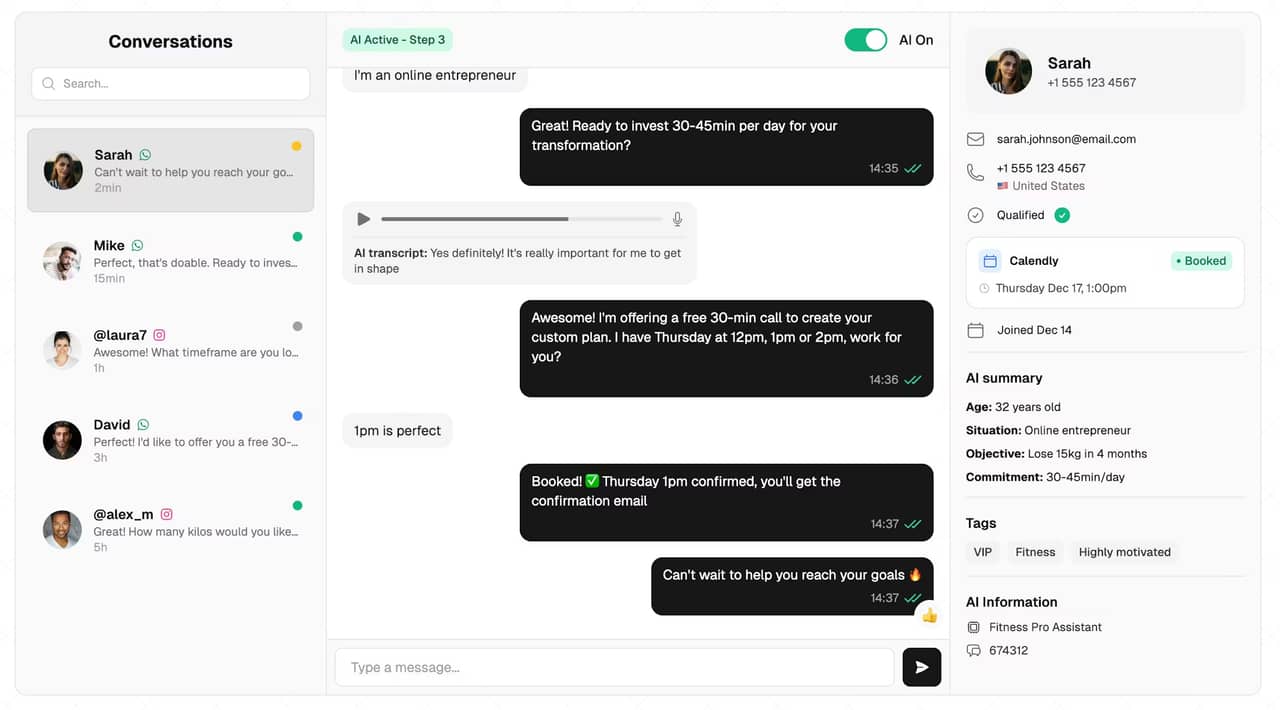
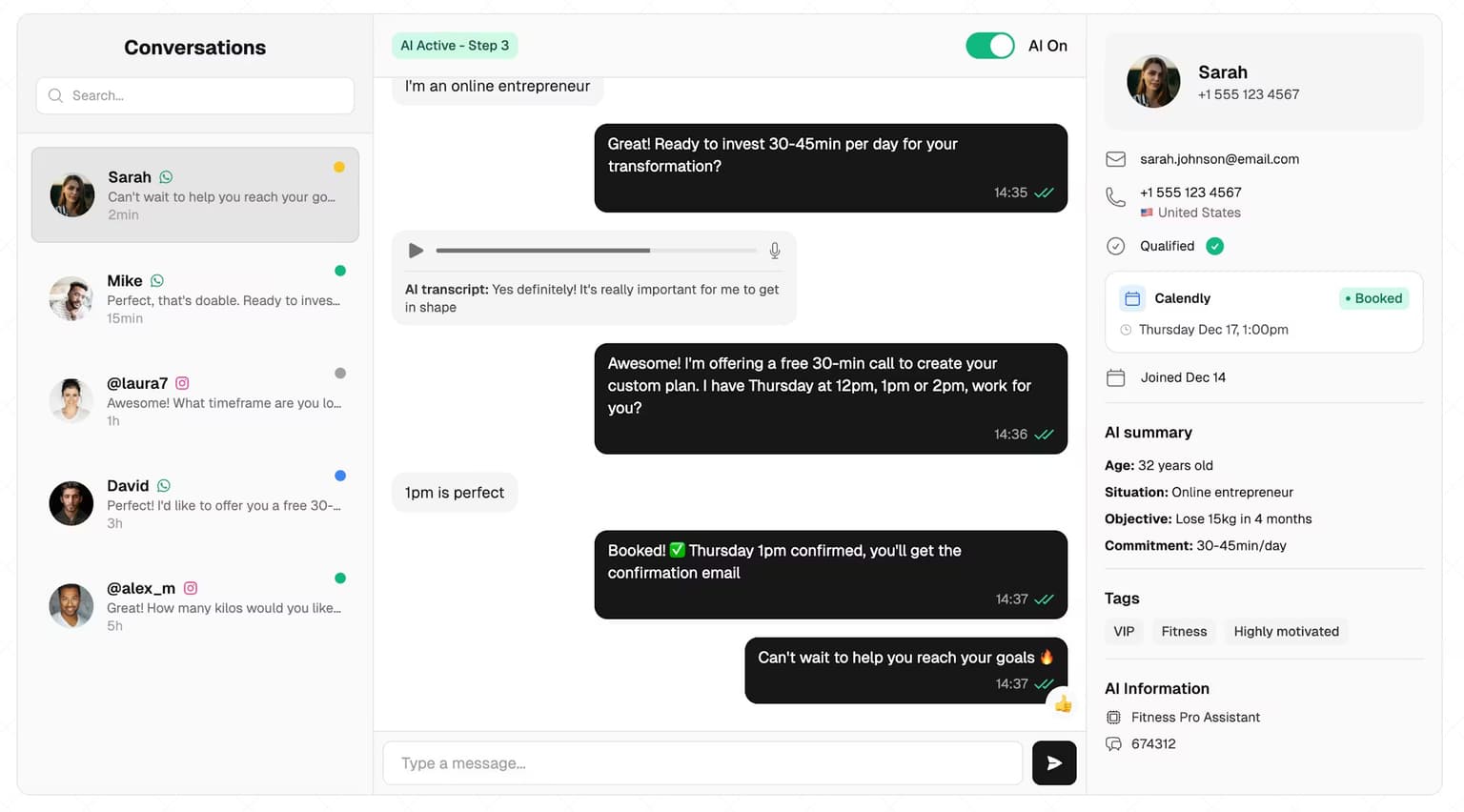
Path 2 sends the broadcast. Path 3 is what happens after — the AI conversation that handles every single reply. Broadcasts get 60–80% open rates; the leak is that nobody answers the replies fast enough. In 2026, this is the version of a broadcast that actually converts: blast the marketing template, then route every reply into an AI setter that qualifies and books a call inside the same WhatsApp thread. This is the model SetSmart is built for, and it's the same model behind every high-converting WhatsApp automation playbook we've seen.
What is the WhatsApp broadcast limit in 2026?
The WhatsApp broadcast limit is 256 contacts per broadcast list in the free WhatsApp Business app, and recipients only receive the message if they have saved your number. On the WhatsApp Business API there is no per-list cap: instead, Meta assigns your business portfolio a messaging limit of 250, 2,000, 10,000, or 100,000 unique users per moving 24-hour period, rising to unlimited as quality and volume grow. Unverified businesses start at 250 unique users per 24 hours; completing Meta business verification unlocks 2,000, and the higher levels scale automatically from there.
Beyond those headline numbers, there are four limits to understand. Hitting any of them silently throttles your campaign or gets your number flagged.
1. The 256-contact list cap (Business app only)
The free WhatsApp Business app limits each broadcast list to 256 contacts. You can create multiple lists, but you can't merge them, and you can't broadcast to a list of unsaved numbers. This is a deliberate anti-spam constraint, not a bug. The cap doesn't apply to the Business API — the API has separate tier-based limits described below.
2. The API messaging limit (250 to unlimited)
On the API, the limit is not per list but per business portfolio: the maximum number of unique WhatsApp users you can deliver messages to within a moving 24-hour period, shared across all the phone numbers in your portfolio. Per Meta's current documentation, the levels are:
| Messaging limit | Unique users / moving 24h | How to unlock |
|---|---|---|
| Starting | 250 | Default for new, unverified business portfolios |
| Level 2 | 2,000 | Complete Meta business verification (or deliver 2,000 template messages to unique users within a moving 30-day period with a high quality rating) |
| Level 3 | 10,000 | Automatic: high-quality messaging plus using at least half of your current limit in the prior 7 days |
| Level 4 | 100,000 | Same automatic scaling criteria, sustained |
| Top | Unlimited | Same automatic scaling criteria, sustained |
Two details people miss: the limit counts unique users, not messages (several templates to the same person in 24 hours count once), and upgrades happen automatically, within about 6 hours per Meta's docs, once you meet the scaling criteria. The fastest path up is to complete business verification early (that alone moves you from 250 to 2,000), broadcast only to engaged opted-in contacts, and answer replies fast so your quality rating stays high. Quality rating drops if recipients block you or report spam; if it drops too far, Meta lowers your limit or restricts the number.
3. Template approval and the marketing category
Every broadcast on the API uses a template message — pre-written text that Meta approves before you can use it. Templates fall into three categories:
- Utility — order confirmations, shipping updates, appointment reminders (cheapest)
- Authentication — OTPs and verification codes (cheapest)
- Marketing — promotions, discounts, re-engagement, new product announcements (most expensive)
Marketing templates are the broadcast category. Meta rejects templates that are too generic ("Hi, we miss you"), too aggressive ("Last chance to save"), or that lack a clear opt-out. Reviews usually take a few hours but can take up to 24 hours during high-volume periods.
4. The opt-in requirement
Meta requires explicit opt-in before you broadcast to any number on the API. Valid opt-in sources:
- A web form where the user provides their WhatsApp number and ticks a marketing-consent box
- A click-to-WhatsApp ad where the user sends the first message
- A QR code that opens WhatsApp pre-filled with a message (generate one free with our WhatsApp QR code generator)
- An import from another channel where the user previously gave WhatsApp marketing consent
If you broadcast to unverified numbers and the recipients block you, your quality rating tanks within hours.
The 7 best WhatsApp broadcast tools for 2026
Below is the shortlist we recommend after deploying broadcast campaigns for coaches, course creators, agencies, and D2C brands across our network. Pricing is approximate and changes quarterly — check each vendor's page for current rates.
1. SetSmart — best for broadcast + AI conversation follow-up
What it does: SetSmart sits on the WhatsApp Business API and is built around the "broadcast plus AI conversation" model in Path 3 above. You send a marketing template to a segment, and every reply goes to an AI setter that qualifies the lead, handles objections, and books a call — all inside WhatsApp. The broadcast is the cold open; the AI is the closer.
Pricing: Free 7-day trial, then $97/month (1,000 messages included).
Best for: Coaches, course creators, info-product sellers, SMMAs, and D2C brands who want broadcasts to actually convert into calls — not just generate replies that pile up unanswered.
Trade-off: SetSmart is not a one-way blast tool. If you only want to send a promo and don't care about the conversation, a pure broadcast tool is cheaper.
2. ManyChat — best for broadcast + flow-builder bundling
What it does: ManyChat's WhatsApp broadcast feature is genuinely good. You build subscriber lists from click-to-WhatsApp ads or website widgets, send promotional templates, and route replies through a no-code flow builder. Great for Shopify-style abandoned-cart broadcasts. See our ManyChat WhatsApp guide for the full setup.
Pricing: Starts at $15/month (Pro plan); higher tiers scale with subscriber count.
Best for: D2C brands already running click-to-WhatsApp ads who want flow-builder logic and a free starting tier.
Trade-off: Conversations are still flow-based, not conversational. If a lead replies outside your flow, ManyChat hands off to a human inbox — there's no AI closer behind it. Full comparison in our ManyChat alternatives guide.
3. Wati — best for pure broadcast at scale
What it does: Wati is a BSP focused specifically on WhatsApp broadcasts, shared team inbox, and basic chatbot flows. It's one of the most popular dedicated WhatsApp tools for agencies and ecommerce brands.
Pricing: Starts at around $39/month (Growth plan), with usage-based template fees on top.
Best for: Teams broadcasting 5k–100k messages a month who want a clean broadcast dashboard, segmentation, and template management.
Trade-off: No conversational AI — replies land in a shared inbox for human agents to handle. Slow response = lost qualification (53% of inbound DM conversations die before message 3 when nobody answers fast enough — see the study section below).
4. AiSensy — best budget WhatsApp broadcast tool
What it does: AiSensy is a popular BSP in India and growing globally — broadcasts, simple chatbots, and a shared inbox. Pricing skews lower than Wati.
Pricing: Starts at around $19/month (Basic), with markup on conversation fees.
Best for: Small agencies, solopreneurs, and lean ecommerce brands sending a few thousand broadcast messages per month who want a low monthly floor.
Trade-off: UI is more dated and analytics are thinner than Wati. Conversational handling is rules-based.
5. Respond.io — best for multi-channel teams
What it does: Respond.io is a multi-channel inbox (WhatsApp, Messenger, Instagram, SMS, web chat) with a unified broadcast and automation engine. If your team handles inbound from many channels in one place, this is the bridge.
Pricing: Starts at around $79/month (Team plan).
Best for: Agencies and D2C support teams who need WhatsApp broadcasts alongside Instagram and Messenger workflows. Pairs naturally with our Messenger chatbot stack.
Trade-off: Heavier setup. Overkill if WhatsApp is your only channel.
6. Gallabox — best for SME/SMB broadcast + CRM-light workflows
What it does: Gallabox combines WhatsApp broadcasts with a built-in lightweight CRM and a shared inbox. Popular in EMEA and APAC SME accounts.
Pricing: Starts at around $39/month (Growth plan).
Best for: Service businesses and SMBs who want broadcasts plus customer record-keeping without buying a separate CRM.
Trade-off: Conversational replies are mostly manual. No real AI closer.
7. 360dialog — best raw API access for developers
What it does: 360dialog is a pure Meta BSP — they provide the WhatsApp number, template approval pipeline, and the raw API. You build your own broadcast UI on top, or you use them as the underlying provider for another tool. SetSmart uses 360dialog under the hood for many EU customers.
Pricing: No platform fee in some plans — you only pay Meta conversation fees plus a small per-message margin. See our 360dialog pricing breakdown.
Best for: Developers, agencies who want to white-label, and brands with custom internal tooling.
Trade-off: No UI for non-technical users. You need a developer or a layer on top.
WhatsApp broadcast templates that get approved (and convert)
Meta rejects roughly half of first-time marketing templates submitted by new accounts. Below are three formats we've seen approved repeatedly, with response rates above the 23% WhatsApp baseline.
Template 1 — Cart recovery (ecommerce)
Hey , this is Lina from Maison Verte.
Your is still waiting in your cart — the size you picked is back in stock since this morning.
Want me to hold one for you? Just reply YES and I'll send a checkout link.
Reply STOP to unsubscribe.
Why it works: addresses the person by name, references a specific product, asks a one-character reply (lowest friction), includes the legal opt-out. Approved as Marketing template.
Template 2 — Webinar re-engagement (course creator)
Hi — quick reminder. Tomorrow at 7pm Paris time, I'm running the live "0 to first 10 clients" workshop you registered for.
Want the Zoom link sent here on WhatsApp 30 minutes before? Reply LINK and I'll set it up.
Reply STOP to opt out of future reminders.
Why it works: utility-leaning even though it's marketing-categorized, clear time/value, single-word reply, opt-out included.
Template 3 — New audit slot (coach / consultant)
Hi , this is from .
I opened 5 new audit slots for next week (free, 20 min, on a call). I thought of you because you joined the waitlist back in .
Want me to send the 5 available times? Reply YES.
Why it works: clear context (waitlist), scarcity (5 slots), specific time commitment (20 min), one-word reply. Approved as Marketing template.
What kills approval: vague phrases ("we miss you"), promotional language without context, missing opt-out, no personalization variable. Templates with at least one {{variable}} and a clear reply intent get through 80%+ of the time.
For more script patterns, see our library of Instagram DM scripts — many adapt to WhatsApp with minor wording changes.
Why most WhatsApp broadcasts fail (and what fixes them)
We analyzed the message-level data inside our study of 828K AI-driven DM conversations across Instagram and WhatsApp. The pattern is the same on broadcast follow-ups: 53% of inbound conversations died before message 3 — usually because the human inbox didn't answer the broadcast reply for hours, and by then the buyer had scrolled on.
That's the broadcast-conversion leak in one line. Open rates on WhatsApp are 70–98%. Reply rates can hit 15–25%. But the qualification rate collapses if those replies sit unanswered for 30+ minutes — which is what happens whenever a small team gets 200 simultaneous replies to one campaign.
Three fixes:
- Cap your broadcast size to what your reply capacity can handle. If a human inbox can answer 20 replies per hour, don't broadcast to 5,000 contacts at once. Drip it over 24–72 hours.
- Pre-write the next 2 messages. The reply rarely needs original prose — it needs a fast confirmation or qualifying question. Have it ready in saved replies.
- Or replace human reply with an AI setter that responds in under 5 seconds, qualifies the lead with the right 3–5 questions, and books a call. This is the AI setter model — the broadcast plus the conversational closer behind it.
Among our network, the WhatsApp follow-up loop is the single highest-ROI optimization: a single follow-up doubles booked calls (+106% in the dataset), and on WhatsApp specifically responders qualify at ~34% — about 1.9× the Instagram qualification rate. The broadcast generates the entry; the follow-up captures it.
Pricing: what a WhatsApp broadcast actually costs in 2026
A WhatsApp broadcast in 2026 is priced on three layers:
- Meta conversation fee — billed per 24-hour conversation (not per message), with different rates per category (utility / authentication / marketing) and per country. Marketing conversations in the US cost around $0.025–$0.08 per recipient; in countries like India or Brazil the rate is lower.
- BSP platform fee — the monthly subscription you pay your broadcast tool (Wati, AiSensy, SetSmart, ManyChat, etc.).
- Optional per-message markup — some BSPs add a small fee on top of Meta's rate. Pure infrastructure BSPs like 360dialog tend to have lower markup.
A realistic monthly cost for a brand sending 10,000 marketing template messages to opted-in US contacts looks like:
- Meta conversation fees: ~$300–$700 depending on category mix
- BSP platform: $39–$99/month (depending on tool)
- AI setter on replies: $97/month (SetSmart, fixed)
- Total: $400–$900/month all-in for a 10k-message campaign
The biggest cost lever is template category mix. Routing as many touchpoints as possible through utility templates (order confirmations, reminders, appointment updates) drops the cost 50–80% versus marketing-only campaigns.
When NOT to use WhatsApp broadcast
Broadcast is the wrong tool when:
- You have no opt-in pipeline. Buying lists or scraping numbers will get you blocked within days.
- Your offer is purely transactional (e.g., one-click upsell). Email or push is faster and cheaper.
- Your team can't answer the replies. A broadcast with no follow-up burns the list. Better to send nothing.
- You're targeting markets where WhatsApp adoption is low (most of the US outside Hispanic and immigrant communities, parts of Northern Europe). For US-first audiences, Messenger or Instagram DM may convert better.
A 7-day plan to launch your first WhatsApp broadcast
If you're starting from zero, here's the sequence we use with new coaching, course-creator, and D2C brand clients.
Day 1 — Pick your BSP. For under 5,000 broadcast recipients per month, ManyChat or AiSensy. For 5k–50k, Wati or Gallabox. For replies that need to convert into bookings, SetSmart on top of 360dialog.
Day 2 — Register your WhatsApp business number with Meta. Verify the business on Meta Business Suite. Display name approval can take 24–48 hours.
Day 3 — Build the opt-in source. The fastest are: a click-to-WhatsApp ad campaign on Instagram/Facebook, a checkout-page WhatsApp opt-in checkbox, a wa.me link in your Instagram bio, or a QR code on your physical packaging.
Day 4 — Write and submit 2 marketing templates and 1 utility template. Use one variable minimum. Include the STOP opt-out.
Day 5 — Build the conversation flow behind the broadcast. If using SetSmart, configure the AI setter with your qualification questions and calendar. If using a flow builder, draft the decision tree.
Day 6 — Test broadcast to a list of 10–20 internal contacts. Confirm delivery, render, and reply routing. Fix any rendering issues (emoji, line breaks, variable substitution).
Day 7 — First real broadcast, drip-style. Send to 250–500 contacts to check reply volume vs your capacity. Adjust pacing before scaling to your full list.
For a deeper version of this playbook adapted to the lead-qualification side of WhatsApp, see our WhatsApp automation guide, and for the Instagram parallel, our walkthrough on how to automate Instagram DMs with AI.
Common mistakes that get WhatsApp broadcast numbers banned
The five fastest ways to get a number throttled or banned in 2026, ranked:
- Broadcasting to non-opted-in contacts. A single batch of unsolicited messages can drop quality rating from High to Low overnight.
- Repeated identical templates without engagement. If your reply rate falls below ~2% and people start blocking, Meta deprioritizes your number.
- Spammy template content. Aggressive sales copy, promises ("guaranteed"), shouty caps, or vague offers without a clear next step are flagged on review.
- Missing or hidden opt-out. Every marketing template must include an obvious way to stop receiving messages.
- Sending marketing templates outside the 24-hour service window without re-opt-in. If someone stopped replying 30 days ago, you can't just blast them again — you need a fresh opt-in trigger.
If any of these sound familiar, fix them before scaling — recovery from a low quality rating is much slower than avoiding the drop.
WhatsApp broadcast vs Instagram broadcast
Instagram added a Broadcast Channels feature in 2023 (now called Channels), then folded it into the Meta-wide Channels product in 2024–2025. Instagram broadcasts work differently from WhatsApp broadcasts:
- Instagram Channels = public follower feed — you broadcast, followers see it in their Updates inbox, they cannot reply (only react). It's an audience-building tool, not a sales tool.
- WhatsApp broadcast lists / API = private DMs — recipients see the message in their normal chat, they can reply, and that reply opens a 24-hour conversation window for free-form messaging.
Use Instagram Channels for audience and announcements; use WhatsApp broadcasts for conversion. If your audience is on both, run Instagram for top-of-funnel awareness and WhatsApp for the sale. See our Instagram automation tools round-up for the IG side.
FAQ
Did WhatsApp get rid of broadcast in 2026?
No. Broadcast lists are still available in the free WhatsApp Business app (capped at 256 saved contacts per list), and business broadcasts on the WhatsApp Business API are growing. What changed is Meta enforces opt-in, template approval, quality rating, and per-conversation pricing more strictly — so casual "send to my whole contact list" sprays no longer fly.
What is the WhatsApp broadcast limit per day?
In the free WhatsApp Business app, there's no published daily cap — the constraint is the 256-contact-per-list limit and the requirement that recipients have saved your number. On the WhatsApp Business API, your business portfolio starts with a messaging limit of 250 unique users per moving 24 hours, moves to 2,000 after Meta business verification, then scales automatically to 10,000, 100,000, and unlimited as quality and volume stay high.
What is the WhatsApp broadcast limit per month?
There's no fixed monthly cap. The practical monthly limit is your API messaging limit multiplied by 30 days, minus throttling from low quality rating. A portfolio sitting at the 10,000-user level can broadcast around 300,000 unique conversations a month at full pace.
Can you broadcast on WhatsApp without saving the number?
Only via the WhatsApp Business API. The free Business app requires recipients to have saved your number — if they haven't, they don't receive the broadcast. The API uses opt-in instead (web form, click-to-WhatsApp ad, QR code), so recipients don't need to save you in advance.
Is WhatsApp broadcast free?
It depends on the path. The free WhatsApp Business app is free for broadcasts to up to 256 saved contacts per list — no Meta fee. The Business API is paid: Meta charges per 24-hour conversation (marketing rates are higher than utility), plus your BSP charges a platform fee, plus optional per-message markup. Total cost for a 10k-message US marketing campaign is typically $400–$900 all-in.
What's the difference between WhatsApp broadcast and WhatsApp Channels?
WhatsApp broadcast lists send a private DM to each recipient, and recipients can reply. WhatsApp Channels are a public one-way feed in the Updates tab where followers can react but cannot reply. Use broadcasts for conversion (sales conversations); use Channels for announcements and audience-building.
How do I increase my WhatsApp broadcast limit?
On the API, the daily messaging limit grows with your quality rating and volume. Complete Meta business verification first: that alone moves you from 250 to 2,000 unique users per 24 hours. Then only broadcast to engaged opted-in contacts, answer replies within 5 minutes (an AI setter helps here), keep your template categories appropriate (utility for transactions, marketing for promotion), and avoid spammy copy. The higher levels (10,000, 100,000, unlimited) unlock automatically when quality stays High and you use at least half of your current limit within the prior 7 days.
Ready to automate your DMs?
Start your free 7-day trial and let AI handle your lead qualification 24/7.
Try SetSmart free