WhatsApp Flows: How They Work for Coaches (2026)

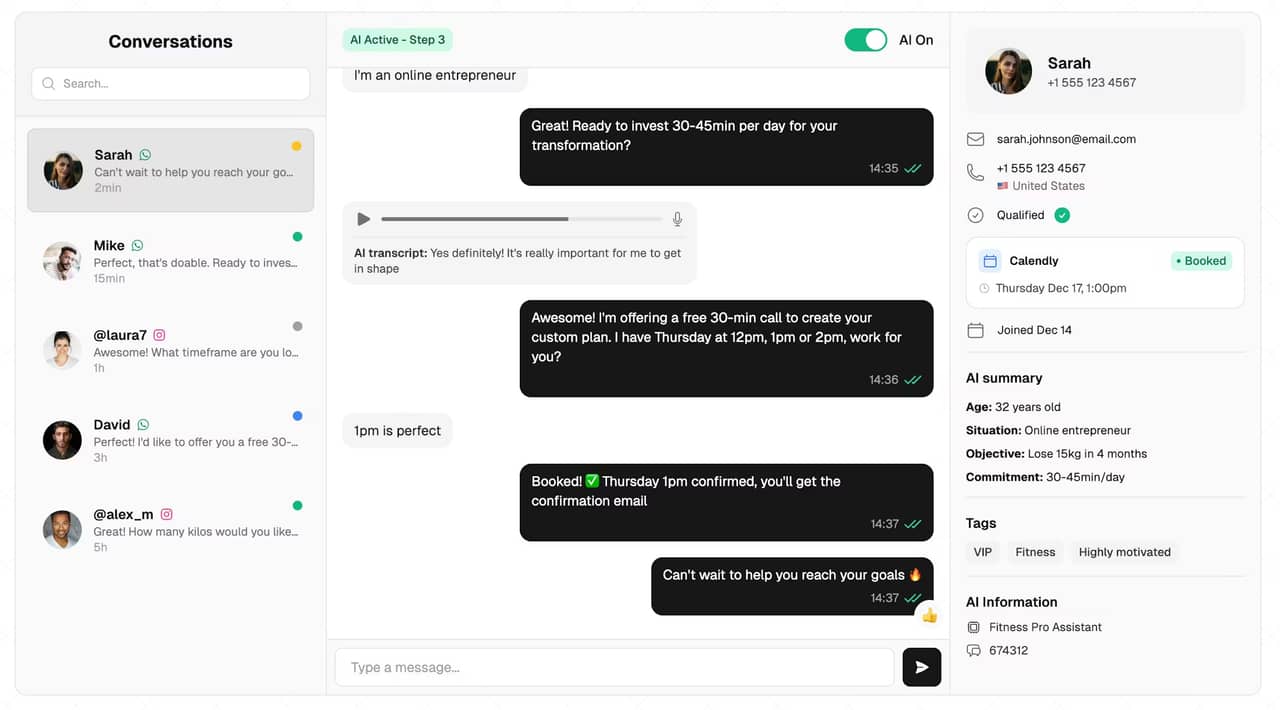
WhatsApp Flows are Meta's native way to put a structured, multi-screen form directly inside a WhatsApp chat. Instead of typing back and forth, a lead taps a button and fills in a small in-chat mini-app: pick a date, choose a goal, enter an email, book a slot. For a coach or creator running inbound conversations on WhatsApp, that sounds like the missing piece for booking calls without leaving the app.
The reality is more nuanced. Flows are excellent at collecting clean, structured data. They are not a replacement for a real conversation, and they cannot qualify a messy inbound lead the way a human setter or an AI one does. This guide explains exactly what WhatsApp Flows are, how they work under the hood, what you can build with them in 2026, and where a Flow stops and an AI setter starts.
What are WhatsApp Flows?
Direct answer: a WhatsApp Flow is a structured, interactive form that opens inside a WhatsApp conversation, letting a business collect information or complete an action without the person ever leaving the chat.
Think of it as a tiny app that lives inside the message thread. Meta launched Flows on the WhatsApp Business Platform to move businesses beyond free text and simple buttons. Where a normal chatbot menu gives you a couple of reply buttons, a Flow can show a full screen with text fields, dropdowns, radio buttons, checkboxes, date pickers, and even photo uploads. The person completes it, taps submit, and the structured answers come back to the business.
That is the key difference from ordinary WhatsApp automation: a Flow is not a message, it is an interface. It turns "reply with 1 for morning or 2 for afternoon" into a clean date-and-time picker. It is the same idea as an embedded form on a website, except it runs natively inside WhatsApp, so there is no tab switch, no page load, and no drop-off from sending someone to an external link.
Flows only work on the WhatsApp Business Platform, the official API version of WhatsApp for businesses. The free WhatsApp Business app does not support them, which is an important limit we will come back to.
How WhatsApp Flows work
Under the hood, a Flow has three moving parts: the screens, the data, and the trigger. Understanding all three is what separates a Flow that books calls from one that annoys people.
Screens and components
A Flow is built from one or more screens. Each screen is a layout of components: headings, body text, text inputs, dropdowns, single or multiple choice options, date pickers, opt-in checkboxes, and a footer button that moves the person forward. You assemble these in Meta's Flow Builder or inside a provider's visual editor, similar to how you would build a WhatsApp chatbot flow, except the output is an interactive card rather than a scripted message.
The golden rule is restraint. Every extra screen and every extra field is another chance for someone to abandon halfway. A booking Flow that asks for a goal, a preferred day, and a time in one clean screen will always beat a five-screen questionnaire.
Static vs dynamic Flows
There are two ways a Flow handles data, and the distinction matters:
- Static Flows are self-contained. All the screens and options are defined up front, and when the person submits, the answers are returned to the chat. These are simple to build and need no server. A lead-capture or feedback Flow is usually static.
- Dynamic Flows call your endpoint (a data exchange) as the person moves through the screens. This is what lets a Flow show live, real-time information, for example a calendar that only displays slots you actually have open. Dynamic Flows are more powerful and are what makes real appointment booking possible, but they require a connected backend.
Triggering a Flow
A Flow does not appear on its own. You attach it to something: a message template, a reply inside a WhatsApp chatbot, a call-to-action button, or the landing message from a click-to-WhatsApp ad. When the person taps the button, the Flow opens as an overlay in the chat. They complete it, and the response is delivered back so your system can act on it, confirm a booking, tag a lead, or route them to a human.
What you can build with WhatsApp Flows
Flows shine anywhere you need clean, structured input from a person mid-conversation. For coaches, creators, and agencies, these are the use cases that actually matter, in order of value.
Appointment booking. This is the headline use case for our audience. A Flow can present available times, capture a name and contact detail, and confirm a slot without sending the person to a separate scheduling page. Paired with a system that qualifies first, it becomes a genuine booking engine, which is the whole point of appointment setting on WhatsApp.
Lead capture and qualification forms. Collect a name, email, budget range, or main goal in a tidy structured screen instead of parsing free text. This is useful for a first touch, though as we will see, a form is not the same as a real qualification conversation.
Surveys and feedback. Post-call feedback, program check-ins, or a quick satisfaction survey all fit a Flow neatly, since the answers come back structured and easy to store.
Sign-ups and registrations. Webinar registrations, waitlists, and challenge sign-ups work well, because a Flow removes the friction of a landing page.
Notice what is missing from this list: selling, persuading, and handling objections. A Flow is a form, not a salesperson. It is brilliant at the structured step and useless at the human one.
How to set up a WhatsApp Flow
Here is the mechanism end to end. The exact screens differ slightly between Meta's own Flow Builder and third-party providers, but the arc is always the same.
- Confirm API access. Flows require the WhatsApp Business Platform. If you are on the free Business app, you first need a number connected through an official Business Solution Provider. Costs are conversation-based, which our WhatsApp Business API pricing guide breaks down in plain numbers.
- Open the Flow Builder. Create a new Flow and start from a template (appointment booking, lead generation, survey) or a blank canvas.
- Design one to three screens. Add only the fields you genuinely need. Use the right component for each: a date picker for dates, a dropdown for fixed options, a single text input for a name. Resist the urge to ask for everything.
- Choose static or dynamic. For a fixed form, keep it static. For live calendar slots or personalized options, wire up the data endpoint so the Flow can pull real-time information.
- Attach a trigger and test. Link the Flow to a message, a chatbot reply, or an ad, then run it yourself from a second phone before any real lead sees it. Never ship a Flow you have not completed at least once.
Once it is live, treat the structured data it returns as the start of a system, not the end. A booking form that nobody follows up on still leaks leads.
WhatsApp Flows vs chatbot vs AI setter
This is the comparison that trips people up. A Flow, a chatbot, and an AI setter solve different problems, and the best coach setups often use all three together.
| Capability | WhatsApp Flow | Rule-based chatbot | AI setter |
|---|---|---|---|
| Collects structured data (dates, choices) | Yes | Basic | Yes |
| Reads free-text replies in context | No | No | Yes |
| Handles objections and questions | No | No | Yes |
| Qualifies before booking | No | Scripted only | Yes |
| Follows up when a lead goes quiet | No | Limited | Yes |
| Books the call on your calendar | With a backend | With a backend | Yes |
Read the table this way. A Flow is the clean input step, the moment where a ready lead picks a time. A rule-based chatbot routes people down fixed branches and works when the path is predictable. An AI setter is the part that holds a real conversation, understands what someone actually wrote, answers their questions, and decides when the person is qualified enough to book. The Flow captures the booking; the setter earns it.
The mistake is expecting a Flow to do the setter's job. If you drop a raw booking Flow on a cold lead who just said "how much is your program?", most people close it without submitting. They wanted a reply, not a form.
Best practices for WhatsApp Flows
A few rules keep Flows converting instead of scaring people off:
- One to three screens, never more. Completion drops with every extra step. Ask for the minimum.
- Trigger a Flow at the right moment. Send it after the person has shown intent, not as the opening move. A warm lead fills a form; a cold one wants a conversation first.
- Use the right component. A date picker for dates, a dropdown for a fixed list, a single input for a name. Do not make people type what they could tap.
- Pre-fill and personalize with dynamic data where you can, so the person confirms rather than re-enters.
- Always follow up. A submitted form is a signal, not a booked, showed-up call. This is where most coaches leak revenue, and where automation earns its keep.
That last point deserves real weight. Collecting a form is easy; getting the person to actually show up to the call is where the money is, and that depends on speed and follow-up, not on the form itself.
Where WhatsApp Flows fit in a coach's booking system
Here is the honest positioning. WhatsApp is where you qualify a lead and book the sales call, not where you close a high-ticket offer. The close happens on the call, run by you or your closer. A Flow is one component of that booking layer, not the whole thing.
The pattern that works looks like this. Traffic arrives from an ad, a story, or your bio. A conversation opens. Something reads the reply, answers questions, and figures out whether the person is a real fit, that is the qualification step, and it needs to understand free text, not just tick boxes. Once the person is qualified and ready, a Flow (or a booking link) captures the slot cleanly. Then follow-ups keep the appointment alive until the call actually happens.
Why the qualification step matters so much: in our analysis of 828K WhatsApp and Instagram DM conversations, WhatsApp responders qualify at around 34% of engaged chats, and a single well-timed follow-up doubles booked calls. A static Flow cannot ask a follow-up question, cannot re-engage a lead who went quiet, and cannot tell a tire-kicker from a buyer. It only captures whoever already decided to submit.
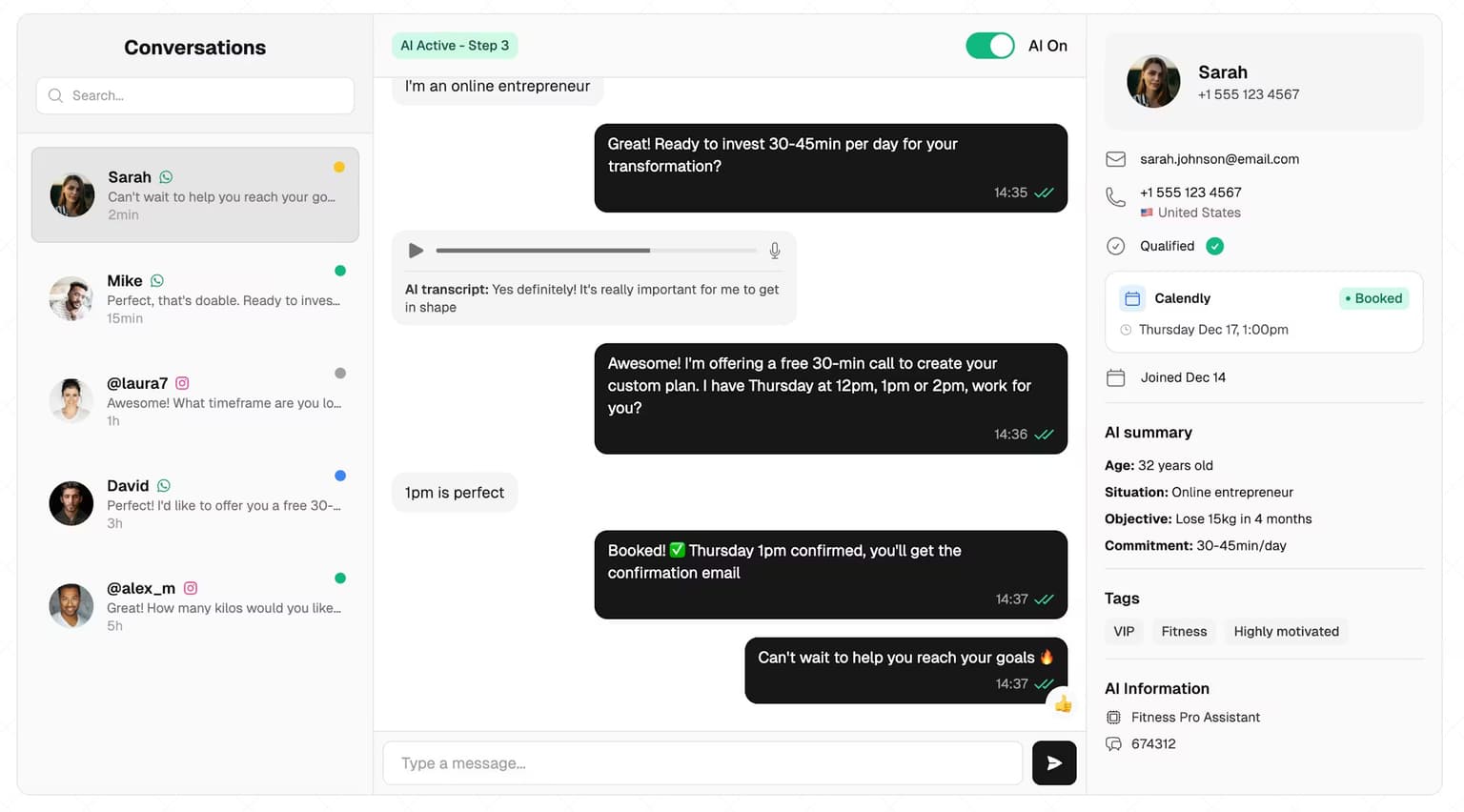
This is why a Flow pairs so well with an AI setter rather than replacing one. The setter carries the messy human part of the conversation across Instagram, WhatsApp, and Messenger, qualifies, and then hands off to the clean structured step. SetSmart is one option built for exactly this: it holds a natural conversation, qualifies the lead, and books the call, responding in under 5 seconds around the clock, which no manual inbox can match. Pricing is a free 7-day trial, then from $97/month, with 1,000 messages included.
If most of your WhatsApp traffic comes from ads, wiring this together with click-to-WhatsApp ads means every click lands in a conversation that qualifies itself before any form appears. And once volume grows, a proper WhatsApp CRM keeps every lead, every Flow submission, and every follow-up organized instead of buried in a phone. For teams comparing builders, tools like ManyChat for WhatsApp add Flows on top of visual automation, and for sending updates to many contacts at once there is a separate WhatsApp broadcast feature. The through-line across our WhatsApp marketing playbook is the same: capture cleanly, but qualify and follow up like a human.
FAQ
What are WhatsApp Flows in simple terms?
WhatsApp Flows are structured, multi-screen forms that open inside a WhatsApp chat. They let a business collect information (a booking, a name, a preference) or complete an action without the person leaving the conversation or visiting an external website.
What is the difference between WhatsApp Flows and a chatbot?
A chatbot sends and receives messages, usually down fixed branches. A Flow is an interactive form the person fills in, with fields like date pickers and dropdowns. Many setups use both: a chatbot or AI setter carries the conversation, and a Flow captures the structured step such as booking a time.
Are WhatsApp Flows free?
The Flows feature itself does not carry a separate license fee, but Flows only run on the WhatsApp Business Platform (the API), which uses conversation-based pricing. The free WhatsApp Business app does not support Flows. See our WhatsApp Business API pricing breakdown for the real numbers.
Can WhatsApp Flows book appointments?
Yes. A dynamic Flow connected to a backend can show live calendar slots and confirm a booking inside the chat. On its own, though, it only captures people who are already ready to book. To qualify leads first and follow up on the ones who go quiet, pair the Flow with an appointment setter or an AI one.
Do WhatsApp Flows replace an AI setter?
No. A Flow is a form, not a conversation. It cannot read a free-text reply, answer questions, handle objections, or decide who is qualified. An AI setter does the human part of the conversation and then uses a Flow or booking link for the clean structured step.
How many screens should a WhatsApp Flow have?
Keep it to one to three screens. Completion rates fall with every additional screen and field, so ask only for what you truly need at that moment, most often a goal, a preferred time, and one contact detail.
Ready to automate your DMs?
Start your free 7-day trial and let AI handle your lead qualification 24/7.
Try SetSmart free