WhatsApp Message Templates That Get Approved (2026)

A WhatsApp message template is a pre-approved message you register with Meta so you can start or re-open a conversation with a lead outside the 24-hour window. Once WhatsApp approves it, you can send it at scale on the WhatsApp Business API: appointment reminders, follow-ups, and re-engagement messages that land in the inbox instead of getting blocked.
The problem is that templates get rejected constantly, and Meta's rejection notes rarely explain why. This guide covers what a WhatsApp message template actually is, the three categories, the approval rules that decide pass or fail, and 12 examples framed for coaches, creators, and agencies who want templates that both get approved and book calls. It is written for people running real DMs, not an ecommerce store blasting order updates.
What is a WhatsApp message template?
Direct answer: a WhatsApp message template is a message format you submit to Meta in advance, and once it is approved you are allowed to send it to a user even when there is no open conversation.
This exists because of the 24-hour customer service window. When a lead messages your business, a 24-hour window opens in which you can reply freely with any text, image, or voice note. These free-form replies are called session messages. The moment that window closes, you can no longer send arbitrary text. To reach that person again, whether it is 25 hours or 25 days later, you must send an approved template.
Templates are a WhatsApp Business API concept. The free WhatsApp Business app does not use them; it ships with greeting messages, away messages, and quick replies instead, which we cover in our WhatsApp Business automated messages guide. The moment you move to the API, usually to run WhatsApp automation at volume or connect an assistant, templates become the gatekeeper for every proactive message you send. If you are not sure whether you need the API at all, our WhatsApp API explainer breaks down who it is really for.
For a coach or agency, this matters more than it sounds. A lead clicks your ad, chats for a few minutes, then goes quiet. The next day you want to nudge them. That nudge is a template, and if it is not approved, it never sends. Templates are how you keep the follow-up alive, and the follow-up is where most of the money is.
The 3 WhatsApp template categories
Every template you submit must be filed under one of three categories. Meta reviews it against that category's policy, so choosing the right one is the single biggest factor in whether it gets approved.
| Category | What it is for | Example |
|---|---|---|
| Marketing | Promotions, offers, invitations, re-engagement, anything that sells | "Doors to the program close Friday, want a spot?" |
| Utility | Updates tied to a specific action the user took: reminders, confirmations, receipts | "Your call with Alex is confirmed for Tuesday 3pm." |
| Authentication | One-time passcodes and login verification only | "Your code is 4821. It expires in 5 minutes." |
The distinction that trips people up is marketing versus utility. A utility template must relate to a transaction or action the user already took: they booked, they paid, they requested something. The moment a template promotes, invites, or nudges someone toward buying, it is marketing, and filing it as utility to dodge the category will get it rejected or reclassified. Meta reads intent, not just wording.
Why does the category matter beyond approval? Because pricing is tied to it. Since Meta moved to per-message pricing in 2025, marketing templates cost the most, utility and authentication cost less, and session replies inside the open 24-hour window are free. The full breakdown is in our WhatsApp Business API pricing guide, but the practical takeaway is simple: never file a genuine utility message as marketing, and never try to smuggle a promotion into a utility template.
How WhatsApp template approval works
Here is the mechanism, start to finish.
You create the template inside your API provider's dashboard or Meta's WhatsApp Manager, choose a category and language, write the body, add optional buttons, and submit it. Meta then reviews it, usually within a few minutes but sometimes up to 24 hours. You get back one of three states:
- Approved — the template is live and you can send it immediately.
- Rejected — it broke a rule; you get a short, often vague reason and must edit and resubmit.
- Paused or disabled — this happens after a template is live if too many recipients block or report it, dragging its quality rating down.
That last point is the one most guides skip. Every approved template carries a quality rating (shown as green, yellow, or red) based on how recipients react. Send a template people find spammy and the rating drops; drop far enough and Meta pauses the template automatically, no matter that it was approved. Approval is the start line, not the finish line. This is the same reputation logic that governs WhatsApp broadcast sending, where blast-and-pray campaigns quietly kill a number's ability to reach anyone.
Variables are the other approval landmine. Templates use placeholders like {{1}} and {{2}} that get filled in at send time (a name, a date, a link). Meta enforces strict formatting: a template cannot start or end with a variable, cannot have two variables next to each other, and the sample values you provide must make the message read like real content, not a test string. Sloppy variables are the quiet reason a lot of "why was this rejected?" templates fail.
What gets your WhatsApp template rejected
Rejections almost always come down to a handful of causes. If you learn these, your approval rate jumps.
- Wrong category. A promotional message filed as utility. Fix: refile it as marketing.
- Variable formatting. Starting or ending with
{{1}}, two placeholders touching, or blank sample values. Fix: wrap variables in real words and add realistic examples. - Placeholder-looking content. Bodies that read like
Hi {{1}}, {{2}}with no real sentence. Meta wants a template that makes sense to a human reviewer. - Grammar and gibberish. Broken sentences, ALL CAPS shouting, or filler text. Fix: write it like a message you would actually send.
- Prohibited content. Anything Meta bans (certain financial, health, or restricted claims). Coaches selling weight-loss or income outcomes should soften absolute promises.
- Abusive URLs or missing context. A bare link with no explanation, or a shortened URL Meta cannot inspect. Use full, branded links.
A useful mental test before you submit: would a stranger reading this cold understand what it is and why they are getting it? If yes, it usually passes. If it reads like a mass blast, it usually does not. The same trust-versus-spam trade-off runs through all of WhatsApp marketing, and earning the WhatsApp green tick verification makes reviewers and recipients treat your number more kindly.
12 WhatsApp message template examples for coaches and creators
Templates beat blank boxes. Here are 12 you can adapt, grouped by job, each written to pass review and to move a lead toward a booked sales call rather than close a deal in chat. Swap the bracketed parts for your own.
Appointment and booking (utility):
Hi Name, your discovery call with Coach is confirmed for day, time. Reply here if you need to move it.
Hi Name, quick reminder your call is tomorrow at time. Here is the link: url. See you then.
Hi Name, you asked about the program a few days ago. I have two call slots open this week, option A or option B. Which works?
Follow-up and re-engagement (marketing):
Hey Name, you started telling me about your goal to outcome and then life got busy. Still want to sort it out? Happy to map a plan on a quick call.
Hi Name, no rush, just checking: are you still looking to outcome this quarter, or should I close your file for now?
Hey Name, I kept a spot for you. If goal is still the plan, want me to send a couple of call times?
Lead nurture and value (marketing):
Hi Name, I put together a short breakdown of the exact steps my clients use to result. Want me to send it over?
Hey Name, a client just hit milestone using the program. If you want the same, reply YES and I will explain how it works.
Offer and deadline (marketing):
Hi Name, onboarding for the next group closes date. If you want in, let's grab 15 minutes so I can check it is a fit.
Hey Name, the offer you asked about is open until date. Want the details or a quick call to talk it through?
Reactivation (marketing):
Hi Name, it has been a while. Your goal to outcome still stands? I have a new approach that is working really well right now.
Hey Name, we never finished our chat. If you are still serious about goal, I would love to help. Two questions and I will point you the right way.
Notice the pattern: each one ends with a question or a single next step, and none tries to hard-sell the offer in the message itself. That is deliberate. On WhatsApp you qualify and book; the close happens on the call, run by you or a closer. Templates open the door, then a real conversation walks the lead through it. For more copy to build from, our WhatsApp automated messages examples and the qualify-then-book logic behind any good DM setter translate directly.
Template pricing: what they actually cost in 2026
Direct answer: templates are not free, and the price depends on the category and where the conversation stands.
Since the 2025 pricing change, Meta bills most template messages per message sent. Marketing templates are the most expensive, utility and authentication cost less, and any reply you send inside the open 24-hour service window (a session message) is free. That is why the smartest setups lean on session messages for the back-and-forth and only spend on a template when they genuinely need to re-open a closed window.
The exact per-message fees vary by country and change over time, so rather than quote numbers that go stale, our WhatsApp Business API pricing breakdown keeps the live figures. The strategy that survives every pricing update is the same: reply fast inside the free window so you rarely need a paid template, and when you do send one, make it a genuinely useful utility message or a follow-up worth the few cents it costs. Speed is the cheapest lever you have, and it is the one most businesses waste.
Free app quick replies vs API templates
A lot of people searching for "WhatsApp message template" actually just want a canned reply in the free app, not the API template system. The two are different tools for different stages.
| Question | Free app quick replies | API message templates |
|---|---|---|
| Needs Meta approval | No | Yes |
| Can message outside the 24h window | No | Yes |
| Sends at scale to many contacts | No | Yes |
| Works on the free Business app | Yes | No |
| Costs money to send | Free | Per message |
Start on the free app quick replies if you handle a small number of chats yourself and just want to answer FAQs faster. Move to API templates when you are running ads, following up with more people than you can track by hand, or need to re-open conversations that have gone cold. Note that the free app cannot schedule a message to a specific contact for later either; scheduled and proactive sending is an API and template job. If you are weighing a flow builder like ManyChat for WhatsApp or want reusable WhatsApp flows, those sit on top of the same API layer.
Turn approved templates into booked calls
An approved template is a door opener, not a closer. It gets your message delivered; what happens after the lead replies is where calls are won or lost. And the second someone answers a template, the 24-hour window reopens and you are back in free session messaging, which is exactly when a real conversation should take over.
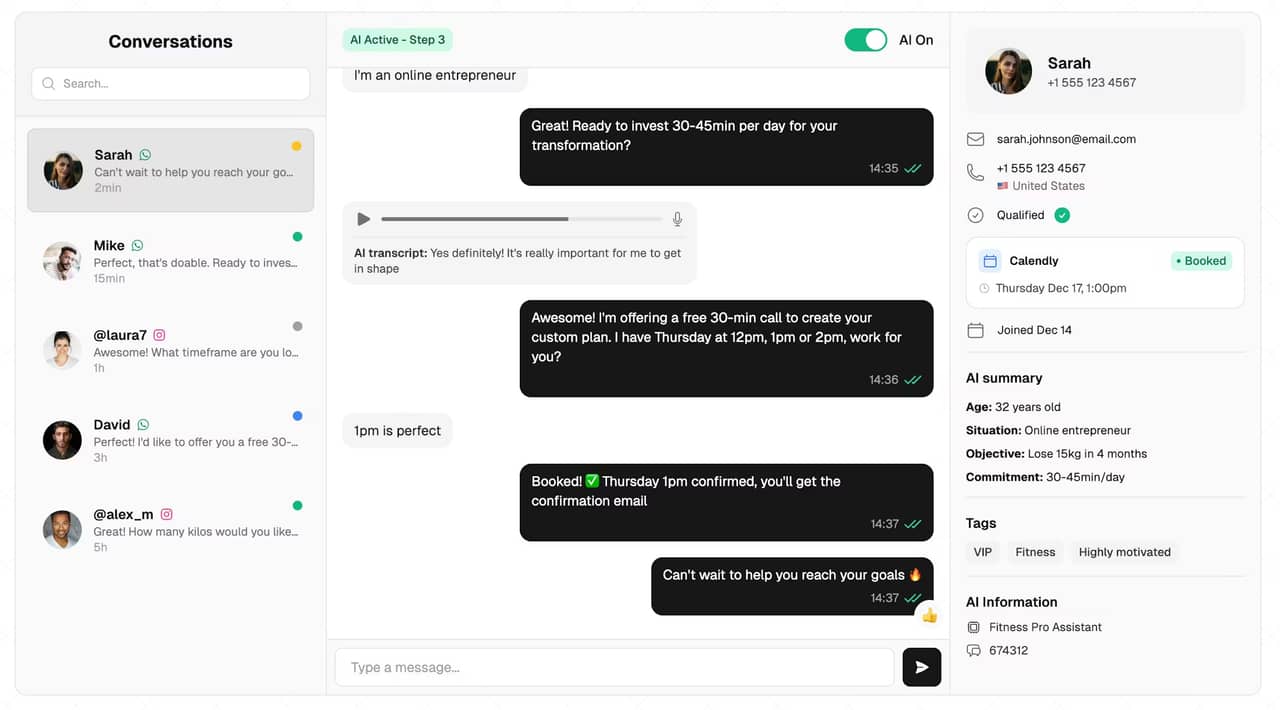
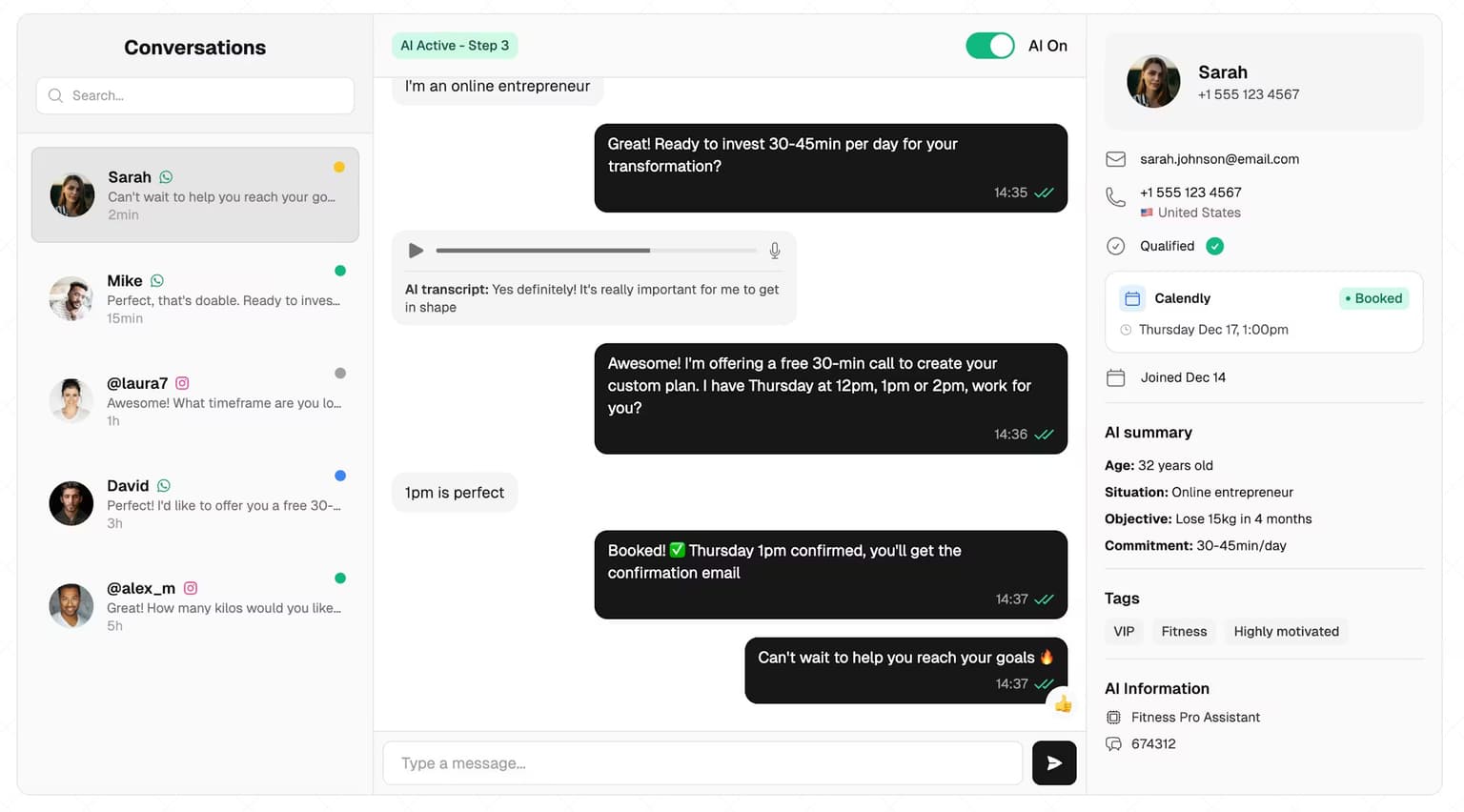
This is where an AI setter earns its place. Instead of a template firing into silence, an assistant:
- Reads the reply and answers in your voice, so a follow-up actually leads somewhere.
- Qualifies the lead with your two or three key questions, like a human setter would.
- Books the call by proposing calendar slots inside the chat once the person is a fit.
- Follows up automatically if the thread goes quiet again, which is where most recovered revenue lives.
That follow-up matters more than most people realize. In our analysis of 828K real Instagram and WhatsApp DM conversations, a single well-timed follow-up more than doubled booked calls (+106%). Templates are what let you send that follow-up once the free window has closed; an AI layer is what makes the reply worth having. This is the difference between a static auto-reply and a WhatsApp chatbot that carries the conversation, and it pairs naturally with click-to-WhatsApp ads so every ad click lands in a chat that qualifies itself. Once you run volume, a proper WhatsApp CRM keeps every lead and every template organized instead of buried.
SetSmart is one tool built for exactly this: it runs on WhatsApp (plus Instagram and Messenger), holds a natural conversation, qualifies, and books, then hands the call to you. It responds in under 5 seconds, around the clock. Pricing is a free 7-day trial, then from $97/month with 1,000 messages included.
FAQ
How do I create a WhatsApp message template?
Open your WhatsApp Business API provider's dashboard or Meta's WhatsApp Manager, go to Message templates, and click Create. Choose a category (Marketing, Utility, or Authentication), set the language, write the body with any {{variables}}, add optional buttons, and submit for review. The free WhatsApp Business app does not use API templates; it has quick replies instead.
How long does WhatsApp template approval take?
Usually a few minutes, but Meta allows up to 24 hours. Simple, clearly written utility templates tend to clear fastest. If a template is stuck for longer than a day, it is often flagged for manual review, which happens more with marketing content.
Why was my WhatsApp template rejected?
The most common reasons are the wrong category (a promotion filed as utility), variable formatting errors (starting or ending with a placeholder, or two variables touching), placeholder-looking content with no real sentence, and prohibited claims. Edit the body so it reads like a genuine message, refile under the correct category, and resubmit.
Can I send a WhatsApp message template for free?
No. Template messages are billed per message under Meta's current pricing, with marketing costing more than utility and authentication. The only free proactive messaging is a session reply sent inside the open 24-hour window after a lead messages you. See our WhatsApp Business API pricing guide for the live figures.
What is the difference between a template and a session message?
A session message is any free-form reply you send within 24 hours of the lead's last message; it needs no approval. A template is a pre-approved message you must use to contact someone once that 24-hour window has closed. Templates open or re-open conversations; session messages carry them.
Can WhatsApp templates include buttons and images?
Yes. Templates support quick-reply buttons and call-to-action buttons (such as a booking URL or a phone number), plus header media like an image or document, within Meta's limits. Buttons are a strong way to turn an approved template into a booked call without making the lead type anything.
Ready to automate your DMs?
Start your free 7-day trial and let AI handle your lead qualification 24/7.
Try SetSmart free