828K AI DM Conversations Analyzed: What Books Calls

In 2011, Harvard Business Review published a now-famous study by James Oldroyd, Kristina McElheran, and David Elkington. Their finding: companies that contacted leads within 5 minutes were 21x more likely to qualify them than those who waited 30 minutes. The average company took 42 hours to respond.
That study — and the "5-minute rule" it created — was based on phone calls and web form submissions. It's been cited thousands of times, and for good reason: it fundamentally changed how sales teams think about speed.
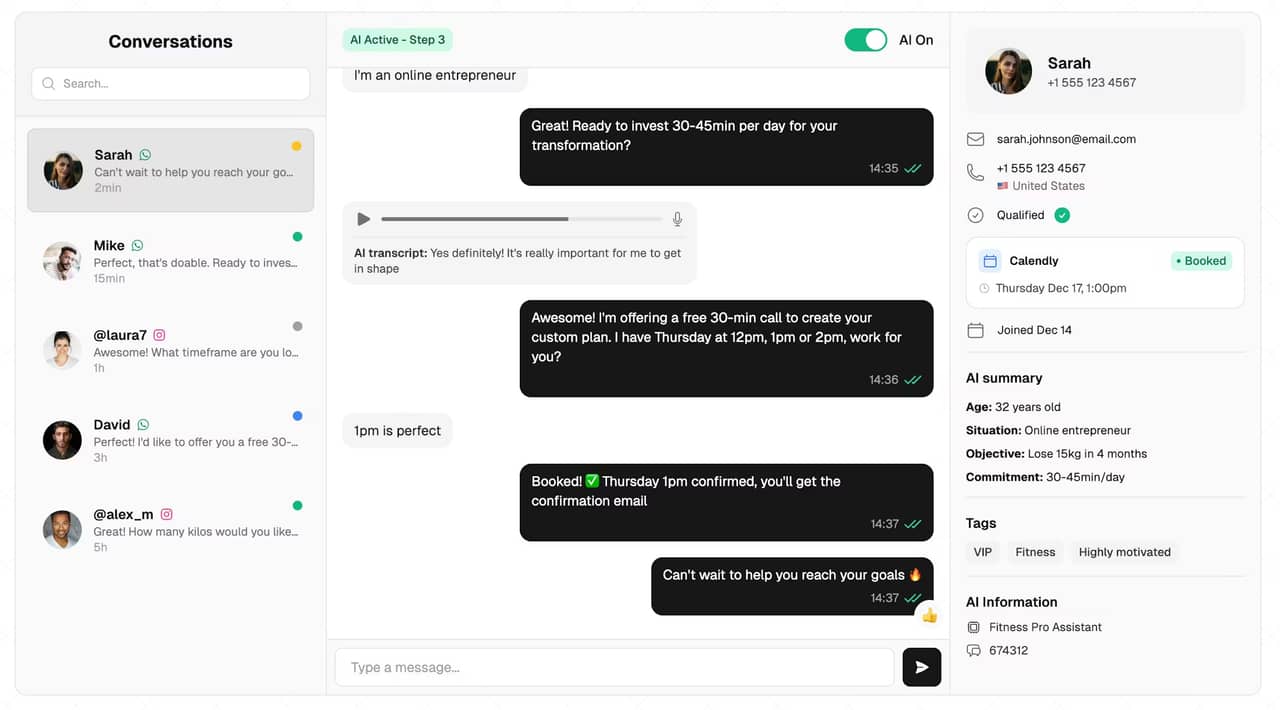
But here's the problem. In 2026, most lead conversations don't happen on the phone. They happen in Instagram DMs and WhatsApp messages. And the first response isn't sent by a human — it's sent by an AI.
We decided the 5-minute rule needed a DM-era update. We analyzed 828,761 AI-powered DM conversations containing over 5.6 million messages, across 391 businesses, spanning 21 months. This is the largest public dataset on AI-driven lead qualification through direct messages, and it underpins our wider analysis of generative AI for sales use cases.
Here's what the data says.
Methodology
All data comes from the SetSmart platform. We analyzed every conversation with at least one message exchanged:
- 828,761 conversations across Instagram DMs and WhatsApp
- 5,603,338 total messages exchanged
- 391 distinct businesses (coaches, consultants, agencies, course creators)
- Time period: July 2024 – March 2026 (21 months)
Key definitions:
- "Qualified" = the AI determined the lead matched the business's target criteria (budget, need, timeline). Tracked consistently across all channels. For a deeper look at how the scoring works in practice (including the BANT lead qualification framework, the specific lead qualification questions we tested across the dataset, the operational 15-step lead qualification checklist, and a DM-friendly variant), see our guide to AI lead qualification, and our 7-step lead qualification process for the end-to-end workflow.
- "Booked a call" = the lead agreed to book a sales call during the conversation. Detected by the AI in real time based on the lead's explicit intent.
- "Message counts" = total messages in the conversation (both AI and lead combined). A "21-message conversation" means roughly 10 back-and-forth exchanges.
Finding 1: 53% of Conversations Die Before Message 3
Before we get to what works, here's the uncomfortable truth: more than half of all AI DM conversations never become real conversations.
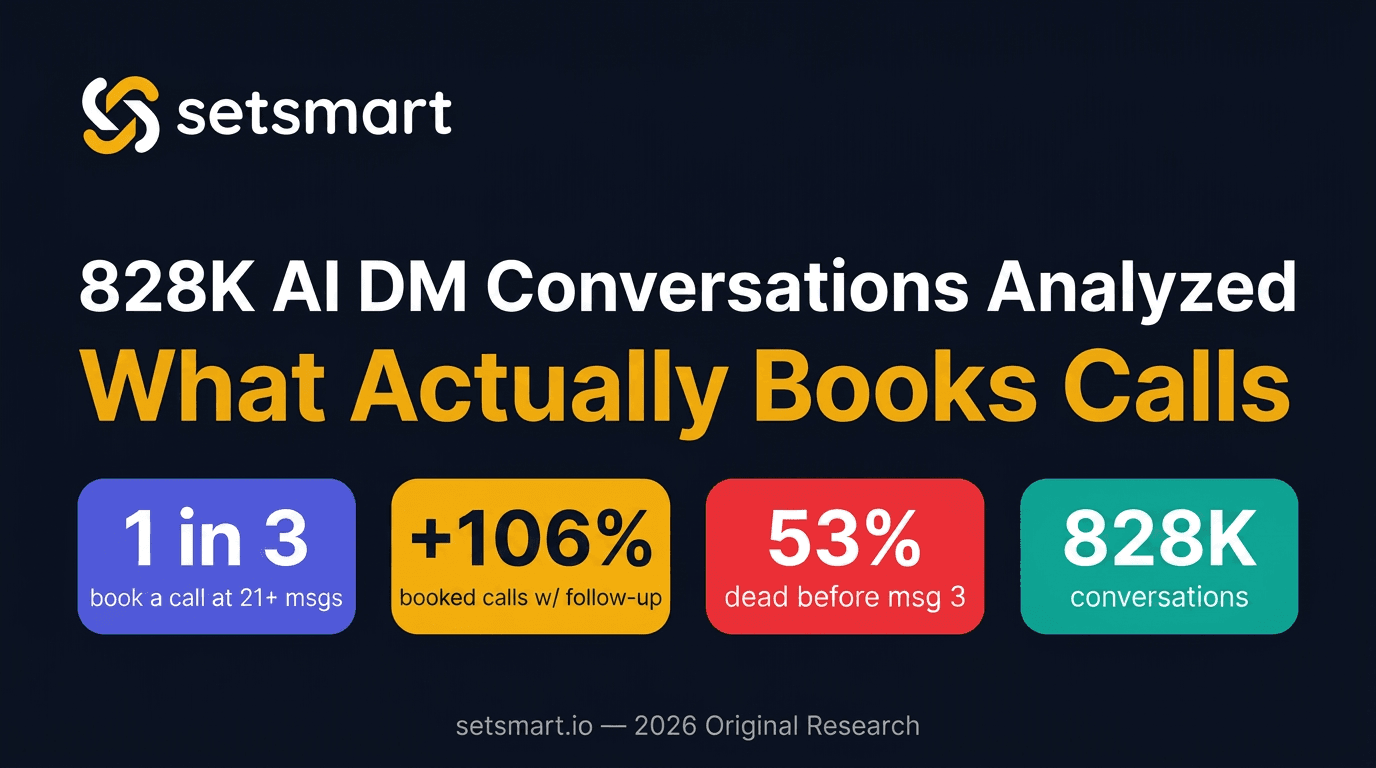
53.3% of all conversations (441K out of 828K) never get past 2 messages. These are outbound WhatsApp messages with no reply, one-word DM responses, or leads who disengage immediately. This is why basic auto-replies don't work for outbound lead qualification — they kill the conversation before it starts.
Only 18.9% of conversations reach the 11+ message zone — where qualification actually happens. Everything in this study is about increasing that 18.9%.
Finding 2: The Full Funnel — From 828K Conversations to 34K Booked Calls
Here's the full funnel across all conversations:
Stage-by-stage conversion:
- 40.3% of conversations get a lead response
- 22.9% of engaged leads qualify
- 44.7% of qualified leads express interest in a call
These numbers represent a blended average across 391 businesses. Top-performing businesses see qualification rates 3–5x higher.
Finding 3: Channel Comparison — Instagram vs WhatsApp
Each channel serves a fundamentally different role in the sales funnel:
| Metric | Instagram DMs | |
|---|---|---|
| Total conversations | 373,042 | 453,175 |
| Qualification rate | 10.85% | 7.87% |
| Qual rate (of engaged) | 17.77% | 33.96% |
| Booked calls rate | 3.84% | 4.36% |
| Booked calls (of engaged) | 6.28% | 18.82% |
| Avg messages (all) | 9.4 | 4.5 |
| Avg messages (qualified) | 25.9 | 22.3 |
| Median msgs to qualify | 23 | 20 |
How each channel works differently
Instagram DMs — Most Instagram conversations are user-initiated. Someone sees a Reel, comments a keyword (comment-to-DM automation), or sends a DM after seeing a Story. The AI responds instantly and starts qualifying. Because the lead initiates, engagement is naturally high. Instagram generates the highest total number of qualified leads (40,490) due to sheer volume — see our breakdown of how the full Instagram lead generation funnel maps onto these stages.
WhatsApp — WhatsApp conversations typically start with an outbound message from the business (via click-to-WhatsApp ads, opt-in forms, or broadcasts, with a Meta per-message fee that we break down in our WhatsApp Business API pricing guide). Only ~23% of recipients respond — but those who do are highly intent-driven. Among WhatsApp responders, 33.96% qualify and 18.82% book a call — 3x Instagram's rate among engaged leads.
Qualification rate by channel (of engaged leads)
Booked calls rate by channel (of engaged leads)
WhatsApp responders qualify at 1.9x the rate of Instagram responders — and book calls at 3x the rate. But Instagram generates more qualified leads in absolute numbers (40,490 vs 35,669) because of its massive volume.
Messages needed to qualify (median)
WhatsApp leads qualify in 13% fewer messages than Instagram leads. WhatsApp conversations tend to be more direct and transactional.
Finding 4: The Magic Number Is 11 Messages — Where Calls Get Booked
The single strongest predictor of whether a lead books a call isn't channel, time of day, or day of week — it's how many messages you exchange.
| Messages Exchanged | Conversations | Booked Calls Rate | Qualification Rate |
|---|---|---|---|
| 1–4 messages | 557,560 | 0.07% | 0.43% |
| 5–10 messages | 114,724 | 1.67% | 8.77% |
| 11–20 messages | 79,860 | 11.25% | 29.30% |
| 21–40 messages | 61,748 | 28.87% | 52.10% |
| 40+ messages | 14,881 | 34.13% | 56.27% |
Booked calls rate by conversation depth
At 1–4 messages, virtually nobody books a call (0.07%). At 11–20 messages (~5-10 exchanges), 11.25% book — a 160x improvement. At 21+ messages (~10+ exchanges), nearly 1 in 3 leads books a call (28.87%). That's a 412x improvement over the 1–4 message group.
The 11-message threshold is the inflection point. Before it, almost no calls get booked. After it, the booking rate climbs rapidly with every additional message.
After 40 messages, the rate plateaus around 34%. If a lead hasn't booked by then, more messages won't change the outcome.
WhatsApp: the 3-message engagement cliff
WhatsApp shows a particularly dramatic engagement pattern:
| Messages | Conversations | Engagement Rate | Qualification Rate |
|---|---|---|---|
| 1–2 | 207,489 | 0.58% | 0.02% |
| 3–6 | 31,680 | 61.27% | 11.39% |
| 7–12 | 13,555 | 97.54% | 29.13% |
| 13–20 | 10,027 | 99.96% | 52.96% |
| 21+ | 14,139 | 99.99% | 68.95% |
The jump from 1–2 messages to 3–6 messages is a 105x improvement in engagement (0.58% → 61.27%). If a WhatsApp lead sends their third message, there's a 61% chance they become a real conversation.
At 21+ messages, 68.95% of WhatsApp conversations result in a qualified lead.
The golden rule: the entire game on WhatsApp is getting past the 3-message threshold. For a full breakdown of WhatsApp strategies, see our WhatsApp automation guide.
Finding 5: Follow-Ups Double Everything
Follow-up messages are automated re-engagement messages sent when a lead goes silent. Among leads who engaged (responded at least once), here's what a single follow-up does:
| Among Engaged Leads | No Follow-Up | With Follow-Up | Improvement |
|---|---|---|---|
| Qualification rate | 19.17% | 40.65% | +112% |
| Booked calls rate | 8.66% | 17.84% | +106% |
Booked calls rate among engaged leads
A single follow-up more than doubles both qualification (+112%) and booked calls (+106%) among engaged leads.
Per channel (among engaged leads)
| Channel | No Follow-Up | With Follow-Up | Improvement |
|---|---|---|---|
| 14.11% | 39.85% | +182% | |
| 31.48% | 42.17% | +34% |
Instagram sees a +182% lift from follow-ups — nearly tripling qualification among engaged leads. This is because many Instagram leads respond once and then go silent; the follow-up pulls them back in.
WhatsApp shows a smaller lift (+34%) because WhatsApp responders are already high-intent.
This is the single easiest optimization for any business using AI DMs. Turn on automated follow-ups. For the practical playbook — timing windows, message patterns, channel-specific rules, and common mistakes — see our complete guide to AI lead follow up.
Finding 6: The 47x Gap — Top Performers vs The Rest
Not all businesses get the same results. Among the 288 businesses with at least 100 conversations, the spread is enormous:
The top 10% of businesses achieve a 31.78% qualification rate and 13.60% booked calls rate. The bottom 25%? Just 0.67% qualification and 0.39% booked calls. Same AI, same channels — wildly different results.
What separates them? The top performers tend to have:
- Well-configured AI with clear qualification criteria
- Follow-ups enabled
- A specific offer (not generic "let's chat")
- Multi-channel presence (Instagram + WhatsApp together)
The bottom performers often have misconfigured AI, no follow-ups, or are sending outbound messages to cold audiences with no warm-up. If you're evaluating tools, our comparison of the best AI setters breaks down what to look for, our roundup of lead qualification tools compares 9 categories side by side, and our Instagram DM bot guide separates Meta-approved tools from ban-risky scrapers.
Finding 7: Timing Barely Matters — Consistency Does
One of the most surprising findings: time of day and day of week have almost no impact on qualification or booked calls.
| Time Block | Booked Calls Rate |
|---|---|
| Evening (6–11pm) | 4.35% |
| Morning (6–11am) | 4.18% |
| Afternoon (12–5pm) | 3.96% |
| Night (12–5am) | 3.87% |
| Day | Booked Calls Rate |
|---|---|
| Sunday | 4.52% |
| Tuesday | 3.71% |
The gap between the best and worst time slot is just 0.48 percentage points. Between the best and worst day, it's 0.81 points. Compare that to the 68x impact of conversation depth or the +113% impact of follow-ups.
The implication: don't overthink timing. Optimize for depth and follow-ups instead. The whole point of AI is that it responds at 2 AM on a Sunday with the same quality as 10 AM on a Monday. That consistency — not timing — is what drives results.
How AI DMs Compare to Traditional Lead Response
The original Harvard Business Review study (2011) found that the average company took 42 hours to respond to a web lead. Only 37% responded within the first hour. These numbers haven't improved much — a 2024 study found the average B2B response time is still 42 hours, and only 12% of companies respond within 5 minutes.
Here's how AI DM conversations compare:
| Metric | Traditional (Industry Data) | AI DM Conversations (This Study) | Source |
|---|---|---|---|
| Average response time | 42 hours | < 5 seconds | HBR (2011) |
| % responding within 5 min | 12% | 100% | LeadChaser (2025) |
| Lead qualification rate | 5–15% | 9.2% (overall), 22.9% (of engaged) | Salesforce |
| Follow-up attempts before giving up | 1.3 | Automated, unlimited | Brevet Group |
The biggest advantage isn't any single metric — it's that an AI setter responds instantly, every time, on every channel, with personalized conversation, and follows up automatically. Traditional sales teams can't match this consistency at scale.
What the 5-minute rule looks like in the DM era
The Harvard study showed that speed matters because leads go cold. In the DM era, AI eliminates the speed problem entirely — response time is measured in seconds, not minutes.
But our data reveals a new dimension the original study couldn't measure: conversation depth. When response time is instant, the differentiator becomes how many messages you exchange. Conversations with 11+ messages are 68x more likely to qualify. A single follow-up message doubles qualification.
The 5-minute rule isn't wrong — it's incomplete. In 2026, the rule should be: respond in seconds, then keep the conversation going. For all the benchmarks in one place, see our lead response time statistics page.
Key Takeaways
Based on 828,761 conversations and 5.6 million messages:
- 53% of conversations are dead on arrival. More than half never get past 2 messages. The entire game is getting leads past the engagement cliff.
- Think in messages, not minutes. Conversation depth is the strongest predictor. 11+ messages = 68x more qualification. 21+ messages = 412x more booked calls.
- Instagram qualifies volume. WhatsApp qualifies intent. Instagram generates 40K qualified leads through sheer volume. WhatsApp responders qualify at 34% — nearly double Instagram's rate.
- Follow-ups double everything. Among engaged leads, a single follow-up doubles qualification (+112%) and doubles booked calls (+106%). On Instagram specifically, it nearly triples qualification (+182%).
- Top 10% of businesses hit 31.78% qualification. Bottom 25% hit 0.67%. Same AI — the difference is configuration, follow-ups, and offer clarity.
- On WhatsApp, get past 3 messages. The engagement cliff between message 2 and message 3 is the biggest drop-off. Once past it, 61% of leads become real conversations.
- Timing doesn't matter. Consistency does. The gap between the best and worst time slot is less than half a percentage point. AI's real advantage is responding the same at 2 AM as at 10 AM.
About This Study
This study was conducted by the SetSmart team using anonymized, aggregated data from the SetSmart platform. No individual conversations, business names, or personal data were used. All metrics are aggregated across the full dataset.
Data snapshot: 828,761 conversations | 5.6M messages | 391 businesses | July 2024–March 2026
For questions about methodology or data, contact contact@setsmart.io.
How to cite this study
If you reference this data, please link back to this page. Here's a suggested citation:
SetSmart. "828K AI DM Conversations Analyzed: What Books Calls." SetSmart Blog, April 2026. https://setsmart.io/blog/ai-dm-conversation-study
Ready to automate your DMs?
Start your free 7-day trial and let AI handle your lead qualification 24/7.
Try SetSmart free