What Is a Business Coach? Costs & Red Flags (2026)

"Business coach" might be the most overused title on Instagram. Scroll for five minutes and you will see a dozen people offering to help you scale, systemize, or finally hit your revenue goal. Some of them are seasoned operators who have built and sold companies. Others started calling themselves a coach last month. From the outside, they look exactly the same.
This guide gives you a plain answer to what a business coach is, what they actually do week to week, how they differ from a consultant or a mentor, and what they charge in 2026 using real rate data rather than guesses. You will also get a list of red flags to check before you hire anyone. In the last part we switch sides: if you are a business coach yourself, we cover how working coaches actually fill their calendar with qualified discovery calls, because coaching well and getting clients are two very different skills.
What is a business coach?
Here is the direct answer: a business coach is a professional who helps a business owner or leader get clear on where the business is going, decide what to work on next, and follow through on it over time. A business coach does not run your company for you. They ask hard questions, bring structure to your decisions, challenge the assumptions holding you back, and hold you accountable to the plan you set together.
The International Coaching Federation, the largest professional body in the field, defines coaching as "partnering with clients in a thought-provoking and creative process that inspires them to maximize their personal and professional potential." A business coach applies that process to the business side of a person's life: revenue, offers, pricing, team, systems, time, and the founder's own decision-making.
The simplest way to picture it: a business coach is to a business owner what a strength coach is to an athlete. The athlete still lifts the weight. The coach designs the program, spots the weak points, corrects technique, and makes sure the athlete shows up on the days they would rather skip. The value comes from structure, an outside perspective, and accountability, not from a secret formula.
Business coaching is also a big and fast-growing profession. ICF's 2025 Global Coaching Study, run with PwC across more than 10,000 respondents, estimates 122,974 coach practitioners worldwide and about $5.34 billion in annual revenue for the profession, with leadership and executive coaching as the largest specialty.
What does a business coach do?
Direct answer: a business coach helps you set the right goals, find the real bottleneck, build a plan to fix it, and stick to that plan. In practice the work falls into five recurring jobs.
- Clarifying direction. Turning "I want to grow" into specific targets: revenue, profit, hours worked, number of clients, or a sale date. Most owners are busy; very few are clear.
- Finding the bottleneck. Is the problem lead flow, conversion, pricing, delivery, cash, or the owner doing everything? A good coach diagnoses before they prescribe, because fixing the wrong constraint wastes a quarter.
- Building the plan. Usually a 90-day plan with a handful of priorities, owners, and deadlines. Coaches push you to cut more than you add.
- Accountability. Weekly or biweekly check-ins on what you committed to and whether it happened. This is the part owners underestimate and the part that produces most of the results.
- Developing the leader. Delegation, hiring, difficult conversations, focus, and the founder habits that cap the business. As the company grows, this becomes most of the work.
What a business coach typically does not do: write your marketing for you, keep your books, manage your team, or guarantee a revenue number. Some coaches blend in hands-on help (more on that in the next section), but if someone promises "I'll double your revenue in 90 days or your money back," you are probably looking at a sales pitch, not a coaching engagement.
What does a business coach do for a small business?
For a small business owner, the coach usually starts with the basics that never got built: a clear offer, pricing that leaves margin, a simple weekly scorecard, and a calendar that protects time for the work only the owner can do. Small business coaching is less about leadership theory and more about getting the owner out of firefighting mode so the business can grow without burning them out.
Business coach vs consultant vs mentor
Direct answer: a consultant finds the answers and often does the work, a business coach helps you find your own answers and execute them, and a mentor shares what they learned from their own experience, often informally and for free. The roles overlap more than people admit: ICF's 2025 research found that 57% of coaches also offer consulting and 49% also deliver mentoring.
| Business coach | Consultant | Mentor | |
|---|---|---|---|
| Who does the thinking | You, guided by questions and frameworks | The consultant, who recommends a solution | You, informed by the mentor's story |
| Who does the work | You | Often the consultant | You |
| Time frame | Ongoing, usually 3 to 12 months | Project-based, ends at delivery | Open-ended, informal |
| Typical cost | Hourly or monthly retainer | Project fee or day rate | Often free |
| Best when | You know roughly what to do but keep not doing it | You need a specialist skill you do not have | You want perspective from someone a few steps ahead |
A useful test: if you want someone to build your sales funnel, hire a consultant or an agency. If you want to become the kind of owner who makes good decisions about funnels, hiring, and pricing without needing outside help forever, hire a coach. If budget is the constraint, a mentor is a strong starting point, and in the US, SCORE offers free mentoring for small business owners.
Business coaching is also different from life coaching, although the skills overlap. A life coach works on goals across your whole life; a business coach keeps the focus on the company and your role in it. If you want the full picture of the broader profession, see our guide on what a life coach does.
What happens in a business coaching engagement
Direct answer: most engagements start with a free or low-cost discovery call, move into an assessment and a 90-day plan, then run on a fixed rhythm of sessions with check-ins in between. Here is what that usually looks like.
- Discovery call. A 20 to 45 minute conversation where the coach learns about your business and goals, and you judge whether you trust them. Good coaches qualify you here as much as you qualify them. (If you are a coach, our guide to running a discovery call breaks this step down.)
- Assessment. Numbers, offer, team, calendar, and a frank look at what has and has not worked. Some coaches use questionnaires or profiling tools; others just ask very good questions.
- The plan. Three to five priorities for the next 90 days, each with a measurable outcome and a deadline.
- Regular sessions. Commonly 60 minutes every week or every two weeks, by video or in person. Each session reviews commitments, works through one or two decisions, and ends with clear next actions.
- Between-session support. Many coaches offer messaging access for quick questions and accountability nudges. In 2026 that increasingly happens on WhatsApp or in Instagram DMs rather than email.
- Quarterly review. What moved, what did not, and what the next 90 days should focus on.
The format varies: one-to-one coaching is the classic model, but group programs, peer advisory boards, masterminds, and intensive "VIP days" are all common. Group formats cost less per person; one-to-one gives you more attention on your specific situation.
Types of business coaches
Direct answer: "business coach" covers several specialties, and the best coaches pick one. The niche determines what they focus on and who they can genuinely help.
| Type of business coach | Typical client | Main focus |
|---|---|---|
| Small business coach | Owner-operators, local businesses | Profit, systems, getting the owner out of daily operations |
| Startup / founder coach | Early-stage founders | Focus, fundraising readiness, first hires, founder resilience |
| Executive / leadership coach | Managers and senior leaders | Leadership, communication, managing teams |
| Business growth coach | Businesses that have plateaued | Marketing, sales process, offer and pricing |
| Industry-specific coach | Dental practices, trades, accountants, financial advisors | Benchmarks and playbooks for one industry |
| Online business coach | Coaches, creators, course sellers, agency owners | Offer, content, Instagram and DM sales process, scaling delivery |
The last row is the fastest-growing corner of the market: coaches who coach other online coaches and creators. Their clients sell programs, memberships, and high-ticket coaching offers, and the playbook they teach is almost always the same: content on Instagram, conversations in the DMs, and sales calls booked from those conversations.
How much does a business coach cost?
Direct answer: most business coaches charge between $95 and $225 an hour, according to CoachVouch's 2026 analysis of 3,335 business coaches, with US coaches at $110 to $250 an hour. Coaches who sell monthly plans in that dataset charge $106 to $600 a month. Premium one-to-one engagements go well beyond that: The Alternative Board puts one-to-one business coaching at $200 to $500 an hour, or $500 to $3,000 or more per month on a retainer.
| Pricing model | Typical range | Source |
|---|---|---|
| Hourly, most business coaches | $95 to $225 an hour | CoachVouch, 3,335 coaches |
| Hourly, US business coaches | $110 to $250 an hour | CoachVouch, 1,613 coaches |
| Monthly plans | $106 to $600 a month | CoachVouch, 59 coaches |
| Premium one-to-one, hourly | $200 to $500 an hour | The Alternative Board |
| Premium one-to-one, retainer | $500 to $3,000+ a month | The Alternative Board |
Why the spread is so wide:
- Experience and proof. A coach who has built a company in your industry, or who can show a track record of client results, charges more than a generalist.
- Format. Group programs and memberships cost far less per person than private coaching. Monthly plans often bundle calls, messaging, and course material, so compare them by the number of live hours you actually get.
- Scope. Some coaches add workshops, templates, done-with-you implementation, or a community. That is closer to consulting and is priced accordingly.
- Outcome-based packaging. Many coaches stopped selling hours and now sell a 3, 6, or 12 month program built around a specific result. That is the logic behind most coaching packages, and at the top of the market it becomes high ticket coaching with programs priced in the thousands.
A practical way to budget: work out what the problem is costing you right now (lost revenue, wasted hours, a bad hire), then decide what a fix is worth. A coach who costs $1,000 a month is cheap if they help you fix a $10,000-a-month leak, and expensive if you never implement anything.
Is a business coach worth it?
Direct answer: a business coach is worth it when you have a clear goal, the business is stable enough to act on advice, and you will actually do the work between sessions. It is not worth it if you are hoping someone else will fix the business for you.
Signs a business coach is a good investment for you:
- You have revenue and customers, but growth has stalled and you cannot see why.
- You know what you should be doing and keep not doing it.
- You are the bottleneck: every decision, every client issue, and every sale runs through you.
- You are about to make a big move (first hire, new offer, price increase, new market) and want a sparring partner.
- You work alone and have nobody to challenge your thinking.
Signs you should wait or choose something else:
- You have no product or customers yet. A course, a mentor, or a free program will teach you the basics for less.
- You need a specific deliverable, like a website or ad campaigns. Hire a specialist.
- You are in a personal crisis. A coach is not a therapist, and the business will not get the attention it needs.
- You cannot afford it without risking your cash flow. Coaching should be paid from the business, not from rent money.
Honest caveat: coaching results are hard to measure, and most return-on-investment figures you see online come from coaching companies themselves. The best evidence is specific: talk to two or three past clients with businesses like yours and ask what changed.
Red flags when hiring a business coach
"Business coach" is not a protected title in most countries. Anyone can print it on a business card tomorrow, which is why vetting matters. ICF's 2025 research found that 73% of coaches agree clients and organizations expect them to hold a certification or credential, but a credential alone does not prove someone can help your specific business.
Watch for these red flags:
- Guaranteed income claims. "Six figures in 90 days" is a marketing hook, not a promise anyone can keep.
- No business of their own outside coaching. A coach whose only business success is selling coaching may struggle to help you run a restaurant or an agency.
- Lifestyle-first marketing. Rented cars and screenshots of Stripe dashboards say little about how they coach.
- Pressure on the sales call. "This price is only valid today" or pushing you into financing you clearly cannot afford.
- Vague process. If they cannot explain what the first 90 days look like, they probably do not have a process.
- No references. Good coaches will happily connect you with past clients.
- One-size-fits-all program. The same course and the same scripts for every client, regardless of business model.
Questions worth asking on the discovery call:
- What kinds of businesses do you usually work with, and at what stage?
- What does a typical engagement look like, from week one to month three?
- How do we measure whether this is working?
- What happens between sessions if I get stuck?
- Can I speak to two clients whose businesses look like mine?
- What is your training or background, and which credentials do you hold?
How to become a business coach
Direct answer: you do not need a license to become a business coach, but most credible coaches combine real business experience with formal coach training and, increasingly, an ICF credential. The path usually looks like this: pick a niche you know well, complete a coach training program, coach your first clients, then build a repeatable way to find new ones.
ICF offers three main credentials, and the requirements scale with experience:
| ICF credential | Coach education | Coaching experience | Mentor coaching |
|---|---|---|---|
| ACC (Associate Certified Coach) | 60+ hours | 100+ hours (75 paid), 8+ clients | 10 hours |
| PCC (Professional Certified Coach) | 125+ hours | 500+ hours (450 paid), 25+ clients | 10 hours |
| MCC (Master Certified Coach) | 200+ hours | 2,500+ hours (2,250 paid), 35+ clients | 10 hours |
Each credential also requires a performance evaluation and an exam, and renews every three years with continuing education. Notice what the table implies: you need paying clients to earn the credential, so client acquisition is part of the job from day one, not something you figure out after certification.
If you are starting from scratch, our guide on how to start an online coaching business covers niche, offer, and pricing. Keep in mind that coaching income tracks the number of clients you can sign, not the title on your website.
How business coaches get clients in 2026
Here is the part most "what is a business coach" articles skip. ICF's 2025 research found that 59% of coaches expect to earn more next year, and they expect that growth to come from more clients and more sessions, not from higher fees. In other words, the main lever on a coach's income is client acquisition. Being a great coach does not fill a calendar on its own.
For most online business coaches, the acquisition engine looks like this:
- Attract. Post content on Instagram (or run ads) that speaks to one painful problem your ideal client has: stuck at a revenue plateau, working 70-hour weeks, no repeatable sales process.
- Start the conversation. Turn interest into a DM with a comment keyword, a story reply, or a link in bio. This is where a follower becomes a lead.
- Qualify. Find out whether they have the business stage, the budget, and the urgency your program needs. Many people who DM you are curious, not ready.
- Book the call. Get qualified leads onto a discovery or sales call, because business coaching offers are sold in a real conversation, not in the chat.
- Close on the call and deliver. You (or your closer) sell the program on the call, then coach.
The full version of that system is in our playbooks on how to get coaching clients and how to market your coaching business, and the step-by-step structure is mapped out in our sales funnel for coaches guide.
Where the funnel breaks
The bottleneck almost always sits between steps 2 and 4. A post performs, 40 DMs land overnight, the coach answers some of them the next afternoon, half the leads have moved on, and the ones who reply get a booking link with no qualification at all. The calendar fills with calls that go nowhere while serious buyers wait. That is not a coaching problem. It is a response-time, qualification, and follow-up problem.
These are the questions a business coach typically needs answered in the DM before offering a call:
| What you need to know | Example DM question |
|---|---|
| Business stage | "What do you sell, and roughly where is the business at month to month?" |
| The real problem | "What feels like the biggest thing holding growth back right now?" |
| Goal and timeline | "Where do you want the business to be in 6 months?" |
| Readiness to invest | "Are you open to investing in support to get there if it's the right fit?" |
| Next step | "Sounds like a call makes sense. Here are a few times this week." |
For ready-made wording, our Instagram DM scripts cover openers, qualification, and follow-ups you can adapt to a business coaching offer.
Where an AI setter fits
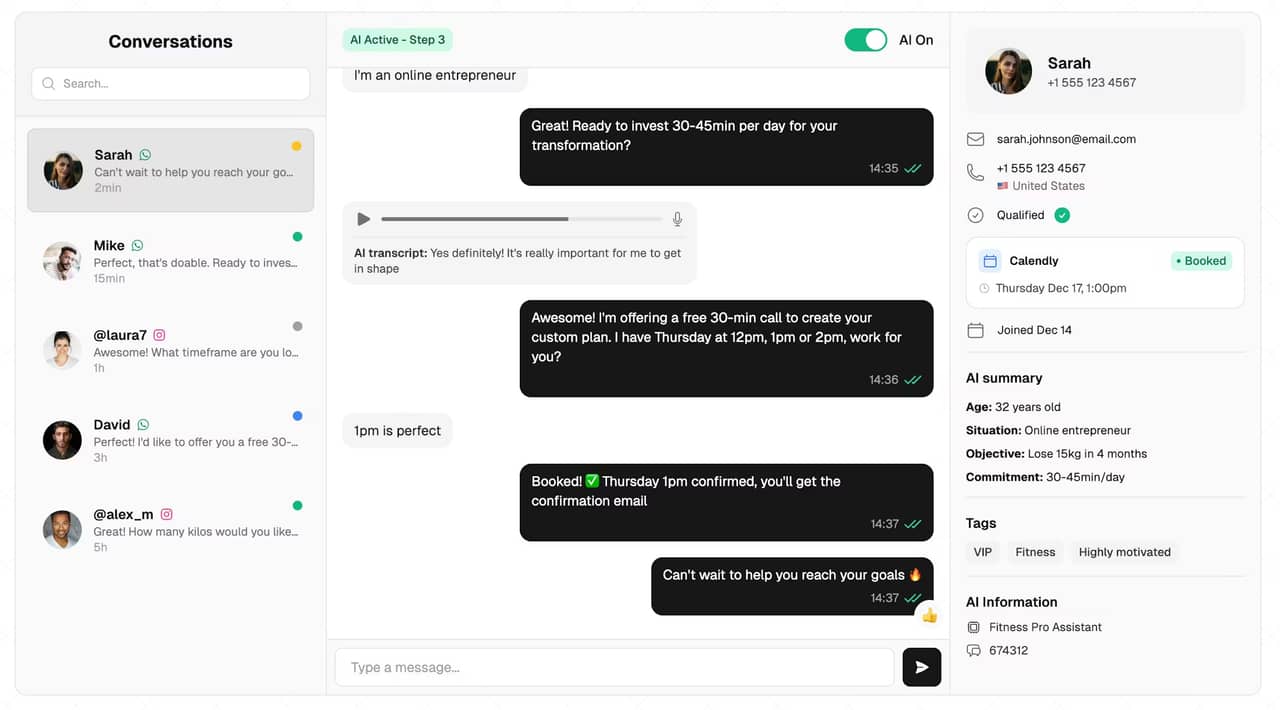
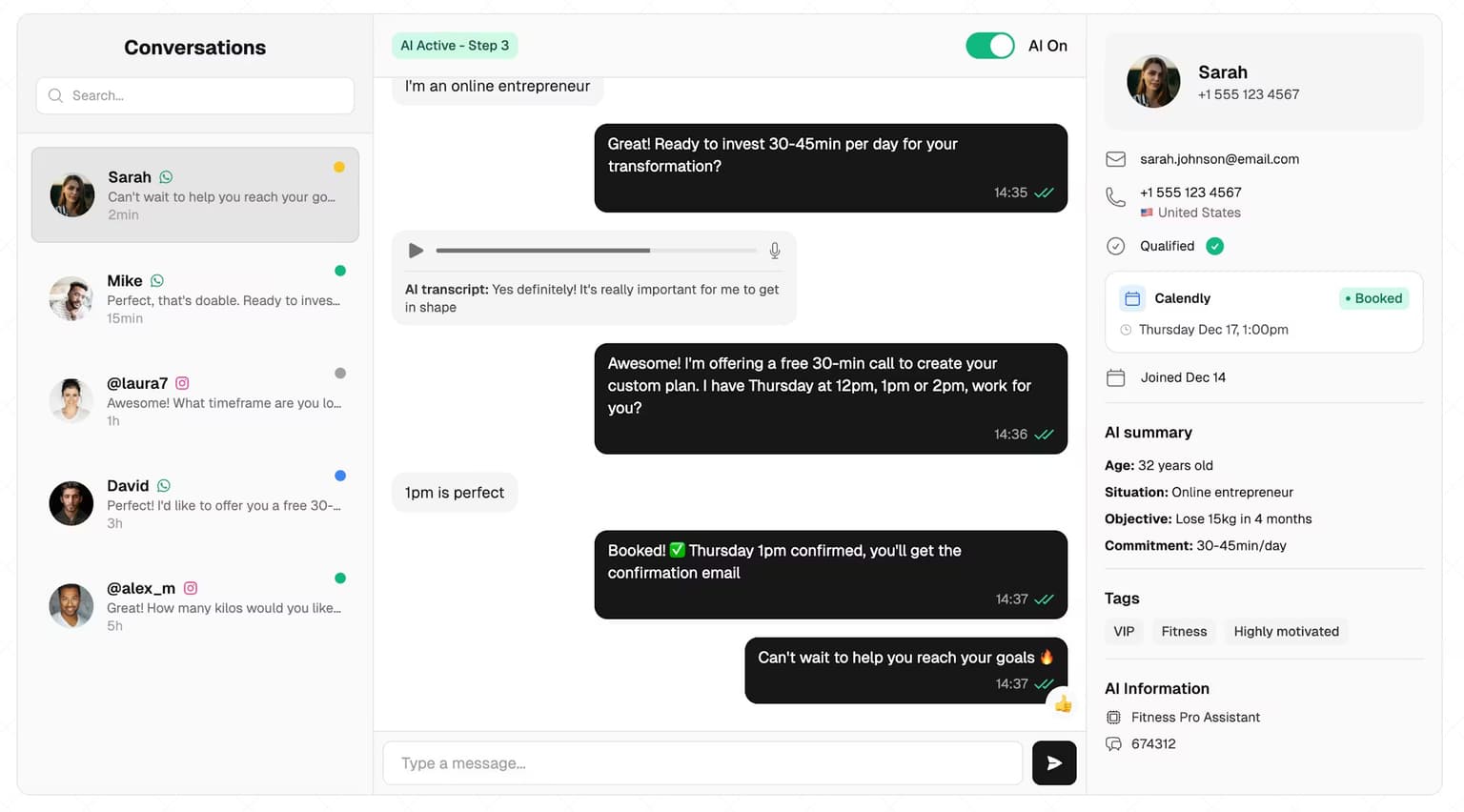
This is exactly the gap an AI setter fills. SetSmart answers every Instagram and WhatsApp DM in seconds, asks your qualifying questions in your tone of voice, follows up with leads who go quiet, and books the qualified ones straight into your calendar through Calendly, Cal.com, iClosed, or GoHighLevel, without sending a link for them to forget. It works like a full-time appointment setter that never takes a day off. If you are still picking a booking tool, our comparison of scheduling software for coaches shows which ones support in-chat booking.
"I book 15 to 25 calls per week... without managing a single setter." Mathis Ladoué, Online Fitness Coach, 22.4K followers
To be clear about the boundary: the AI qualifies and books, it does not close your coaching program in the DM. The sale still happens on the call, coach to client. SetSmart's job is to make sure the people on your calendar are the right people, and that nobody who was ready to talk slipped through the cracks while you were busy coaching.
FAQ
What does a business coach do exactly?
A business coach helps an owner or leader clarify goals, identify the main bottleneck in the business, build a focused plan (usually 90 days at a time), and stay accountable to it. They work through questions, frameworks, and regular check-ins. Unlike a consultant, they do not usually do the work for you.
How much should I pay for a business coach?
Most business coaches charge $95 to $225 an hour, with US coaches at $110 to $250, based on CoachVouch's analysis of 3,335 coaches. Monthly plans commonly run $106 to $600, while premium one-to-one retainers range from $500 to $3,000 or more a month. Compare offers by live hours and by the specific outcome they target.
Is it worth having a business coach?
It is worth it when you have an existing business, a clear goal, and the discipline to implement between sessions. It is rarely worth it before you have customers, or when what you really need is a specialist to deliver a project. Ask for references from past clients whose businesses resemble yours.
How much money do business coaches make?
Income depends far more on client volume and pricing model than on credentials. A coach charging $200 an hour with 10 hours of client work a week earns a very different living from one selling a $5,000 program to four clients a month. ICF's 2025 research shows most coaches expect future growth to come from more clients rather than higher fees, so client acquisition is the key driver.
How do I get certified as a business coach?
No certification is legally required, but the most recognized credentials come from the International Coaching Federation. The entry-level ACC requires 60+ hours of coach education, 100+ hours of coaching experience (75 paid), 10 hours of mentor coaching, a recorded session evaluation, and an exam. PCC and MCC raise those thresholds.
What is the difference between a business coach and a consultant?
A consultant diagnoses the problem, recommends the solution, and often implements it for a project fee. A business coach helps you reach your own decisions and holds you accountable over months. Many coaches blend both, so ask upfront how much hands-on work is included.
Knowing what a business coach does is the easy part. Building the pipeline that keeps your calendar full is where most coaches get stuck. SetSmart answers your Instagram and WhatsApp DMs in seconds, qualifies each lead the way you would, and books the ready ones straight onto your calendar. Free 7-day trial, then from $97/month, or see the full pricing.
Ready to automate your DMs?
Start your free 7-day trial and let AI handle your lead qualification 24/7.
Try SetSmart free