High Ticket Coaching: The 2026 DM-to-Call Playbook

High ticket coaching is how a solo coach turns a small, engaged audience into a real business: instead of selling a $47 ebook to hundreds of people, you sell a $5,000 transformation to a handful of the right ones. The math is friendlier, the clients are more committed, and the whole thing runs on conversations, most of them happening in your Instagram and WhatsApp DMs.
This is the exact model most of the coaches we work with use, and it is also the most misunderstood. Search "high ticket coaching" and you get a wall of hype, a few "is this a scam?" threads, and very little on the part that actually decides whether you eat: the system that fills your calendar with qualified sales calls. This guide fixes that. We will define high ticket coaching honestly, cover the best niches and price ranges, and then walk through the DM-to-call funnel that turns followers into booked calls.
What is high ticket coaching?
High ticket coaching is a premium coaching program, usually priced from $2,000 to $25,000, that a client commits to after a real conversation rather than an impulse click. Instead of a cheap course the buyer consumes alone, they get a structured program with a clear promise, direct access to you or your team, and accountability over several weeks or months.
The "high ticket" part is not about charging more for the sake of it. It is about pricing for an outcome. A weight-loss coach who guarantees a plan, weekly check-ins, and support for twelve weeks is selling a result, not a PDF. Because the price is high, nobody buys it from a link in a bio. They buy it after a booked sales call where you understand their situation and they trust you to deliver.
That single fact shapes everything else. Your content exists to start conversations. Your DMs exist to qualify and book. The call exists to close. If you try to collapse those steps, sell a $5,000 program straight from a story link, or "close in the DM", conversion falls off a cliff. High ticket coaching is a conversation business, and the conversation is where most coaches lose the deal.
Why coaches move to a high ticket coaching model
The pull toward high ticket coaching is simple: fewer clients, more income, deeper results. If your offer is $5,000, you need two clients a month to clear six figures a year. If your offer is a $97 course, you need dozens of sales every single month, plus the traffic to feed them. For a solo coach with a few thousand followers, the premium path is usually the faster one to a stable income.
There are three reasons the model works so well for the online coach avatar:
- Better clients. People who invest $5,000 show up, do the work, and get results, which gives you the testimonials that sell the next round.
- Simpler operations. A dozen committed clients is easier to serve well than five hundred course buyers who need constant support and refunds.
- Room to actually coach. Premium pricing buys back your time, so you can deliver a real transformation instead of drowning in low-value tasks.
The catch is demand generation. A high ticket coaching business lives or dies on a steady flow of booked sales calls, and that flow has to come from conversations you can only partly do by hand. This is where most coaches stall, and where the Instagram DM funnel does the heavy lifting. Before you obsess over the offer, it helps to nail the basics of client acquisition covered in how to get coaching clients.
The best high ticket coaching niches in 2026
The best high ticket coaching niches share three traits: a painful, expensive problem, a buyer who can pay, and a result you can point to. You do not need a huge market. You need a specific person with a problem they are motivated to solve now.
Here are niches that consistently support premium pricing for online coaches:
| Niche | Example transformation | Typical price range |
|---|---|---|
| Weight loss & nutrition | Lose 20-40 lbs and keep it off with a personalized plan | $2,000 - $6,000 |
| Online fitness coaching | Custom training and habits over a 12-16 week block | $2,500 - $5,000 |
| Business & sales coaching | Add a repeatable path to consistent monthly revenue | $5,000 - $15,000 |
| Career & executive | Land a promotion or a higher-paid role in 6 months | $3,000 - $12,000 |
| Agency & creator growth | Done-with-you system to sign and keep clients | $3,000 - $10,000 |
Notice the pattern: each promise is specific and measurable. "Feel better" does not sell for $5,000. "Lose the same 15 pounds you have lost three times before, for good, in twelve weeks" does. If you coach in the fitness world, the niche-by-niche breakdown in our fitness marketing playbook shows how to sharpen that promise for a specific avatar.
How to build a high ticket coaching program
A high ticket coaching program is not "more calls with me". It is a packaged path from where the client is now to the outcome you promised, with your support built in. Build it around the transformation, then decide what has to happen for the client to get there.
Use this simple structure for a high ticket coaching business model:
- The promise. One clear outcome for one clear person. This is the headline your whole program earns.
- The method. Your step-by-step path to the outcome, broken into phases the client can see progress against.
- The delivery. The mix of 1:1 calls, group calls, messaging support, and resources that fits your time and their needs.
- The proof. Milestones and check-ins so both of you can see the result taking shape, which fuels renewals and referrals.
- The container. A fixed length (8, 12, or 16 weeks is common) so the program has a beginning, a middle, and a graduation.
The most common early mistake is over-delivering on access and under-delivering on outcomes. You do not need to be available 24/7. You need a program that reliably produces the result. If you are still shaping the actual product, our guide on building a high ticket offer covers the offer mechanics in depth, and how to start an online coaching business walks through the foundations. To pick the tech stack that hosts your program, compare the best online coaching platforms.
How to price high ticket coaching
Price high ticket coaching for the value of the outcome and the depth of support, never for your time. A client paying $6,000 is not buying 12 hours of calls. They are buying a result that is worth far more than $6,000 to them, delivered with less risk than doing it alone.
A practical way to set your first premium price:
- Anchor on the outcome's value. If your program helps a business owner add $50,000 a year, $6,000 is an easy return. If it helps someone finally get healthy, price the peace of mind, not the hours.
- Pick a number you can defend on a call. Your price has to survive the sentence "so it is six thousand dollars". If you flinch, lower it slightly until you do not, then raise it as your proof stacks up.
- Offer one or two tiers, not five. A core program and a premium (more access, faster results) version is plenty. Too many options stall the decision.
Payment plans help serious buyers say yes, but keep them tight (2 to 4 installments) so you are not financing hesitation. As your results and waitlist grow, raise the price. Coaches almost always underprice at the start, then discover that a higher price attracts more committed clients, not fewer. For the mechanics of the actual close, the high ticket closing playbook covers the setter-closer model and the call itself.
The high ticket coaching funnel: from DM to booked call
Here is the part most "high ticket coaching" articles skip. A great offer with no demand is a hobby. The funnel that feeds a premium program is a conversation funnel, and for online coaches it runs through the DMs. The whole point is to move a stranger, one step at a time, to a booked sales call.
| Stage | Job to be done | Where it happens |
|---|---|---|
| 1. Attract | Get the right person watching | Reels, carousels, stories for one avatar |
| 2. Capture | Turn attention into a DM | Comment-to-DM, story replies, "DM me the word" |
| 3. Qualify | Confirm they are a fit for a premium program | A few natural questions in the DM |
| 4. Book | Get the sales call on the calendar | Offer a slot, confirm, send a reminder |
| 5. Close | Make the offer and enroll the client | Live on the sales call, human to human |
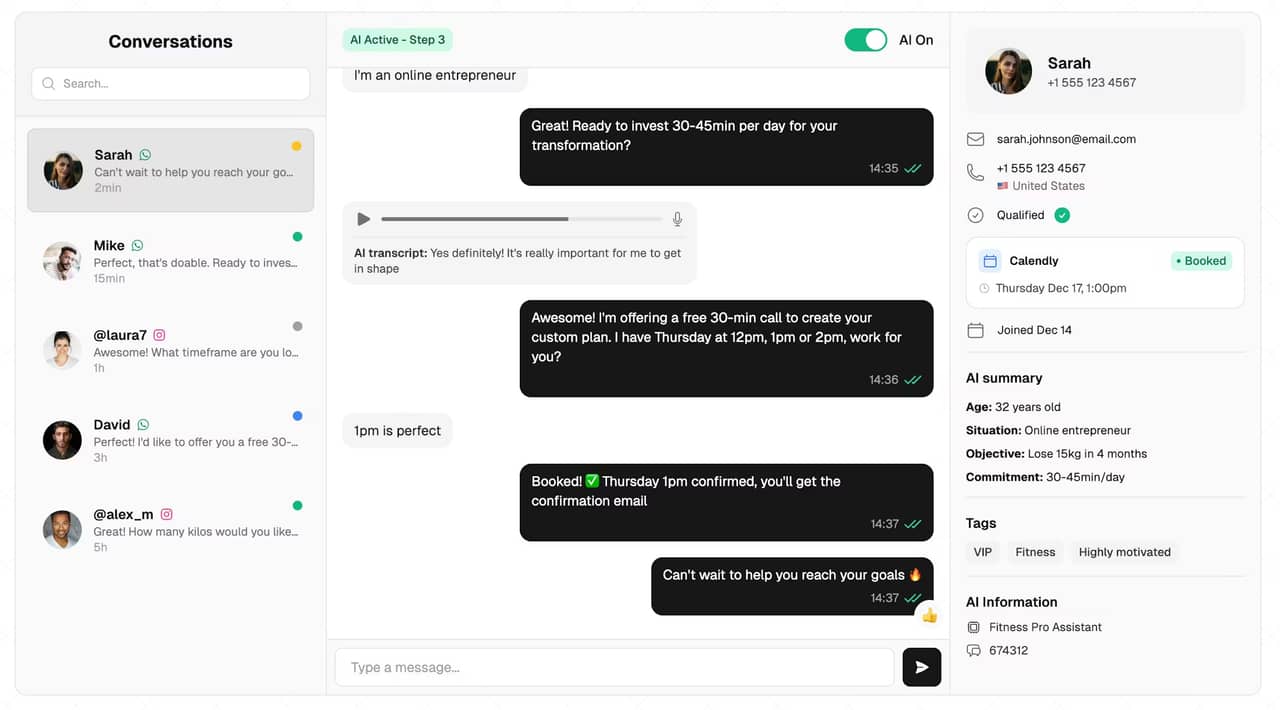
Four of the five stages happen before the call, and most of them live in the inbox. That is why response speed and follow-up matter so much for premium offers. The lead who asked about your program at 9pm has cooled off by the time you reply between client sessions the next afternoon. In our analysis of 828K DM conversations, one well-timed follow-up more than doubled booked calls, yet most coaches never send it because they are busy coaching.
To build this funnel, your content needs one concrete call to action ("comment GO", "DM me PLAN"), and your capture layer needs to fire instantly. The trigger mechanics live in our Instagram DM automation guide, and the words to use once the thread opens are in our Instagram DM scripts. If you sell into WhatsApp, the same logic applies through WhatsApp automation.
How to sell high ticket coaching without closing in the DM
You do not sell high ticket coaching in the DM. You qualify and book in the DM, and you sell on the call. Trying to explain a $5,000 program over text is how coaches talk themselves out of deals: the price lands with no context, no rapport, and no chance to handle the real objection.
The DM has one job before the call: figure out whether this person is a fit, and get the serious ones onto your calendar. A clean qualifying flow looks like this:
- Acknowledge and open. Reply fast, reference what they asked about, and ask one easy question.
- Qualify gently. Two or three questions about their situation, goal, and readiness. Enough to know if a call is worth both your time.
- Invite to the call. For a fit, propose the call as the next step: "The best way to see if this is right for you is a quick call. Want me to send a couple of times?"
- Book and confirm. Lock the slot, confirm it, and set a reminder so the call actually happens.
This is exactly what a DM setter does, whether that setter is a person or an AI. The role is appointment setting, not closing. The close stays human, on the call, where premium buyers actually decide. If you want the deep version of the setter-to-closer handoff, the appointment setter guide breaks down each side, and the AI setter pillar explains how the whole system fits together across channels.
Tools that run a high ticket coaching funnel
The bottleneck in a high ticket coaching business is rarely the offer. It is the number of conversations you can personally answer, qualify, and follow up while also delivering the coaching. Every hour you spend chasing replies is an hour you are not on a paid call. This is why the coaches who scale premium programs lean on automation for the top of the funnel and keep themselves for the close.
Here is where the layers fit:
- Content and scheduling tools get the right people watching.
- Capture automation (comment-to-DM, keyword and story triggers) turns attention into DMs instantly, covered in how to automate Instagram DMs with AI.
- An AI setter qualifies leads in natural conversation and books the sales call, then handles the follow-ups that most coaches forget.
- A calendar and CRM keep the booked calls and the pipeline organized.
This is the layer SetSmart handles. It is an AI setter for Instagram, WhatsApp, and Messenger that holds real conversations, qualifies leads against your criteria, books the sales call directly in the chat, and follows up automatically, so your calendar fills while you coach. It responds in seconds instead of hours, works around the clock, and never forgets a follow-up. Pricing is a free 7-day trial, then $97/month including 1,000 messages, with usage-based pricing above that. The close still belongs to you on the call; SetSmart just makes sure the calls are there to close. As your program grows, the tactics in how to grow your online coaching business help you turn a full calendar into a repeatable machine.
Common high ticket coaching mistakes to avoid
Most high ticket coaching failures are not offer problems. They are conversation and consistency problems. Avoid these and you are ahead of the majority:
- Pricing on time, not outcome. If you sell hours, you cap your income and invite haggling. Sell the result.
- Trying to close in the DM. Text kills premium deals. Qualify and book; close on the call.
- Slow replies. Interest is perishable. A lead who waits hours for an answer often books with someone faster.
- No follow-up. The single highest-leverage habit in the whole funnel, and the one coaches skip most.
- A vague promise. "Transform your life" does not book calls. A specific, measurable outcome does.
- A too-small audience with no capture. You do not need more followers as much as you need a reliable way to turn the ones you have into conversations.
Fix the conversation layer first. A steady stream of qualified sales calls covers a lot of other sins, and it is the one thing a solo coach can systematize with the right setup. Coaches in the softer-skills space can adapt the same funnel using our guide on how to get life coaching clients.
FAQ
What is high ticket coaching?
High ticket coaching is a premium coaching program, usually priced from $2,000 to $25,000, that clients commit to after a booked sales call rather than an impulse purchase. It bundles a method, direct coaching or support, and accountability into a structured program with a clear, measurable outcome.
What are the best high ticket coaching niches?
The best niches pair a painful, expensive problem with a buyer who can pay: weight loss and nutrition, online fitness, business and sales coaching, career and executive coaching, and agency or creator growth. Specificity beats size, so one clear avatar with an urgent problem outperforms a broad market every time.
How much should I charge for high ticket coaching?
Most coaches treat $2,000 and up as high ticket, with premium programs commonly landing between $3,000 and $15,000. Price for the value of the outcome and the depth of support, pick a number you can defend on a call, and raise it as your proof and waitlist grow.
Can you sell high ticket coaching on Instagram?
Yes, but you sell it through Instagram, not inside a single DM. Use content to start conversations, move interested people into your DMs, qualify and book a sales call there, then make the offer live on the call. Instagram is where the pipeline starts; the call is where premium buyers decide.
Is high ticket coaching a scam?
High ticket coaching is a legitimate business model, but the label attracts hype and low-quality programs, which is why skepticism is fair. A real program has a specific promise, a clear method, honest proof from past clients, and support that actually produces the outcome, not just a flashy price tag and pressure to buy.
How do I get more sales calls for my high ticket coaching program?
Give your content one clear call to action, reply to every DM fast, qualify each lead with a few questions, and follow up the ones who go quiet. Doing all of that by hand while coaching is why most calendars stay half full, so many coaches use an AI setter to answer, qualify, and book calls automatically.
Ready to automate your DMs?
Start your free 7-day trial and let AI handle your lead qualification 24/7.
Try SetSmart free