Life Coach Salary 2026: What They Really Earn

Ask ten sources what a life coach makes and you will get ten different answers, from $33,000 a year on one salary tracker to $150 an hour on a coaching school's website. Both can be true at the same time, which is exactly why the "life coach salary" question is so confusing. The number on a job board and the number a booked-out private coach earns are measuring two completely different careers.
This guide cuts through the noise. We will look at what the real data sources actually say, explain why the averages are almost useless on their own, break down income by niche and certification, and then get to the part that decides your paycheck: not your credential, but how many qualified sales calls you can put on your calendar each month. If you already coach and want the client side, pair this with our guide on how to get life coaching clients.
How much does a life coach make in 2026?
Here is the direct answer: most life coaches in the United States earn somewhere between $30,000 and $70,000 a year, salary trackers cluster the average in the high-$60,000s, and a smaller group of specialized, well-positioned coaches earn well into six figures. The spread is enormous because "life coach" is not a regulated job title with a fixed pay band. It is a business, and business income depends on your offer, your niche, and your sales pipeline.
A few reference points from public data:
- ZipRecruiter puts the U.S. average around $67,000 a year, with state-level averages dropping into the low $30,000s in some markets.
- Job-board trackers that lean on employed postings (like Indeed) tend to report lower base figures, often in the $30,000 to $45,000 range, because they capture salaried roles at wellness centers and corporate programs rather than private practices.
- The International Coaching Federation Global Coaching Study has pegged average annual revenue for North American coach practitioners in the low-to-mid $60,000s.
- Established private coaches routinely charge $100 to $250 an hour, and package their work into multi-session programs priced from roughly $1,500 to $5,000 per client.
Notice how those figures do not really agree. That is the whole story of the life coach salary question, and it is worth understanding before you anchor on any single number.
Life coach salary by source: why the numbers disagree
Direct answer: the sources disagree because they measure different populations. Salary aggregators mostly capture employed coaches with a paycheck, while the coaches earning the most are self-employed and their income never shows up as a "salary" at all.
| Source | What it measures | Typical figure reported |
|---|---|---|
| ZipRecruiter | Aggregated postings and self-reported pay | ~$67,000 / year (U.S. average) |
| Indeed | Mostly salaried, employed roles | ~$30,000 to $45,000 base |
| ICF Global Coaching Study | Coach practitioner revenue | Low-to-mid $60,000s (North America) |
| Private practice rate cards | Hourly and per-program pricing | $100 to $250 / hour, $1,500 to $5,000 / client |
There is one more wrinkle that skews everything: the U.S. Bureau of Labor Statistics does not track "life coach" as its own occupation. Coaches get folded into broader buckets, so the tidy government number that exists for nurses or teachers simply does not exist here. Every figure you see is an estimate stitched together from job boards, surveys, and self-reporting. Treat them as rough context, not as a ceiling on what you can earn.
Employed vs self-employed: two very different incomes
The single biggest reason for the salary gap is employment type, and it deserves its own section because it changes the entire calculation.
An employed life coach works for a company: a corporate wellness program, a health clinic, a coaching franchise, or a school. They get a steady paycheck, usually in the $35,000 to $55,000 range, plus benefits and no responsibility for finding clients. The trade-off is a hard ceiling. You are paid a salary regardless of how many people you help, and raises come slowly.
A self-employed life coach runs a business. Their "salary" is whatever is left after expenses, and it can be anything from near-zero in a slow first year to multiple six figures once they have a proven offer and a full calendar. There is no ceiling, but there is also no floor. This is the group where the real money is, and it is also the group most salary trackers miss entirely because there is no employer filing a payslip.
If you are on the self-employed path, your income is not a salary at all. It is the output of a simple equation: number of qualified sales calls, times your show-up-to-close rate, times your program price. Everything else in this article is really about moving those three numbers, and most of the leverage sits in the first one. Learning how to grow your online coaching business is largely about engineering a reliable supply of those calls.
Life coach salary by niche
Direct answer: your niche is one of the strongest predictors of income, because it sets both what you can charge and how urgently people want the outcome. Coaches solving a specific, painful, valuable problem earn far more than generalist "life" coaches.
A quick tour of the ranges people actually charge:
- Executive and business coaches sit at the top, often billing $200 to $500+ an hour or five-figure engagements, because they are tied to a company's revenue and the ROI is easy to justify.
- Health, nutrition, and weight-loss coaches command strong prices because the outcome is concrete and emotional. This is the sharpest, most profitable corner of the online coaching world, which is why we cover it in depth in our fitness marketing guide.
- Relationship and dating coaches monetize well when they niche down to a specific transformation.
- Spiritual, holistic, and intuitive coaches report lower averages on the salary trackers, largely because pricing tends to stay hourly and packages stay small.
- Generalist "life" coaches who help "anyone with anything" struggle the most, because a vague promise is hard to price and hard to sell.
The lesson is not that spiritual coaching is worth less than executive coaching. It is that specificity, urgency, and a clear outcome let you package a premium program. A "life coach" is a commodity; a "coach who helps burned-out nurses rebuild their energy in 90 days" is not. Naming that transformation is the first step toward a high ticket offer.
Certified vs non-certified: does a certification raise your salary?
Direct answer: certification helps your confidence and credibility, but it does not automatically raise your income, and it is not legally required to coach in most places. A certificate on your wall does not book a single client. A clear offer and a full calendar do.
Certification matters most in two situations. First, if you want an employed coaching role, many organizations require an ICF credential or an accredited program. Second, in trust-heavy niches (health, corporate, therapy-adjacent work), a recognized certification lowers the buyer's perceived risk and can support a higher price. Beyond that, plenty of the highest-earning online coaches built their businesses on results and reputation rather than letters after their name.
Where certification quietly backfires is when new coaches treat it as the finish line. They spend a year and thousands of dollars collecting credentials, then discover they have no idea how to find clients or run a sales conversation. If you are choosing a path, learn the business skills in parallel: positioning, pricing, and the DM-to-call system that actually generates revenue. Our overview of the best online coaching platforms is a good place to see what tools serious coaches run on.
What actually moves a life coach's income
This is the section that matters more than any salary chart. Direct answer: three levers control your income, and none of them is your certification. They are your niche and positioning, your offer price, and the volume of qualified sales calls you can generate.
We already covered niche and pricing. The one coaches consistently underestimate is the third lever: conversation volume. Coaching is sold in conversations, not clicks. Almost nobody buys a $3,000 program from a link in a bio. They buy after a real exchange where you understand their situation, they trust you, and you both agree the fit is right. That happens in the DMs first, then on a booked call.
Here is where most coaches leak money. They pour effort into content and followers, get a trickle of interested replies, and then let those conversations die in a crowded inbox. When we looked at 828K real DM conversations we analyzed, the pattern was brutally clear: the vast majority of conversations stall in the first couple of messages, and a single well-timed follow-up doubles the number of booked calls. Most coaches simply never send it.
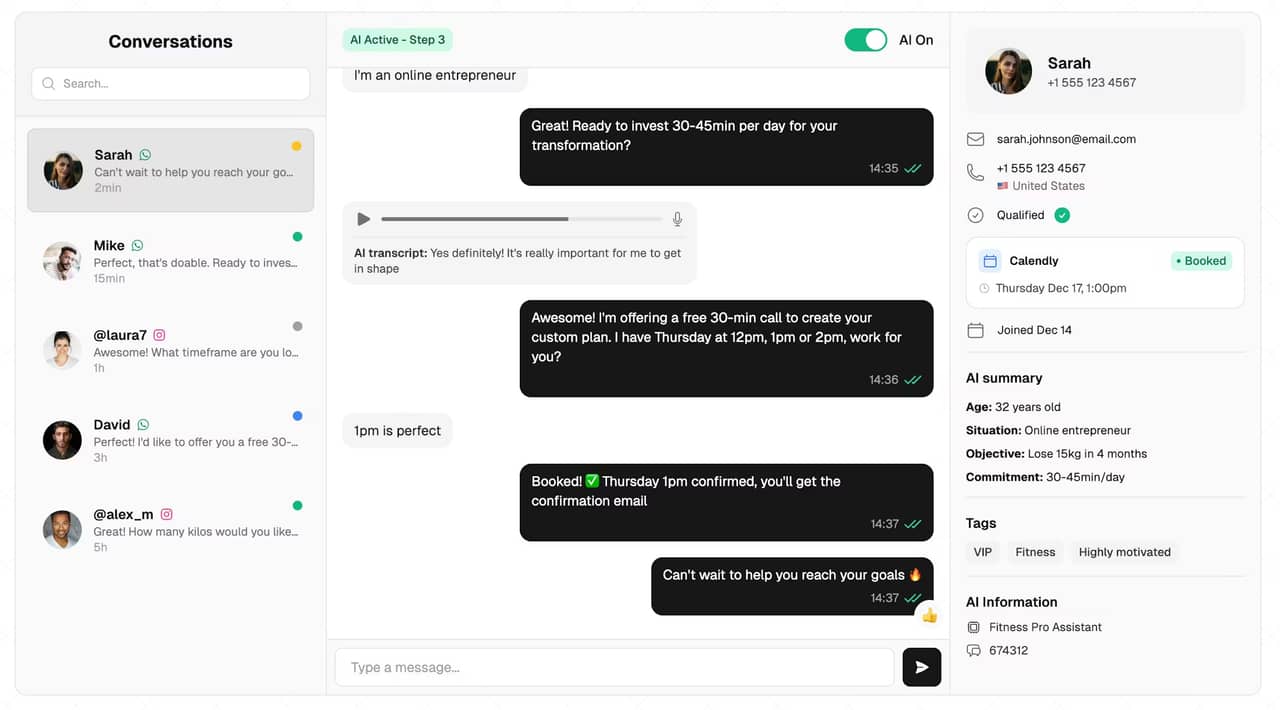
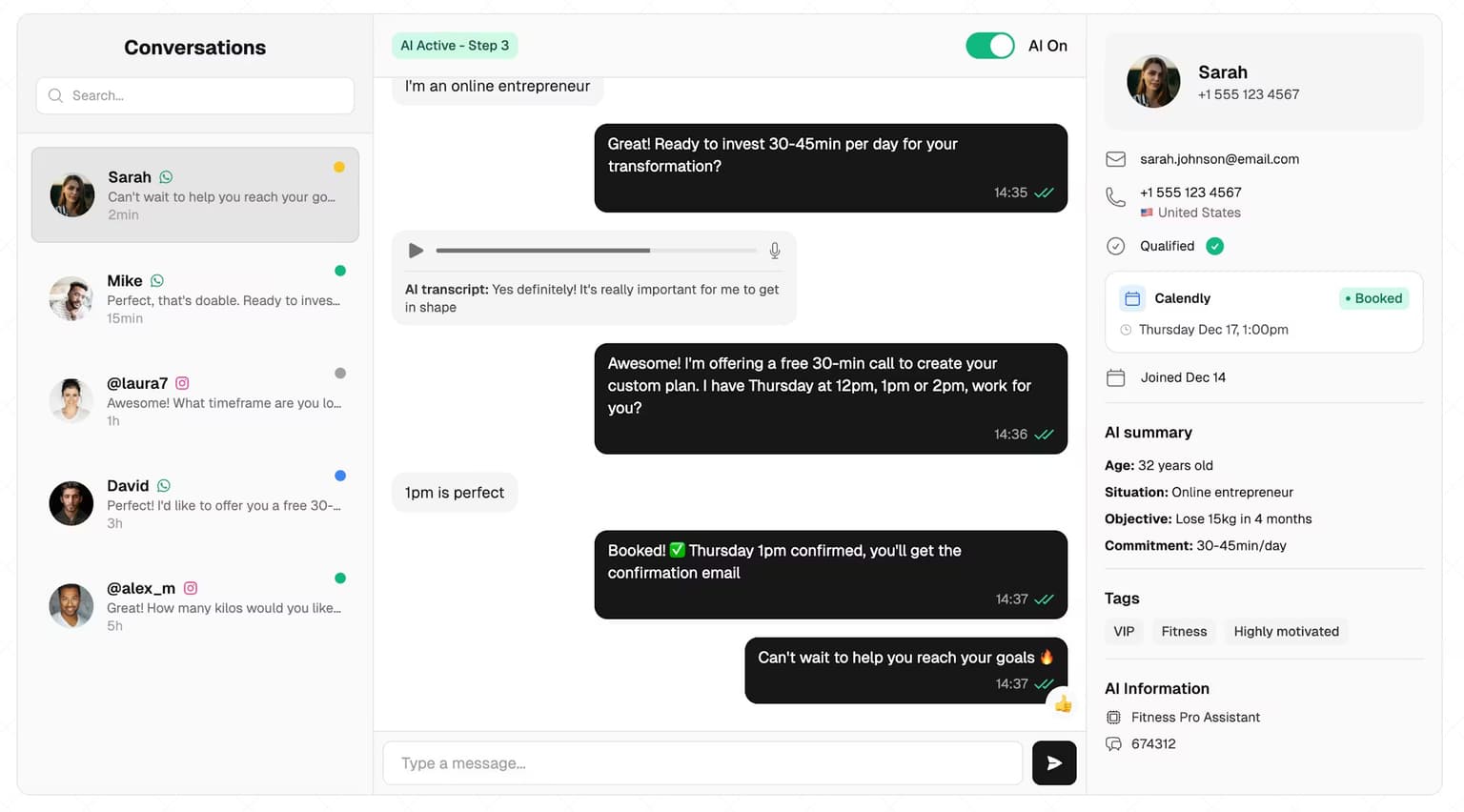
That is why the income equation is so sensitive to your pipeline. Doubling your booked calls, without touching your price or your close rate, roughly doubles your revenue. This is exactly the job an AI setter is built for: it answers every DM in seconds, asks the qualifying questions you would ask, follows up with the quiet leads, and books the fit ones straight onto your calendar. If the concept is new to you, start with what is a DM setter and the pillar on the multi-channel AI setter. The role itself, human or automated, is what we cover in appointment setter.
Note the framing carefully: the setter does not "close" anyone in the DM. It fills your calendar with qualified sales calls so you spend your time coaching and selling on the call, not chasing cold replies. The closing still happens live, the way high ticket sales always have. For a deeper look at the client-getting side, our guides on lead generation for coaches and how to get coaching clients go step by step.
How much should you charge as a life coach?
Direct answer: stop selling your hours and start selling outcomes. Hourly pricing caps your income at the number of hours in a week; program pricing lets you charge for the transformation, which is worth far more than 60 minutes of your time.
The typical progression looks like this:
- Hourly (beginner). You charge $50 to $150 an hour for single sessions. Simple to start, but it traps you: your income is capped, clients drop off between sessions, and you spend your life rebooking.
- Packages (intermediate). You bundle 6 to 12 sessions plus support into a program priced at $1,000 to $3,000. Clients commit, get better results, and your revenue per client jumps. See how to structure these in our coaching packages guide.
- High ticket programs (advanced). You sell a $3,000 to $10,000+ outcome-based program to a smaller number of committed clients. This is the model most full-time online coaches eventually move to, and it is the focus of our high ticket coaching playbook.
The move from hourly to packages to high ticket is the single fastest way to raise your effective "salary" without adding more hours. A coach charging $150 an hour and a coach charging $5,000 per program can serve the same number of people and earn wildly different incomes. The difference is not talent. It is packaging and the confidence to sell on a call, which is a learnable skill, closely related to high ticket closing.
From $2,000 to $10,000 a month: a realistic income path
Direct answer: you do not get from a few thousand a month to a full-time income by working more hours. You get there by raising your price and increasing the number of qualified calls on your calendar. Here is a realistic path.
Stage 1, roughly $2,000 a month. You have a niche and a few clients, mostly hourly or small packages. Your bottleneck is volume: not enough conversations. The fix is a repeatable way to start DMs, usually content plus comment-to-DM funnels feeding Instagram lead generation. Get your positioning tight and your offer named before you scale traffic.
Stage 2, roughly $5,000 a month. You have moved to packages priced at $1,500 to $3,000 and you are booking a handful of sales calls a week. Now your bottleneck is the inbox itself: replies pile up, you answer late, and good leads go cold. This is the point where a setter, human or AI, pays for itself, because every extra booked call is real money. Marketing consistency matters too, which is why we wrote how to market your coaching business.
Stage 3, roughly $10,000 a month and up. You have a high ticket program at $3,000 to $10,000, a full calendar of qualified calls, and a system that follows up automatically so nothing slips. At this level your income is limited mostly by how many good conversations you can generate and how well you close them, not by hours. This is the shape of nearly every six-figure online coaching business we see, and it is covered end to end in how to start an online coaching business.
The through-line across all three stages is the same: income follows qualified conversations. Fix your niche, package your offer, and never let a booked-call opportunity die in an unanswered DM.
FAQ
Does a life coach make good money?
They can, but "life coach salary" is misleading because most successful coaches are self-employed, not salaried. Employed coaches typically earn $35,000 to $55,000, while self-employed coaches with a strong niche and a high ticket program regularly clear six figures. Income tracks your offer price and the number of qualified sales calls you book, not a fixed pay band.
How much do life coaches make per hour?
Beginner coaches often charge $50 to $150 an hour, while established specialists charge $150 to $250 or more. That said, the highest earners rarely sell by the hour. They package sessions into programs priced per outcome, which raises their effective hourly rate far above any single-session fee.
Is there high demand for life coaches?
Yes, coaching is one of the faster-growing service industries, and demand for niche coaches (health, business, relationships) is especially strong. The catch is that demand does not equal easy income: you still have to find the people who want your specific outcome and book conversations with them, which is where most new coaches struggle.
What qualifications do I need to be a life coach?
In most places, none are legally required to call yourself a life coach. A certification from an accredited program or the ICF can build credibility and is often required for employed roles, but it does not guarantee income. Practical business skills, positioning, pricing, and selling on a call, matter more for your earnings than the credential itself.
How much should I charge as a life coach?
Start where you are comfortable, then move up quickly. Rather than defaulting to a low hourly rate, package your work into a program tied to a clear result and price it on the value of that outcome. Coaches who sell $1,500 to $5,000 programs earn far more than those stuck selling $75 sessions, even with the same number of clients.
How do I actually increase my income as a coach?
Pull three levers: niche down so you can charge more, package your offer instead of selling hours, and increase the number of qualified sales calls on your calendar. The last one is usually the biggest and most neglected. Answer every DM fast, qualify the fit, and follow up consistently so interested leads turn into booked calls instead of going cold.
Your life coach salary is not set by a job board. It is set by your offer and the conversations you can turn into booked calls. SetSmart answers your Instagram and WhatsApp DMs in seconds, qualifies each lead, and books the ready ones onto your calendar, so you can focus on coaching. Free 7-day trial, then from $97/month, or see the full pricing.
Ready to automate your DMs?
Start your free 7-day trial and let AI handle your lead qualification 24/7.
Try SetSmart free