How to Grow Your Online Coaching Business (2026)

Growing an online coaching business is a different problem from starting one. You already have an offer, some content rhythm, and a first batch of clients. The question now is why the curve went flat, and which lever actually moves it.
Here is the direct answer: an online coaching business grows on three numbers. Qualified conversations (how many interested people you talk to), conversion (how many of those become booked sales calls, then clients), and retention (how long clients stay and what they say when they leave). Everything you can buy or build, from ads to a new funnel to a setter, is just a way to push one of those three numbers. Coaches who stall usually pour money into the first number while the second one leaks, which is like filling a bathtub with the drain open.
This guide walks through the seven levers that reliably grow a coaching business past its first plateau, in the order that usually pays off fastest. If you are still earlier in the journey, start with how to start an online coaching business and come back once the machine runs.
Find your real bottleneck before you buy anything
Most coaches diagnose their growth problem wrong. They feel "not enough clients" and conclude "I need more leads," then spend on ads or a content agency. But more volume into a leaky funnel just means losing more leads faster.
Run this five-minute audit instead. Over the last 30 days:
- How many new DM conversations did you start? If it is under 50, you have a traffic problem: go to levers 2 and 7.
- What percentage of those conversations got a reply from you within an hour? If it is under half, you have a conversion problem in the inbox: go to levers 3 and 4. This is the most common and least diagnosed bottleneck.
- How many booked calls showed up, and how many of those closed? If people book but do not buy, the problem is qualification or the offer: levers 1 and 3.
- How many clients renewed, referred, or left a testimonial? If almost none, you have a retention problem that caps everything else: levers 5 and 7.
Be honest about which number is worst. The rest of this guide only works if you apply the right lever to the right leak.
Lever 1: Sharpen the offer before you scale anything
The instinct when growth stalls is to add: a second program, a lower tier, a course, a membership. The coaches who actually scale do the opposite. They concentrate.
A high-ticket offer with one clear transformation is easier to sell in a DM, easier to explain in content, and easier to deliver profitably than a menu. "12 weeks to lose 10kg without giving up restaurants" outsells "online fitness coaching, plans from $50" at every stage of the funnel, because the prospect can picture the outcome and the price anchors to the result, not the hours.
Growing usually means raising the promise and the price, not widening the catalog. If your close rate on calls is healthy and clients get results, a price increase is the cheapest growth lever available: same volume, more revenue, better clients. Coaches are almost always underpriced relative to the transformation they deliver.
Lever 2: Build a content engine that compounds
At the growth stage, content stops being about going viral and starts being about consistency per week. The math is boring and it works: a fixed cadence of Reels and Stories that name a specific struggle, with a clear call to action that starts a conversation, beats sporadic bursts of inspiration every time.
Two upgrades matter once you are past the beginner stage:
- Content that starts conversations, not applause. A Reel that earns 40 comments saying "GUIDE" beats one with 2,000 passive likes, because comments become DMs and DMs become calls. Our fitness marketing playbook breaks down the conversation-starter formats that work for fitness and health niches.
- Systematic capture. Every post should have a keyword trigger so a comment or story reply opens a DM automatically. This is standard comment-to-DM automation and it is the bridge between attention and revenue.
If you coach in the fitness space, the same engine applies with sharper hooks: how to get personal training clients covers the trainer-specific version.
Lever 3: Fix the DM leak (the highest-ROI lever for most coaches)
Here is the uncomfortable pattern we see across coaching accounts of every size: the content works, people DM, and then the business quietly loses half of them because nobody answers fast enough, asks the right questions, or moves the conversation toward a call.
At small scale you can brute-force this with your thumbs. At growth scale you cannot. Between sessions, content, and delivery, you physically cannot hold 60 qualifying conversations a day, and every hour a lead waits is an hour for them to cool off, get distracted, or DM the next coach.
The fix has two halves:
- Speed. The first reply needs to go out in seconds, at any hour, including the 11pm leads who watched your Reel in bed. Those are often the best ones.
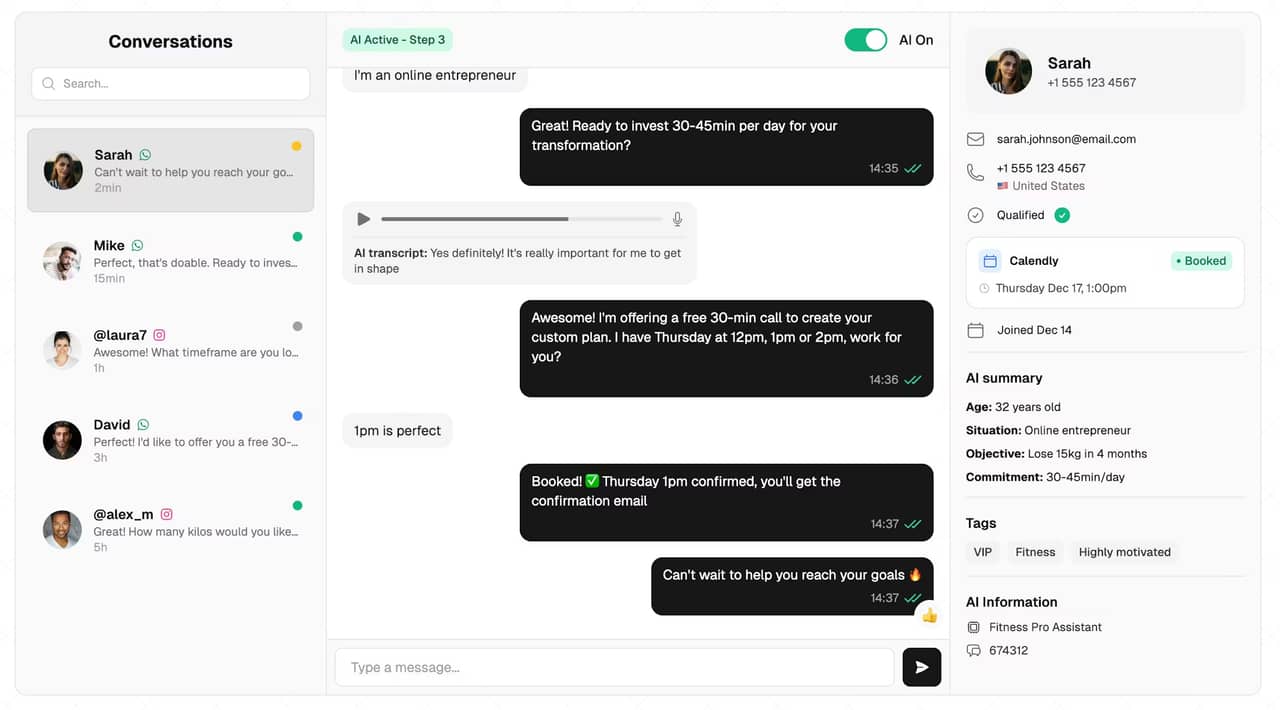
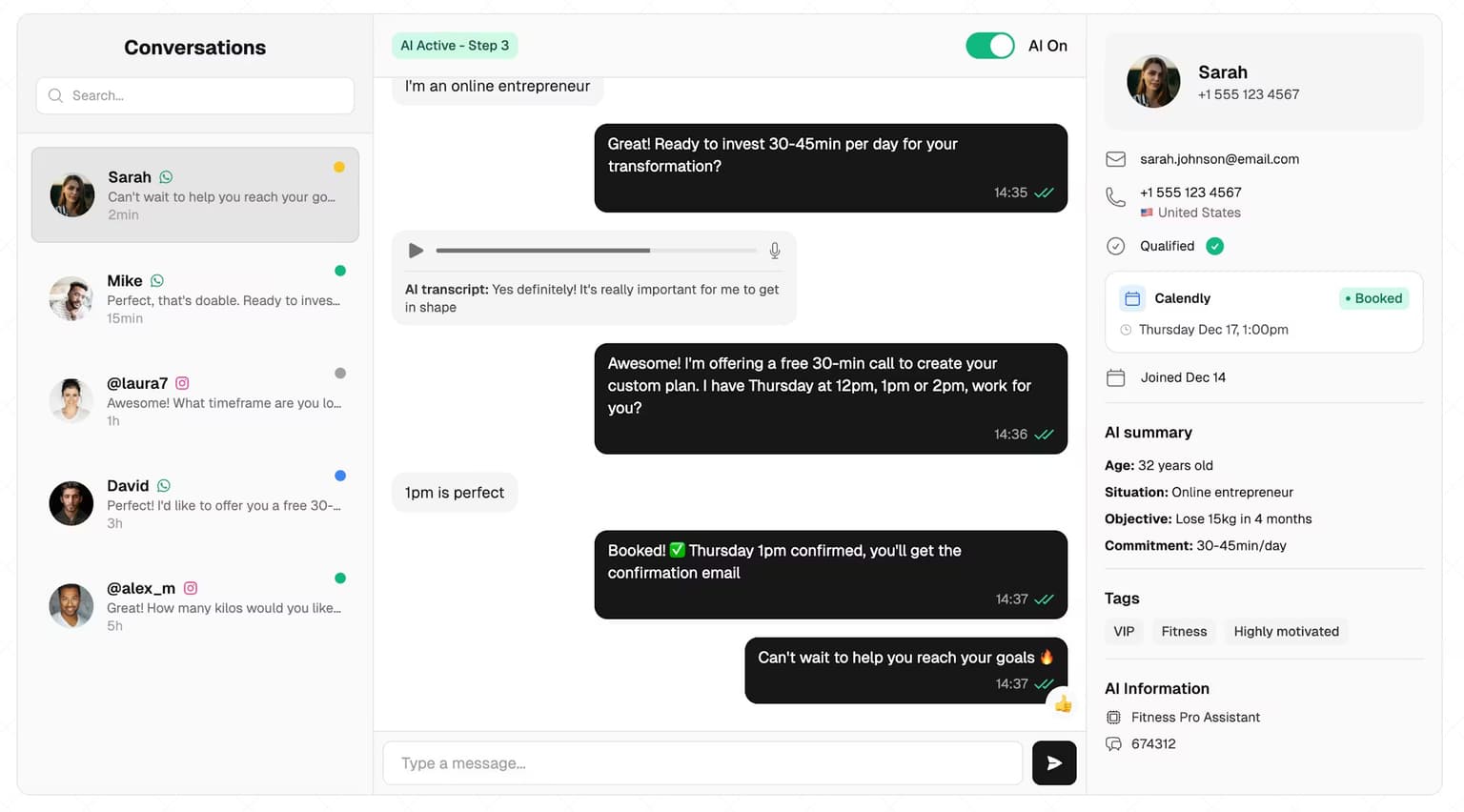
- Structure. Every conversation should follow the same arc: acknowledge, ask two or three qualifying questions (goal, situation, timeline), and propose a call with real slots when there is a fit. Our Instagram DM scripts give you the language for each step.
One rule holds the whole system together: the DM books the call, it does not close the sale. High-ticket coaching sells on a real conversation where you can handle objections and tailor the offer. The DM's only job is to fill your calendar with qualified sales calls, which is exactly what an AI DM setter automates when the volume outgrows your thumbs.
"Our number of calls exploded, we went from 40 to 120 monthly calls with Instagram and AI." Théo Riffault, Fitness Coach, 46.3K followers
Lever 4: Follow up like a machine
Silent leads are not dead leads. They are parents who got interrupted at bedtime, professionals who got pulled into a meeting, and prospects who meant to reply and forgot. Almost nobody nudges them, which makes follow-up the cheapest growth lever on this list.
In our analysis of 828K real DM conversations, a single well-timed follow-up more than doubled booked calls (+106% among engaged leads). One message, sent a few hours after the thread goes quiet, recovers revenue you already earned with your content.
At the growth stage, the standard is simple: no interested lead goes 24 hours without a nudge, and the nudge happens automatically rather than depending on your memory. Two timed follow-ups (a few hours later, then the next day) catch the majority of recoverable threads. If you rely on willpower for this, it will be the first thing you drop on a busy week, and it is precisely the thing that should never be dropped.
Lever 5: Grow retention before you grow ad spend
Client acquisition gets all the attention, but retention compounds. A coach who keeps clients six months instead of three just doubled revenue per client with zero extra marketing, and long-tenure clients generate the testimonials and transformations that make the content engine work.
Three retention moves that pay for themselves:
- Measure and show progress. Clients quit when they stop seeing the transformation. A monthly progress review that makes the delta visible (photos, numbers, habits) resets motivation and renewals.
- Structure the offboarding into an upsell. The end of a 12-week program is a decision point. Coaches who prepare a "what's next" continuation offer before week 10 keep a large share of finishing clients.
- Ask for proof at the peak. The best moment for a testimonial or referral ask is right after a win, not at the end of the program. Collect proof continuously and feed it back into your content and your reviews.
Lever 6: Delegate or automate? The setter math
At some point every growing coach faces the same fork: the DMs are eating hours a day, so you either hire a human setter or automate the conversation layer.
The honest comparison looks like this. A decent human setter costs somewhere around $2,000 a month, needs training, takes commissions in many setups, works set hours, and quits. An AI setter like SetSmart runs at $97 a month after a free 7-day trial, answers in seconds around the clock, holds the qualifying conversation in natural language, books calls straight into your calendar, and never ghosts your leads. What it does not do is close: you (or your closer) still sell on the call, which is where a human belongs anyway. For a breakdown of how the role works, see what a DM setter actually does and the wider appointment setter comparison.
The practical answer for most coaches under about $50k per month is automation first: it removes the bottleneck at a fraction of the cost, and it makes a later human hire better, because the human inherits clean data and a full calendar instead of an overflowing inbox.
"I book 15 to 25 calls per week, without managing a single setter." Mathis Ladoué, Online Fitness Coach, 22.4K followers
Fitness coaches can see this exact setup, with real accounts and numbers, on the AI DM setter for fitness coaches page.
Lever 7: Turn proof into a growth loop
The final lever ties the others together. Every client result you deliver is an asset that can generate the next client, if you systematize it:
- Capture the win (screenshot, stat, quote) the moment it happens.
- Publish it as content with a conversation-starting call to action.
- Route the reactions into DMs with your keyword triggers.
- Qualify and book automatically, so the interest converts while it is hot.
- Deliver the transformation, and the loop restarts.
Coaches who run this loop stop depending on ads for growth. The proof compounds: more results mean more believable content, which means more conversations from the same audience size. This is also what makes a small, engaged account outperform a big passive one. You do not need 100k followers to grow past six figures; you need a loop that converts the audience you already have.
A 90-day growth plan
If you want the levers in a sequence:
- Days 1-15: Run the bottleneck audit. Tighten your offer to one clear transformation and adjust pricing if your close rate supports it.
- Days 16-30: Fix the DM leak. Install comment-to-DM triggers, define your qualifying questions, and automate the first reply and follow-ups so no lead waits or goes silent unattended.
- Days 31-60: Lock the content cadence (three Reels and daily Stories per week is plenty), each with a specific call to action, and let the proof loop start feeding it.
- Days 61-90: Build the retention layer: progress reviews, a continuation offer, and systematic testimonial capture. Review the numbers and decide whether the next constraint is traffic (scale content or ads) or capacity (raise prices or add group delivery).
Most coaches who run this sequence find that they did not have a lead problem at all. They had a conversion and follow-up problem that got fixed in the first month, and the "growth" was already sitting in their inbox.
FAQ
How do I scale an online coaching business without working more hours?
Separate what only you can do (coaching and closing) from what a system can do (answering DMs, qualifying, booking, following up). Automate the second category, then raise prices or move to group delivery when your calendar fills. Scale comes from removing yourself from the conversation layer, not from longer days.
How many clients can an online coach handle?
A solo coach delivering 1:1 typically maxes out around 20-30 active clients before quality drops. Past that, growth comes from raising prices, moving to group or hybrid delivery, or hiring delivery help. The acquisition side does not have that ceiling once qualification and booking are automated.
When should I hire a setter for my coaching business?
Later than you think. A human setter makes sense when your calendar is consistently full, your offer converts, and you need a human touch on high-volume outbound. For inbound DMs, an AI setter covers speed, qualification, and booking at about 5% of the cost of a hire, which is why most coaches automate first and hire later.
How do I grow my coaching business on Instagram specifically?
Post conversation-starting Reels and Stories on a fixed cadence, put a keyword call to action on every post, and route comments and story replies into DMs automatically. Then qualify each lead in the chat and book the sales call. The full setup is covered in our Instagram DM automation guide.
Why is my coaching business not growing?
In most cases the leak is between interest and booked call: slow DM replies, no qualification, and zero follow-up. Audit your last 30 days of conversations before buying more traffic. If fewer than half of interested leads got a fast reply and a follow-up, fixing the inbox will grow revenue faster than any new marketing channel. When you are ready to add channels, use the full coaching marketing system.
Ready to automate your DMs?
Start your free 7-day trial and let AI handle your lead qualification 24/7.
Try SetSmart free