WhatsApp vs WhatsApp Business for Coaches (2026)

Direct answer: WhatsApp and WhatsApp Business are two separate apps that run on the same network. Regular WhatsApp is built for personal messaging. WhatsApp Business is free too, but it adds a business profile, a product catalog, chat labels, and three automated messages (greeting, away, quick replies). If you sell anything through your DMs, WhatsApp Business is the better app, and switching takes about ten minutes.
The comparison most guides stop there. It should not, because there is a third tier that decides whether your inbox actually produces booked calls: the WhatsApp Business API. For an online coach running client conversations through Instagram and WhatsApp, the real question is not "personal or business app". It is "at what point does the free app stop being enough".
This guide covers the feature-by-feature difference, what each option costs in 2026, whether you can run both apps (and both numbers) on one phone, the honest downsides of switching, and how to pick the tier that matches your volume.
WhatsApp vs WhatsApp Business: the short answer
Three products, one network. Every message still lands in the same WhatsApp your leads already have on their phone. What changes is what you can do on your side.
| Option | Built for | Cost | Best when |
|---|---|---|---|
| WhatsApp (personal) | Friends and family | Free | You are not selling on the number |
| WhatsApp Business app | Solo operators and small teams | Free | You answer every chat yourself |
| WhatsApp Business API | Software, automation, teams | Per-message fees plus a tool | More DMs arrive than you can answer |
If you are choosing between the first two, choose WhatsApp Business. It is free, it is the same app experience, and it separates your client conversations from your mother's voice notes. The interesting decision is the second one, and we get to it below.
What WhatsApp Business actually adds
Everything in the free Business app is a variation on one theme: helping a stranger trust you and get an answer faster.
A real business profile. Category, description, opening hours, address, email, and a website link. On personal WhatsApp all a lead sees is a name and a photo. On Business they see who you are before they type. Put your booking link in the website field; it gets clicked more than you would expect.
A product catalog. You can list offers, packages, and prices with images, group them into collections, and share the catalog link anywhere. Coaches use it for programme tiers rather than physical products. If you want help structuring what goes in there, our guide on building coaching packages covers the offer side.
Labels. Colour-coded tags on chats and contacts: new lead, call booked, follow up, client. This is the poor man's pipeline and it works until roughly a hundred open conversations, at which point you want a proper WhatsApp CRM instead.
Three automated messages. A greeting message that fires when someone contacts you for the first time, an away message on a schedule for when you are offline, and quick replies you trigger by typing a shortcut like /price. These are canned blocks of text, not a bot, and our walkthrough of WhatsApp Business automated messages shows exactly how to set each one up.
A short link and QR code. A wa.me link for your bio, your ads, and your story stickers, so a tap opens a chat with you already pre-filled. This is what makes WhatsApp work as a funnel destination rather than a support channel.
Basic messaging metrics. How many messages were sent, delivered, read, and received. Thin, but more than personal WhatsApp gives you (nothing).
| Capability | WhatsApp Business | Business API | |
|---|---|---|---|
| Business profile and hours | No | Yes | Yes |
| Product catalog | No | Yes | Yes |
| Labels to organise chats | No | Yes | Via your tool |
| Greeting and away messages | No | Yes | Yes |
| Broadcast to a list | Up to 256, saved contacts only | Up to 256, saved contacts only | Unlimited, template-based |
| Replies that read what the lead wrote | No | No | Yes |
| Qualifies leads and books calls | No | No | Yes |
| Several people on one number | No | Linked devices only | Yes, proper seats |
| Verified badge path | No | No | Yes |
| Cost | Free | Free | Per-message fees plus a tool |
One thing the Business app does not change: the conversation itself. Same encryption, same voice notes, same read receipts, same blue ticks. Your lead cannot tell which app you are on beyond the profile details, and there is no penalty in reach or deliverability for using Business.
The third option: the WhatsApp Business API
The API is not an app. It is the official interface that lets software send and receive WhatsApp messages on your number, which is how every automation platform, shared team inbox, and AI assistant plugs into the channel. You reach it through Meta's Cloud API directly or through a provider (a BSP such as Twilio, 360dialog, or a platform that wraps the whole thing for you).
What it unlocks that the free app cannot:
- Real conversation logic. Software reads the reply and answers in context instead of firing a fixed block of text. This is the difference between an auto-reply and a genuine WhatsApp chatbot.
- Automatic follow-ups. The free app will never nudge a lead who went quiet after two messages, which is exactly where most opportunities are lost.
- Broadcasts past 256 contacts, without requiring every recipient to have saved your number. The rules and template categories are covered in our WhatsApp broadcast guide.
- A team on one number, with proper seats and assignment rather than a phone passed around.
- The verified badge route. The WhatsApp green tick and Meta Verified for Business both run through an API account, not the free app.
The trade-offs are real. The API costs money, per message, on a rate that depends on the recipient's country and the template category (replies inside the 24-hour customer service window are free). Setup involves Meta business verification, and your number can only live in one place: once it is registered on the API, the Business app stops working for it. Our WhatsApp Business API pricing breakdown has the current rate card and the provider markups nobody warns you about.
Can you use WhatsApp and WhatsApp Business on the same phone?
Yes, with one condition: two different numbers. Both apps can sit on the same handset, each registered to its own number, which is the setup most coaches end up with. Personal number for family, business number for clients.
What you cannot do is run the same number in both apps at once. A number lives in one app at a time. When you register an existing number in WhatsApp Business, the account migrates and the personal app releases it.
The practical implications:
- Migrating keeps your chat history. When you install WhatsApp Business on the same phone and enter the same number, you are offered the option to move your existing chats and media across. Back up first anyway.
- Going back is possible, but lossy. You can return the number to personal WhatsApp, but the business-only assets (catalog, labels, automated messages) do not come with it.
- Dual SIM or a second eSIM makes life easier. A dedicated business number keeps your personal life out of the client inbox and gives you a clean number to point ads and link stickers at.
- Linked devices are not team seats. Both apps support opening your account on a computer and a few extra devices, but everyone is sharing one phone-bound account. Actual multi-agent access is an API feature.
Is WhatsApp Business free? What each tier costs
Yes, the WhatsApp Business app is free to download and free to use on iOS, Android, and the desktop or web companion. There is no subscription, no per-message charge, and no ceiling on how many people you talk to.
Costs only start at the API tier, and they come in two layers:
- Meta's per-message fee. Since July 2025 billing is per template message rather than per conversation, with the rate set by the recipient's country and the template category. Replies you send inside the 24-hour customer service window (after a lead messages you first) are free, with no monthly cap. For an inbound business where leads DM you first, this matters enormously: most of your traffic sits in the free window.
- The software on top. A shared inbox, an automation builder, or an AI assistant. This is where the monthly subscription lives, and prices vary wildly between tools built for ecommerce blasts and tools built for booking calls.
A separate paid item is Meta Verified for Business, a subscription whose price Meta sets by region. Check the current rate inside Meta Business Manager rather than trusting a number in a blog post, and never pay a third party promising to sell you the classic green tick.
The honest downsides of WhatsApp Business
Switching is usually right, but it is not free of friction.
- You still answer everything yourself. The greeting and away messages create the impression of automation and then hand a live human back the entire job. Leads reply to your clever greeting question and sit there until you open the app.
- The app is deaf. Nothing in the free tier reads what someone wrote. "I want to lose 15kg before my wedding in October" and "just browsing" get the identical canned reply.
- Broadcasts are capped and awkward. 256 recipients per list, and only people who have saved your number receive them. That is a hard ceiling on any list-building play.
- It is phone-bound. Lose the phone, lose the inbox. There is no proper multi-seat access for a setter or a VA without moving to the API.
- Migration is one-way-ish. Reverting to personal WhatsApp loses the business assets, so decide the number's role before you switch.
- No badge. The verification path runs through the API, so the free app cannot get you a green tick no matter how established you are.
None of that is a reason to stay on personal WhatsApp. It is a reason to know what the free app is: a better shopfront, not a system.
Which one should you use? A decision guide
Pick by the volume of inbound conversations, not by the size of your ambition.
Under about 10 new chats a day: WhatsApp Business app. You can genuinely reply to everyone. Set the away message so nobody waits overnight, fill the profile, put the wa.me link in your Instagram bio, and get on with coaching. Everything else is premature.
10 to 40 new chats a day: Business app plus discipline, or your first automation. This is where labels, quick replies, and a strict follow-up habit still hold, and also where most coaches start losing leads quietly. If replies routinely take more than a few hours, you have already outgrown the app.
More than about 40 new chats a day, or you run ads: API plus an assistant. Once traffic is paid or your audience is large enough that DMs arrive faster than you can open them, the maths stops working. This is the point where WhatsApp automation pays for itself, and where click-to-WhatsApp ads become viable, because every ad click lands in a conversation that qualifies itself instead of a queue.
Any team larger than you: API. As soon as a setter, VA, or second coach needs access, linked devices stop being a workaround.
One nuance for coaches specifically: the goal on WhatsApp is a booked sales call, not a sale in the chat. Qualification and booking happen by message, the close happens on the call with you or your closer. Choose the tier that fills the calendar with the right people, and keep the selling where it belongs.
How to switch from WhatsApp to WhatsApp Business
Ten minutes, one phone, no data loss if you back up first.
- Back up your chats. In WhatsApp, open Settings, then Chats, then Chat backup, and run a fresh backup.
- Install WhatsApp Business. Download it from the App Store or Google Play onto the same phone.
- Register the same number. Open the Business app, enter your number, verify by code, and accept the prompt to move your existing account and history. If you would rather keep the two lives separate, register a second number here instead and leave personal WhatsApp untouched.
- Complete the profile. Category, a one-line description of who you help and with what, hours, and your booking link in the website field. This is the highest-leverage five minutes in the whole process.
- Switch on Business Tools. Enable the greeting message, set the away message to your real off-hours, and save three or four quick replies for the questions you answer daily (price, how it works, how to book).
- Point traffic at it. Add the
wa.melink to your Instagram bio, your link sticker, and your email signature, then test the whole path from a second phone.
If most of your inbound comes from Instagram rather than a link in bio, the same qualify-then-book logic applies there, and our Instagram DM automation guide covers that side of the funnel.
Where the Business app stops being enough
The free app fixes presentation. It does not fix the two things that actually cost coaches money: speed and follow-up.
In our data from 828K real WhatsApp and Instagram DM conversations, WhatsApp responders qualify at 34% of engaged chats, and a single well-timed follow-up doubles booked calls. Neither of those is available to you on the free app, because it cannot read a reply and it will never nudge a quiet thread.
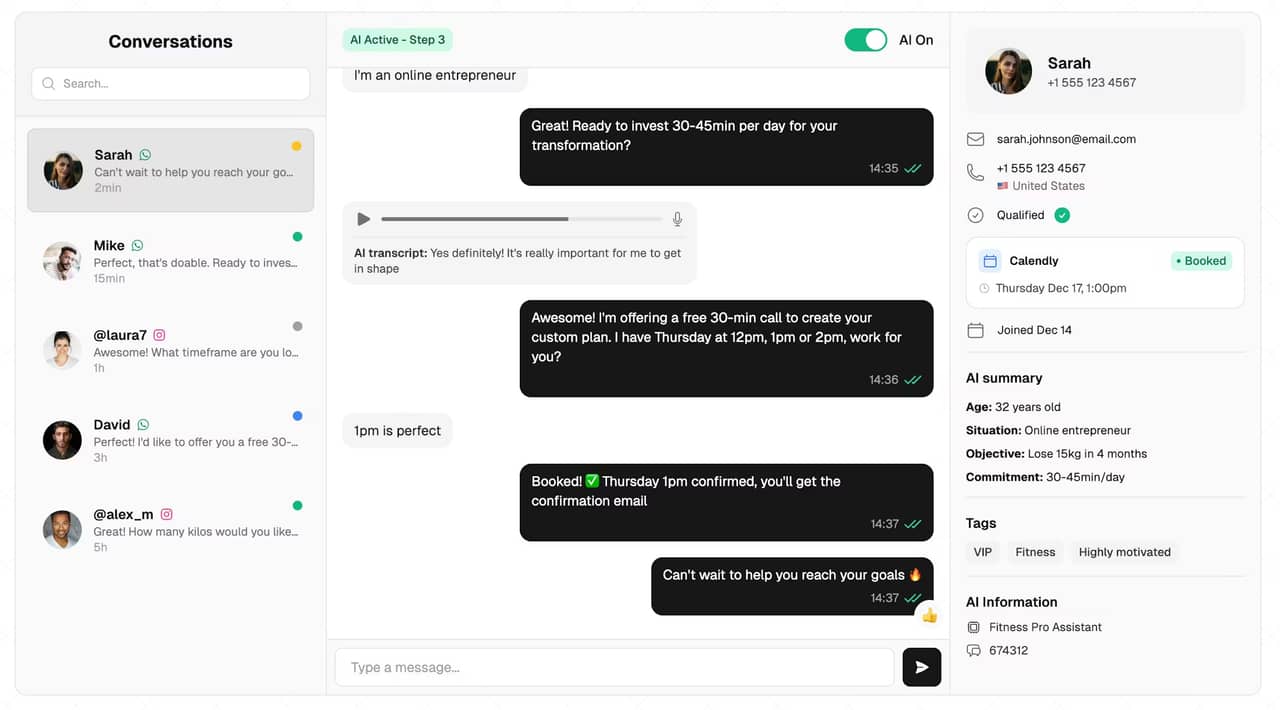
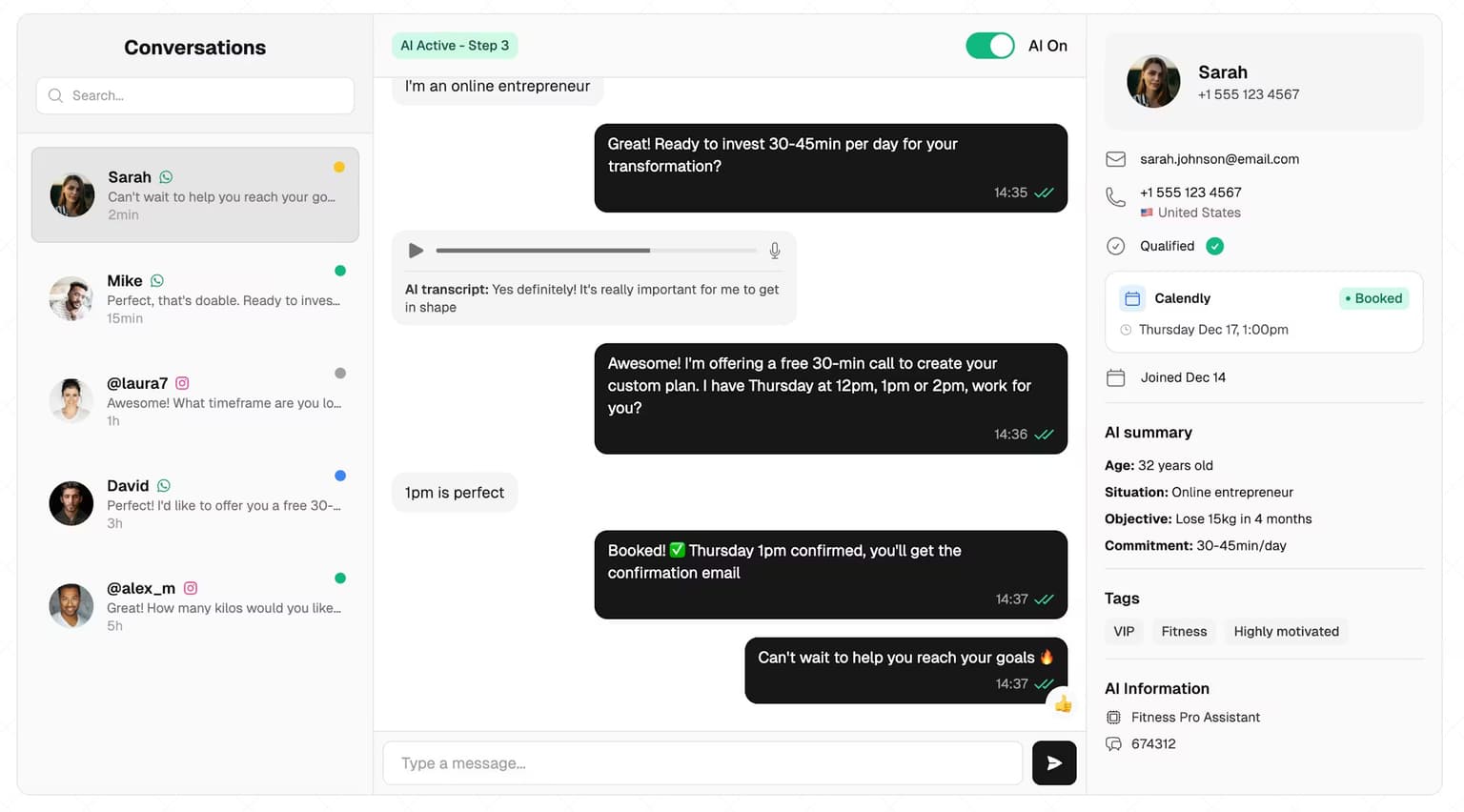
That is the job an AI setter does on top of the API: it answers in seconds at any hour, asks your two or three qualifying questions the way a human DM setter would, proposes calendar slots once someone is a fit, and follows up automatically when a thread goes cold. SetSmart is built for exactly this across WhatsApp, Instagram, and Messenger: a free 7-day trial, then $97/month with 1,000 messages included.
The alternative route is a flow builder such as ManyChat for WhatsApp or a shared-inbox platform like Wati. Those are strong at broadcasts, button menus, and support ticketing. They are weaker at holding an open-ended conversation with a stranger who wrote three messy sentences about their goal, which is most of what a coach's inbox contains. Weigh that honestly against your own traffic before you buy anything, and read our wider WhatsApp marketing playbook for how the channel fits the rest of your funnel.
FAQ
Is it better to use WhatsApp or WhatsApp Business?
If you sell anything through the number, WhatsApp Business is better and it costs nothing. You get a business profile, a catalog, labels, and automated greeting and away messages, and the conversation experience for your lead is identical. Keep personal WhatsApp for personal life on a separate number.
What is the difference between WhatsApp and WhatsApp Business?
WhatsApp is a personal messaging app. WhatsApp Business is a free separate app on the same network that adds a business profile with hours and a website link, a product catalog, chat labels, greeting and away messages, quick replies, a wa.me short link and QR code, and basic messaging statistics.
Can I use WhatsApp and WhatsApp Business on the same phone?
Yes, as long as each app uses a different number. Both can be installed side by side, which is how most coaches split personal and client conversations. The same number cannot be active in both apps at once, so registering it in Business migrates the account.
What is the downside of WhatsApp Business?
The free app is still entirely manual. It cannot read a reply, cannot qualify a lead, cannot book a call, and never follows up. Broadcasts are capped at 256 saved contacts, access is tied to one phone, and the verified badge path runs through the API rather than the app.
Is WhatsApp Business free in 2026?
The WhatsApp Business app is free with no subscription and no per-message charge. Costs appear only if you move to the WhatsApp Business API, which bills per template message by country and category (replies inside the 24-hour customer service window are free) plus whatever software you run on top.
Do I need the WhatsApp Business API?
Only when volume outgrows your hands. If DMs arrive faster than you can answer, if you run ads to WhatsApp, if you need a second person on the number, or if you want automatic qualification, booking, and follow-up, the API is the upgrade. Under roughly 10 new chats a day, the free app is enough.
Will switching to WhatsApp Business delete my chats?
No. When you register your existing number in the Business app on the same phone, you are prompted to migrate your account and chat history. Run a manual backup first anyway, and be aware that moving back to personal WhatsApp later loses business-only items such as the catalog and labels.
Ready to automate your DMs?
Start your free 7-day trial and let AI handle your lead qualification 24/7.
Try SetSmart free