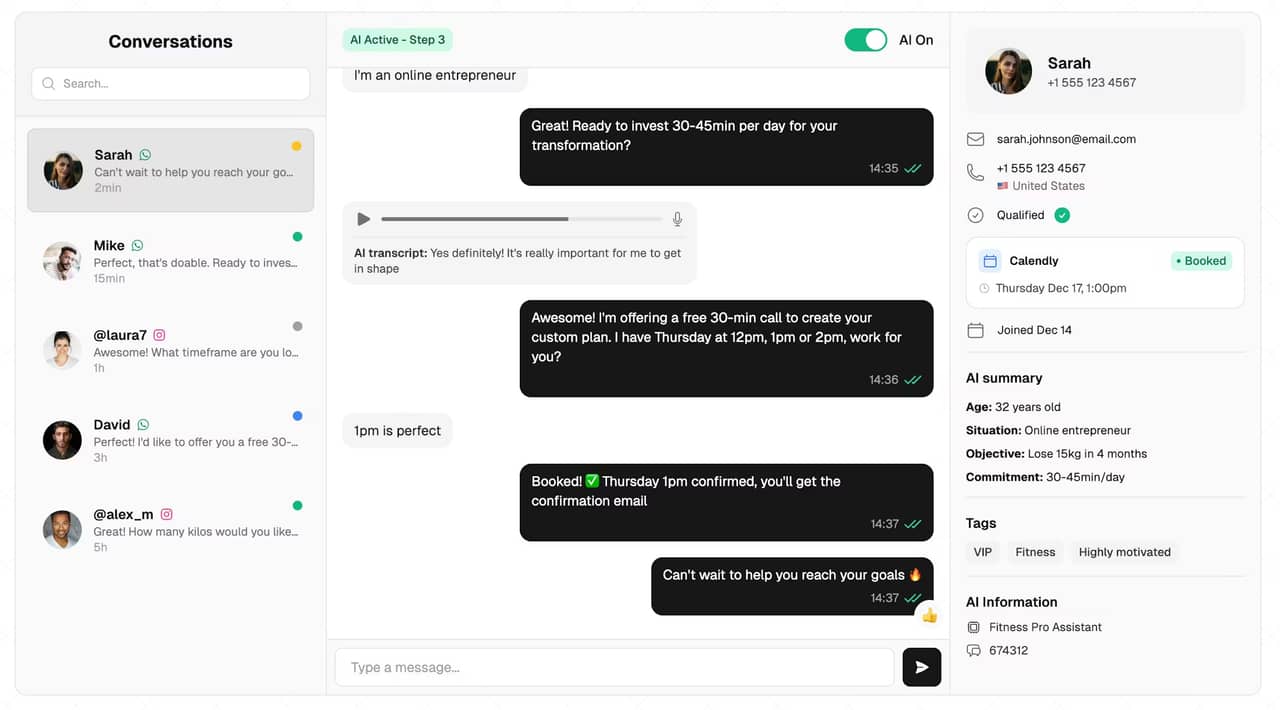
Wati Pricing 2026: Is It Worth It for WhatsApp?

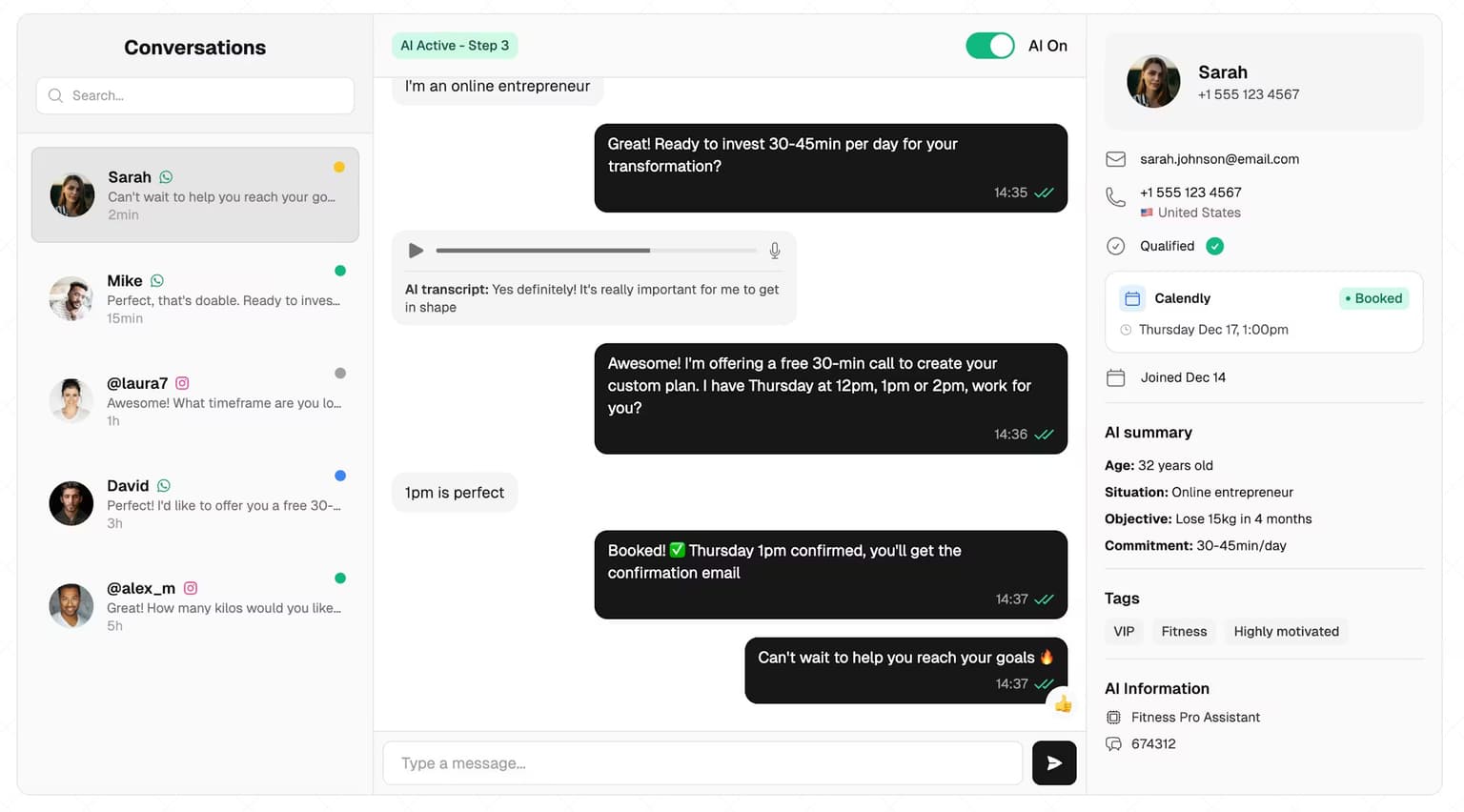
Wati pricing in 2026 runs across three public plans, commonly listed as Growth ($49/mo), Pro ($99/mo) and Business (~$299/mo) on annual billing, plus a custom Enterprise tier. Those headline numbers are only the platform fee, though: on top of every plan you pay Meta's per-message rates and, past the included seats, an extra charge per user, so what you actually spend depends far more on your message volume and team size than the sticker price.
That gap between the advertised plan and the real bill is exactly what trips up coaches and agencies who move to WhatsApp expecting a flat tool. This guide breaks down every Wati plan, the fees nobody puts on the pricing page, and whether a WhatsApp broadcast and support platform is the right way to qualify inbound DMs and book sales calls. If you want the underlying platform math first, start with our WhatsApp Business API pricing breakdown.
Wati Pricing Plans at a Glance
Wati is a WhatsApp Business Solution Provider (BSP): a no-code layer on top of the official WhatsApp API that adds a shared team inbox, broadcast campaigns, and chatbot flows. Here are the current plans, verified against wati.io. Prices below are the annually billed rates (Wati gives up to ~25% off for paying yearly); month-to-month costs more.
| Plan | Starting price (annual) | Seats included | Extra user | Best for |
|---|---|---|---|---|
| Growth | ~$49/mo | 3 | Not available | Solo senders, first broadcasts |
| Pro (Best Value) | ~$99/mo | 5 | +$24/user/mo | Small teams, chatbots, analytics |
| Business | ~$299/mo | 5 | +$69/user/mo | Multiple numbers, dedicated support |
| Enterprise | Custom | Custom | Custom | High-volume, compliance needs |
A quick honesty note: Wati restructures its pricing often, and third-party trackers list slightly different numbers depending on region and billing period. Treat the figures above as the commonly-listed starting points, not gospel, and confirm the live rate on wati.io before you commit. The plan structure (three tiers plus per-seat add-ons and separate message fees) is what matters and has been stable.
How Wati Pricing Actually Works
Wati's platform fee is the smallest part of your bill for most WhatsApp senders. Two other line items usually dwarf it: the per-message cost you owe Meta, and the per-seat charge once your team grows. Understanding both is the difference between a predictable spend and a nasty surprise on month two.
The platform fee is just the entry ticket
The Growth, Pro and Business fees buy you access to Wati's interface: the shared inbox, the broadcast builder, the no-code chatbot, CTWA (click-to-WhatsApp) ad capture, and integrations. Growth connects one channel with three fixed seats and no option to add more. Pro is the tier Wati markets as "Best Value" and unlocks advanced chatbots, forms, retargeting, and AI automation, with five seats and additional users at roughly $24 each per month. Business layers on multiple WhatsApp numbers, round-robin routing, and a dedicated success manager, with extra seats around $69 each.
Message fees stack on top (the part people miss)
Here is the crucial thing: your Wati subscription does not include the messages you send. WhatsApp charges per conversation or per template message depending on category (marketing, utility, authentication) and the recipient's country, and Wati bills those through on top of your plan. A broadcast to a few thousand contacts, or a busy month of inbound chats, can cost more in message fees than your entire platform subscription. Our WhatsApp Business API pricing guide walks through Meta's rate card, and our WhatsApp broadcast breakdown shows how template costs scale with list size.
The hidden costs nobody puts on the pricing page
Add these up before you decide Wati is "$99/month":
- Per-message charges billed via Wati's rate card, separate from and on top of the plan.
- Extra seats at ~$24/user (Pro) or ~$69/user (Business) once you pass the included count.
- Add-ons such as the Shopify integration, which requires a small monthly app fee.
- Annual lock-in to get the ~25% discount, which means committing before you know your real message volume.
Stack a Pro plan with two extra agents and a few thousand marketing templates a month, and your "~$99" tool is realistically $250 to $400. That is normal for a WhatsApp broadcast platform, but it is worth knowing going in, especially if you are used to the flat pricing of a WhatsApp automation tool built around conversations rather than campaigns.
Is Wati Worth It for Coaches and Agencies?
Short answer: Wati is an excellent WhatsApp broadcast and support platform, but it was not designed to qualify inbound DMs and book high-ticket sales calls. It shines when your problem is "send a lot of WhatsApp messages to a lot of opted-in contacts and manage the replies in a shared inbox." It is a heavier, campaign-first fit than most coaches and creators actually need.
That distinction is everything for a DM-led business. Your leads arrive one at a time after a reel, a story, or a "DM me" call to action. The job is not to blast a template to 10,000 people; it is to hold a real conversation with each lead, qualify them, and fill your calendar with sales calls. Those are different tools with different pricing logic.
Where Wati genuinely wins
Let's be fair. Wati is strong at what it was built for:
- High-volume broadcasts to thousands of opted-in contacts with pre-approved templates.
- A polished shared team inbox with assignment, tagging, and reporting for support teams.
- Ecommerce tooling like WhatsApp catalog, abandoned-cart and order templates, and Shopify flows.
- CTWA ad capture and CRM integrations for agencies running WhatsApp at scale.
- Regional strength in India and Southeast Asia, where WhatsApp is the default business channel.
If you are an ecommerce brand or an agency managing WhatsApp support at volume, Wati is a reasonable, mature choice. It sits alongside tools like ManyChat and AiSensy in that broadcast-and-flow category. Agencies that mainly need DM setting for clients, rather than support at volume, can run SetSmart's white-label mode on one plan for every client.
Where it falls short for booking sales calls
For a coach or agency whose money comes from inbound DMs and booked calls, the gaps add up:
- Campaign-first, not conversation-first. The product is optimized for broadcasts and support routing, not for holding a natural, multi-message qualifying chat with one lead.
- Message-metered billing. You pay per message on top of the plan, which punishes exactly the longer conversations that produce booked calls.
- Chatbots are rules-based flows. Wati's automation leans on decision-tree flows and templates, not a conversational AI that adapts to what the lead actually says.
- WhatsApp-centric. If your leads live in Instagram DMs too, you are back to stitching tools together instead of one setter across channels.
This is the same gap you see across the best AI setters: a broadcast platform sends messages, but a dedicated AI setter is built to qualify each lead and propose a call slot inside the chat.
Wati vs. SetSmart Pricing for Coaches
If your goal is booking sales calls from WhatsApp and Instagram DMs, the honest comparison isn't Wati vs. another broadcast tool, it's Wati vs. a purpose-built AI DM setter.
| Feature | Wati (~$49–$299+) | SetSmart ($97) |
|---|---|---|
| Built for | WhatsApp broadcast + support | DM lead qualification |
| Automation style | Rules-based flows + templates | Conversational AI |
| Message billing | Plan + per-message + per-seat | Flat $97/mo, 1,000 messages |
| Channels | WhatsApp-first | Instagram, WhatsApp, Messenger |
| In-chat call booking | Not the focus | Yes (Calendly / GHL) |
| Smart follow-ups | Template-based | Auto at 4h + 23h |
| Cost predictability | Variable (messages + seats) | Fixed |
SetSmart's main plan is a free 7-day trial, then $97/month including 1,000 messages, with usage-based pricing above that. There is no per-seat math, which is the opposite of Wati's platform-plus-messages-plus-seats model. For a coach who can't predict how busy a launch week will get, a flat rate removes the anxiety.
A quick cost reality check
Picture a nutrition coach who gets 600 inbound WhatsApp and Instagram DMs in a month, each running 8 to 12 messages to qualify. On Wati you pay the platform fee, then per-message charges on every one of those replies, then extra seats if a VA helps you answer. In a busy launch month that easily clears $200 to $300. On a flat $99 plan, the busy month costs the same as the quiet one.
And the depth matters. In our analysis of 828K DM conversations, WhatsApp responders qualify at 34%, and the conversations that book calls are the long ones, not one-line template exchanges. A pricing model that charges you more for every extra message is working against the exact behavior that produces booked calls. Speed matters too, which is why fast, automated replies beat the slow norms documented in our lead response time statistics.
Wati Pricing vs. ManyChat and Chatbase
Most people evaluating Wati are also looking at the other tools creators and agencies compare. The pricing philosophies are completely different, so "which is cheaper" depends entirely on your volume and channel.
| Tool | Billing basis | Entry price | Best at |
|---|---|---|---|
| Wati | Plan + per message + per seat | From ~$49/mo | WhatsApp broadcast + support |
| ManyChat | Per active contact | Free, then ~$15/mo | Comment-to-DM flows, link sending |
| Chatbase | Per message credit | Free, then ~$32/mo | Website / support AI agents |
| SetSmart | Flat monthly | Trial, then $97/mo | Qualifying DMs + booking calls |
The pattern: Wati prices for volume (broadcasts and support at scale), ManyChat pricing charges per contact even if those people barely message you, and Chatbase pricing charges per AI reply. None of the three were designed to qualify a lead and propose a call slot inside the conversation, which is the job an appointment setter does. That's the line that separates a broadcast tool from a setter.
How to Choose the Right Plan
Match the tool to the job, not the other way around.
Pick Wati if...
- Your main need is WhatsApp broadcasts to thousands of opted-in contacts.
- You run ecommerce or high-volume support and want a shared inbox with routing.
- You have a team that will use the seats and a budget for per-message fees.
- WhatsApp is your dominant channel and you are comfortable with variable, volume-based billing.
Pick an AI DM setter instead if...
- Instagram, WhatsApp, or Messenger DMs are where your leads come from.
- You need the AI to qualify leads and book sales calls, not just send templates.
- You want predictable monthly cost that doesn't spike during a launch.
- You run story triggers, comment-to-DM, and "DM the keyword" funnels and want one setter across channels.
If you're weighing options, our WhatsApp automation guide, the best AI setters roundup, and the WhatsApp chatbot breakdown all map the trade-offs for coach and agency use cases. A broadcast platform is great for sending campaigns; a conversational AI setter is built for booking calls.
The Bottom Line on Wati Pricing
Wati pricing looks simple on the page, three tiers from around $49 to $299, but the platform fee is only the entry ticket. Per-message charges billed via Meta's rate card, per-seat add-ons, and annual lock-in make the real cost less predictable than the headline suggests. For a WhatsApp broadcast and support operation, it's a solid, mature platform and a fair deal at scale.
For coaches and agencies whose business runs on inbound DMs and booked sales calls, the math and the design both point elsewhere. You want a tool built to qualify inbound conversations and book sales calls on a flat, predictable plan, not a campaign platform metered by the message. Verify Wati's latest numbers on wati.io before you commit, since pricing changes often, and pick the tool that matches where your leads actually live.
FAQ
How much does Wati cost in 2026?
Wati's plans are commonly listed at around $49/month (Growth), $99/month (Pro) and $299/month (Business) on annual billing, with a custom Enterprise tier. Those are platform fees only: you also pay Meta's per-message rates through Wati and extra per-seat charges once you pass the included users, so the real monthly cost is usually higher.
What are Wati's hidden costs?
The three costs that don't show on the headline are per-message fees (billed via Wati's rate card on top of your plan), extra seats (~$24/user on Pro, ~$69/user on Business), and add-ons like the Shopify integration. Annual billing also locks you in for a year to get the discount.
Does Wati have a free plan?
Wati typically offers a free trial rather than a permanent free plan, so you can test the inbox and broadcasts before paying. Because pricing and trial terms change, confirm the current offer on wati.io, and remember message fees apply as soon as you send.
Is Wati or ManyChat better for coaches?
It depends on the job. Wati is stronger for high-volume WhatsApp broadcasts and support, while ManyChat is better known for Instagram comment-to-DM flows and link sending. Neither is built to hold a natural qualifying conversation and book a call, which is where a dedicated AI setter fits better for a coach.
Is Wati worth it for booking sales calls from DMs?
Wati can send and route WhatsApp messages well, but it's a broadcast and support platform, not a DM setter. If your goal is qualifying inbound DMs and filling your calendar with sales calls, a flat-rate AI setter like SetSmart (free 7-day trial, then $97/month) is more predictable and built around conversation plus in-chat booking.
Ready to automate your DMs?
Start your free 7-day trial and let AI handle your lead qualification 24/7.
Try SetSmart free