Chatbase Pricing 2026: Worth It for Instagram DMs?

Chatbase pricing in 2026 runs across four public tiers: Free ($0), Hobby ($32/mo), Standard ($120/mo), and Pro ($400/mo) on annual billing, plus a custom Enterprise plan. Every paid plan is metered in message credits rather than contacts, so what you actually pay depends on how many AI replies your bot sends each month.
That model makes Chatbase cheap to start and expensive to scale, and it raises a bigger question for anyone running an Instagram or WhatsApp business: is a website-first AI support agent the right tool to qualify your DMs and book sales calls? This guide breaks down every plan, the hidden costs, and where Chatbase fits (and doesn't) for coaches and creators who live in the inbox. For the wider feature, pros, and cons picture, see our full Chatbase review.
Chatbase Pricing Plans at a Glance
Here are the current Chatbase plans, verified against chatbase.co. The headline prices below are the annually billed rates (Chatbase gives 20% off for paying yearly). Month-to-month billing costs more, roughly 25% above these figures.
| Plan | Annual (per mo) | Monthly billing | Message credits/mo | AI agents | Seats |
|---|---|---|---|---|---|
| Free | $0 | $0 | 50 | 1 | 1 |
| Hobby | $32/mo | ~$40/mo | 700 | 1 | 2 |
| Standard | $120/mo | ~$150/mo | 4,000 | 2 | 3 |
| Pro | $400/mo | ~$500/mo | 15,000 | 3 | 5 |
| Enterprise | Custom | Custom | Higher limits | Custom | Custom |
The annual discount is real, but it locks you in for a year. If you're testing Chatbase for a single Instagram funnel, start monthly and switch to annual once you know your credit usage.
How Chatbase Pricing Actually Works
Chatbase doesn't charge per contact like ManyChat or Chatfuel. It charges message credits. One credit roughly equals one AI response, and heavier models burn more credits per reply. That single design choice changes everything about how you budget.
Message credits, not contacts
With a contact-based tool, 500 people can each send your bot 30 messages and you pay the same. With Chatbase, every one of those AI replies draws down your credit balance. A few hundred chatty conversations can drain the Hobby plan's 700 credits in days.
This is fine for a low-volume FAQ widget on a website. It gets expensive fast for a creator whose Instagram blows up after a viral reel and 2,000 people slide into the DMs in 48 hours.
What each plan unlocks
- Free ($0): 50 credits/month, 1 AI agent, 400 KB of training data, limited models. Agents get deleted after 14 days of inactivity, so it's a sandbox, not a production tool.
- Hobby ($32/mo annual): 700 credits, advanced models, 5 AI Actions per agent, 10 MB training, 2 seats, basic analytics, and integrations.
- Standard ($120/mo annual): 4,000 credits, 8 AI Actions, API access, voice and telephony, outbound campaigns, and "advanced integrations" (Stripe, Zendesk, and channel connectors).
- Pro ($400/mo annual): 15,000 credits, 12 AI Actions, advanced analytics, source suggestions, and 5 seats.
- Enterprise (custom): SSO, white-labeling, audit logs, SLAs, and HIPAA-eligible setups for regulated teams.
The hidden costs nobody mentions
The sticker price isn't the whole bill. Chatbase publishes three add-ons that quietly inflate the cost:
- Auto-recharge credits: $40 per 1,000 extra message credits when you run dry. If your DMs are busy, you'll hit this often.
- Extra AI agents: $300 per agent per year. Need a separate bot for a second offer or language? That's another line item.
- Remove "Powered by Chatbase" branding: $1,188 per year. For a creator who cares about a clean brand, that's a steep tax.
Stack a Standard plan plus a couple of auto-recharges and an extra agent, and your "$120/mo" tool is realistically $200 to $300/mo.
Is Chatbase Worth It for Instagram and WhatsApp DMs?
Short answer: Chatbase is a strong website and customer-support AI agent, but it was not built to run an Instagram or WhatsApp DM sales funnel. It can connect to those channels on paid plans, but its design center is support deflection, not qualifying inbound leads and booking sales calls.
That distinction matters enormously for coaches and creators. Your leads don't arrive on a website widget; they arrive in your Instagram DMs after a reel, a story poll, or a "DM me GO" call to action. The job isn't to answer FAQs and close the ticket. The job is to qualify the person and fill your calendar with sales calls.
Where Chatbase genuinely wins
Let's be fair. Chatbase is good at what it's designed for:
- Website support bots trained on your docs, help center, and PDFs.
- Deflecting repetitive questions so a support team handles fewer tickets.
- Fast setup from existing content; you can have a usable agent live in an afternoon.
- Broad integrations (Stripe, Zendesk, Salesforce, Slack, and channel connectors) on higher tiers.
If your main problem is "too many support emails," Chatbase is a reasonable buy. The Instagram AI chatbot landscape has a place for support-style agents.
Where it falls short for DM-led businesses
For an inbound DM business, the gaps add up:
- It's metered on credits, not outcomes. You pay more the more your AI talks, which punishes exactly the long, multi-message conversations that actually convert.
- DM channels are an add-on, not the core. Instagram, WhatsApp, and Messenger are integrations layered onto a website-first product, so the experience isn't tuned for the way creators run story triggers and comment-to-DM funnels.
- Support framing, not sales framing. The bot is built to resolve and deflect, not to ask qualifying questions and propose a call slot in the chat.
- Branding tax. Removing "Powered by Chatbase" costs almost $1,200/year, which most solo creators won't pay.
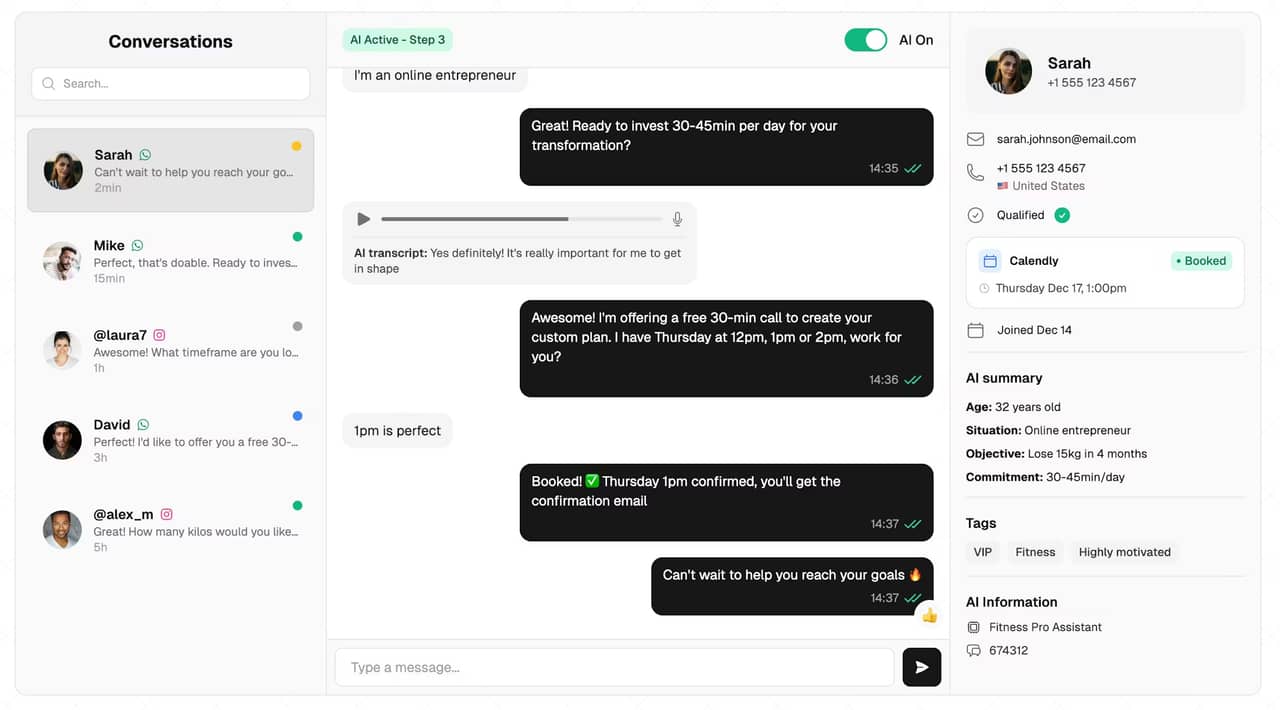
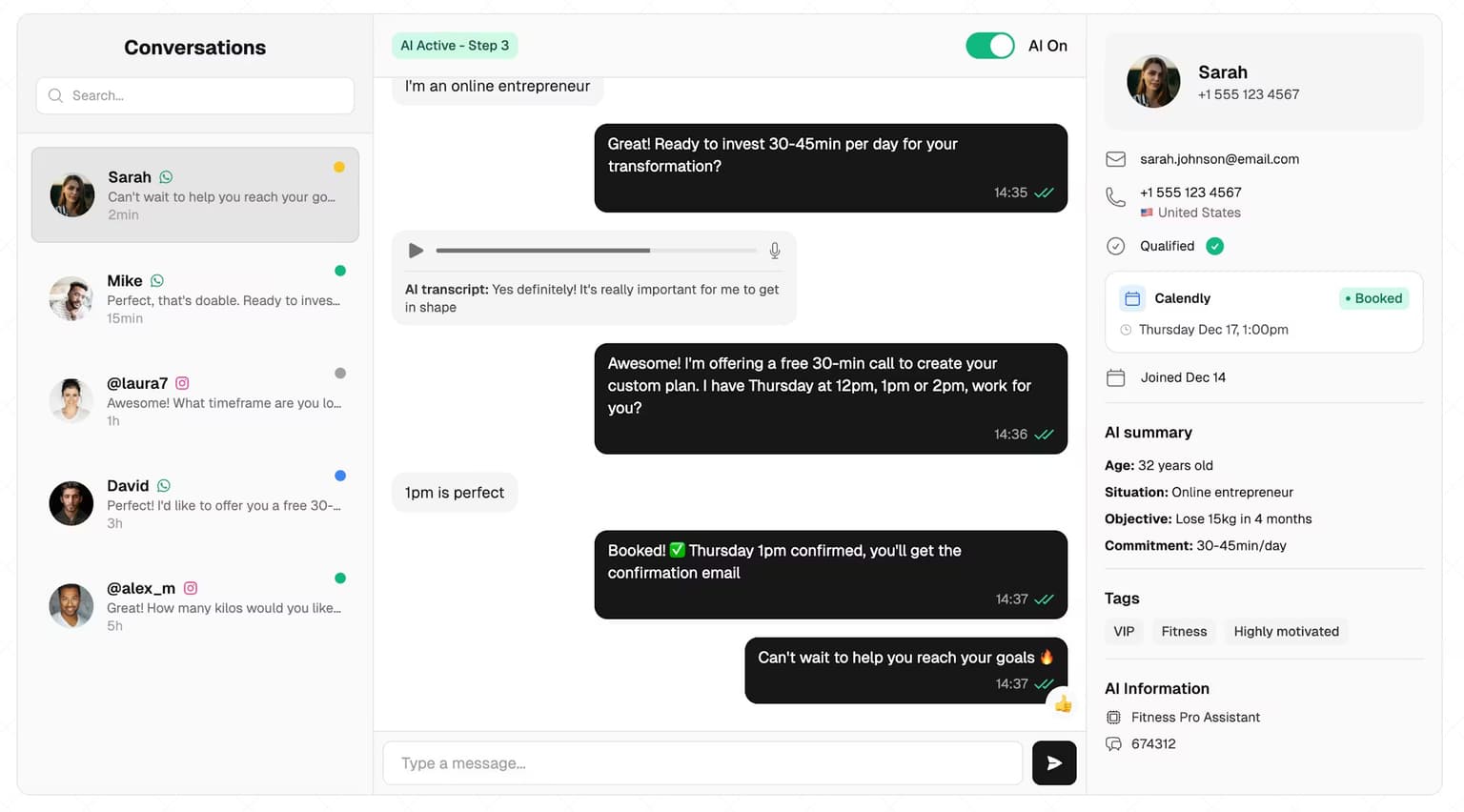
This is the same gap we see across the best AI setters: generic chatbot platforms answer questions, but a dedicated AI setter is built to qualify and book.
Chatbase vs. SetSmart Pricing for Coaches
If your goal is booking sales calls from Instagram and WhatsApp DMs, the honest comparison isn't Chatbase vs. another support bot, it's Chatbase vs. a purpose-built AI DM setter.
| Feature | Chatbase ($32–$400+) | SetSmart ($97) |
|---|---|---|
| Billing model | Per message credit | Flat $97/mo, 1,000 messages |
| Built for | Website / support deflection | DM lead qualification |
| Instagram DMs | Integration (paid tiers) | Core channel |
| WhatsApp + Messenger | Integration (paid tiers) | Native, official Meta APIs |
| In-chat call booking | No | Yes (Calendly / GHL) |
| Smart follow-ups | Limited | Auto at 4h + 23h |
| Cost predictability | Variable (credits + add-ons) | Fixed |
SetSmart's main plan is a free 7-day trial, then $97/month including 1,000 messages, with usage-based pricing above that. There is no per-credit math, which is the opposite of Chatbase's metered model. For a creator who can't predict how busy a launch week will get, a flat rate removes the anxiety.
A quick cost reality check
Picture a coach who gets 600 inbound Instagram DMs in a month, each running 8 to 12 messages to qualify. On Chatbase that's thousands of message credits, pushing you onto Standard or Pro plus auto-recharges, easily $150 to $300/mo. On a flat $97 plan, the busy month costs the same as the quiet one.
And the depth matters: in our analysis of 828K DM conversations, the conversations that qualify and book are the long ones, not the one-line FAQ exchanges. A pricing model that charges you more for every extra AI reply is working against the exact behavior that produces booked calls. Speed matters too, which is why fast, automated replies beat the industry's slow norms documented in our lead response time statistics.
Chatbase Pricing vs. ManyChat and Chatfuel
Most creators evaluating Chatbase are also looking at the flow-based tools that dominate the Instagram and Messenger space. The pricing philosophies are completely different, so a straight "which is cheaper" answer depends on your volume. If WhatsApp is your main channel, our Wati pricing breakdown covers the broadcast-platform side of the comparison.
| Tool | Billing basis | Entry price | Best at |
|---|---|---|---|
| Chatbase | Per message credit | Free, then $32/mo | Website / support AI agents |
| ManyChat | Per active contact | Free, then ~$15/mo | Comment-to-DM flows, link sending |
| Chatfuel | Per active contact | From $39/mo | Messenger flows with AI steps |
| SetSmart | Flat monthly | Trial, then $97/mo | Qualifying DMs + booking calls |
The pattern: contact-based tools (ManyChat, Chatfuel) get pricier as your audience grows even if those people barely message you, while Chatbase's credit model gets pricier as conversations get longer and deeper. For a ManyChat vs. Chatfuel style decision you're comparing flow builders; Chatbase sits in a different category as an AI agent. None of the three were designed to qualify a lead and propose a call slot inside the conversation, which is the job an appointment setter does. That's the line that separates a chatbot from a setter.
A credit-budgeting example
Say you're a nutrition coach and a reel sends 800 people into your DMs in a month. If your AI averages 9 replies per conversation, that's roughly 7,200 message replies. On Chatbase that blows past Standard's 4,000 credits, so you're either on Pro ($400/mo annual) or buying auto-recharge packs at $40 per 1,000 credits, adding ~$130 on top. Your real bill that month is closer to $300 to $400. A contact-based tool would charge for all 800 contacts whether or not they converted. A flat plan charges the same in a viral month as a slow one, which is why predictability is worth real money to a solo creator.
How to Choose the Right Plan
Match the tool to the job, not the other way around.
Pick Chatbase if...
- Your primary need is a website or help-center support bot trained on your docs.
- You want to deflect repetitive questions and reduce support volume.
- You're comfortable with variable, credit-based billing and occasional top-ups.
- DMs are a nice-to-have, not your main acquisition channel.
Pick a DM setter instead if...
- Instagram, WhatsApp, or Messenger DMs are where your leads actually come from.
- You need the AI to qualify leads and book sales calls, not just answer questions.
- You want predictable monthly cost that doesn't spike during launches.
- You run story triggers, comment-to-DM, and "DM the keyword" funnels and need a tool that treats those as first-class.
If you're weighing options across the category, our Chatbase alternative roundup, our AI sales assistant tools guide, and the ManyChat alternatives guide all map the trade-offs for creator and coach use cases. A flow-based tool like ManyChat is great for sending links; a conversational AI setter is built for booking calls.
The Bottom Line on Chatbase Pricing
Chatbase pricing is straightforward on paper, four tiers from free to $400/mo, but the message-credit model plus add-ons (auto-recharge, extra agents, the $1,188/yr branding removal) makes the real cost less predictable than it looks. For a website support agent, it's a solid, fairly priced choice.
For coaches and creators whose business runs on Instagram and WhatsApp DMs, the math and the design both point elsewhere. You want a tool built to qualify inbound conversations and book sales calls on a flat, predictable plan, not a support bot metered by the reply. Verify the latest numbers on chatbase.co before you commit, since pricing changes, and pick the tool that matches where your leads actually live.
FAQ
How much does Chatbase cost in 2026?
Chatbase costs $0 for the Free plan, $32/mo for Hobby, $120/mo for Standard, and $400/mo for Pro on annual billing, with a custom Enterprise tier. Monthly billing runs roughly 25% higher, and message-credit overages or add-ons can push the real cost above the headline price.
Does Chatbase have a free plan?
Yes. The Chatbase free plan gives you $0 access with 50 message credits per month, 1 AI agent, 400 KB of training data, and limited models. Free agents are deleted after 14 days of inactivity, so it's best treated as a test sandbox rather than a production bot.
How do Chatbase message credits work?
Each AI response consumes message credits, and more advanced models cost more credits per reply. Plans include a fixed monthly allowance (500 on Hobby, 4,000 on Standard, 15,000 on Pro), and you can buy more via auto-recharge at $40 per 1,000 credits when you run out.
Is Chatbase worth it for Instagram and WhatsApp DMs?
Chatbase can connect to Instagram, WhatsApp, and Messenger on paid plans, but it's built as a website and support AI agent, not a DM setter. If your goal is qualifying inbound DMs and booking sales calls, a purpose-built AI setter fits the workflow and the budget better.
What's a cheaper Chatbase alternative for coaches?
For coaches and creators, a flat-rate AI DM setter like SetSmart (free 7-day trial, then $97/month) is more predictable than Chatbase's credit model and is built around Instagram and WhatsApp qualification plus in-chat call booking. Flow tools like ManyChat are cheaper still but can't hold real qualifying conversations.
Is Chatbase or ManyChat better for Instagram?
It depends on the job. ManyChat is a flow-based tool strong at comment-to-DM triggers and sending links, while Chatbase is an AI agent better suited to support. Neither books sales calls through natural conversation, which is where a dedicated Instagram chatbot built for setting shines.
Ready to automate your DMs?
Start your free 7-day trial and let AI handle your lead qualification 24/7.
Try SetSmart free