Instagram AI Chatbot: GPT vs Flow-Based (2026)

When most people search for an Instagram AI chatbot, they actually want two different things in one tool: an auto-reply system that handles comments and DMs at scale, AND a conversational agent that can actually qualify a lead and book a call without sounding like a robot.
The catch is that those two needs are powered by completely different tech. One side of the market is flow-based bots (ManyChat, Chatfuel, Tidio) — they execute pre-written button trees. The other side is GPT-based AI agents (SetSmart, Inrō, the newer Meta AI features) — they generate replies on the fly using a large language model.
The difference matters more in 2026 than it did even a year ago, because Instagram now has its own native Meta AI chat inside DMs, and creators ask us almost daily: "Is Meta AI enough? Do I still need a third-party bot? And if I do, should I pick a flow tool or a GPT tool?"
This guide answers all three. Below we break down GPT-based vs flow-based Instagram AI chatbots, where Meta's own AI fits in, what each type costs, and which one books more calls in practice. If you want a side-by-side product listicle instead, our 7 best Instagram chatbots post covers specific tools and pricing, and our Chatbase pricing breakdown shows whether a website-first AI agent's credit model fits Instagram DMs, while the Chatbase review weighs its features and limits for the channel, and our Chatbase alternative guide ranks the DM-native options.
TL;DR
- Flow-based bots are decision trees (if-this-then-that). Great for comment-to-DM lead magnets. Bad at open-ended conversations.
- GPT-based AI chatbots use a large language model to read each message and write a natural reply. Great at qualifying leads. Cost more.
- Meta AI is now baked into Instagram DMs, but it's a general-purpose assistant — not a sales agent for your business.
- For a coach, course creator, or SMMA doing inbound sales on Instagram, a GPT-based AI chatbot trained on your offer outperforms flows on every metric that matters (response rate, qualification rate, booked calls).
- Pricing range in 2026: free (Inrō starter, Meta AI) → $15/mo (ManyChat starter) → $97/mo for full GPT-based sales agents like SetSmart.
What is an Instagram AI chatbot, exactly?
An Instagram AI chatbot is any automated system that reads and replies to messages on your Instagram account — DMs, story replies, and comment-triggered DMs. The word "AI" in the name is doing a lot of work, though, because it covers three very different technologies:
- Rules-based (flow-based) bots. Pre-programmed paths. The bot waits for a keyword or button click, then sends the next message in the sequence. ManyChat, Chatfuel, and most "Instagram chatbot for free" tools live here.
- GPT-based AI agents. A large language model (GPT-4.1, Claude, or a fine-tuned variant) reads the entire conversation history and generates a reply that matches your tone, qualifies the lead, and pushes toward an outcome (book a call, send a price, take an order).
- Meta AI (native). Meta's own assistant inside Instagram DMs. Useful for end users who want recommendations or to chat about general topics. It is not a sales chatbot you can deploy on your own account.
When a creator says "I want to add an AI chatbot to my Instagram," they almost always mean #2 — but they end up buying #1 because it's cheaper and easier to set up. The result is a bot that sends "Hey! Comment 'BOOK' for the free guide!" and then dies the moment the lead asks a question the flow doesn't anticipate.
If you want to dig into how the auto-reply side of this works specifically, our Instagram auto-reply guide walks through the mechanics. For the comment-to-DM flow specifically, see Instagram comment-to-DM automation.
GPT-based vs flow-based: the core difference
Here's the cleanest way to think about it. A flow-based bot is a vending machine. A GPT-based bot is a junior setter you trained.
| Capability | Flow-based bot | GPT-based AI chatbot |
|---|---|---|
| Reads message context | No (only matches keywords) | Yes (full conversation history) |
| Handles unexpected questions | No — falls back to "human handover" | Yes — generates a relevant reply |
| Time to set up | 2-6 hours (building flows) | 15-30 minutes (uploading your offer doc) |
| Brand voice | Robotic (templated) | Natural (trained on your tone) |
| Qualifies leads | Only via multi-choice buttons | Yes — asks open questions and listens |
| Books calls (Calendly, etc.) | Yes (after a button path) | Yes (when the lead is ready) |
| Handles non-English DMs | No (unless you build a flow per language) | Yes (LLM detects + replies) |
| Cost in 2026 (per month) | $0 - $15 (Inrō, ManyChat starter) | $97 - $300 (SetSmart, custom) |
| Best use case | Lead-magnet delivery, simple FAQ | Inbound sales, qualification, booking |
The trade-off is straightforward: flows are cheap and predictable but break the moment the lead deviates from the script. GPT-based AI handles deviations natively, but costs more and needs an offer document, a tone reference, and a goal to work properly. If you want a tool that maps to specific products in each camp, check our roundup of the best AI setters.
Why GPT-based AI chatbots book more calls in 2026
This isn't theoretical. Across our analysis of 828K AI-driven DM conversations on Instagram and WhatsApp (study here), the single biggest predictor of a booked call wasn't channel, vertical, or even offer price — it was conversation depth. Conversations that reached 11 or more messages booked calls 412× more often than conversations that died at message 1-4.
Why? Because flow-based bots tend to stall at message 2 or 3. The lead replies with something off-script ("hey what's the price first?" / "do you work with people in Spain?"), the flow has no matching keyword, and the conversation either dies or gets routed to a human inbox that nobody checks. GPT-based bots, by contrast, just answer the question and keep the thread alive — which is exactly the behavior that compounds into booked calls.
A few other structural reasons GPT-based AI is pulling ahead of flow-based on Instagram specifically:
- Instagram users type in full sentences, not buttons. The DM interface looks like iMessage, not like a website chat widget. Button menus feel out of place; natural replies don't.
- Meta is loosening its 24-hour messaging window for AI agents (in tests as of late 2025). Bots that send relevant, contextual follow-ups have more room than bots that send the same scripted nudge.
- Coaches and creators sell with personality. A flow-based bot dilutes your brand voice into multiple-choice buttons. A GPT-based bot can be trained on your own DMs to sound like you.
- The qualification window is short. Instagram leads convert in days, not weeks (unlike B2B email). You need an agent that can ask the right qualifying questions in DM #1 or #2.
For the broader playbook on how this plays out on the platform, see our guide on how to automate Instagram DMs with AI.
What about Meta AI inside Instagram?
In 2024 Meta started rolling out Meta AI — a chat interface inside Instagram, WhatsApp, and Messenger. Users can summon it with @MetaAI in a DM, or open a dedicated chat from the inbox. By 2026, Meta AI is available in most regions (with some EU restrictions tied to GDPR), and it's free.
Here's what Meta AI is and isn't:
| Question | Answer |
|---|---|
| Can I talk to Meta AI from my Instagram account? | Yes — anyone can. |
| Can I make Meta AI reply on behalf of my business? | No. It's a personal assistant, not a deployable agent. |
| Does Meta AI qualify leads or book calls for me? | No. It doesn't know your offer, your calendar, or your audience. |
| Will Meta AI replace third-party Instagram chatbots? | Not in the near term. It complements them but doesn't serve the inbound-sales use case. |
| Can users opt out of Meta AI on Instagram? | Yes, partially — settings vary by region and account type. |
If you searched "Instagram AI chatbot" hoping to figure out Meta AI specifically (some PAA questions on the SERP suggest a lot of people do), the short version is: Meta AI is a feature for consumers using Instagram. The chatbot most businesses want — one that answers DMs, qualifies leads, and books calls — still has to come from a third-party tool connected through the Meta Business API.
The 3 types of Instagram AI chatbot
It helps to separate the market into three honest buckets, because the buying decision is different in each one.
1. Free / starter flow bots (Inrō, ManyChat free, Chatfuel free)
These are entry-level keyword-trigger bots. Set up a comment trigger, send a lead magnet, capture an email. You'll see them in every "Instagram automation for free" article on the SERP.
- Best for: A creator with under 10K followers who just wants a comment-to-DM lead-magnet flow.
- Won't do: Conversational qualification, multi-language replies, or anything outside the pre-built flow.
- Risk: You'll grow out of it within 60 days. The DMs that come in via the lead magnet won't be answered intelligently — you'll have a full inbox and no booked calls.
- For pricing details: Chatfuel pricing, ManyChat pricing, and is ManyChat free.
2. Mid-tier flow bots with AI add-ons (ManyChat Pro + OpenAI block, Chatfuel + GPT step)
In 2024 most flow-based tools added an "AI step" — an OpenAI API call inside a flow. The bot still runs a tree, but inserts a GPT-generated reply at one or two specific nodes (typically for "answer this question about my product"). It's a hybrid, and it works well for narrow tasks.
- Best for: A creator who already has a working ManyChat or Chatfuel flow and wants to plug in a "smart FAQ" step.
- Won't do: Fully conversational qualification, because the AI step is still bounded by the flow tree around it. The bot eats your OpenAI tokens each time, which adds a variable cost layer.
- Risk: Most teams stitch this together and end up with a fragile pipeline (flow → API → flow) that breaks when Meta updates webhook behavior.
- See ManyChat alternative for tools that move beyond the flow + AI-step hybrid.
3. GPT-native AI agents (SetSmart, Instaset, custom agents)
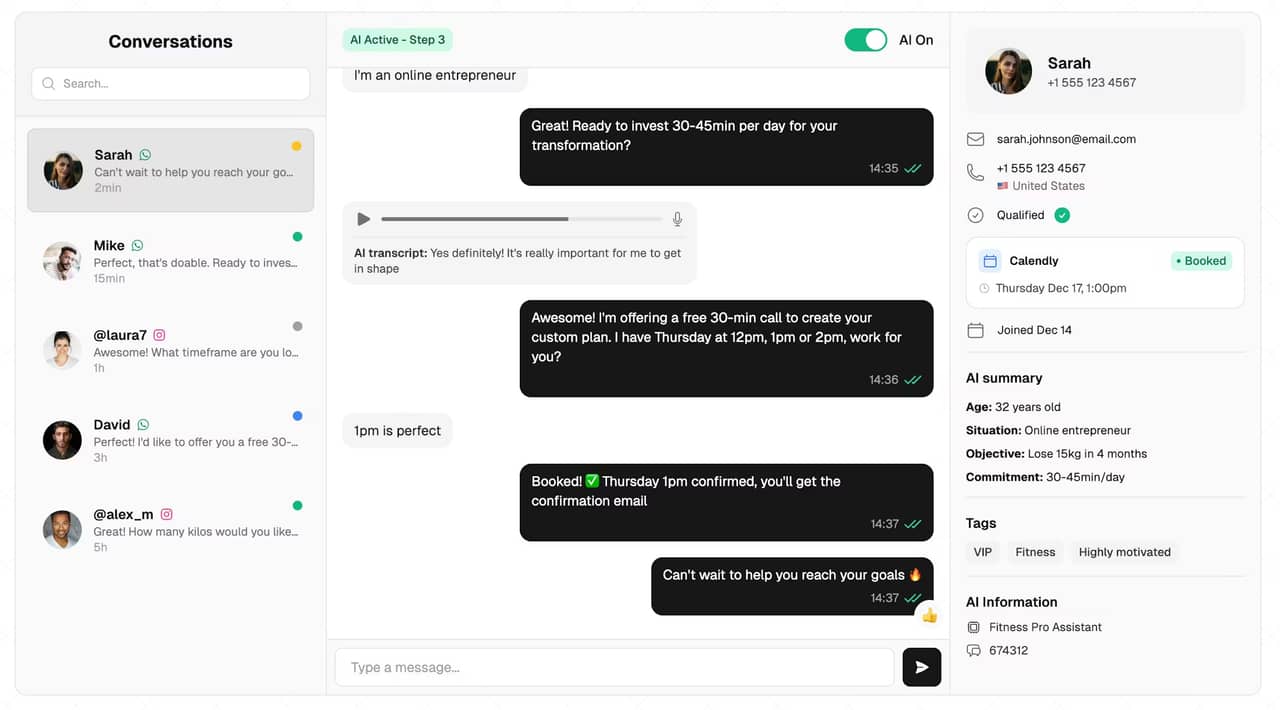
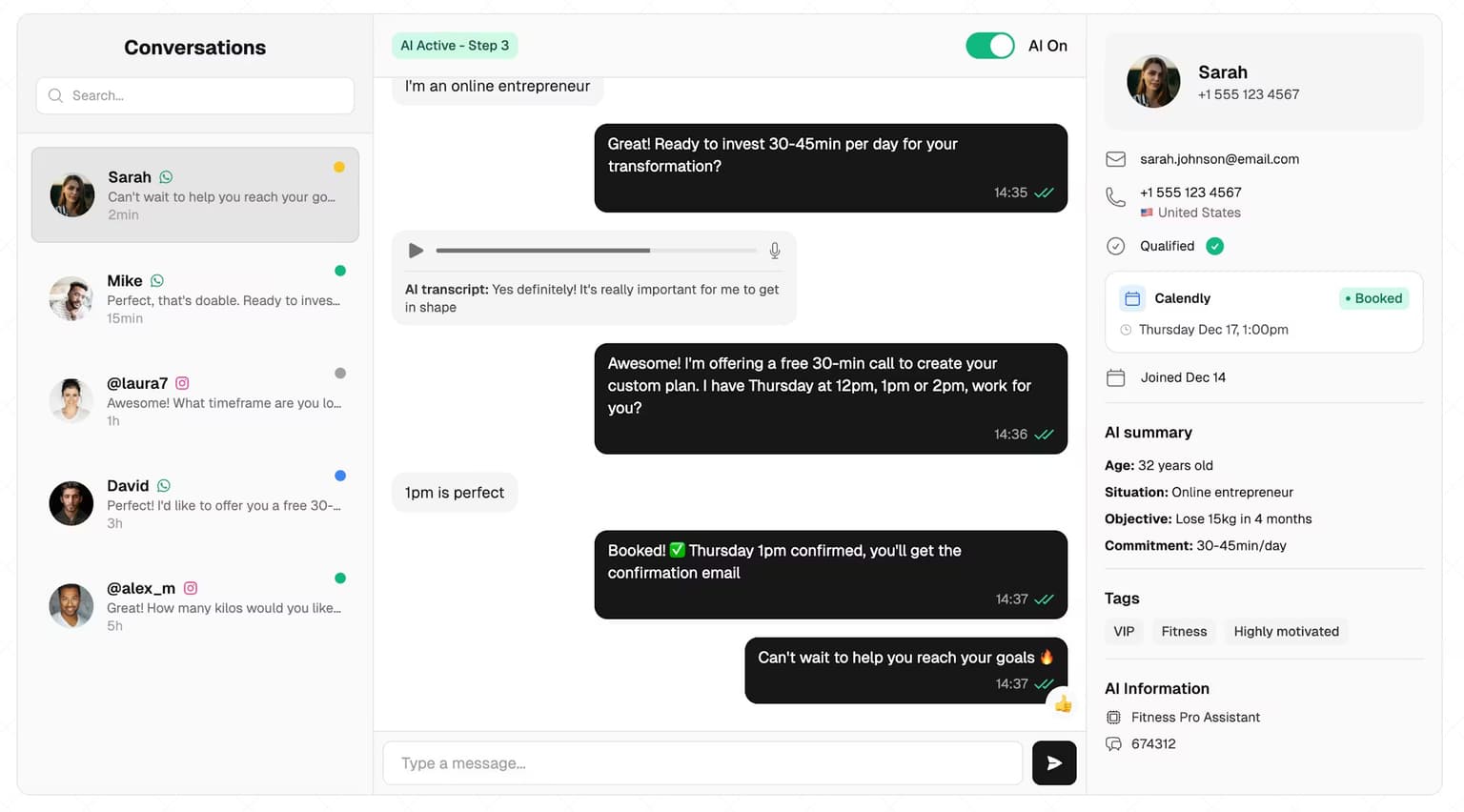
These tools are built around an LLM from day one. You don't draw a flow — you upload an offer document, set the agent's goal (qualify, book a call, take an order), and let the model handle every reply. The agent reads the entire conversation history each time, decides what to ask next, and only hands off to a human when truly necessary.
- Best for: Coaches, course creators, info-product sellers, agencies reselling a white label AI chatbot, and ecommerce brands who get more than 20-50 inbound DMs a day and want them all answered intelligently.
- Won't do: Replace your offer or your sales process. Garbage in, garbage out — if your offer doc is vague, the agent will be vague.
- Risk: Higher monthly cost. You'll typically pay $97-$300/month depending on volume.
- This is the category SetSmart sits in. If you want the deeper "what is a DM setter" framing, that post covers the role.
How to choose between GPT and flow
A short decision tree:
- Are most of your DMs sales-oriented (lead asking about your offer, pricing, booking)? → Pick a GPT-based AI agent.
- Are most of your DMs predictable opt-ins from comment triggers (lead magnet, ebook, free training)? → A flow-based bot is enough.
- Mixed? → Start with a GPT-based agent that supports comment-to-DM triggers as a feature (most do in 2026). You get the best of both worlds without stitching two tools together.
- Budget is the constraint? → Start with Inrō free or ManyChat free. Upgrade within 60-90 days when the flow's limitations become obvious.
- You sell high-ticket (>$1,000)? → GPT-based, no exceptions. Flows leave money on the table because they can't handle objections or build trust mid-conversation.
The single best signal you've outgrown a flow-based bot: you start losing leads at message 2 or 3 because the bot's "I'll let a human reply" fallback never gets handled. Our Instagram DM bot breakdown goes deeper on that failure mode.
How SetSmart connects
SetSmart is a GPT-based AI chatbot built specifically for inbound DMs on Instagram, WhatsApp, and Messenger. You upload your offer document, set the qualification questions you'd ask if you were doing it yourself, and the agent handles every DM in your tone.
- What it does: Reads each incoming DM, decides what to ask next, qualifies the lead, and books a call on your calendar when the lead is ready.
- Response time: Under 5 seconds, versus an industry average of 42 hours for unanswered inbound DMs.
- Channels: Instagram, WhatsApp, Messenger — same agent, one inbox.
- Languages: Auto-detects and replies in 30+ languages.
- Pricing: Free 7-day trial, then $97/month (1,000 messages included).
SetSmart is a Meta Business Partner, which matters because the Instagram Graph API has gotten stricter about who can deploy AI on the platform. For more on that, see our Instagram business chat guide.
Sample conversation: flow vs GPT
This is a real-shaped example of how the same incoming DM plays out in each system. The lead is responding to a story poll about a $497 coaching program.
Lead message 1: "saw your story — interested in the coaching program but how does the pricing work?"
Flow-based bot reply: "Hi! 👋 Thanks for reaching out. To get the full details on our coaching program, please click below: 📝 Pricing info | 📞 Book a call | 💬 Talk to a human"
GPT-based AI agent reply: "Hey! Quick context first so I can answer that properly — are you looking for the group program ($497) or the 1-on-1 track? And what's the main thing you're working on right now?"
The flow forces the lead to choose from a menu. The GPT agent gathers context to qualify and personalize the answer. Both get a reply out fast, but only the GPT version starts a real conversation. By message 5, the flow bot is usually waiting for a "human" who never logs in; the GPT agent has already qualified the lead and is asking what time on Tuesday works for the call.
If you want a fuller playbook on the exact scripts that work in 2026, see Instagram DM scripts and the broader Instagram DM marketing framework.
5 mistakes that kill an Instagram AI chatbot
After deploying chatbots for hundreds of creator and SMMA accounts, the same five errors show up over and over.
1. Treating "AI" as a checkbox feature
Adding an "OpenAI block" to a ManyChat flow is not the same thing as deploying a GPT-based AI agent. The AI block runs once, in a fixed slot, with no memory of the rest of the conversation. If the rest of your bot is a flow, your "AI chatbot" is still a flow with one smart node.
2. Skipping the offer document
GPT-based agents need to know what you sell, what the price is, who it's for, and who it's not for. If you don't write those down clearly, the agent will hallucinate — sometimes inventing pricing or features you don't offer. A 1-page offer doc is the bare minimum.
3. No qualification criteria
"Qualify the lead" is too vague. You need to specify the 2-3 questions the agent must answer before booking a call (budget, timeline, fit). Without them, the bot books low-quality leads and your calendar fills with no-shows.
4. No follow-up logic
Even a brilliant first reply isn't enough. In our 828K dataset, a single follow-up roughly doubles booked calls (+106% among engaged leads). If your AI chatbot doesn't follow up after 4-24 hours, you're leaving most of the value on the table. Our AI lead follow-up post breaks down the cadence.
5. Picking the cheapest tool first
The "free Instagram chatbot" path is fine for the first 90 days, but the moment you start running paid ads to Instagram or hitting 50+ inbound DMs a day, the flow-based bot becomes the bottleneck. Migrating tools mid-campaign costs you weeks. Pick the tool that fits where you're going, not where you are.
7-day rollout plan
If you're starting from zero, here's a realistic 7-day plan to get a GPT-based Instagram AI chatbot live.
| Day | Task |
|---|---|
| 1 | Pick a tool. If you only need flows → ManyChat. If you want a real AI agent → SetSmart or Inrō Pro. |
| 2 | Write the offer document (1 page: what, who, price, what's included, what's not). |
| 3 | List your 3 qualification questions. Write your booking-link copy. |
| 4 | Connect the tool to your Instagram Business account via the Meta Business API. |
| 5 | Test with 10 fake conversations. Edit the agent's instructions until replies feel like you. |
| 6 | Run a small story poll or comment-to-DM trigger to drive 20 real inbound DMs. |
| 7 | Review the 20 conversations. Adjust the offer doc and qualification questions based on real edge cases. |
By the second week you'll have a tuned agent and a clear sense of which conversations need human handoff and which can run end-to-end automated.
When an Instagram AI chatbot is the wrong choice
A few honest disqualifiers:
- You're a service business with bespoke pricing. A bot that has to negotiate scope per lead will struggle. Use it for lead qualification only, then hand off to a human.
- Your offer is complex regulated content (legal, medical, financial advice). AI compliance is improving but the cost of one bad reply is high. Use the bot for routing and human-handoff only.
- You get fewer than 5 inbound DMs a week. You'd save more time hiring a part-time human VA than configuring an AI agent.
- You sell exclusively in a region where Meta AI restrictions affect your account. Some EU accounts have limited third-party AI deployment options as of 2026.
For everyone else, the math is straightforward: under-5-second replies, 24/7, 30+ languages, no salary. The question is which type of AI chatbot fits your actual use case, not whether you should use one.
Instagram AI chatbot vs other channels
Instagram is one channel. If you're considering a multi-channel rollout, here's the short comparison.
| Channel | Best AI use case | Notes |
|---|---|---|
| Instagram DM | Inbound sales for creators, coaches, SMMAs | Highest reach for B2C; story replies drive volume |
| High-intent qualification + post-call follow-up | 23% open-rate; WhatsApp automation guide | |
| Messenger | Lower-volume in 2026 but still strong for retargeting | See Messenger chatbot |
| Long-cycle nurturing post-DM | Pair with DM, don't replace |
Real-account snapshot
Mathis Ladoué, who runs a high-ticket coaching offer and tested both a flow-based bot and a GPT-based agent over the same 30-day period:
"I had ManyChat for months — it sent the lead magnet fine but every conversation died after that. Switched to SetSmart, kept the comment-to-DM trigger, and within two weeks I was getting 5-7 booked calls a week from DMs I would have lost. The qualifying questions feel like I wrote them in person."
His before/after wasn't a tool swap — it was a category swap. Flow-based to GPT-based.
FAQ
What is an Instagram AI chatbot?
An Instagram AI chatbot is an automated system that reads and replies to Instagram DMs, comments, and story replies. The "AI" part can mean either a flow-based bot (decision tree), a GPT-based agent (large language model), or Meta's native AI assistant.
How do I opt out of AI on Instagram?
Meta AI can be limited or disabled in Settings → Account → Apps and websites in some regions (mostly EU). For third-party AI chatbots on a business account, the account owner controls deployment — leads can't opt out individually but they can stop replying.
What are the best AI chatbots in 2026?
The best Instagram AI chatbots in 2026 split into two categories: flow-based (ManyChat, Chatfuel, Inrō free) for lead-magnet workflows, and GPT-based (SetSmart, Instaset) for inbound sales and lead qualification. See our 7 best Instagram chatbots for a side-by-side comparison, or our SetSmart vs Inrō head-to-head for the AI-agent matchup.
Is Meta AI the same as an Instagram chatbot?
No. Meta AI is a personal assistant inside Instagram DMs for end users to chat with. A business Instagram chatbot is a separate tool you deploy on your account to reply to your own incoming DMs.
Is an Instagram AI chatbot free?
Some are. Inrō and ManyChat have free starter tiers that cover comment-to-DM triggers and basic flows. GPT-based AI agents (SetSmart, Instaset) start around $97/month because of the LLM inference cost.
Can an Instagram AI chatbot book calls automatically?
Yes — GPT-based agents can ask qualifying questions, send a Calendly or Cal.com link, and confirm the slot inside the DM. Flow-based bots can also book calls, but only via a button path; they can't qualify the lead mid-conversation.
Is it safe to use an AI chatbot on Instagram?
Yes, provided your chatbot vendor is a Meta Business Partner and uses the official Graph API. Don't use grey-market browser-automation bots — they violate Meta's terms and risk getting your account banned.
How long does it take to set up an Instagram AI chatbot?
A flow-based bot takes 2-6 hours to design. A GPT-based agent takes 15-30 minutes once you have a 1-page offer document and 3 qualification questions ready.
Ready to automate your DMs?
Start your free 7-day trial and let AI handle your lead qualification 24/7.
Try SetSmart free