AI Lead Follow Up: Why It Doubles Calls (2026)

Most leads don't ghost you because they're not interested. They ghost because they got distracted, opened your DM in line at the gym, then forgot. AI lead follow up is the quiet mechanism that recovers those conversations — without you ever opening the app.
This is the highest-ROI lever in modern sales. In our study of 828,761 AI DM conversations across 391 businesses, a single automated follow-up more than doubled booked calls (+106%) and qualification rates (+112%) among engaged leads. On Instagram specifically, follow-ups nearly tripled qualification (+182%).
This guide breaks down what AI lead follow up actually is, why it works, when to send it, what to write, and how to set it up across Instagram, WhatsApp, and Messenger.
What Is AI Lead Follow Up?
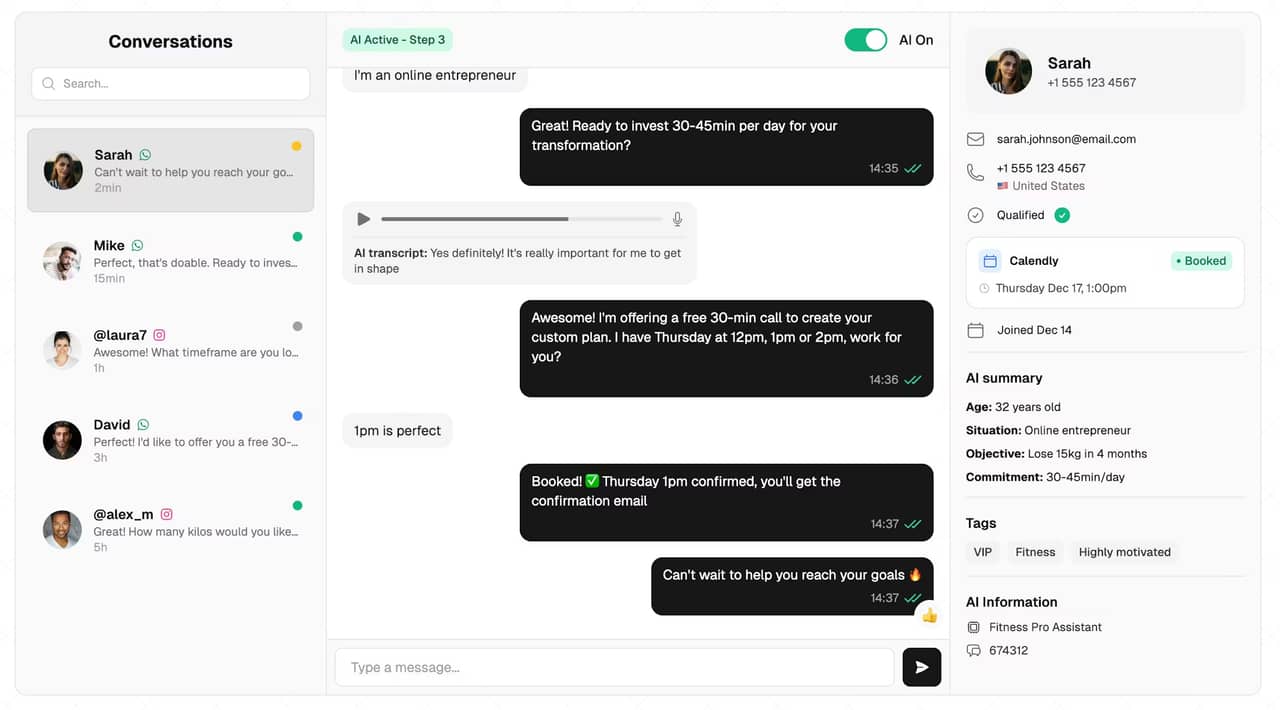
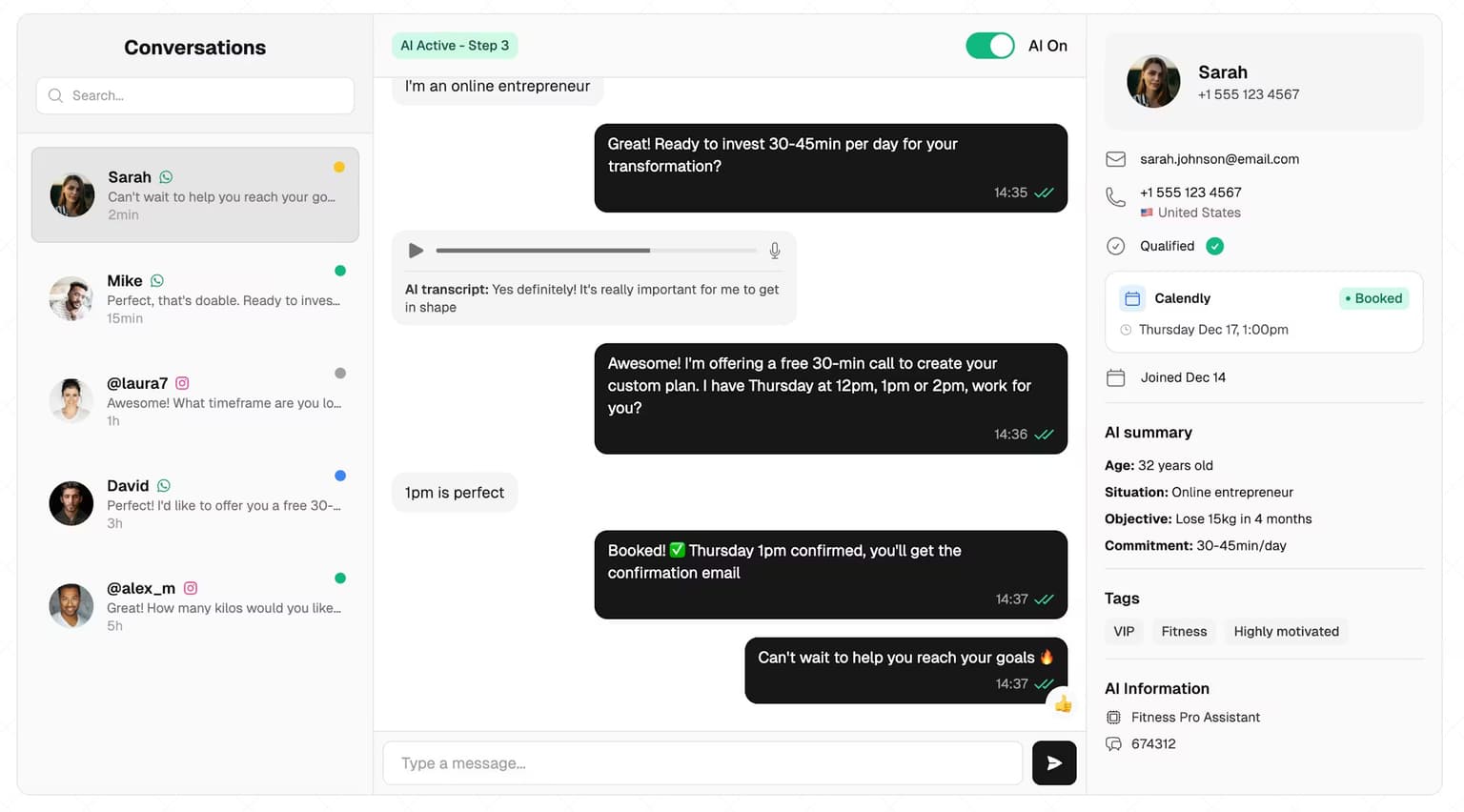
AI lead follow up is the use of an AI agent to automatically re-engage leads who stopped responding mid-conversation. Instead of relying on a human SDR to remember to ping a silent lead 4 hours later, an AI setter detects the silence, picks a context-aware message, and sends it at the right moment — across Instagram DMs, WhatsApp, Messenger, or SMS.
Three properties separate AI follow-up from a basic drip sequence:
- It reads context. A drip sends the same message to everyone. An AI follow-up checks the last message in the thread and adapts the tone — "still thinking about the program?" if the lead asked for pricing, "I'm here if you have any questions" if they only said hello.
- It stops on its own. When a lead replies, the AI cancels the next scheduled follow-up automatically and resumes a normal AI lead qualification conversation. This is the failure point in 90% of homemade automations.
- It books the call when the lead is ready. A good AI DM setter doesn't just nudge — it proposes a calendar slot in the same message when the lead's intent is high enough.
If you're new to the broader concept of AI in DMs, start with our overview of what a DM setter does. This article focuses specifically on the follow-up mechanism, which is the single biggest performance lever inside any DM-based sales system.
Why AI Lead Follow Up Works: The Data
Sales teams have been told for years that "the fortune is in the follow-up." That's true on email and phone. In DMs, the effect is even stronger — and we have the numbers to prove it.
Most conversations die before they should
Out of 828,761 AI conversations in the SetSmart study, 53.3% never made it past the second message. That's 441,000 leads who responded once, then went silent. Without follow-up, every single one is dead.
The key insight: most "ghosting" isn't rejection. It's friction. The lead got pulled into a meeting, lost the notification under 30 other messages, or wanted to think about it. They're not gone — they're just not in the app right now.
A single follow-up doubles everything
Looking only at engaged leads (those who responded at least once), here's what happens when an automated follow-up is enabled:
| Metric | Without follow-up | With one follow-up | Lift |
|---|---|---|---|
| Qualification rate | 19.17% | 40.65% | +112% |
| Booked calls rate | 8.66% | 17.84% | +106% |
These aren't hypothetical numbers. They're the actual delta measured across 828K conversations. One message — sent automatically when the lead goes silent — doubles your booked calls.
Instagram benefits the most
The lift is even bigger on Instagram, where follow-ups nearly triple qualification:
- Instagram qualification: +182% with a single follow-up (14.11% → 39.85%)
- WhatsApp qualification: +34% with a single follow-up (31.48% → 42.17%)
Why the gap? Instagram leads tend to reply once, scroll past the next notification, and forget. A 4-hour nudge pulls them back into the thread. On WhatsApp, leads are more transactional and less distracted, so the baseline is already higher. For deeper Instagram tactics, see our Instagram DM automation guide and the Instagram DM marketing playbook for the wider funnel.
Speed matters, but persistence matters more
The classic "5-minute rule" (responding within 5 minutes makes you 21x more likely to qualify) is still true — see our lead response time statistics page for the full data. But once everyone uses AI to respond instantly, persistence becomes the new differentiator. The 828K dataset shows that conversations with 11+ messages are 68x more likely to qualify than those with 1–4 messages. Follow-ups are the mechanism that pushes a stalled 3-message thread into a 12-message qualifying conversation.
When to Send AI Follow-Ups: The 4h + 23h Pattern
The single most common question we get from coaches and agencies setting up AI follow-up: how long should I wait?
Across hundreds of millions of messages, the pattern that consistently produces the highest qualification lift is two follow-ups, scheduled at:
- First follow-up: ~4 hours after the lead goes silent
- Second follow-up: ~23 hours after the lead goes silent
That's it. Two messages. Don't add a third unless your offer is high-ticket and your AI is excellent at value-add nudges.
Why 4 hours, not 1?
A 1-hour follow-up feels desperate and often catches the lead mid-distraction (they replied during a meeting). A 4-hour gap matches the natural rhythm of someone checking their phone — they had time to think, they're back on Instagram, your follow-up surfaces in their notifications. Conversion rates are statistically the same whether you send at 3h or 5h, so 4h is the safe default.
Why 23 hours, not 24?
A 24-hour follow-up arrives at the exact same time the original message did. If the lead was busy at 6pm yesterday, they're often busy at 6pm today. Pulling it in by an hour catches them at a slightly different moment in their day. Small detail, measurable lift.
Why not more than 2 follow-ups?
Three or more follow-ups produce diminishing returns and start triggering Meta's spam signals on Instagram and WhatsApp Business API. After two unanswered nudges, the right move is to put the lead in a long-tail nurture sequence (weekly value email, retargeting ad) — not to keep DMing.
How to Write an AI Follow-Up Message
Direct answer: keep it under 25 words, ask one question, never reference the gap. Here are the three patterns that actually work.
Pattern 1: The soft check-in
Hey name, didn't want this to get buried — were you still curious about thing they asked about?
Why it works: it acknowledges the silence without guilt-tripping, and reopens the loop with a specific reference to their last question. No "just following up" energy. For more script ideas, our Instagram DM scripts library has 30+ tested variants.
Pattern 2: The value-add
Quick thought — most their role who ask about this end up wanting to know about adjacent question. Want me to share what we do there too?
Why it works: it gives the lead a reason to re-engage that's not "buy now." It positions you as helpful, not pushy. Best for high-ticket coaching and consulting offers.
Pattern 3: The direct CTA
Still keen on their goal? I have a 15-min call open Tuesday at 3pm or Thursday at 10am — want one?
Why it works: when intent was already clear in the first conversation, don't dance around it. Propose two slots, let the lead pick. This pattern is what drives the +106% booked calls lift in the data.
The AI should pick which pattern to use based on how clear the lead's intent was in the first conversation. Vague replies → soft check-in. Asked one specific question → value-add. Said "I'm interested, send me more info" → direct CTA.
Channel-Specific AI Follow Up Tactics
Instagram DM follow-ups
Instagram is where AI follow-up has the biggest impact (+182% qualification lift). A few channel-specific rules:
- Use the lead's name only if they used yours first — Instagram's vibe is more casual than email
- Voice notes work surprisingly well as a second follow-up — they signal you're a real human and bypass DM saturation
- Don't follow up across separate threads if the lead also commented on a Reel — Meta's API treats each surface differently and you risk looking spammy
- Best time of day: evenings (6pm–11pm) book 31% more calls than afternoons in our dataset
Our how to automate Instagram DMs with AI guide covers the full Instagram setup beyond follow-ups. If you're picking a tool, see our best AI setters breakdown for which platforms handle Instagram follow-ups properly via official Meta APIs.
WhatsApp follow-ups
WhatsApp follow-ups are subject to the 24-hour customer service window rule. After 24 hours of lead silence, the next message must be a pre-approved template (Meta will charge a marketing or utility conversation fee, typically $0.025–$0.04 per recipient depending on country).
This means your AI follow-up cadence should be:
- First follow-up: 4 hours (free, inside the window)
- Second follow-up: 23 hours (still inside the window — the reason for 23, not 25, is partly this)
- Third nudge (if any): a templated re-engagement message sent 3–7 days later
The good news: WhatsApp leads are far more responsive once engaged. Our data shows WhatsApp responders qualify at 34% — nearly 2x Instagram's rate. Combine that with click-to-WhatsApp ads (covered in our click-to-WhatsApp ads guide) and you have one of the highest-converting funnels available right now. For the broader WhatsApp playbook, see our WhatsApp automation guide.
Messenger follow-ups
Facebook Messenger sits between the two. The 24-hour window applies, but Messenger users tolerate slightly more nudges than Instagram users (different demographic, more transactional mindset). Same 4h + 23h sales cadence works — see our wider Messenger chatbot guide for the channel-specific stack.
How to Set Up AI Lead Follow Up (5 Steps)
Below is the practical setup checklist we walk every new account through. It applies whether you use SetSmart, a competitor, or a homemade Zapier flow.
Step 1: Pick the channel where leads actually reply
Audit your last 100 inbound leads. For most coaches, course creators, and agencies, 70%+ of replies happen in Instagram DMs and WhatsApp — not email. Set up follow-up where the volume is, not where you wish it was.
Step 2: Define your two follow-up windows
Default: 4 hours, 23 hours. Don't overthink it. You can adjust later based on data.
Step 3: Write three short follow-up variants
One per pattern (soft check-in, value-add, direct CTA). Keep each under 25 words. Have a friend read them out loud — if they sound like a real human texting, you're good. If they sound like a bot, rewrite.
Step 4: Configure the AI to detect engagement and stop
This is the most important step. Tell the AI:
- Which signals mean the lead is engaged (answered a qualifying question, said "yes" to a call)
- What to do once engaged (book the call, ask follow-up qualifying questions)
- When to fully stop (lead said "not interested", lead booked, lead asked you to stop)
Without this, your AI will keep nudging leads who already booked. That's the fastest way to get blocked.
Step 5: Measure qualification rate before and after
Run for 14 days with follow-ups off. Then 14 days with follow-ups on. Compare qualification rate. You should see a +50–100% lift within 2 weeks. If not, your bottleneck isn't follow-up — it's your offer clarity or your first message. Our AI sales assistant comparison has more on diagnosing bottlenecks across the funnel.
AI Follow Up vs Human Follow Up
Direct answer: a human SDR will write a slightly better individual follow-up. An AI will send 100x more of them, on time, every time.
| Dimension | AI follow-up | Human follow-up |
|---|---|---|
| Response time | < 5 seconds | 4–47 hours |
| Cost per 1,000 leads | $97/month flat | $2,000–$4,000 SDR salary |
| Consistency | 100% (never forgets) | ~30% (humans forget) |
| Personalization | Good, context-aware | Excellent on rare edge cases |
| Works at 3am Sunday | Yes | No |
| Handles 1,000+ open threads | Yes | No |
The math is brutal. A competent SDR remembers to follow up on maybe 30% of stalled leads. An AI follows up on 100% of them, in under 5 seconds of calendar time. At scale, the AI wins on volume even if its individual messages are 10% worse.
That doesn't mean humans go away. The right model in 2026 is AI handles every initial conversation and every follow-up. Humans handle the actual sales call once the lead is qualified and on the calendar.
Common AI Follow-Up Mistakes
Three failure patterns we see constantly:
Mistake 1: Too many follow-ups
Three, five, seven nudges. The lead either books, blocks, or reports you as spam. Two follow-ups is the data-backed sweet spot.
Mistake 2: Generic templates
"Hey, just checking in!" sent to a lead who asked a specific pricing question. The lead knows it's a bot. The AI should reference the actual context of the previous message.
Mistake 3: Follow-ups that don't stop
The most embarrassing failure: lead booked the call, AI keeps DMing them "still interested?" three more times. Make sure your tool has a booked = true exit condition built in. Most don't.
Mistake 4: Ignoring the channel rules
Sending a 25-hour WhatsApp follow-up as a free-form message. Meta blocks it, you don't realize for a week, you've lost 7 days of leads. Always respect the 24-hour customer service window on WhatsApp.
Mistake 5: No exit signal for "not interested"
If a lead replies "not interested, please stop", the AI must immediately stop the entire follow-up sequence and tag the conversation. Most homemade flows ignore negative signals and keep nudging — which is the single fastest way to get reported for spam, especially on WhatsApp. Spend 10 minutes upfront writing the exit conditions; it saves your account.
Mistake 6: Using the same follow-up for cold and warm leads
A lead who clicked a click-to-WhatsApp ad and asked about pricing is warm. A lead who replied to a Story poll with one emoji is cold. They need completely different follow-ups. The warm lead gets the direct CTA pattern. The cold lead gets the soft check-in. Sending the direct CTA to the cold lead burns the relationship in one message.
Real Examples of AI Follow-Ups That Booked Calls
Below are three anonymized examples from accounts running on the SetSmart platform. Names changed, structure preserved.
Example 1: Coaching offer, Instagram DMs
The lead messaged after a Reel about a 12-week mindset program. The first AI exchange went well — the lead shared their goal and asked about pricing — but they ghosted before booking. The 4-hour follow-up was a soft check-in:
Just wanted to make sure that didn't get lost — the early-bird spot is open until Friday if you want to grab a 15-min call to see if it's a fit.
The lead replied within 11 minutes. The AI proposed two slots in the same message. The lead picked one. Total time from first message to booked call: 6 hours, 100% AI-driven.
Example 2: SMMA, WhatsApp click-to-ad funnel
The lead clicked a Facebook ad for a done-for-you lead-gen service. The first message went through the AI's standard qualification (industry, monthly ad spend, current CPA). The lead answered all three questions and then went silent. The 4-hour follow-up was a value-add:
One thing most agencies miss in your industry is the specific tactic — happy to share a quick Loom showing how it works. Want me to send it?
The lead said yes, the AI sent the resource link, and 23 hours later sent a direct CTA proposing a call. Booked.
Example 3: High-ticket consulting, Messenger
The lead was a CEO who responded to a LinkedIn post and was redirected to Messenger. Heavy initial engagement, then 3 days of silence. The first follow-up at 4h didn't land. The 23h follow-up did. Pattern used: direct CTA with two specific time slots and a single-sentence outcome promise.
30 minutes, two questions, one decision: whether the framework I shared on LinkedIn applies to your business. Tuesday 2pm or Thursday 11am?
The lead replied, "Thursday 11am works." Booked.
The common thread across all three: the follow-up was specific, short, and proposed a next action. None of them said "just checking in." None of them apologized for the gap.
Where AI Lead Follow Up Fits in the Bigger Picture
Follow-up is the single highest-ROI lever in modern DM sales — but it sits inside a larger system. The full funnel looks like:
- Generate the lead (ads, content, comment-to-DM)
- Respond instantly (AI setter responds in < 5 seconds)
- Qualify through conversation (AI asks 3–5 qualifying questions naturally)
- Follow up on silence (4h + 23h pattern — the focus of this article)
- Book the call in-DM (AI proposes calendar slots without leaving the thread)
- Hand off to human closer (qualified leads go to a real sales call)
Skip any of these stages and the funnel breaks. But if we had to point to the single biggest leak in 9 out of 10 accounts we audit, it's stage 4. Most businesses simply don't follow up. Turning on automated follow-up is the single biggest win available to almost everyone reading this.
FAQ
Does AI lead follow up actually work, or do leads see it as spam?
It works — provided the messages are short, contextual, and capped at two. In our 828K conversation dataset, automated follow-ups doubled booked calls (+106%) without measurable spam complaints. Leads tolerate one or two thoughtful nudges; they reject five generic blasts. The line is in the volume and the context, not in whether AI sent it.
When should I send the first AI follow-up?
Around 4 hours after the lead goes silent. Earlier (1–2 hours) feels desperate. Later (8+ hours) lets the conversation cool too much. Send the second around 23 hours later. Two messages, then stop.
What's the best AI tool for lead follow up?
The best tool depends on the channel. For Instagram DMs and WhatsApp, SetSmart handles the 4h + 23h pattern natively, respects WhatsApp's 24-hour window, and stops follow-ups automatically when the lead books. For comparison with other AI sales tools, see our AI sales assistant comparison.
Will AI follow-ups get my Instagram or WhatsApp account banned?
No, if the tool uses official Meta APIs (Instagram Business API and WhatsApp Business API). Browser-automation tools that scrape Instagram or send WhatsApp Web messages will get banned because they violate Meta's terms. Always check that your AI follow-up tool is an Official Meta Business Partner before scaling.
Can AI follow up on leads from email or phone too?
Yes, but the lift is smaller. Email open rates hover around 20%, so an extra email follow-up only converts a fraction of silent leads. DMs (Instagram, WhatsApp, Messenger) have 90%+ open rates, so an AI follow-up there is far more impactful. Start where the volume and the open rates are.
How is AI follow up different from a drip campaign?
A drip campaign sends the same pre-written message at fixed intervals to everyone. AI follow-up reads the previous conversation, picks a contextual message, and stops the moment the lead replies or books. Drip = blind. AI = aware.
Ready to automate your DMs?
Start your free 7-day trial and let AI handle your lead qualification 24/7.
Try SetSmart free