AI Lead Qualification: How It Works in 2026

If your inbox or DMs are full of leads but only a handful turn into calls, the bottleneck isn't traffic — it's qualification. AI lead qualification is the layer that decides which of those leads are worth your team's time, ranks them by intent, and routes the best ones straight to a calendar.
This isn't theoretical. In our study of 828,761 AI DM conversations, the gap between the top 10% and bottom 25% of businesses came down to one thing: how well their AI separated buyers from tire-kickers. Top performers qualified 31.78% of engaged leads. The bottom quartile qualified 0.67%.
This guide breaks down what AI lead qualification is, how it actually works under the hood, which frameworks survive in DMs, what the data says about getting it right, how it slots into the broader 7-step lead qualification process and the operational 15-step lead qualification checklist, and how to set it up without killing your conversion rate.
What Is AI Lead Qualification?
AI lead qualification is the process of using a large language model to evaluate inbound leads against your ideal customer profile (ICP), score them, and decide who gets routed to sales, who gets nurtured, and who gets disqualified. It replaces the manual triage — reading every reply, asking discovery questions, and deciding who's worth a call — that an SDR or appointment setter would normally do as part of the broader definition of lead qualification.
There are three things that make AI qualification different from a chatbot or a static lead scoring rule:
- It reads context. A scoring rule looks at form fields. An AI reads the full conversation thread and notices that "I'm just shopping around for now" is not the same intent as "we're choosing a vendor next week."
- It asks follow-up questions. Instead of accepting a vague answer, the AI probes — "when you say 'soon', what does that look like for you?" — and uses the response to refine the score.
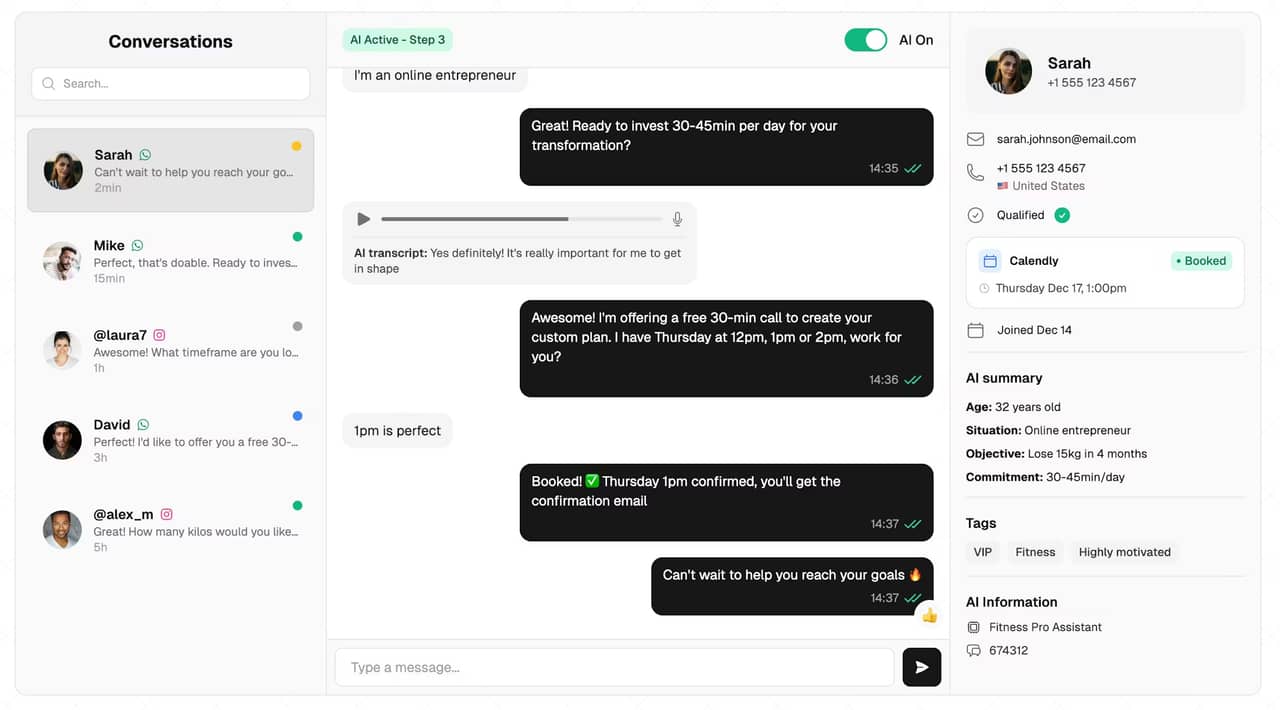
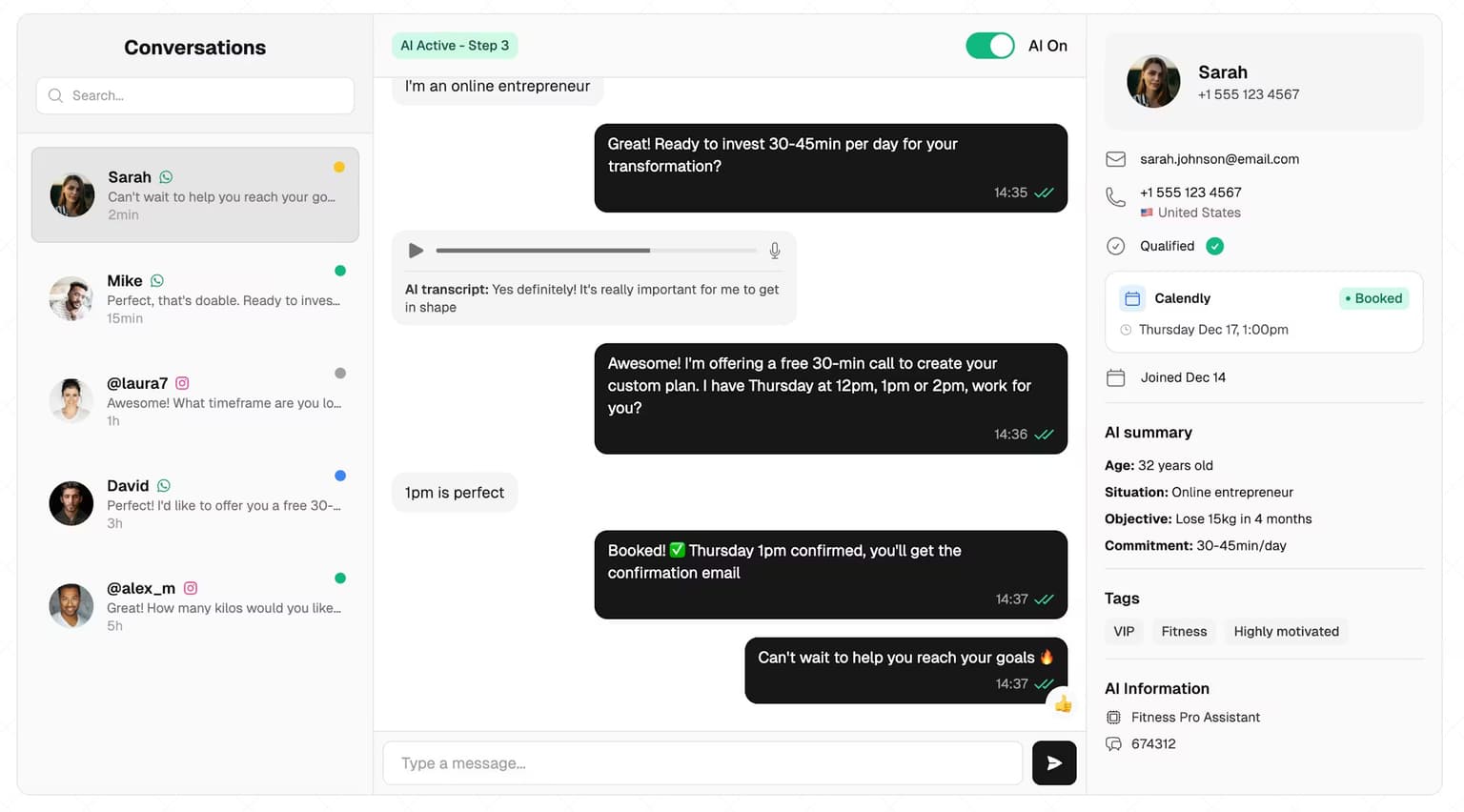
- It hands off cleanly. Once a lead clears the threshold, the AI either books the call directly (in DMs) or pushes the lead into the CRM with full qualification notes for a human closer to take over.
If you're new to the broader category, our overview of what an AI setter does explains the full pipeline from first DM to booked call, our breakdown of the 9 best lead qualification tools shows how this fits into the wider market, and our ranking of generative AI for sales use cases puts it inside the bigger 2026 stack. This article zooms in on the qualification step — the moment the AI decides "this lead is worth it" or "this lead is not."
How AI Lead Qualification Actually Works
Under the hood, an AI sales assistant running qualification does five things in parallel:
- Listens for intent signals. Words like "pricing", "trial", "when can we start", "I need this", "next quarter" all push the lead's intent score up.
- Asks structured discovery questions mapped to your qualification framework (we'll cover BANT, MEDDIC, and a DM-friendly variant in the next section).
- Updates a rolling score after every message. The score isn't binary — it's a confidence interval that the lead matches your ICP.
- Triggers actions at thresholds. Above a certain score, the AI proposes a call. Below, it nurtures or disqualifies. In the middle, it asks one more question.
- Logs everything to the CRM so the human closer who picks up the call already knows the lead's pain, budget hint, and previous objections.
The whole loop happens in seconds per turn — fast enough that the lead never feels like they're being interrogated, and never has to repeat themselves on the call.
Where AI qualification beats human SDRs
| Dimension | Human SDR | AI qualification |
|---|---|---|
| Response time | 2–48 hours | Under 5 seconds |
| Availability | Business hours | 24/7 |
| Consistency | Mood-dependent | Same playbook every conversation |
| Cost | $2K–$4K/month per SDR | ~$97/month for unlimited leads |
| Note-taking | Often skipped under pressure | Every conversation logged automatically |
| Memory across sessions | Forgets context | Recalls every previous DM with the lead |
Our lead response time statistics page details why the speed gap alone changes outcomes: a 5-minute response is 21x more likely to qualify a lead than a 30-minute one. AI closes that gap by responding instantly, every time.
Where humans still win
AI qualification is not a replacement for senior sales reps in two cases. First, on enterprise deals with multi-stakeholder buying committees — the back-and-forth of finding the actual decision-maker still benefits from a human ear. Second, on cold outbound phone calls where tone and silence matter as much as words. For everything else — inbound DMs, ad replies, comment-to-DM funnels, WhatsApp lead capture — AI qualification is faster and more consistent.
Qualification Frameworks That Work With AI
The classic frameworks (BANT, MEDDIC, CHAMP, GPCT) were designed for humans on phone calls. They mostly survive when you adapt them for AI in DMs, but you need to strip them down. Here's what works.
BANT (Budget, Authority, Need, Timing) — adapted for AI
BANT is the oldest framework and still the most useful for B2B. The AI asks four implicit questions across the conversation, never as a checklist:
- Budget: "Is this a project you've already allocated budget for, or are we still scoping?"
- Authority: "Are you the one who'd kick this off, or would you loop someone else in?"
- Need: "What's the trigger? Why now and not six months ago?"
- Timing: "What's your ideal timeline if we got started this month?"
BANT works for AI but it's heavy. Asking about budget in the second DM kills consumer and SMB leads instantly. Use BANT lead qualification for B2B SaaS, agencies, or high-ticket consulting. Skip it for coaches and creators.
MEDDIC (Metrics, Economic buyer, Decision criteria, Decision process, Identify pain, Champion) — adapted for AI
MEDDIC is the enterprise version of BANT. It's overkill for DM qualification because most of the discovery (decision criteria, decision process, champion identification) happens after the first call. Use the AI to qualify on Metrics ("how many leads do you handle per month right now?") and Identify pain ("what's broken about your current process?"), then let a human closer handle the rest on the call.
PIF (Problem, Intent, Fit) — DM-friendly framework
For DM qualification, we recommend a stripped-down 3-question framework we call PIF:
- Problem: "What's the biggest issue with your current setup?"
- Intent: "Are you actively looking to fix this, or just exploring?"
- Fit: One question that confirms your ICP — "are you running paid ads on Instagram or organic only?" for a tool, "are you already taking client calls or pre-revenue?" for a coaching offer.
PIF qualifies in 3 to 4 messages. It works because it doesn't ask budget upfront (kills consumer leads), doesn't require authority (most DM leads ARE the buyer), and gives the AI enough signal to decide whether to propose a call.
Lead scoring on top of frameworks
Whichever framework you pick, the AI converts the answers into a lead score. A simple weighting that works for most SetSmart customers:
- Clear intent signal ("I want this", "send me pricing"): +40
- Direct fit answer (matches ICP exactly): +30
- Pain match (problem aligns with what your offer solves): +20
- Engagement (responded to all qualifying questions): +10
- Negative signals (price objection in message 1, "just looking", competitor name without context): −20 each
Above 60 = book the call. 30–60 = nurture with a follow-up. Below 30 = disqualify silently or send a self-serve resource. Adjust the thresholds against your own data after the first 100 conversations.
What the Data Says About AI Qualification at Scale
Frameworks are theory. Here's what 828K real AI conversations reveal about what actually drives qualification.
Qualification rates jump with conversation depth
The single biggest predictor of whether a lead qualifies isn't the channel, the offer, or even the AI prompt — it's how many messages the conversation lasted. Data from the SetSmart 828K study:
A conversation that reaches 11+ messages is 68 times more likely to qualify a lead than one that ends after 4 messages. The implication for AI qualification: depth matters more than speed-to-qualify. An AI that aggressively closes by message 3 leaves money on the table compared to one that nurtures patiently.
Channel changes everything
Not all channels qualify equally. The 828K conversation dataset shows WhatsApp responders qualifying at nearly 2x the rate of Instagram responders:
- WhatsApp responders: 34% qualification rate, 14.75% booked call rate
- Instagram responders: ~18% qualification rate, ~6% booked call rate
The reason isn't that WhatsApp leads are inherently better. It's that the WhatsApp UX (notifications, sound, perceived urgency) keeps conversations alive longer. Most accounts using both channels see roughly 1.9x higher qualification on WhatsApp at equal lead quality. If your offer fits a WhatsApp audience, our WhatsApp automation guide walks through setup.
Follow-ups double the qualification rate
A single automated follow-up at the right moment more than doubles qualification:
- Engaged leads, no follow-up: 19.17% qualify
- Engaged leads, one follow-up: 40.65% qualify (+112%)
On Instagram specifically, follow-ups nearly triple qualification (+182%). This is the second-highest leverage point in any AI qualification setup, right after framework choice. We covered the full timing and message templates in our AI lead follow up playbook — the 4-hour and 23-hour windows recover the majority of dropped conversations.
Top quartile vs bottom quartile
The 31.78% vs 0.67% gap between the best and worst businesses in the dataset isn't about luck or traffic. After looking at hundreds of accounts, the top 10% share four traits:
- Tight ICP definition — the AI knows exactly who's a fit and disqualifies the rest within 2–3 messages.
- Patient AI conversations — they let the AI take 6–12 messages before pushing the call.
- Channel-appropriate follow-ups — automated follow-ups configured per channel, not generic.
- Single-message booking — when intent is high, the AI proposes a slot in the same message instead of saying "let me check".
Most underperforming accounts violate two or three of these. Fixing them is more impactful than switching tools.
Setting Up AI Lead Qualification Step by Step
Here's the sequence that consistently produces a 25%+ qualification rate within the first 30 days. We've seen it work for coaches getting clients on Instagram, agencies running paid ads, and B2B SaaS qualifying inbound demo requests.
1. Audit your last 100 conversations manually
Before automating anything, read 100 of your past inbound DMs (or chat transcripts) and label each one: qualified, unqualified, or "should have been qualified but I dropped it." Most teams discover their real problem isn't lead quality — it's lost conversations because nobody followed up. This audit also tells you what your true qualification rate is, which becomes the baseline you'll measure AI against.
2. Write your ICP in one paragraph
If you can't describe your ideal customer in 4–5 sentences, neither can the AI. Include role/business type, the specific pain you solve, the trigger event that makes them buy, the budget range, and the disqualifiers (who you don't want). Paste this paragraph into the AI's system prompt verbatim. This single step usually moves qualification rates by 10–15 percentage points.
3. Pick the framework — PIF for DMs, BANT for B2B email/phone
For inbound DMs, comment-to-DM, or click-to-WhatsApp ads, use the PIF framework above. For B2B inbound forms or longer sales cycles, use BANT. For enterprise, use light MEDDIC and let humans handle the rest.
4. Configure the qualification questions
The AI shouldn't ask all qualifying questions in one message. Spread them across the conversation, one per turn, ideally interleaved with relational replies. For a tested catalogue you can adapt to your offer, see our 21 lead qualification questions playbook. A pattern that works in Instagram DMs:
- Message 1: greet + ask about the lead's situation (Problem)
- Message 2: dig deeper on the pain
- Message 3: confirm fit (Fit)
- Message 4: gauge urgency (Intent)
- Message 5: propose the call
If you want pre-built scripts, our Instagram DM scripts guide has the exact phrasings that convert best.
5. Set the qualification threshold and routing
Define what happens at each lead score:
- High intent (book the call): AI sends a calendar link or proposes a slot in-chat.
- Medium intent (nurture): AI offers a relevant resource and tags the lead for follow-up.
- Low intent or unqualified: AI thanks them, sends a self-serve link if appropriate, and disengages.
- Edge case (manual review): AI flags the conversation and notifies a human.
The "edge case" routing is the most underused. About 5–8% of conversations don't fit cleanly into the score buckets — those are usually your best leads.
6. Enable automated follow-ups
Schedule one follow-up at ~4 hours after silence and one at ~23 hours. Make them context-aware (the AI should reference the last topic, not send a generic "still there?"). This single setup doubles qualified leads as shown above.
7. Pipe qualified leads to booking and CRM
The qualification step is wasted if the lead has to fill out another form. The AI should propose a calendar slot in the same DM where it qualifies them, and push the contact + qualification notes to your CRM automatically. SetSmart natively integrates with Calendly, GoHighLevel, iClosed, and any CRM via Zapier — see the SetSmart Zapier integration for the full list.
8. Review every conversation in the first 100
After launch, manually read every transcript for the first 100 leads. Fix the false positives (AI marked qualified, lead was junk) and false negatives (AI dismissed a buyer) by editing the system prompt. Most accuracy gains happen in this first review. After that, sample 10% weekly.
AI Lead Qualification Tools Compared
Below are the main categories of tools that handle AI lead qualification today. Our deeper review of all eight tools is in AI sales assistants compared; this is the qualification-focused summary.
| Category | Best for | Where it falls short |
|---|---|---|
| AI DM setters (SetSmart) | Instagram, WhatsApp, Messenger inbound | Not built for cold email outbound |
| AI SDRs (Clay, Apollo AI, Outreach) | Outbound email, B2B | Doesn't handle social DMs natively |
| Conversational chatbots (Drift, Intercom Fin) | Website chat qualification | Limited to your own site, no DM coverage |
| Voice AI receptionists (Synthflow, Bland) | Inbound phone qualification | Lower trust on first contact, needs phone traffic |
| Generic chatbot platforms (ManyChat, Chatfuel) | Simple comment-to-DM funnels | Button flows, not real qualification |
If your leads come from Instagram comments, Reels DMs, story replies, or click-to-WhatsApp ads, an AI DM setter is the right category. If they come from a contact form on your site, a conversational chatbot fits better. The full breakdown of AI setter options is in our best AI appointment setters ranking.
What to look for in an AI qualification tool
Five non-negotiable features when evaluating a tool:
- Real conversational AI, not button flows. Button flows can collect form data; only LLMs can qualify on nuance.
- Native channel integration — Official Meta API for Instagram and WhatsApp, not browser scraping. Anything that scrapes risks bans on business accounts.
- Configurable qualification logic — you should be able to edit the criteria, not just toggle a generic "qualify leads" switch.
- In-chat booking — qualifying without booking is half a feature.
- Automated follow-ups built in — not as a separate add-on.
Common Mistakes That Kill AI Qualification
After reviewing hundreds of accounts, most failures fall into the same five buckets.
Mistake 1: Asking budget in message 2. Kills 60%+ of consumer leads. Save budget for the call or for warm leads who already showed intent.
Mistake 2: Treating every channel the same. WhatsApp tone is more direct, Instagram tone is more casual. Same prompt across both = mediocre results on both. Optimize per channel.
Mistake 3: Disqualifying too aggressively. AI dismisses leads as "not a fit" because they didn't answer one question. Many of those leads were buying — they were just slow to type. Use follow-ups before disqualifying.
Mistake 4: Skipping the manual review. Letting the AI run for 90 days untouched. Quality drifts as your offer evolves. Sample conversations weekly.
Mistake 5: No clear handoff. AI qualifies the lead, then the human closer doesn't know what was discussed and asks the same questions again. The lead feels like a number. Always pipe qualification notes to the call brief.
Where AI Lead Qualification Is Going
Three trends are reshaping the category in 2026:
- Multi-channel context. Leads message you on Instagram, then on WhatsApp, then via your contact form. Modern AI qualification tools (including SetSmart's Instagram CRM) merge these into one conversation history so the AI doesn't repeat questions.
- Voice and DM convergence. Voice notes are now common in DMs. AIs that can both transcribe and send voice notes outperform text-only ones, especially for coaches and creators.
- MCP-powered control. Claude, ChatGPT and Cursor users can now drive their own qualification setup via Model Context Protocol — see our Instagram MCP server and WhatsApp MCP server guides for the technical side.
The end state is what we already see in top-performing accounts: every lead, on every channel, gets a context-aware reply within seconds, gets qualified through a conversation that doesn't feel like one, and either books a call automatically or gets disqualified silently. Human closers spend 100% of their time on calls with qualified leads.
FAQ
What is AI lead qualification?
AI lead qualification is the process of using a large language model to evaluate inbound leads against your ideal customer profile, score them on intent and fit, and decide who to route to a sales call vs nurture vs disqualify. It replaces the manual triage that an SDR or appointment setter would normally do.
How does AI assist in lead qualification?
The AI reads every reply in context, asks structured discovery questions one at a time, updates a rolling intent score after each message, and triggers an action at thresholds (book the call, nurture, disqualify). It also logs every detail to your CRM so the human closer who picks up the call already knows the lead's pain, fit, and previous objections.
What are the best AI tools for lead qualification?
For inbound DMs (Instagram, WhatsApp, Messenger), an AI DM setter like SetSmart is the right category. For outbound B2B email, AI SDR/BDR tools (Clay, Apollo AI) work better. For website chat, conversational platforms like Drift or Intercom Fin fit. For inbound phone calls, voice AI receptionists like Synthflow handle qualification. The full comparison is in our AI sales assistants ranking.
Is automated lead qualification accurate?
In our 828K conversation dataset, top-performing accounts hit a 31.78% qualification rate of engaged leads, while the bottom quartile sits at 0.67%. The gap is mostly down to ICP clarity, follow-up configuration, and patience (letting conversations reach 11+ messages). With proper setup, AI matches or beats human SDR accuracy on inbound DMs while responding 30 to 600 times faster.
Does AI lead qualification work on WhatsApp and Instagram?
Yes, and they're the two highest-performing channels in our dataset. WhatsApp responders qualify at 34% (14.75% book a call) and Instagram responders at ~18% (~6% book a call). The catch: you must use the official Meta APIs (not browser scraping) to avoid account bans, and configure follow-ups per channel since Instagram leads need them more.
Can AI replace a human appointment setter entirely?
For inbound DM and chat channels, yes — AI handles qualification and booking faster, cheaper, and more consistently than a human setter. For complex B2B with multi-stakeholder buying committees or cold outbound phone calls, humans still win on the discovery step. The realistic 2026 setup: AI qualifies and books, humans close the calls. Our deeper take is in appointment setting services.
Ready to automate your DMs?
Start your free 7-day trial and let AI handle your lead qualification 24/7.
Try SetSmart free