What Is Lead Qualification? A 2026 Definition

Lead qualification is the act of deciding, before a salesperson spends time on a lead, whether the lead is worth that time. It's a yes/no decision (with a bit of "how hot") based on four lenses: fit, intent, capacity to buy, and timing. Done well, it triples the odds that any given conversation ends in a booked call. Done badly, it's the reason a $400 ad-cost lead ends up in a CRM nobody opens.
Most articles answering "what is lead qualification" stop at a textbook definition. This one goes further: a clean definition, a worked example, the modern 6-stage process, what AI changed in 2026, and how to recognize a "qualified" lead vs a "scored" or "nurtured" one (those are different things, even though half the internet uses them as synonyms).
We pull from real numbers — 828K AI sales conversations we analyzed across Instagram and WhatsApp — so the recommendations are grounded in what actually moves the needle, not what 2010 sales blogs said.
TL;DR — what is lead qualification, in one screen
| Question | One-line answer |
|---|---|
| What is it? | The decision of whether a lead is worth a salesperson's time, before that time is spent. |
| Who does it? | An SDR, BDR, AI setter, or qualifying form. In 2026, increasingly an AI setter that runs 24/7. |
| When? | Between lead capture (form, DM, ad click) and the discovery call. |
| Based on what? | Four lenses — Fit (ICP), Intent (ready to buy?), Capacity (budget?), Timing (when?). |
| Output? | Three buckets — Hot (book a call), Warm (nurture), Cold (disqualify or recycle). |
| Why it matters? | Top 10% of accounts qualify 47x more leads than the bottom 25%. The gap is process, not budget. |
| Common mistake? | Confusing it with lead scoring (a number) or nurturing (a sequence). Qualification is the gate. |
Lead qualification, defined in plain English
Lead qualification is a filter between marketing and sales. Marketing's job is to generate as many leads as possible. Sales' job is to close. Lead qualification is what stands in the middle, deciding which leads make it through and which don't.
A clean working definition:
Lead qualification is the structured assessment of whether a prospect matches your ideal customer profile (ICP), has a real problem you can solve, can afford the solution, and is ready to act on a relevant timeline — and the routing decision that follows.
Three things to notice in that definition:
- It's structured — not "the SDR's vibe."
- It includes a routing decision, not just an assessment. A lead that's qualified but not ready right now goes into nurture, not into the call queue.
- It's about fit + intent + capacity + timing, not just budget. Budget alone is a 1980s sales artifact.
If your team can't answer "is this lead qualified?" with the same yes/no on Tuesday and Thursday, you don't have a qualification system — you have personal opinions.
Lead qualification example (worked end-to-end)
A B2B SaaS founder runs a $1,200/month Instagram ad campaign. Two leads come in on the same day:
Lead A — DMs from the ad, says: "Saw your post on AI for sales. We're a 30-person agency in Toronto, currently using ManyChat for our IG inbox but it can't qualify on WhatsApp. Looking to switch in the next 4-6 weeks. Budget is around $200/mo."
Lead B — DMs the same day, says: "yo bro, how does this work."
Both are leads. Only one is qualified.
Lead A is qualified across all four lenses:
- Fit: 30-person agency = matches the ICP for our SetSmart product (15-100 employees, customer-service-heavy)
- Intent: explicitly named the problem they want solved (multi-channel qualification)
- Capacity: $200/mo budget exceeds the $97/mo SetSmart price point
- Timing: 4-6 weeks = inside the typical buying window
Routing: Hot — book a call this week.
Lead B has zero qualifying signals. Could be a buyer, could be a tire-kicker, could be a competitor. Routing: engage and qualify in the DM thread, never escalate to a sales call until at least three of the four lenses are confirmed. If after 3-4 messages the lead doesn't share anything — disqualify and move on. (See our breakdown of 21 lead qualification questions for the exact prompts that work in DMs.)
This is the entire job of lead qualification, repeated thousands of times per week, ideally without a human burning out doing it.
The four lenses of lead qualification
Every framework you've heard of — BANT, MEDDIC, CHAMP, ANUM, GPCT, FAINT — is a rearrangement of the same four lenses. Pick your acronym based on what you sell, but the underlying questions don't change.
Lens 1 — Fit (does the lead match your ICP?)
The first and most important filter. Even a hot lead with budget is worthless if you can't actually serve them well.
Fit = firmographic + behavioral match against your Ideal Customer Profile:
- Firmographic: company size, industry, geography, tech stack
- Behavioral: how they found you, content they engaged with, role of the person reaching out
A coaching offer for "ambitious 25-35 year old men in fitness" can't be sold to a 58-year-old corporate executive woman, no matter how much budget she has. That's a fit failure, and it's the most common reason qualified-by-budget leads ghost after the discovery call.
Lens 2 — Intent (is the lead ready to act?)
Intent is what separates a curious browser from a buyer. Signals:
- They asked a buying question ("what's your pricing?", "how do I sign up?", "what's the onboarding like?")
- They mentioned a deadline ("we need this live before our next launch")
- They acknowledged a problem ("our current tool can't do X")
- They requested a demo, sample, or trial
The opposite of intent is information-gathering. "Curious to learn more" is a 0/10 intent signal in 2026. Buyers know what they want.
Lens 3 — Capacity (can the lead afford it?)
The classic "B" of BANT — but with a twist for 2026. Capacity isn't just "do they have $X in the bank." It's:
- Budget exists: there's a line item or willingness to allocate
- Decision authority: the person you're talking to can sign or influence the decision
- No critical blockers: no procurement freeze, no IT lockdown, no compliance veto
You don't need to know the exact dollar amount. You need to know whether $99/mo (or $99K/yr, depending on your offer) would be a "yes, easy" or a "let me check with finance, get back to you in 6 weeks." See our breakdown of BANT lead qualification for the exact AI-adapted version we use today.
Lens 4 — Timing (when?)
The lens most teams skip — and the one that decides whether a "qualified" lead actually closes this quarter or next.
Three timing tiers worth tracking:
- Now (0-30 days): book a call this week, treat as hot
- Soon (30-90 days): nurture lightly, re-qualify in 30 days
- Later (90+ days): low-touch nurture, consider it a future-pipeline lead, not a current opportunity
A lead that says "we're evaluating in Q3" in January is qualified — just not for January. Marking them "cold" and ignoring them is how you lose the deal in May.
Lead qualification vs lead scoring vs nurturing — they're not the same
Three terms that get used interchangeably and shouldn't be.
| Concept | What it produces | When it happens | Owner |
|---|---|---|---|
| Lead qualification | A yes/no decision + a routing bucket (hot/warm/cold) | Once, at the gate between marketing and sales | SDR / AI setter |
| Lead scoring | A numeric score (e.g. 0-100) updated as behavior accumulates | Continuously, from first touch to closed deal | Marketing ops / CRM |
| Lead nurturing | A sequence of touches (email, DM, retargeting) to warm a lead up | After qualification, when timing or intent is the gap | Marketing / lifecycle |
The simplest way to remember: scoring ranks leads, qualification filters them, nurturing matures them. A lead can be high-scored but unqualified (a bot scrapes your site 50 times = high engagement, no fit). A lead can be qualified but need nurturing (right ICP, no budget for 60 days). The three are pipelines, not synonyms.
Why lead qualification matters more in 2026 than it did in 2016
Three forces converged to make qualification the single highest-leverage activity in modern sales:
1. Lead volume exploded — but conversion didn't
Paid acquisition costs have roughly tripled since 2018. A $50 cost-per-lead is now $150. Meanwhile, average lead-to-customer conversion sits in the 2-5% range for most B2B and high-ticket B2C. That math only works if you spend zero salesperson time on the 95-98% who won't buy. Qualification is what makes that possible.
2. Speed-to-lead is now decisive
Speed and qualification are linked: a lead contacted within 5 minutes is 21x more likely to qualify than one contacted after 30 minutes (Harvard Business Review, 2011 — and the gap is wider in 2026, see our lead response time statistics). The industry's average response time is around 42 hours. Most leads are dead before a human ever sees them. AI qualification closes that gap by responding in seconds, 24/7.
3. Conversation depth, not message count, predicts qualification
Across the conversations we analyzed, qualification rates climb sharply with conversation depth:
The lesson isn't "send 40 messages." It's that qualification is a conversation problem, not a form-fill problem. Most teams kill the conversation at message 2-3, and 53% of conversations die there. Holding the conversation past message 10 is what unlocks the 30%+ qualification range.
The modern lead qualification process (6 stages)
Here's what a 2026-grade lead qualification process looks like end-to-end. Each stage has a clear input, a clear output, and a clear owner.
Stage 1 — Capture
Input: a lead clicks an ad, sends a DM, fills a form, or replies to a cold message. Output: a lead record with name, channel, source, and the first message. Owner: marketing automation.
Keep the form short. Every additional field cuts conversion by ~7%. Name + first message is enough — you'll qualify the rest in the conversation.
Stage 2 — Acknowledge in under 5 minutes
Input: a new lead record. Output: an acknowledgement message + first qualifying question, sent within 5 minutes. Owner: AI setter (24/7) or SDR (during business hours only — and the data shows business-hours-only loses to 24/7 by a wide margin).
This is the stage where 80% of teams lose. Median industry response time is around 42 hours. By then, the lead has already DM'd three competitors.
Stage 3 — Run the qualification questions
Input: an engaged lead. Output: enough information to score across the four lenses (fit, intent, capacity, timing). Owner: AI setter or SDR.
Spread the questions across 5-10 messages. Never interrogate. The pattern is: contextual statement → soft question → wait for reply → next question. Our cookbook of 21 tested qualification questions is what we use.
Stage 4 — Score and bucket
Input: the lead's answers across the four lenses. Output: a hot/warm/cold bucket and a routing decision. Owner: AI scoring rules, sometimes overridden by an SDR.
A common scoring shortcut:
- Hot = fit confirmed + intent expressed + capacity confirmed + timing inside 30 days → book a call
- Warm = fit confirmed + 2 of 3 other lenses → 30-day nurture, re-qualify
- Cold = fit failure OR all 4 lenses ambiguous after 5+ messages → disqualify or low-touch nurture
Stage 5 — Follow up before disqualifying
Input: a lead who hasn't responded in 24-72 hours. Output: at least one follow-up message before the lead is marked cold. Owner: AI setter or scheduled SDR queue.
This stage is non-negotiable. In our data, a single follow-up doubles booked calls (+106% lift among engaged leads). Killing a lead after one ignored message is throwing away half your pipeline.
Stage 6 — Hand off to a human (or close in DM)
Input: a hot lead. Output: either a booked discovery call OR a closed deal in the DM thread. Owner: AE / closer / founder.
For sub-$2K offers, close in the DM. For high-ticket, book the call. Either way, hand the AE the full transcript + qualification notes — never make them re-qualify on the call.
The full 7-step version with channel-specific tweaks is in our lead qualification process deep-dive.
What "qualified" actually looks like — by channel
The same four lenses apply, but the evidence you accept is different on each channel. Don't apply email-grade qualification to an Instagram DM, and don't apply DM-grade qualification to an outbound cold call.
| Channel | Realistic # of qual questions | Typical qualification rate | Best signal of intent |
|---|---|---|---|
| Instagram DM | 3-4 across 8-12 messages | ~17.8% of engaged | Mentions a specific product or feature |
| 4-6 across 5-10 messages | ~34% of engaged | Asks about pricing or scheduling | |
| 2-3 (in body or via discovery form) | ~5-10% reply, <3% qualify | Calendar link click | |
| Outbound cold call | 2 (in <30 sec) before earning more | ~2-4% connect → qualify | Agreeing to a discovery slot |
| Web form | All upfront — but keep it <5 fields | Varies wildly by ICP fit | Selecting "interested in pricing" |
WhatsApp is the highest-yielding channel for qualification — about 1.9x the rate of Instagram and roughly 6-10x email — because the medium itself signals real intent (people don't give out their WhatsApp number for browsing). See WhatsApp automation for the channel-specific playbook.
Manual lead qualification vs AI lead qualification
For 30 years, lead qualification was a human job. In 2026, it's increasingly an AI job — and the data on why is straightforward.
| Dimension | Human SDR | AI setter |
|---|---|---|
| Reply time | Industry median ~42h | <5 seconds, 24/7 |
| Cost per qualified lead | $15-50 (US salary basis) | $0.10-1.50 |
| Consistency | Drifts with mood, week, manager | Same script, every conversation |
| Follow-up discipline | ~30% of leads get a follow-up | 100% (it's a cron job) |
| Complex objections | Wins clearly | Handles 80%, hands off the 20% |
| B2B enterprise | Wins clearly | Best for inbound capture, not deep discovery |
| Volume tolerance | Caps at ~50 leads/SDR/day | Unlimited |
The pragmatic 2026 setup is AI for the first 80% (capture, acknowledge, run the qualification questions, follow up, route) and a human for the last 20% (deep discovery, complex objections, the actual close). See AI lead qualification for the deep dive on how the handoff works in practice.
The 47x gap — process is the difference, not budget
The most striking number from our dataset: the top 10% of accounts qualify leads at 31.78%, while the bottom 25% qualify at 0.67%. That's a 47x spread, and it has almost nothing to do with how much they spend on traffic.
What top accounts do differently:
- They reply in seconds, not days. Speed is the cheapest multiplier and almost nobody uses it.
- They hold the conversation past message 10. Qualification rate jumps from 8.77% (5-10 msgs) to 29.30% (11-20 msgs).
- They send at least one follow-up. Doubles booked calls. Trivial to automate.
- They define and enforce an ICP. Bottom-quartile teams treat every lead as equal. Top teams disqualify ruthlessly.
- They route hot leads to a human within minutes. No "I'll get back to you tomorrow" — that's the kiss of death.
You don't need a bigger ad budget to get from 0.67% to 31.78%. You need a lead qualification checklist that runs every time, the same way.
Common confusions, cleared up
"Isn't qualification just BANT?"
BANT is one qualification framework — Budget, Authority, Need, Timing. It's a fine starting point but it was designed in 1960s-era IBM enterprise sales. For modern, conversational, mid-ticket B2B and B2C, you usually want a softer version that leads with Need and Timing, treats Budget as a soft signal, and replaces Authority with "decision-influence" (the right person isn't always the buyer in 2026 — recommenders matter). Our BANT lead qualification breakdown maps the AI-adapted version.
"What about MQL vs SQL?"
MQL (Marketing Qualified Lead) and SQL (Sales Qualified Lead) are lead qualification stages, not the qualification act itself. An MQL is a lead marketing has scored as worth sales' attention. An SQL is a lead sales has confirmed is worth a discovery call. Qualification is what happens between MQL and SQL.
"Is qualification the same as a discovery call?"
No. Qualification prevents unqualified leads from reaching a discovery call. The discovery call itself is for deeper diagnosis with already-qualified leads (pain depth, decision process, success criteria). Some teams collapse the two into one call to save time — that works for low-ticket offers but breaks at any meaningful price point.
"Do I need a tool for qualification?"
For under ~50 leads/month, a CRM and a checklist are fine. Above that, you need at least one of: an AI setter that runs in DMs/WhatsApp, a qualifying form that branches based on answers, or an SDR with a tight script. The right tool depends on your channel mix — see lead qualification tools for a tested comparison.
"Can AI qualify enterprise leads?"
AI is best at the first 80% — the capture, acknowledge, ask-the-obvious-questions phase. For an enterprise deal where qualifying involves political mapping, custom procurement paths, and legal review, the answer is no, the AI hands off to a human. For SMB and mid-market, AI handles end-to-end qualification routinely.
How SetSmart approaches lead qualification
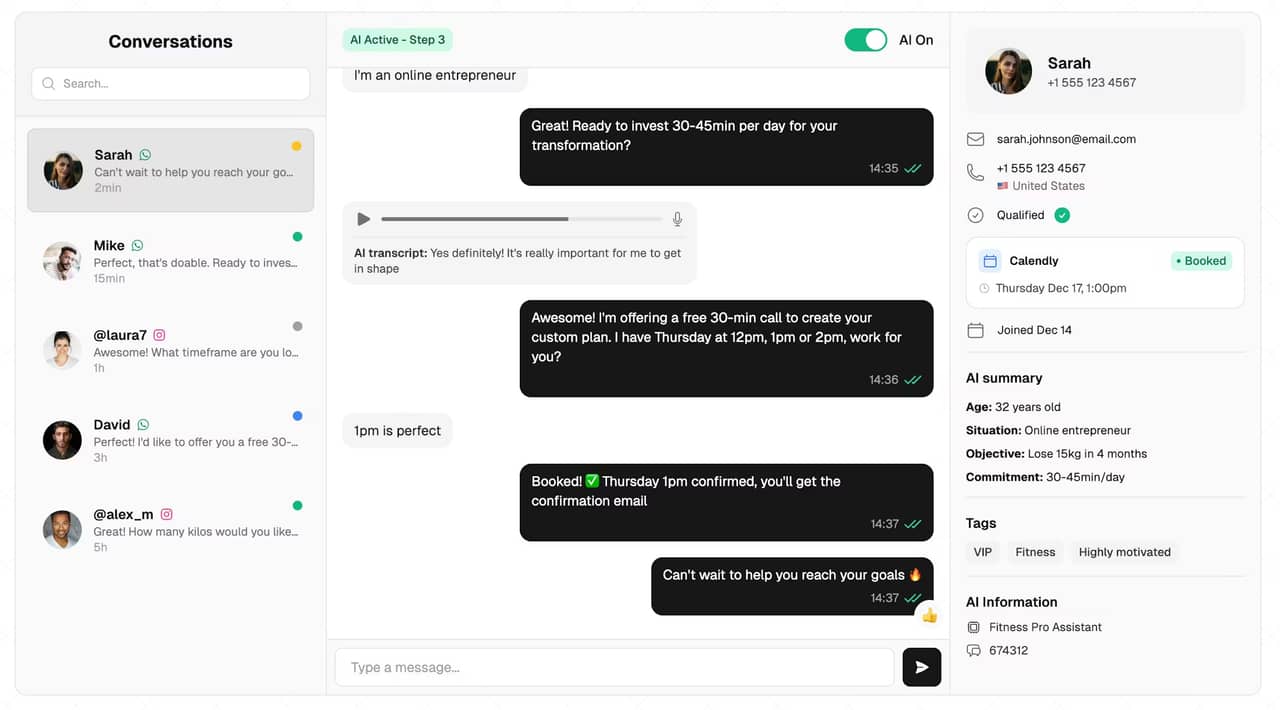
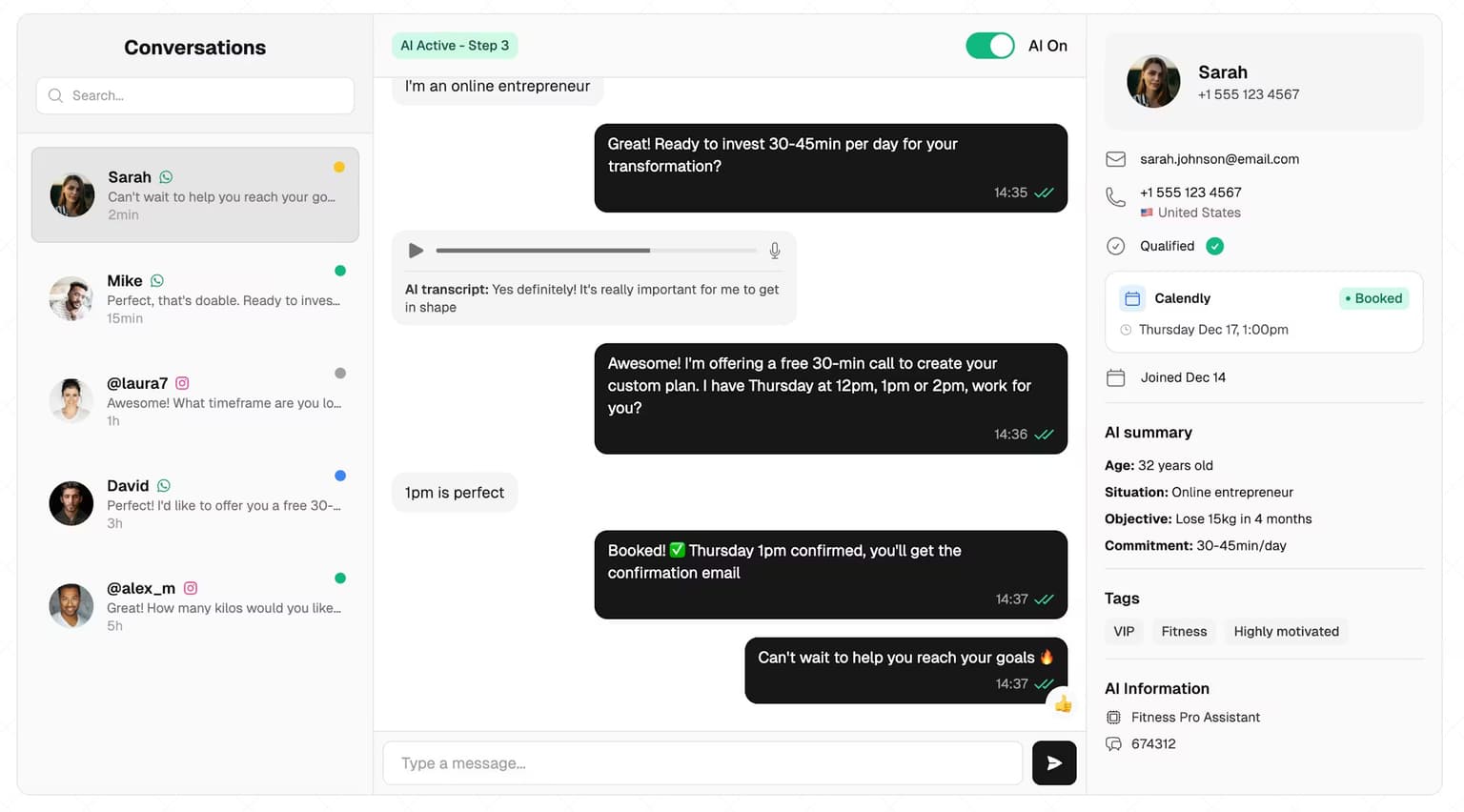
We built SetSmart specifically for the part of the funnel where qualification is hardest: high-volume inbound DMs across Instagram and WhatsApp, where leads expect a reply in minutes and most teams take days.
What it does:
- Replies to every DM in under 5 seconds, 24/7
- Runs your qualifying script across the four lenses, in natural conversation
- Buckets leads as hot/warm/cold based on your rules
- Books discovery calls directly into your calendar for hot leads
- Sends follow-ups to ghosting leads (the +106% lift)
- Hands warm leads back to your team with a full transcript and notes
Pricing: Free 7-day trial, then $97/month for the Pro plan (1,000 messages included). No per-seat or per-contact billing.
It's not the right tool for everyone — if you're doing enterprise B2B with 20-stakeholder deals, you don't need an AI setter, you need an SDR. But if you're a coach, agency, e-commerce brand, course creator, or SaaS team running paid traffic into DMs, this is what we built. See best AI setters for an honest comparison against the other tools in the category.
What real teams say about qualification at scale
"We were ignoring 60% of our IG DMs because nobody had time. Switched to AI qualification, recovered 18 booked calls in the first month from leads we'd already paid to acquire." — Mathis Ladoué, agency owner
"The change wasn't the AI being smarter than us. It was the AI being awake at 11pm on a Sunday when our highest-intent leads happen to message." — Edouard Clerc, course creator
"We tested it as a curiosity, kept it because the qualification rate jumped from ~5% to ~22% in two months. Same traffic, same offer." — Théo Riffault, founder
These aren't outliers. The 47x gap between top and bottom accounts is mostly mechanical — speed and process — which is exactly what AI does well.
When NOT to invest heavily in lead qualification
A few cases where heavy qualification is the wrong investment:
- You have <10 leads/month: a 5-minute review of each is faster than building a system. Qualify by hand.
- Your offer is low-ticket and self-serve ($5-50 one-off): the cost of a qualification call exceeds the deal value. Just put the buy button up front.
- You're testing a new offer: you don't yet know your ICP. Talk to everyone for the first 50 leads, then build the qualification rules from what you learned.
- You sell exclusively into one named-account list: ABM (account-based marketing) is a different game — qualification at the lead level matters less than account-level fit, which is upstream.
For the other 90% of teams running on inbound traffic, qualification is the highest-leverage thing they can fix.
FAQ
What is the meaning of lead qualification in simple terms?
Lead qualification is the process of deciding whether a lead is worth a salesperson's time, before that time is spent. It's a structured assessment across four lenses — fit (do they match your ICP?), intent (are they ready to buy?), capacity (can they afford it?), and timing (when?) — followed by a routing decision (book a call, nurture, or disqualify).
What is needed to qualify a lead?
You need three things. First, a clear definition of your Ideal Customer Profile (ICP) — the firmographic and behavioral traits of your best customers. Second, a small set of qualifying questions that test fit, intent, capacity, and timing across 3-6 messages. Third, a routing rule that turns the answers into a decision (hot → call, warm → nurture, cold → disqualify). The lighter and more conversational the questions, the higher your qualification rate.
What is lead qualification in sales?
In sales specifically, lead qualification is the gate between marketing-generated leads and the salesperson's calendar. Sales teams use it to spend time only on leads who can plausibly buy in a relevant timeframe. The most common frameworks in B2B sales are BANT, MEDDIC, CHAMP, GPCT, and SPICED — but they all assess the same four underlying lenses (fit, intent, capacity, timing).
What is lead qualification in marketing?
In marketing, lead qualification is what produces a Marketing Qualified Lead (MQL) — a lead that has demonstrated enough behavior and fit signals to be worth handing to sales. Marketing qualification is mostly behavioral and demographic (lead score reaches X, ICP fields confirmed). It's a different exercise from sales qualification, which tests intent and capacity through a real conversation.
Why is lead qualification important?
Because in 2026, the cost of acquiring a lead is roughly 3x what it was in 2018, and most teams still convert at 2-5%. Without qualification, salespeople spend the majority of their time on leads who will never buy — burning the lead acquisition budget twice. With qualification, the same lead volume produces 5-50x more booked calls. Our data shows the top 10% of accounts qualify leads at 31.78% versus 0.67% for the bottom 25% — a 47x gap that's almost entirely process, not budget.
Can AI handle lead qualification on its own?
Yes for the first 80% — capture, instant acknowledgement, running the qualification questions, follow-ups, and routing. Modern AI setters (like the one we built) qualify leads as well as a trained SDR for inbound DM and WhatsApp traffic, at a fraction of the cost and 24/7. AI hands off to a human for the last 20% — complex objections, deep discovery, and the actual close. See AI lead qualification for the technical breakdown.
What's the difference between lead qualification and lead scoring?
Lead qualification is a yes/no decision (qualified or not, plus a hot/warm/cold routing bucket) made once at the gate between marketing and sales. Lead scoring is a numeric value (typically 0-100) that updates continuously as the lead engages with your content. Scoring ranks leads; qualification filters them. A high-scoring lead can be unqualified (a competitor browsing your site) and a qualified lead can have a low score (a referral who hasn't engaged with your content but is clearly ready to buy).
Ready to automate your DMs?
Start your free 7-day trial and let AI handle your lead qualification 24/7.
Try SetSmart free