Lead Qualification Tools: 9 Tested (2026)

Sales teams waste roughly 70% of their hours on leads that never had a shot. A decent lead qualification tool cuts that waste in half — assuming you actually understand what lead qualification is before you tool up. A bad one just buries your pipeline in more "score: 78" noise.
We pulled every major lead qualification tool in 2026 and compared them against a hard benchmark: our own analysis of 828K real AI-driven sales conversations. This article ranks the 9 tools we actually trust, shows what each one is good at, and tells you where the category is heading.
Short version: the winner depends on where your leads come from. Inbound form fills? HubSpot wins. Outbound email and SDR cadences? Clay. Social DMs and ads? SetSmart. Enterprise SDR teams? Gong. We'll cover each.
TL;DR — the 9 tools ranked
| # | Tool | Best for | Starting price | Our score |
|---|---|---|---|---|
| 1 | SetSmart | DM / ad lead qualification (IG, WhatsApp, Messenger) | Free 7-day trial, then $97/mo | 9.4 / 10 |
| 2 | HubSpot Sales Hub | Inbound forms + CRM-first teams | $20/user/mo | 8.9 / 10 |
| 3 | Clay | Outbound enrichment + list-building | $149/mo | 8.7 / 10 |
| 4 | Apollo.io | SMB outbound with built-in sequences | $49/user/mo | 8.3 / 10 |
| 5 | Drift / Intercom | B2B website chat qualification | $39/user/mo | 8.1 / 10 |
| 6 | Chili Piper | Inbound routing + instant booking | $30/user/mo | 8.0 / 10 |
| 7 | Gong | Enterprise call intelligence | Custom (≈$120/user/mo) | 7.9 / 10 |
| 8 | Salesforce Einstein | Large orgs already on Sales Cloud | $75/user/mo add-on | 7.4 / 10 |
| 9 | ManyChat (+ flows) | Rule-based DM qualification only | $15/mo | 6.1 / 10 |
What "lead qualification tool" actually means in 2026
A lead qualification tool answers three questions automatically: who is this lead, how badly do they need what I sell, and should a human talk to them today or never? It does that by combining enrichment (firmographic data, social signals), interaction data (clicks, DMs, calls, forms), and scoring (either rule-based or AI).
Five years ago these were mostly CRM rule engines: "Title contains 'Director' + company size > 50 = MQL". In 2026 they're AI-native: the system reads the conversation, detects intent, classifies the lead and can book the call without a human touching it — exactly the shift we cover across the wider generative AI for sales stack.
Three product categories sit under the umbrella:
- Scoring + enrichment platforms (HubSpot, Apollo, Clay, Salesforce Einstein) — they enrich the lead, score it, and hand it to a rep.
- Conversational qualifiers (SetSmart, Drift, Intercom, ManyChat) — they actually talk to the lead and extract the qualification signals from the dialog.
- Call / meeting intelligence (Gong, Chorus, Chili Piper) — they qualify after the first call or route qualified leads to the right rep instantly.
Most teams need one from category 1 plus one from category 2. Category 3 kicks in once you have a paid sales team.
How we scored the 9 tools
We didn't just read G2 reviews. We applied the same framework we use internally to audit our own AI lead qualification engine — and we map every tool against the 7-step lead qualification process. Each tool was scored on five dimensions:
| Dimension | Weight | What we looked at |
|---|---|---|
| Qualification accuracy | 30% | How often the tool flags a genuinely qualified lead (not just any reply) |
| Speed to first reply | 20% | Time from lead event to first contact (see our lead response time statistics) |
| Depth of conversation | 20% | How long the tool can keep the lead engaged before a human takes over |
| Integrations | 15% | CRM, calendar, ad platforms, Meta Business Suite, Zapier / Make |
| Price / value | 15% | Cost vs qualified-lead output at SMB volume (<1000 leads/mo) |
Why those weights? Because the data tells us where the money actually is: 53% of conversations die before message 3, and at 21+ messages (~10 exchanges), 1 in 3 leads books a call. A tool's job is to keep the conversation alive long enough to hit that depth. Everything else is secondary.
1. SetSmart — best for DM and ad lead qualification
Best for: coaches, agencies, e-commerce brands and service businesses that run Instagram / WhatsApp / Facebook ads and qualify in DMs. Pricing: Free 7-day trial, then $97/month (Pro plan, 1,000 messages included). Our score: 9.4 / 10.
SetSmart is the only tool in this list we built ourselves, so the bias warning is upfront — the numbers below are publicly auditable.
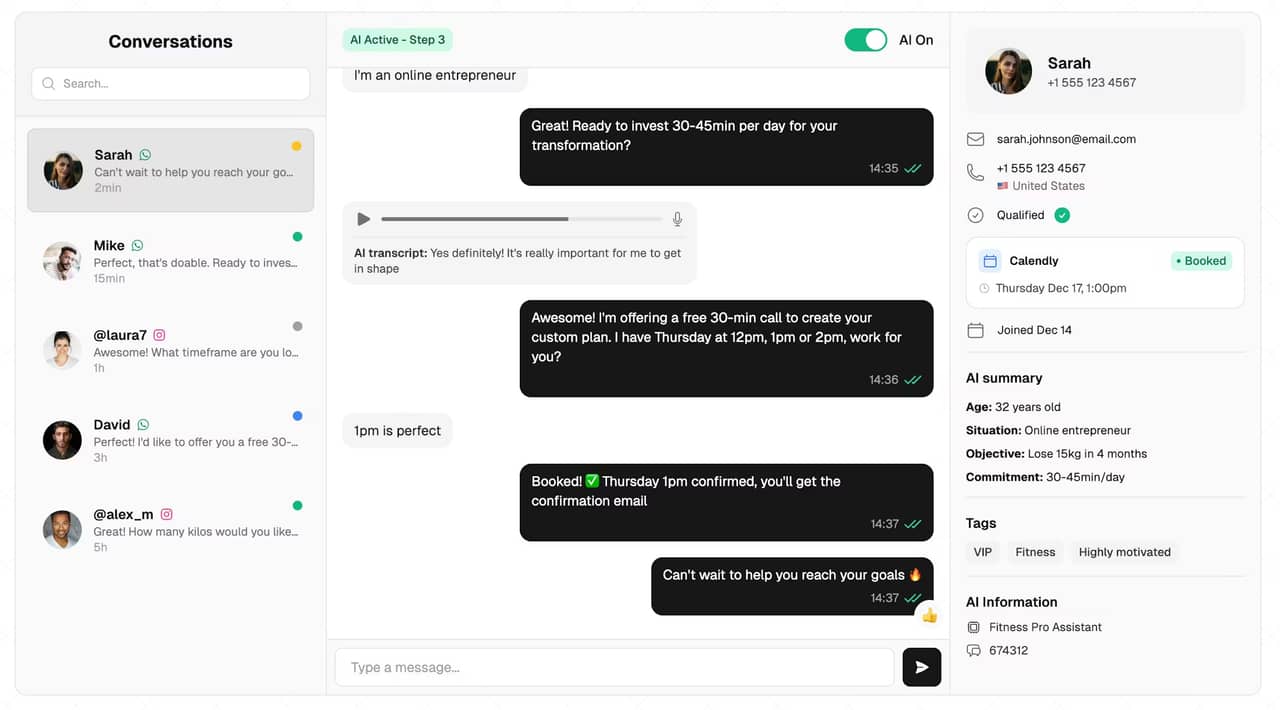
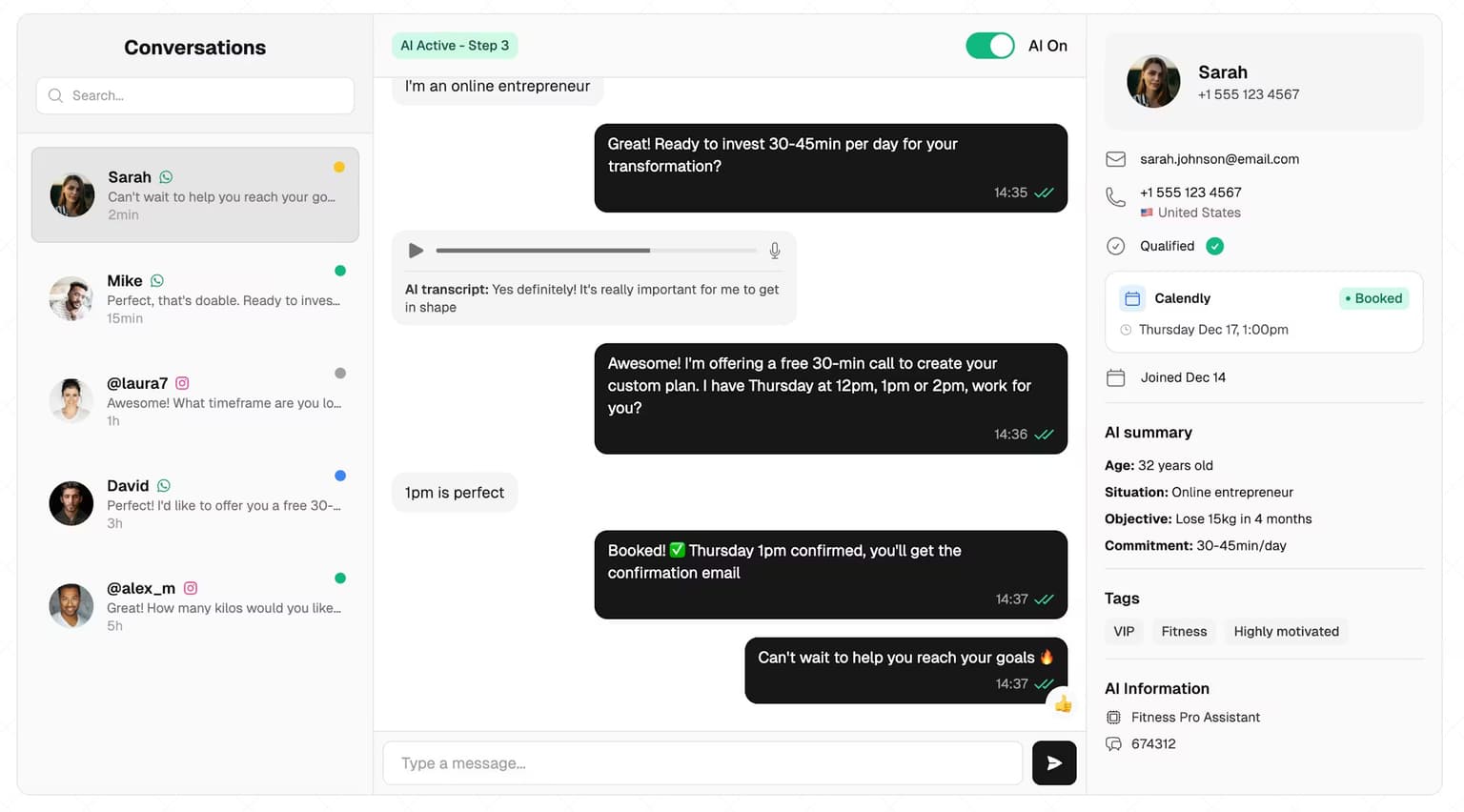
What it does: runs an AI setter on Instagram DMs, WhatsApp and Messenger that replies in under 60 seconds, asks qualification questions in natural language (BANT-style, configurable), and books the call in a connected calendar when the lead is ready. The conversation is persistent — if the lead ghosts, the AI sends a follow-up at 4h and 23h (we found AI follow-up doubles booked calls, +106%).
Why it scores highest in the DM use case:
- Official Meta Business API — no ban risk (unlike browser-automation Instagram DM bots)
- Top 10% of accounts on SetSmart hit 31.78% qualification rate vs 0.67% for the bottom 25% — same AI, the difference is the prompt and response speed
- WhatsApp responders qualify at 34%, about 1.9x the Instagram baseline
- Works as an AI DM setter, DM setter replacement and inbound qualification bot, all in one
Where SetSmart is not the answer: outbound email sequences (use Apollo or Clay), website chat for B2B SaaS (Drift/Intercom is more entrenched), and post-call analysis (that's Gong's domain).
2. HubSpot Sales Hub — best for inbound forms + CRM-first teams
Best for: B2B companies where most leads come from website forms, content downloads, or demo requests. Pricing: Sales Hub Starter $20/user/mo, Pro $100, Enterprise $150. Our score: 8.9 / 10.
HubSpot's lead qualification story is built around the CRM. Forms feed contacts, workflows assign lifecycle stages, and their AI (HubSpot AI, formerly ChatSpot) scores leads against fit + engagement signals. The Breeze Intelligence add-on (released late 2025) enriches contacts automatically with company size, industry, tech stack.
Where it shines:
- Tight workflow automation — route MQLs by territory, notify reps in Slack, fire a sequence, book via Meetings.
- Native integrations with everything (Shopify, Stripe, Intercom, Zoom, Zendesk) means the qualification signal doesn't get lost between tools.
- Predictive lead scoring is actually usable in Pro (needs ~500 closed-won records to train, though).
Where it struggles:
- The AI doesn't talk to the lead. It scores them based on form fills and page views — great if your funnel starts with a form, mostly useless if your leads land in DMs from an Instagram ad.
- Pricing escalates fast. Starter is fine at $20/user, but real features (lead scoring, forecasting, ABM) are Pro+ territory.
- Meeting booking via HubSpot is functional but less slick than Chili Piper or Cal.com.
If your pipeline is 70%+ inbound forms, HubSpot is the default and a great one. If most of your leads come from social, you'll want to pair it with a dedicated Instagram DM automation or WhatsApp automation layer on top.
3. Clay — best for outbound enrichment and list-building
Best for: RevOps and outbound SDR teams that build targeted lists from scratch. Pricing: $149/mo Starter, $349/mo Pro, custom Enterprise. Our score: 8.7 / 10.
Clay isn't strictly a "qualification" tool — it's an enrichment and research platform. But in the outbound world, qualification is enrichment: you qualify the account before you ever send a message. Clay lets you stitch together 75+ data providers (Apollo, ZoomInfo, LinkedIn Sales Nav, Bouncer, Clearbit, Anthropic / OpenAI for AI research) into a single spreadsheet-style workflow.
Typical use case: upload 5,000 target companies → Clay enriches with firmographics → runs a ChatGPT prompt on each company's latest news → scores each account against your ICP → pushes only the "fit" accounts into your sequencer.
Strengths:
- AI-first design. You can write prompts like "Does this company hire salespeople right now?" and have GPT-4 scrape LinkedIn + job boards to answer.
- Waterfall enrichment — if provider A doesn't have the email, fall back to B, C, D. Cheaper than any single tool.
- Output flows cleanly into Apollo, Outreach, Salesloft, HubSpot.
Limits:
- Steep learning curve. The first week is frustrating.
- Price scales with usage (credits). A heavy user easily spends $500–$1,000/mo.
- Not conversational. Clay researches, it does not talk. Pair it with a sequencer + an AI SDR.
4. Apollo.io — best SMB all-in-one
Best for: SMB outbound teams that want a database, sequencer, and basic qualification in one tool. Pricing: Free, Basic $49/user/mo, Pro $79/user/mo, Organization $119/user/mo. Our score: 8.3 / 10.
Apollo is the Swiss Army knife of outbound. 275M+ contacts, email sequencer, dialer, basic AI writing, and a CRM sync. For $49/user you get more functionality than most $500/user stacks had in 2022.
On qualification specifically, Apollo's AI assistant will:
- Score leads by job title, company size, funding, tech stack and intent signals (Bombora).
- Auto-draft a first email based on the lead profile.
- Detect reply sentiment and classify responses (interested / not now / wrong person) — this is the qualification angle.
What Apollo does not do well: it can't qualify an inbound DM lead, it can't run a multi-turn chat, and its reply classification is coarser than Gong's or SetSmart's. Good for outbound, poor for inbound. Many teams use Apollo for outbound email and a best AI setter on the side for inbound DMs.
5. Drift / Intercom — best B2B chat qualification
Best for: B2B SaaS websites with high traffic that want to qualify via live chat or chatbot. Pricing: Intercom Essential $39/seat/mo, Advanced $99, Expert $139. Drift custom. Our score: 8.1 / 10.
Intercom + Fin AI agent and Drift's Conversation AI both run on the same playbook: a chat widget appears on the site, asks 3-5 qualification questions, books a meeting if the lead is qualified, or dumps them into a help doc if not. Fin is reportedly hitting 50%+ first-contact resolution on support tickets and that engine bleeds into sales qualification.
Where they win:
- Purpose-built for high-volume website traffic.
- Deep CRM + helpdesk integration — the same conversation thread flows between sales and support.
- Decent AI that knows the product docs (ideal for self-serve SaaS where leads come educated).
Where they lose:
- Only on-site. A chatbot does nothing for your Instagram DM inbox.
- Intercom's pricing is notoriously fuzzy — seats + resolutions + message credits. Budget carefully.
- Drift's AI is less aggressive about qualifying and more about routing — it tends to hand off to human reps faster than a self-serve AI setter would.
6. Chili Piper — best inbound routing
Best for: B2B companies with fast SDR teams that book calls directly from forms. Pricing: $30/user/mo. Our score: 8.0 / 10.
Chili Piper is a qualification-and-routing layer on top of your form. A lead fills out your "Request a demo" form; Chili Piper qualifies them in-form (company size, geo, use case), and if they pass, they see a live calendar of the right rep and book instantly. If they don't pass, they get routed to self-serve content.
It shines at: compressing the Form → SDR → AE cycle from hours to zero. Which matters because our lead response time statistics show a 5-minute response time is ~9x more effective than a 30-minute one.
It loses at: anything that isn't a form fill. If your leads come from ads, DMs, outbound, or paid social, Chili Piper has no surface. It's also narrowly a routing product — don't expect CRM or conversational AI from it.
7. Gong — best enterprise call intelligence
Best for: Teams with 10+ AEs who want to qualify after the first call and coach the team at the same time. Pricing: custom, typically $120/user/mo + platform fee. Our score: 7.9 / 10.
Gong records every sales call and meeting, transcribes it, extracts next steps, flags risk signals (competitor mentioned, pricing objection, decision-maker missing), and rolls deals up into a forecast. From a qualification standpoint it's not "pre-call" — it's "was this a qualified deal or did we waste our time?". Massively useful for teams that have already landed a call and need to sort the serious buyers from the tire-kickers.
Cons: expensive, enterprise-only in practice, and it does nothing to help you generate or qualify the lead before the first call. You need another tool upstream.
8. Salesforce Einstein — best for teams already on Sales Cloud
Best for: enterprise orgs already running Salesforce who want AI-native lead scoring without bolting on another vendor. Pricing: $75/user/mo on top of Sales Cloud. Our score: 7.4 / 10.
Einstein Lead Scoring does what it says: looks at your closed-won history and scores new leads by fit + engagement, all inside Salesforce. In 2025 Salesforce shipped Agentforce, which adds an AI SDR that can run outbound, qualify inbound chats, and book meetings.
The core problem: Einstein and Agentforce only shine if you're already a heavy Salesforce customer. The setup is long, the implementation partners are expensive, and the base Sales Cloud license is $150/user/mo before you add Einstein. For a 50-seat team this is easily a $200K/year decision. For an SMB, overkill.
9. ManyChat + flows — rule-based DM qualification only
Best for: small brands that need a basic comment-to-DM automation on Instagram. Pricing: $15–$99/mo. Our score: 6.1 / 10.
We list ManyChat last because, although it's often the first tool teams try when they hear "DM automation", it's a flow-builder, not a qualification tool. It's great at triggering a DM from a Reel comment, sending a lead magnet, or gating content behind an opt-in. It's poor at actually qualifying — the "qualification" is a hard-coded multiple-choice quiz ("Are you a coach? Yes / No / Maybe"). No open-ended understanding, no real conversation.
We cover the pricing in detail in the ManyChat pricing breakdown and the limits of rule-based flows in our ManyChat alternative comparison. Short version: if you need a bot that books calls at 25-30% qualification rate, you need an AI — not a flow.
The data gap: why most tools miss DMs
Here's the number that should drive your tool decision. A disproportionate share of qualified-lead conversations happen on Instagram DMs, WhatsApp, and Messenger — channels that zero of tools 2–8 above treat as first-class. They treat a DM as a notification, a thing to route to a human. The human then takes hours to reply, and by then:
Conversion drop by time-to-first-reply (social DM leads). Baseline = leads replied to within 5 minutes. See lead response time statistics for the full breakdown.
A HubSpot workflow that "notifies the rep on Slack when an Instagram DM arrives" is not qualification. It's triage. And by the time the rep responds, the lead has moved on. This is the single biggest reason we built SetSmart as a first-response AI — to qualify where humans can't keep up.
How to pick a lead qualification tool in 2026
A quick decision framework based on where your leads originate. Pick the row that matches your top source, then the recommendation on the right.
| Your top lead source | Primary tool | Pair with |
|---|---|---|
| Instagram / Facebook ads → DM | SetSmart | HubSpot Free CRM |
| WhatsApp inbound + click-to-chat | SetSmart | Your CRM + Cal.com |
| Website demo form (B2B) | HubSpot + Chili Piper | Intercom for chat |
| Cold email outbound | Clay + Apollo | HubSpot / Salesforce |
| High-volume SaaS website chat | Intercom / Drift | Chili Piper |
| Sales calls (existing pipeline) | Gong | Salesforce Einstein |
| Enterprise Salesforce shop | Salesforce Einstein + Agentforce | Gong, Chili Piper |
Two more rules we apply when advising clients:
- Don't buy a tool that can't touch your fastest channel. If 40% of your leads come through Instagram DMs, an AI that only reads form fills is irrelevant. Speed to first reply is the single most correlated metric with qualification rate in our dataset.
- Buy conversational AI before lead scoring. Scoring tells you who looks good on paper. A conversational AI like an AI sales assistant or a dedicated AI setter qualifies based on what the lead actually says. Intent > demographics, every time.
Three key takeaways for qualification
If you do nothing else this quarter, apply these three findings:
- Depth matters more than volume. 53% of conversations die before message 3. Any tool that doesn't push past message 3 is wasting its own scoring. Pick a qualification tool that asks follow-up questions instead of "thanks for your interest, a rep will reach out".
- One follow-up is worth double. A single follow-up at 4h and 23h produces +106% booked calls vs no follow-up. On Instagram it pushes qualification +182%.
- Tier matters more than channel. The top 10% of businesses we measured qualify 31.78% of DM leads. The bottom 25% qualify 0.67%. Same AI, same channels, but dramatically different setup quality (prompts, response speed, follow-up cadence). Tool is 40% of the job; implementation is 60%.
Testimonials from live accounts
"Before SetSmart we were pushing every Instagram DM into HubSpot and letting it rot. We hit 24% qualification rate in the first month of AI qualification — roughly 3x our manual baseline." — Théo Riffault, coaching agency
"We tried Drift, Intercom, then rebuilt on an AI DM setter because our leads were WhatsApp, not website chat. Response time went from 3h to 38 seconds. Booked calls per week doubled." — Mathis Ladoué, e-commerce
"Clay gave us clean lists. SetSmart gave us the first conversation. Combining the two gave us a qualified lead at a fraction of the SDR cost." — Edouard Clerc, B2B SaaS
FAQ
What is the best AI tool for lead qualification?
There isn't one. The best tool depends on where your leads come from. For inbound forms, HubSpot. For social DMs and ads, SetSmart. For outbound enrichment, Clay. For existing sales calls, Gong. Match the tool to your fastest, highest-volume channel first — then layer in a second tool for the secondary channel once the first is dialed in.
Can AI lead qualification tools fully replace BDRs or SDRs?
For the first 3-5 messages, yes. AI qualifies at 29-34% on high-performing accounts, which matches or beats human BDR benchmarks on response time, follow-up consistency and coverage. Where humans still win: complex B2B deals with multiple stakeholders, phone objection handling, and anything above a $5K ACV that needs rapport. Most SMB teams are running AI up front and a closer on the back end — see our guide to the AI DM setter stack.
What's the difference between lead scoring software and lead qualification tools?
Lead scoring software (Salesforce Einstein, HubSpot predictive scoring) rates leads by firmographic + behavioral signals: a number like "87 / 100". Lead qualification tools actually determine whether a lead is sales-ready by interacting with them, asking questions and extracting answers. In practice, modern platforms blend both: an AI talks to the lead, extracts signals, feeds them into a scoring model, then routes. Use scoring for prioritization; use qualification for conversion.
Are lead qualification tools worth it for small businesses?
Yes — if you're doing more than 50 leads a month. Below that, manual qualification is fine. Above that, you start missing leads because of response time, not lack of effort. Tools like SetSmart ($97/mo with 7-day free trial) or Apollo ($49/user/mo) pay for themselves at 2-3 extra booked calls per month. Our full ROI calc is inside the AI lead qualification guide.
How do lead qualification tools integrate with HubSpot or Salesforce?
Almost all modern tools push qualified leads back into the CRM via native integration or Zapier / Make. Look for bidirectional sync — the tool reads CRM data (existing customer? previous deal?) before qualifying and writes back once the lead is qualified. SetSmart, Apollo, Clay, Drift and Chili Piper all ship native HubSpot / Salesforce connectors. ManyChat does too, but only on Pro+ plans.
Is there a free lead qualification tool?
HubSpot Sales Hub Free is the only genuinely free, production-grade option for inbound qualification — it includes basic scoring, forms, and 2,000 email sends. Apollo has a free tier capped at 250 email credits. For DM qualification, most AI tools (including SetSmart) offer a free trial with a few hundred messages but no permanent free plan, because the underlying LLM cost per message is real.
Do I need lead qualification tools if I already use an AI setter?
An AI setter is a lead qualification tool — for DMs. If 100% of your leads arrive in Instagram, WhatsApp or Messenger, you don't need anything else. If you also run outbound email, paid search, or B2B forms, you'll need a second qualification layer for those channels. Most of our customers pair SetSmart (DMs) with HubSpot Free (forms + CRM) and stop there. See the comparison of the best AI setters for the DM side.
Ready to automate your DMs?
Start your free 7-day trial and let AI handle your lead qualification 24/7.
Try SetSmart free