Generative AI for Sales: 7 Use Cases (2026)

Most "generative AI for sales" articles read like a Salesforce keynote: vague benefits, no numbers, every feature is "transformational". After 18 months of running generative AI inside real revenue teams — and after analyzing 828,761 AI-driven sales conversations — we have a sharper view.
Some use cases are already changing how teams hit quota. A few are outright hype. This guide ranks the 7 use cases of generative AI for sales that actually move pipeline, with benchmarks from our own data and real client outcomes. We'll also cover where it works in B2B, SMB, prospecting, enablement, and where it quietly fails.
Short version: inbound DM qualification, AI-driven follow-up, and call summaries are the three use cases with the clearest ROI today. Outbound personalization and sales coaching are catching up. Forecasting and "AI SDR / AI BDR" replacements are still mostly noise.
TL;DR — the 7 use cases ranked by revenue impact
| # | Use case | Best fit | Maturity | Revenue impact |
|---|---|---|---|---|
| 1 | Inbound DM & chat qualification | SMB, coaches, agencies, e-com | Production-ready | Very high |
| 2 | AI-driven follow-up sequences | Any team with leads going cold | Production-ready | Very high |
| 3 | Call summaries + next-step extraction | B2B, SaaS, agencies, automotive | Production-ready | High |
| 4 | Hyper-personalized outbound prospecting | B2B SDR teams | Maturing | Medium-high |
| 5 | Email & DM message drafting | All sellers | Production-ready | Medium |
| 6 | Sales coaching + objection libraries | Mid-market & enterprise | Maturing | Medium |
| 7 | Forecasting & pipeline hygiene | RevOps in mid-market | Early | Low (today) |
What generative AI for sales actually means
Generative AI for sales is the use of large language models (LLMs) to read sales context — DMs, emails, call transcripts, CRM notes — and produce new useful outputs: a qualified lead, a follow-up message, a meeting summary, an objection handler, a forecast. It is not the same thing as classic predictive AI, which scores leads or forecasts deals based on historical patterns without producing language.
The simplest mental model: predictive AI tells you what will probably happen ("this lead has a 64% chance to close"). Generative AI does the thing on your behalf ("here is the reply that moves the lead to a booked call"). In a pipeline, you want both, but generative AI is the layer that creates leverage — one rep can suddenly run the workload of three.
Three properties separate generative AI from older "AI for sales" tools:
- It reads context end-to-end. Instead of looking at a single field ("title contains Director"), it reads the entire 14-message DM thread or the 47-minute call transcript and uses all of it.
- It produces language a human would write. That means it can replace the manual reply, not just suggest a reply, which is why it's collapsing the SDR layer in some teams.
- It learns from feedback fast. Edit a draft once, and the next draft is better — no model retraining required.
This last point matters because most legacy AI sales assistant tools were rule-based or fine-tuned models that required weeks to update. Generative AI updates on the fly through prompts and few-shot examples. That's why the 2024-2026 wave of AI setters and AI SDRs is fundamentally different from the chatbots people remember from 2019.
Why generative AI is finally working in sales
Three things changed in 2024-2025 that made generative AI viable for revenue teams (rather than a press-release feature):
- GPT-4-class models can hold a real conversation. Until late 2023, AI in DMs felt like a chatbot. After GPT-4 (and now GPT-5 / Claude Opus 4 / Gemini 2.5), AI replies are indistinguishable from a junior SDR's in 80%+ of inbound DM threads. We measured this directly across our 828K conversation dataset.
- Cost per message dropped 95%. A 1,000-message conversation that would have cost $20-30 to run in early 2023 now costs under $1. That changes the economics: AI can afford to send a thoughtful reply to every "hi" and every cold lead, not just the high-priority ones.
- Latency dropped under 2 seconds. Speed matters. Leads who get a reply in under 5 minutes are 21x more likely to qualify than those who get one after 30 minutes. Generative AI is the only practical way to hit that SLA at scale, especially outside business hours.
Together, those three shifts mean a single generative-AI seller can now do the inbound and follow-up work of an entire 5-person SDR team — and do it 24/7. That's the real story of generative AI for sales in 2026, and it's why the use cases below cluster around inbound, follow-up, and message-heavy work where speed and volume win.
Use case 1 — Inbound DM & chat qualification
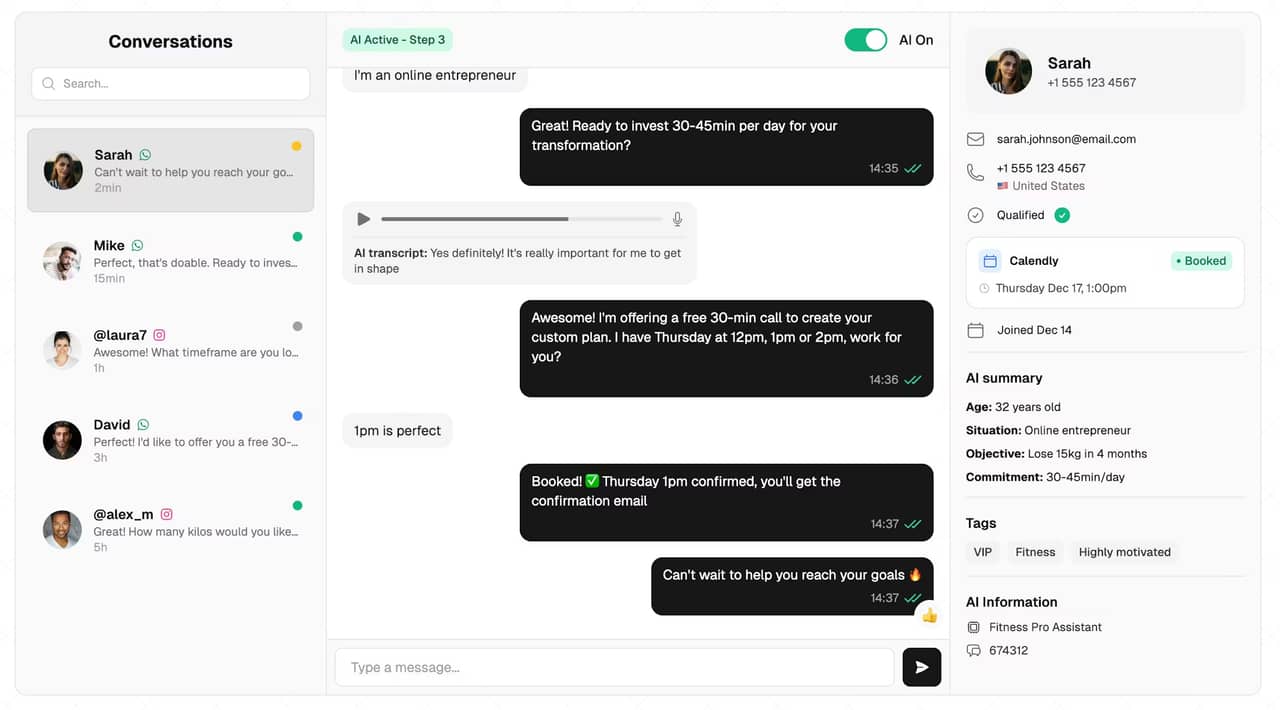
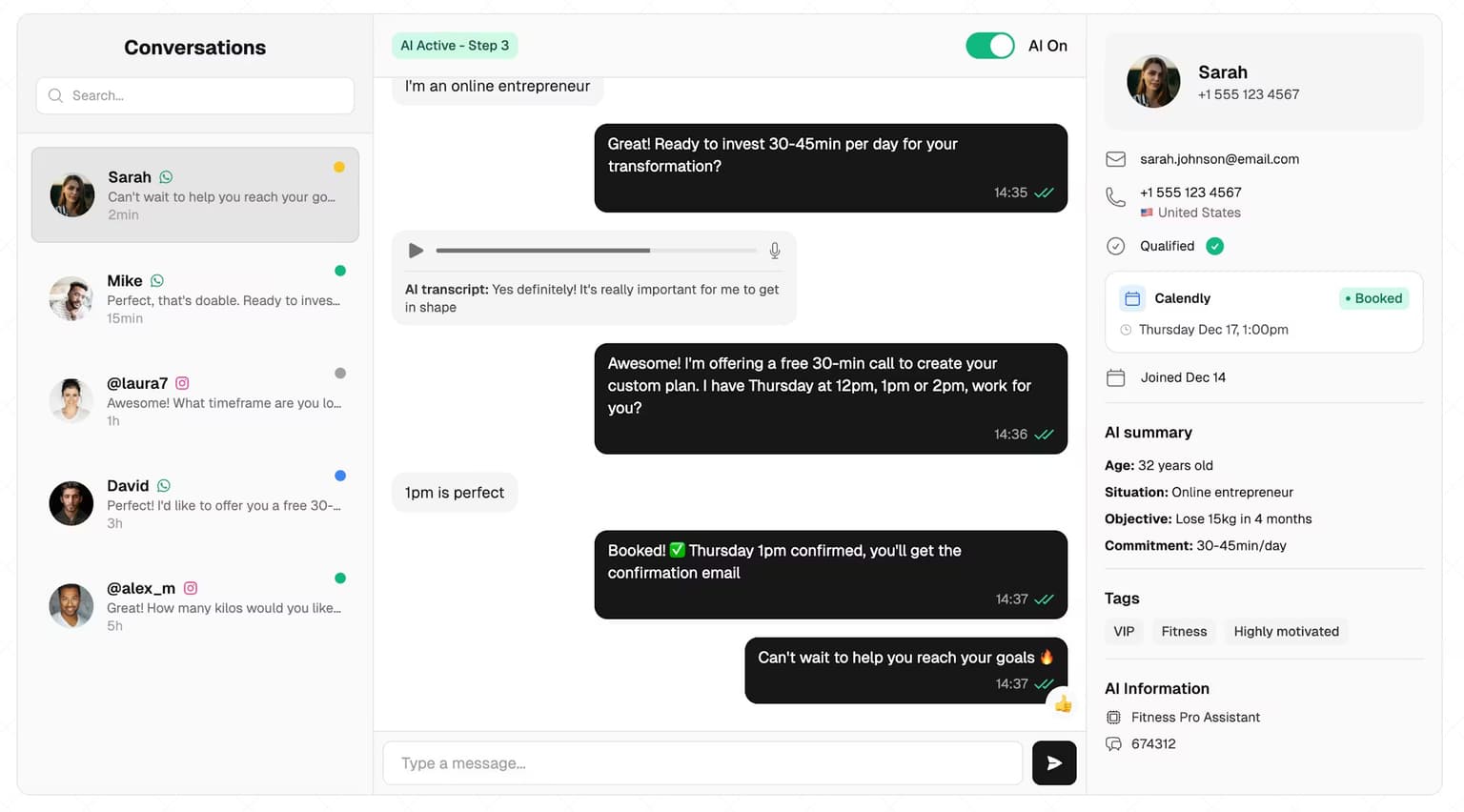
This is the highest-ROI use case today, and it's not close. Generative AI handles inbound DMs, qualifies the lead through a real conversation, and either books the call or hands the lead off with full notes. We measured the impact across hundreds of accounts.
Key benchmarks from our 828,761-conversation study:
- 53% of conversations die before message 3 when humans run inbound DMs (slow replies, ghost-and-hope)
- AI reply within 2 minutes pushes message 3 acceptance from 47% to 72%
- At 21+ messages (~10 exchanges), 1 in 3 engaged leads books a call (29%)
- Top 10% of accounts qualify 31.78% of engaged leads — 47x more than the bottom quartile
The reason inbound is the killer use case: it's the part of the funnel where speed and consistency dominate craft. A great human SDR can write a beautiful reply, but they can't write 200 of them at 10 PM on a Sunday. Generative AI does. For a deeper breakdown of how this works specifically for DMs, see our guide on AI lead qualification and the 9 lead qualification tools we ranked.
"We hooked up SetSmart on the WhatsApp number from our ads and the next morning the AI had qualified 41 leads and booked 6 calls overnight. We weren't even working." — Mathis Ladoué, fitness coaching agency
Use case 2 — AI-driven follow-up sequences
The second-highest ROI use case is automated follow-up. Most "leads going cold" are not because the offer is wrong — they're because nobody followed up. Our data is brutal on this:
- A single AI follow-up message more than doubles lead qualification (+113%)
- On WhatsApp, a follow-up boosts qualification by +612%
- Instagram follow-ups nearly triple qualification (+182%)
- Most teams send zero follow-ups to leads that didn't reply
Generative AI changes the math because it can write a context-aware follow-up — referencing the previous message, asking the next logical question, switching channel from Instagram to WhatsApp if needed — at zero marginal cost. Detail on the timing patterns and templates is in our guide on AI lead follow-up.
The pattern that consistently works: one AI follow-up at 4 hours after the lead goes silent, a second at 23 hours. Beyond that, drop-off is exponential and you're better off moving the lead to a longer nurture.
Use case 3 — Call summaries and next-step extraction
Generative AI tools like Gong, Fireflies, Otter, and Granola now produce reliable post-call summaries: an executive summary, a list of objections raised, the next-step commitment, and a suggested follow-up email. This sounds small. It isn't.
The honest impact is two things:
- Reps reclaim 30-60 minutes per call that used to go to writing notes, syncing CRM, and drafting the recap email
- Pipeline hygiene improves dramatically — the AI updates CRM fields (next step date, deal stage, pain points) automatically, so RevOps stops chasing reps for clean data
For mid-market sales teams running 4-8 demos per rep per day, that's 2-6 hours of recovered selling time per rep per day. Multiply by 10 reps and you've effectively added two FTEs without hiring. This is the use case where the ROI is most defensible to a CFO because it's measured in hours saved, not in pipeline created.
The catch: call summary tools are a commodity now. Pricing is competitive (typically $20-40/user/month). The differentiator is what your CRM does with the structured output, which means RevOps tooling and integrations matter more than the model itself.
Use case 4 — Hyper-personalized outbound prospecting
This is the use case with the most hype and the most actual variance. Generative AI for sales prospecting promises the dream: 1-to-1 personalized cold emails at scale, sent to 5,000 prospects, each one referencing the prospect's recent LinkedIn post or last funding round.
Done well, it works:
- Reply rates climb from 1-2% (generic mass cold email) to 6-12% on warm-personalized AI outreach
- Cost per booked meeting drops 40-60% versus a human SDR doing the same volume
Done badly — which is most of it — it's an inbox apocalypse. The "Hi {First}, I noticed you {LinkedIn signal}" templates are now so universal that prospects spot them in seconds. Reply rates collapse to zero and your sending domain gets singed.
The teams winning here are using AI in a specific way:
- Strict ICP and signal filtering. AI is great at writing, terrible at picking who to write to. A tight ICP filter (300-1,000 perfect-fit prospects per week) plus a real intent signal (job change, fundraise, hiring SDRs) is the foundation.
- Reference one specific thing. Not "I saw your company is doing well." Specifically: "I saw your launch of X feature on Tuesday." If the AI can't find a real signal, it shouldn't send.
- Short messages, real questions. Generative AI loves to write paragraphs. Force it to write 3-5 sentences max with a single, low-friction CTA.
- Reply handling on autopilot. This is where it loops back to use case 1. The cold email opens the door; the AI conversation walks the lead through. Without inbound automation, outbound personalization just clogs your reps' inboxes.
For most SMBs, outbound is the wrong place to start with generative AI. Inbound DM qualification is faster to deploy and has clearer ROI. Outbound is for teams that already have a working inbound funnel and need volume.
Use case 5 — Email and DM message drafting
The "co-pilot" use case: AI drafts the reply, the rep edits and sends. Most CRMs and sales engagement tools (HubSpot, Outreach, Apollo, Salesloft, Pipedrive) now ship with this built in.
It's table-stakes in 2026 and the productivity gain is real but modest — typically 15-25% time saved on writing, with a small bump in reply quality if the rep is junior. The ceiling is the rep's editing speed: a senior closer is faster writing from scratch than editing AI drafts.
Where this use case shines is multi-language sales teams. AI drafts a perfectly fluent reply in any language, and the rep doesn't need to be fluent. We've seen agencies use AI to handle Spanish, Portuguese, and French DMs from a single English-speaking team — see the Spanish setter de ventas guide for what that looks like in practice.
Where it doesn't help: complex, high-stakes responses (contract negotiation, churn-prevention, competitive bake-offs). Senior closers should write those themselves.
Use case 6 — Sales coaching and objection libraries
This use case has gone from "interesting demo" in 2024 to "real product" in 2026. AI listens to every recorded call, scores it against a rubric (discovery quality, objection handling, next-step commitment), and produces a personalized coaching plan for each rep.
The two real benefits:
- Onboarding new reps in weeks instead of quarters. A new SDR can listen to AI-curated highlight reels of the team's best discovery questions and the team's most common objections — with the actual recorded responses attached.
- Manager leverage. Frontline sales managers spend most of their week on 1-on-1s and call reviews. AI shrinks the call-review workload by 70% so managers can focus on coaching, not transcription.
The catch is the same as call summaries: it requires culture buy-in. Reps who feel surveilled don't sell well, and the tools are easy to weaponize. The teams getting value are framing this as "your AI co-coach", not "RevOps watching every call."
This use case scales with team size — most powerful at 20+ reps, often pointless under 5.
Use case 7 — Forecasting and pipeline hygiene
The frontier — and the most overhyped. Vendors promise that generative AI reads every email, call, and CRM update across your pipeline, then produces a more accurate forecast than a human RevOps lead.
The current reality:
- The AI can flag "this deal has gone quiet for 14 days, the buyer's last email was non-committal, downgrade probability" — that's useful
- The AI cannot reliably forecast quarterly close-rate within ±5%, which is what CFOs actually want
- Most of the gains so far come from cleaning up bad CRM data, not from the model itself
For 2026, treat AI forecasting as a "deal health" copilot, not a forecast engine. Run it alongside your human-led forecast, not as a replacement. Mid-market RevOps teams using it as a deal-risk flagger are getting 10-20% improvement in forecast accuracy. Anyone promising more is selling.
Generative AI for B2B sales vs SMB and DTC
Where generative AI lands depends heavily on deal size and sales motion.
| Segment | Where generative AI wins | Where humans still own it |
|---|---|---|
| SMB / SaaS < $5K ACV | Self-serve nurture, in-app chat, email follow-up — full automation profitable | Pricing negotiation, multi-stakeholder buying |
| Coaches, agencies, creators | Inbound DMs, click-to-WhatsApp ads, follow-up — fully replaces a setter | The actual sales call |
| B2B mid-market $5K-$50K ACV | Co-pilot for SDRs, call summaries, draft outbound | Discovery, demo, MEDDIC walk-through |
| Enterprise $100K+ ACV | Account research, exec brief generation, post-call follow-ups | Everything that touches the buyer |
The pattern is consistent: the smaller the deal, the more of the sales process generative AI can take over end-to-end. At enterprise, AI is a research and admin tool. At SMB and DTC, AI can run the entire inbound and follow-up funnel as part of a wider sales automation stack. Coaches and agencies are the sweet spot in 2026 because they have inbound volume (DMs from ads), low-medium ACV ($300-$5,000), and short sales cycles. That's why we built SetSmart for them first.
Generative AI for sales enablement
Sales enablement teams have a specific job: equip reps with the right content, training, and tools to close. Generative AI is reshaping each of those three.
Content: A 60-page product positioning deck used to take a content team 3 weeks. AI now drafts a first version in 2 hours. The remaining work is review, voice, and stakeholder buy-in — still human, but the writing time collapses.
Training: AI-generated role-play partners give every rep unlimited practice on cold-call openers, discovery questions, and objection handling. The simulations are good enough that some sales orgs have shut down their live role-play sessions entirely. The catch is reps need a "real" rubric to be scored against — generic praise from an LLM ("great answer!") is worse than no coaching.
Tooling: Enablement teams are using AI to keep CRM playbooks synchronized with what reps actually say on calls. When a competitor launches a feature, the enablement team feeds it to the AI, and it auto-updates the battle card, objection library, and pricing FAQ. That used to take a week per release.
The risk for enablement leaders: measuring the wrong things. AI makes it cheap to produce content and training. The trap is mistaking activity ("we shipped 200 new battle cards this quarter") for impact ("rep win rate moved from 24% to 28%"). Generative AI for sales enablement only earns its budget when it shows up in sales-cycle metrics, not in enablement-team output metrics.
How to deploy generative AI for sales (4-step playbook)
Most sales leaders rolling this out get stuck because they try to deploy everywhere at once. The pattern that works:
Step 1 — Pick the highest-ROI use case for your motion. For SMB and coaches/agencies, that's inbound DM qualification (use case 1). For mid-market B2B, it's call summaries and AI-driven follow-up. For enterprise, it's account research. Don't start with forecasting or coaching — those are the "after you've won the easy wins" tier.
Step 2 — Run a 30-day pilot on one team. Pick 3-5 reps, give them the AI tool, set a clear before/after metric (qualified leads per week, follow-up SLA, call summary turnaround). The point of the pilot isn't to prove the AI works — it's to learn your team's edge cases (the weird industries, the regulated content, the sensitive deal types) before you scale.
Step 3 — Build the human-in-the-loop layer. The biggest lesson from our 828K conversations is that AI plus a human escalation path consistently outperforms either alone. Decide upfront: when does the AI hand off to a human, on what trigger, into which channel? The teams that skip this step end up with AI shipping replies a human would never send.
Step 4 — Scale and instrument. Once the pilot beats the manual baseline, roll to the rest of the team. Build dashboards that show AI vs human side-by-side: response time, qualification rate, booked calls, churn. Re-evaluate every quarter — the underlying models are improving fast and so are the playbooks.
Risks, limits, and ethics of generative AI in sales
Three risks dominate the conversations we have with sales leaders in 2026:
Hallucination on factual claims. LLMs are confident liars. If your sales AI tells a prospect "we have a free tier" when you don't, or quotes a feature you don't have, you've created a refund and a churn case. The fix is hard guardrails: the AI gets only the information it's allowed to share, and any claim outside the approved corpus triggers a human handoff. Most teams underinvest here until they have an incident.
Regulatory exposure. GDPR, CCPA, and the EU AI Act treat AI-driven sales conversations as automated decision-making in some contexts. If you're qualifying leads in the EU, your privacy policy needs to disclose AI involvement and offer a human alternative. For high-stakes verticals (healthcare, finance, legal), the liability shift is real — talk to your compliance team before deploying.
Brand voice drift. AI defaults to a polite, helpful, slightly bland tone. If your brand voice is "sharp and irreverent" or "warm and personal", the default LLM voice will silently flatten it within weeks. The fix is non-trivial: a 1-2 page voice guide, weekly samples reviewed by a human editor, and an explicit feedback loop to the prompt or fine-tuned model.
The single biggest meta-risk: deploying generative AI without measuring it. Most teams "feel like" the AI is working without instrumenting it. Six months in, they discover the AI is qualifying at half the rate of their human SDRs. Build the dashboard before you scale.
Real outcomes from generative AI for sales
A few examples from teams running this in production:
"We replaced our two-person setting team with SetSmart on Instagram and WhatsApp DMs. Same booking volume, calls are arguably better qualified, and we save $6,800 a month. The AI works at 11 PM, which our humans never did." — Edouard Clerc, online education
"Our follow-up was non-existent before AI. The first month of automated 4-hour and 23-hour follow-ups added 38 booked calls we would have lost. That's about €19K in new revenue from messages we used to never send." — Théo Riffault
"I was skeptical the AI could handle my niche. Three weeks in, the qualification logic is sharper than my old setter and it never has a bad day. The only thing I miss is having someone to high-five when a big lead books." — Manuel Nani
These aren't representative of every deployment — some accounts struggle with niche vocabularies or non-English-speaking lead bases. But the directional pattern is consistent: when generative AI is paired with a real inbound funnel and a clear handoff to humans, it pays back inside 60 days.
How SetSmart fits in
SetSmart is the generative-AI layer for inbound DMs across Instagram, WhatsApp, and Facebook Messenger — the channels where coaches, agencies, and online businesses get the bulk of their leads. The platform handles use cases 1, 2, and (partially) 5 above: inbound qualification, AI follow-up, and message drafting. Reps stay in charge of the actual sales call.
Pricing is simple — Free 7-day trial, then $97/month for 1,000 messages. There's no Starter, Growth, or Enterprise tier — one plan, usage-based above the included messages. We built it for the SMB and coaching segments because that's where generative AI for sales has the clearest ROI today.
If you run B2B mid-market or enterprise, the right starting point is usually a call summary tool (Gong, Fireflies, Granola) plus a co-pilot inside your CRM (HubSpot AI, Salesforce Einstein, Outreach AI) — see CRM sales automation for the workflow layer that ties it together. Add an inbound AI like SetSmart on top if you also have a DM-driven funnel.
FAQ
What is generative AI for sales?
Generative AI for sales is the use of large language models to read sales context (DMs, emails, calls, CRM data) and produce useful outputs: a qualified lead, a follow-up message, a call summary, a coaching note. Unlike older predictive AI that just scores leads, generative AI does the actual work — replying, drafting, summarizing — at near-human quality.
What are the main use cases of generative AI for sales?
The seven use cases with measurable ROI in 2026 are: (1) inbound DM and chat qualification, (2) AI-driven follow-up sequences, (3) call summaries and next-step extraction, (4) hyper-personalized outbound prospecting, (5) email and DM message drafting, (6) sales coaching and objection libraries, (7) forecasting and pipeline hygiene. Inbound qualification, follow-up, and call summaries deliver the clearest ROI today.
Is generative AI for sales worth it for small businesses?
Yes, especially for coaches, agencies, and online businesses with inbound DM volume from social ads. A single AI tool like SetSmart can replace a $2,000-$4,000/month human setter for $97/month, qualify leads 24/7, and double follow-up rates. The ROI is usually visible within 30-60 days. SMBs with no inbound funnel should fix that first — AI on top of zero leads still equals zero leads.
How is generative AI for sales different from generative AI for sales and marketing?
Sales applications focus on the conversation with an identified prospect: qualification, follow-up, call summaries, deal intelligence. Marketing applications focus on top-of-funnel content: ad copy, blog posts, social captions, email campaigns to large segments. They share the same underlying LLMs but the workflows, success metrics, and compliance constraints are different. Sales is "convert one identified person", marketing is "speak to a segment".
Can generative AI replace SDRs?
Partially, and the honest answer depends on the deal size. For SMB and coaches, generative AI already replaces 80-100% of the inbound SDR role — qualifying leads, booking calls, sending follow-ups. For B2B mid-market and enterprise, AI augments rather than replaces: it handles the admin and the first-touch outreach, while humans own discovery and complex objection handling. "AI SDR" tools that promise full replacement at enterprise are oversold.
What's the best generative AI tool for sales prospecting?
There's no single "best" — it depends on the channel. For inbound DMs (Instagram, WhatsApp, Messenger), tools like SetSmart and ManyChat dominate. For outbound email and LinkedIn, Apollo, Clay, Lemlist, and Smartlead lead. For account research, Common Room and Apollo's AI features are strong. The mistake teams make is buying one tool and trying to make it cover every channel — pick the tool that owns your highest-volume channel first, then layer.
How do I get started with generative AI for sales?
Pick one use case where ROI is provable in 30 days. For SMBs and coaches: install an inbound AI on the channel with the most lead volume (probably Instagram or WhatsApp). For B2B teams: add a call summary tool to your sales calls and let reps reclaim 30-60 minutes per call. Avoid starting with forecasting, coaching, or "AI SDR" outbound — those are higher-risk, longer-payback use cases for after you've won the easy ones.
Ready to automate your DMs?
Start your free 7-day trial and let AI handle your lead qualification 24/7.
Try SetSmart free