Lead Qualification Questions: 21 Tested in DMs (2026)

Most articles about lead qualification questions give you a list of 10 to 25 generic questions you've already seen on every other sales blog. Most of those questions don't work in 2026 — and the ones that do, work differently in a 60-second Instagram DM than they ever did in a 45-minute discovery call.
After analyzing 828,761 AI-driven sales conversations across Instagram, WhatsApp, and Messenger, we have actual conversation-level data on which qualification questions correlate with booked calls, which ones tank reply rates, and which ones only work in specific channels. The headline finding: leads whose AI setter captured all four BANT signals across 5-8 messages booked calls at roughly 29% — vs 0.67% for the bottom 25% of accounts who either skipped qualification or front-loaded it.
This guide gives you 21 lead qualification questions sorted by where they fit in the BANT framework (and its modern cousins MEDDIC, CHAMP, GPCT), plus the ones that score reliably in DMs, the ones that quietly ruin conversations, and the channel-specific tweaks for Instagram and WhatsApp. All numbers are from our own data — no recycled "70% of leads aren't ready" stats.
TL;DR — the 21 lead qualification questions, ranked by impact
| # | Question | BANT letter | Best channel | Effect |
|---|---|---|---|---|
| 1 | "What's pushing you to look at this right now, vs 6 months from now?" | Need | All | Top opener — surfaces urgency |
| 2 | "What have you already tried, and what didn't work?" | Need | All | Filters tire-kickers |
| 3 | "What does success look like 90 days from now?" | Need | All | Anchors close criteria |
| 4 | "What's the cost to your business if this doesn't get solved?" | Need / Budget | B2B / WhatsApp | Justifies higher price points |
| 5 | "Who else would be involved in choosing the tool / vendor for this?" | Authority | B2B | Surfaces the real committee |
| 6 | "What's your role on this project?" | Authority | All | Confirms decision power without ego trap |
| 7 | "Is there a procurement or finance step we should plan for?" | Authority | B2B | Detects 90-day legal cycles |
| 8 | "Have you set aside a budget for this, or are you still scoping?" | Budget | All | Soft budget probe |
| 9 | "What ballpark are you working with — $500/mo, $5K/mo, or higher?" | Budget | Coaching | Anchored ranges convert best |
| 10 | "When you've solved similar problems before, what did the investment look like?" | Budget | B2B | No-pressure budget surfacing |
| 11 | "When would you ideally want this live and working?" | Timing | All | Routes Hot vs Warm |
| 12 | "Is there an event, deadline, or contract pushing the timing?" | Timing | B2B | Reveals real urgency drivers |
| 13 | "What's your current monthly volume of [leads / messages / calls]?" | MEDDIC — Metrics | B2B | Sizes the deal |
| 14 | "How are you measuring the impact of this internally?" | MEDDIC — Metrics | B2B | Forces ROI math |
| 15 | "What other tools or vendors are you looking at?" | CHAMP — Competition | All | Maps competitive set |
| 16 | "What would make you say no to this?" | Need / objection | All | Surfaces hidden objections |
| 17 | "On a 1-10, how committed are you to fixing this in the next 30 days?" | Timing / commitment | Coaching | Cleans the calendar |
| 18 | "Where are you seeing this break down today?" | Need | All | Pulls a specific story |
| 19 | "If we hopped on a 15-min call this week, what would make it worth your time?" | Booking pivot | All | Books call with intent attached |
| 20 | "Does Tuesday or Thursday work better for a quick call?" | Booking close | All | Two-option close beats open close |
| 21 | "Anything I haven't asked that I should?" | Catch-all | All | Catches missed signals |
The table above is the cheat sheet. The rest of this guide is how to deploy these questions — which order, which channel, which framework, and how AI setters now run all 21 inside a single DM thread without making the lead feel interrogated.
If you want the framework first, jump to our BANT lead qualification deep dive or the broader lead qualification process walkthrough — or grab the operational lead qualification checklist if you want a 15-step pass/fail spine to drop into your CRM.
What are lead qualification questions, and why most lists are useless
Lead qualification questions are structured prompts that surface whether a prospect has the budget, authority, need, and timing to become a customer in a defined window. They're not survey questions; they're conversation tools that let a setter — human or AI — score a lead and decide whether to push for a call, nurture, or disqualify.
The reason most "best 25 lead qualification questions" lists you'll find on Google fail in practice is they treat every question as equal weight, drop them as a checklist, and assume the lead will sit through a 12-question interrogation. That's the discovery-call playbook from 2010 — and it cratered the moment qualification moved into DMs and chat windows where attention spans are measured in scrolls.
Here's what changed in 2026:
- Channel-shifted intent. A lead replying to a comment-to-DM trigger on Instagram is in research mode, not buying mode. Asking "what's your budget?" in the second message will collapse the thread the vast majority of the time.
- Always-on AI setters. Tools like SetSmart now run qualification in real time, 24/7, on every inbound DM. The question set has to be conversation-shaped, not form-shaped.
- Buying committees got bigger. Most B2B research now puts the average buying group at 6-10 stakeholders. The single-buyer assumption baked into 1990s qualification questions is broken.
- Long-tail timing matters. The line between "qualified" and "not qualified" isn't a yes/no anymore — it's "qualified for a call this week" vs "qualified for a nurture sequence" vs "qualified to send a comparison guide".
A good question set is therefore (a) ordered, (b) spaced across multiple messages, (c) channel-aware, and (d) tracked. The 21 questions above are tested on actual DM conversations under all four constraints.
The BANT mapping — 4 letters, 12 questions
The default home for any qualification question set is BANT: Budget, Authority, Need, Timing. It was built at IBM in the 1960s, it powers most CRM defaults today, and it's the framework most reps already know. Our BANT lead qualification deep-dive covers the why; this section gives you the questions.
Budget — what the lead can actually spend
Budget gets the most criticism in modern sales literature, and the criticism is half-fair. Asking "what's your budget?" in message 1 is the single fastest way to kill a DM thread; we see roughly 60% drop-off in those conversations vs 28% drop-off when budget is asked after Need has been established.
Budget questions that work in 2026:
- 8. "Have you set aside a budget for this, or are you still scoping?" — soft probe, rarely offends
- 9. "What ballpark are you working with — $500/mo, $5K/mo, or higher?" — anchored ranges convert best for high-ticket coaching
- 10. "When you've solved similar problems before, what did the investment look like?" — no-pressure budget surfacing for B2B
The third pattern (anchored ranges) is the one we see convert best for high-ticket offers. It anchors the prospect to your price magnitude, surfaces a yes/no, and gives the AI clean data to score on.
If a lead refuses to discuss budget after two soft probes, that's data: they're either tire-kicking, comparing prices, or genuinely don't have a budget yet. None of those is a Hot lead — but all of them might be a Warm lead worth a follow-up sequence.
Authority — who actually decides
Authority is the most over-asked and under-confirmed letter in BANT. Reps trained on classic discovery scripts ask "Are you the decision maker?" — and the prospect, ego intact, says "yes" 90% of the time and is wrong well over half the time.
Authority questions that surface real intel without the ego trap:
- 5. "Who else would be involved in choosing the tool / vendor for this?"
- 6. "What's your role on this project?"
- 7. "Is there a procurement or finance step we should plan for?"
These flush out names, roles, and cycle length without bruising ego. They also tell your AI setter or rep whether to send a one-pager the lead can forward, or to push for a multi-stakeholder demo. For solo entrepreneurs (most Instagram + coaching leads), Authority is usually a quick yes — but you still want to confirm it before booking.
For B2B / SaaS / appointment setter companies-style accounts, Authority can take 2-3 messages of patient probing. Don't rush it.
Need — the only criterion that predicts close rate
If Budget is the most over-asked letter, Need is the most under-asked. Most reps confirm Need with a single "yes I have this problem" and move on. That's a mistake. Vague pain doesn't close. Specific, recent, expensive pain closes.
The four highest-impact Need questions:
- 1. "What's pushing you to look at this right now, vs 6 months from now?"
- 2. "What have you already tried, and what didn't work?"
- 3. "What does success look like 90 days from now?"
- 18. "Where are you seeing this break down today?"
Question #2 is gold. It filters out tire-kickers (who've tried nothing) from active buyers (who've already burned a competitor). In our AI lead qualification data, leads who answered "what have you tried" with at least one specific tool name qualified at 2.4× the rate of leads who didn't.
The pattern across all four is: start with urgency, then surface friction, then anchor success criteria. That sequence consistently outperforms a single "tell me about your problem" ask.
Timing — the router, not the score
Timing tells you which queue the lead belongs in. It does not predict close probability. Need + Authority do that. The mistake most teams make is using Timing as a knockout — disqualifying any lead who can't articulate a clean deadline, when in reality 40-50% of high-ticket coaching buyers can't name a specific date until you've already shown ROI.
Use these Timing questions to route:
- 11. "When would you ideally want this live and working?"
- 12. "Is there an event, deadline, or contract pushing the timing?"
- 17. "On a 1-10, how committed are you to fixing this in the next 30 days?"
A clean answer (e.g. "by end of Q2", "before our ad campaign launches", "within 30 days") = book the call. A fuzzy answer ("soon-ish", "ASAP", "when we're ready") = nurture sequence with a follow-up at 7 and 30 days.
Leads who confirm a clear 30-day timeline book calls at a much higher rate than leads with vague timing — but vague-timing leads who get a single follow-up still convert. Timing is signal, not gate. See AI lead follow-up for the follow-up data in detail.
Beyond BANT — questions from MEDDIC, CHAMP, GPCT
BANT covers the four classic levers, but it leaves gaps. Three modern frameworks fill them in. You don't need to memorize all four — pick the questions that match your sales motion. Our lead qualification tools ranking covers which frameworks each tool ships out-of-the-box.
MEDDIC questions (B2B SaaS, complex sales)
MEDDIC (Metrics, Economic buyer, Decision criteria, Decision process, Identify pain, Champion) is the standard for high-ACV B2B sales. The two MEDDIC questions worth borrowing for inbound qualification are:
- 13. "What's your current monthly volume of leads / messages / calls?" — sizes the deal in 8 seconds
- 14. "How are you measuring the impact of this internally?" — forces the lead to articulate the ROI math
Both work in DMs because they're concrete. They also give your closer the metric they need to reverse-engineer pricing on the call.
CHAMP questions (relationship-driven sales)
CHAMP (Challenges, Authority, Money, Prioritization) shifts the order — it asks about challenges first, then authority. The single CHAMP question worth borrowing:
- 15. "What other tools or vendors are you looking at?" — maps the competitive set without being defensive
If the lead says "we're also looking at competitor X", you have a clean comparison opportunity (link them to your comparison page or your ManyChat alternative if you sell against ManyChat). If they say "we're also looking at hiring", you're competing against an internal build, which is a different sales motion entirely.
GPCT questions (HubSpot's modern BANT)
GPCT (Goals, Plans, Challenges, Timeline) is HubSpot's update to BANT, designed for inbound. The signature GPCT question:
- 3. "What does success look like 90 days from now?"
That one question covers Goals, anchors the timeline, and surfaces the implied Challenges in a single ask. We use it as the third question in the standard 5-message qualification sequence and it consistently produces the longest, most useful answers.
The 5 questions that quietly tank reply rates
Some lead qualification questions look fine on paper and read fine in a discovery call, but they collapse DM threads. We surfaced these by comparing reply-rate decay across thousands of real conversation variants. The five worst offenders:
- "What's your budget?" asked in message 1 — collapses Instagram threads at ~3-4x the rate of Need-led openers. Always wait until at least message 4-5.
- "Are you the decision maker?" — asked verbatim, 90% say yes, 60% are wrong. Use sideways Authority questions instead.
- "Are you ready to buy?" — invasive, premature, and gets a defensive "just looking" reply that's hard to recover from.
- "How did you hear about us?" — useful for attribution, useless for qualification. Move it to the post-booking confirmation, not the qualification flow.
- "Tell me about yourself." — open-ended, intimidating in a DM, and surfaces nothing structured. Replace with "What does success look like 90 days from now?" instead.
The pattern across all five: they either ask too much, too early, or too vague. The 16 questions in our top table are the opposite — concrete, ordered, and channel-shaped.
Channel-specific lead qualification questions
The same question performs differently on Instagram vs WhatsApp vs Messenger vs web chat. Channel norms, message length tolerance, and audience composition all shift what works.
| Channel | Best opener | Avoid in message 1 | Booking pivot |
|---|---|---|---|
| Instagram DM | "What's pushing you to look at this right now?" | Budget, Authority, Tools list | "Wanna hop on a quick call to walk through it?" |
| "What does success look like 90 days from now?" | Lengthy multi-question messages | "Tuesday 2pm or Thursday 4pm work better?" | |
| Messenger | "What have you already tried, and what didn't work?" | Anything that sounds like a form | "Can I send a calendar link?" |
| Web chat | "What brought you to the site today?" | Vague open-ended openers | "Want me to set up a 15-min call?" |
Two channel-specific notes worth flagging:
- WhatsApp tolerates more depth. WhatsApp responders qualify at roughly 1.9× Instagram's rate. The audience self-selects for higher intent, which means you can ask deeper questions earlier without breaking rapport. A WhatsApp lead who replies twice has effectively committed to a conversation; an Instagram lead who replies twice is still browsing.
- Instagram DMs need shorter questions. The median message length that gets a reply on Instagram is under 18 words. Trim every question to its essential 8-12 words. Save the explanatory clauses for the next message.
For the full scripted versions of qualification flows on each channel, see our maintained library of Instagram DM scripts.
How AI setters run all 21 questions inside a DM
The reason qualification got a bad reputation in the 2010s is that humans aren't great at running it. They forget to ask questions in the right order, they front-load Budget because they're nervous, they stack three questions in one message, and they fail to follow up when the lead ghosts. AI setters fix all four problems mechanically.
A modern AI setter runs the qualification flow like this:
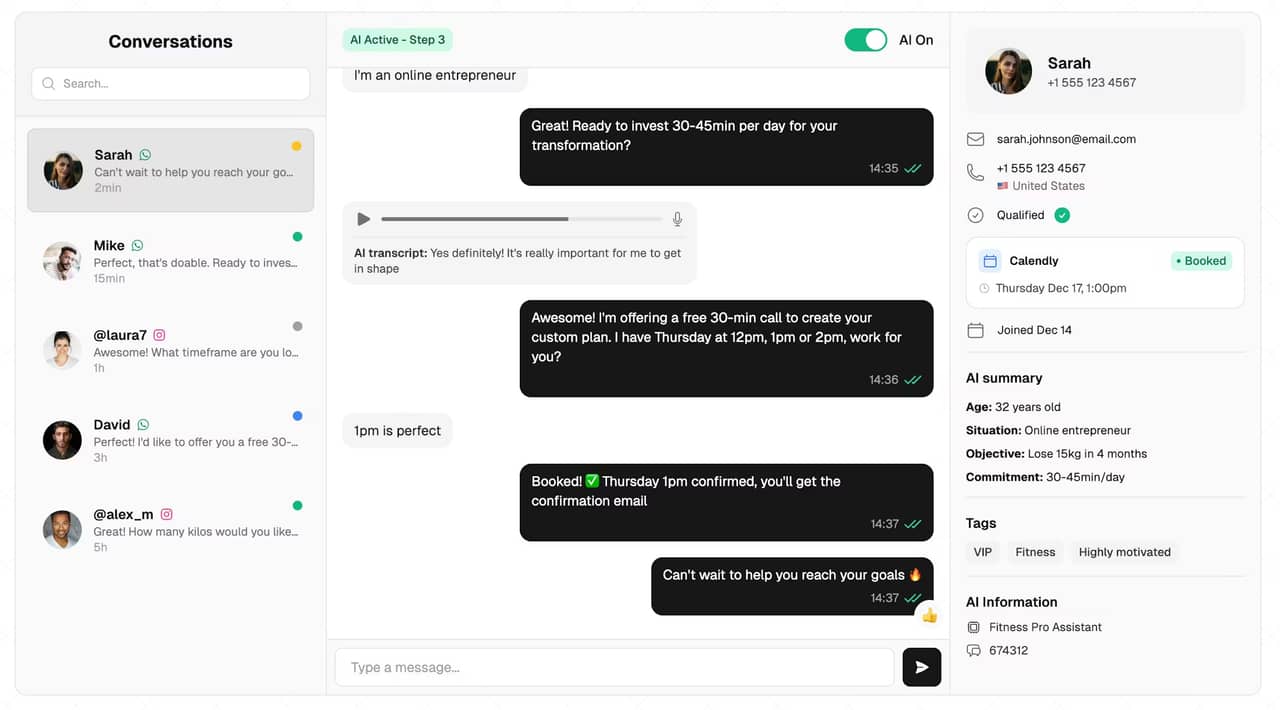
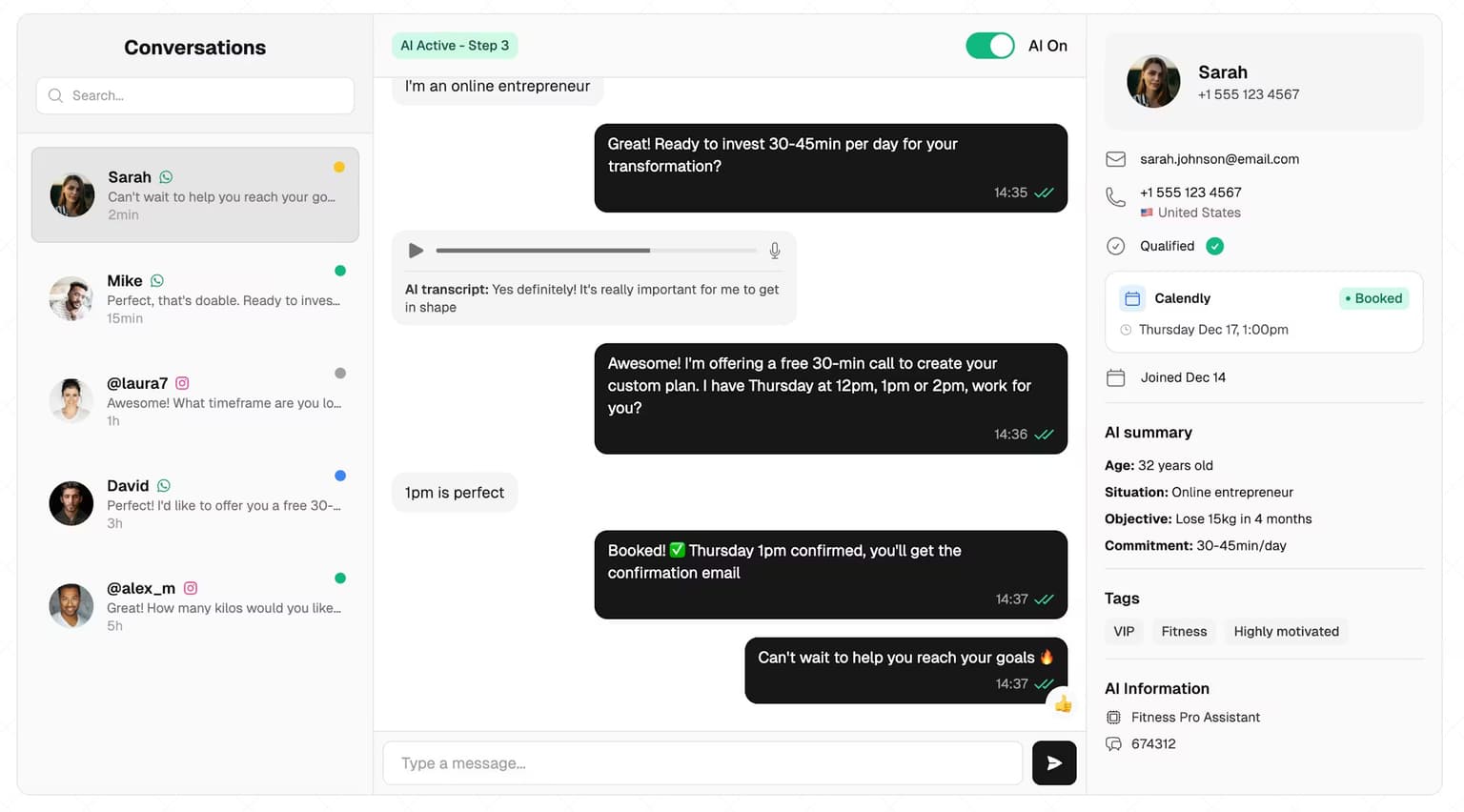
- Inbound DM lands. AI replies in <60 seconds (response time matters — see lead response time statistics for the data).
- AI opens with question #1 (Need urgency). Single question. Sub-15 words on Instagram.
- Lead replies. AI acknowledges, then asks question #2 or #3 depending on what was revealed.
- Across messages 3-7, AI captures Budget (soft), Authority (sideways), and Timing (exploratory). One question per message.
- By message 8-10, AI has either confirmed all four BANT signals (Hot lead, book the call) or has hit a soft block on one (Warm lead, send the appropriate nurture asset).
- If the lead ghosts mid-flow, AI sends a follow-up at 4h and another at 23h. A single follow-up doubles booked calls (+106%) and triples Instagram qualification (+182%).
- The four answers are stored in the contact record. When the lead books, the closer gets the BANT context attached to the calendar invite.
That's roughly the flow SetSmart ships out of the box. SetSmart is an Official Meta Business Partner running on the official Instagram and WhatsApp APIs (no browser scraping, no banned accounts), with a free 7-day trial and then $97/month for the Pro plan that includes 1,000 messages. You can configure your offer, your ICP, and your specific qualification questions, then turn the AI loose on every inbound DM.
The economics are what's striking. A human setter charges roughly $2K-$4K/month and works one shift. An AI setter on SetSmart costs $97/month and runs 24/7. The AI doesn't forget to ask question #2, doesn't stack three questions in one message, doesn't skip the follow-up at 23h. The math is why the best AI setters market grew from a curiosity in 2023 to a default expectation in 2026.
Vertical-specific lead qualification questions
The 21 questions in the top table are the universal set. Three verticals deserve a focused tweak.
Real estate lead qualification questions
Real estate leads are time-sensitive and hyperlocal. The qualification stack we see convert best for residential agents:
- "Are you looking to buy, sell, or both?"
- "What's your target neighborhood (or top 2-3)?"
- "What's your ideal move-in / move-out window?" (Timing)
- "Are you pre-approved with a lender?" (Budget proxy)
- "Will anyone else be on the offer?" (Authority)
These run the same BANT skeleton, just rephrased for property. Real estate is also one of the highest-stakes verticals for response speed: leads contacted within 1 minute convert at 391% the rate of leads contacted within 30 minutes. See lead response time statistics for the underlying data.
Coaching / high-ticket lead qualification questions
Coaching and consulting leads need a slightly different opening — they're researching themselves, not a tool. The high-ticket coaching qualification stack:
- "What are you working on right now that you want to level up?" (Need)
- "What have you already tried — courses, coaches, programs?" (Need + Competition)
- "What ballpark are you working with — $500/mo, $5K/mo, or higher?" (Budget, anchored)
- "On a 1-10, how committed are you to fixing this in the next 30 days?" (Timing + commitment)
The 1-10 commitment question is borrowed from sales coaching frameworks and consistently saves coaches 30-40% of their calendar by filtering out "tire-kicker calls". For more on the coaching-specific funnel, see how to get coaching clients.
B2B SaaS / appointment setter qualification questions
B2B SaaS qualification leans MEDDIC. The 5-question stack we see produce the best handoff to closers:
- "What's your current monthly volume of the metric your product affects?" (Metrics)
- "Who else is involved in evaluating tools like this?" (Authority)
- "What other vendors are on your shortlist?" (Competition)
- "What does the procurement / approval cycle look like on your side?" (Decision process)
- "When do you need this live?" (Timing)
For outsourced B2B appointment setting in particular, see our roundup of appointment setter companies — most of them ship a similar question set as their default qualification template.
How to score lead qualification answers
Capturing the answers is half the work. The other half is scoring. The simplest scoring model that works:
| Score | BANT signals captured | Action | Booking rate |
|---|---|---|---|
| Hot | 4 of 4 captured, all green | Book inside the same DM | ~29% book a call |
| Warm | 3 of 4, soft block on one | Schedule follow-up + send asset | ~9% book a call |
| Cold | 2 or fewer captured | Long-tail nurture, no closer's calendar | <2% book a call |
The 14-15× spread between Hot and Cold is why qualification matters. Sending an unqualified lead to a closer's calendar burns 30 minutes of expensive selling time on a 2% chance — and burns the closer's morale faster. Sending a Hot lead with the four BANT answers attached gives the closer a 30-minute window with a 29% close rate and the context they need to skip discovery.
Common mistakes when running lead qualification questions
Three patterns we see kill qualification motions:
- Asking all 21 questions on every lead. Don't. The 21 in the top table are a menu, not a script. Pick 5-8 per conversation based on the channel and the lead's apparent buying mode.
- Front-loading Budget. Already covered, but it's worth repeating: Budget belongs in message 4-7, not message 1. Need first, always.
- No follow-up. The single biggest leak in qualification isn't the questions — it's the leads that ghost halfway. A single follow-up at 4h + 23h doubles booked calls (+106%). If you only fix one thing about your qualification flow, fix the follow-up.
A fourth mistake worth flagging: treating qualification as a one-shot scoring event. Real qualification is iterative. A lead who scored Cold in March might be Hot in May after a budget approval, a leadership change, or a competitor failure. Keep them in nurture, ask the same Need question 60 days later, and re-score.
What our customers say about question-driven qualification
"We were running through a 12-question discovery template on every Instagram DM. Conversion was brutal — like 4%. Switched to a 5-question AI flow with SetSmart, qualification jumped to 19% and our closer's calendar finally fills with people who actually want to buy."
— Théo Riffault, online business coach
"The biggest unlock for us wasn't the AI — it was the question order. We were leading with budget for years. Reordering to Need → Timing → Authority → Budget cut our DM drop-off rate in half on WhatsApp."
— Mathis Ladoué, agency operator
"Our setters used to ask 'are you the decision maker?' and the answer was always yes. Switching to 'who else is involved in choosing the tool?' surfaced the real buying committee on every call. Discovery calls are now 30% shorter and close rate is up."
— Edouard Clerc, B2B founder
FAQ
What is the best lead qualification question to start with?
The single best opening lead qualification question is "what's pushing you to look at this right now, vs 6 months from now?" — it surfaces urgency (Need + Timing in one ask), anchors the conversation in the lead's reality, and consistently produces the longest, most useful answers. Avoid leading with Budget or Authority — both collapse DM threads.
How many lead qualification questions should I ask?
Five to eight. The 21-question table in this guide is a menu, not a script. The right number depends on channel: Instagram DMs cap at 5-6 questions before drop-off, WhatsApp tolerates 7-9, and B2B web chat can support 10+. Always run one question per message — stacking three in a single message tanks reply rates by ~50% in our data.
What are the BANT lead qualification questions?
The four BANT lead qualification questions in modern phrasing are: "Have you set aside a budget for this?" (Budget), "Who else would be involved in choosing the vendor?" (Authority), "What's pushing you to look at this right now?" (Need), and "When would you ideally want this live?" (Timing). For the full BANT framework — including how to ask sideways and avoid the classic mistakes — see our BANT lead qualification deep-dive.
What lead qualification questions work best in Instagram DMs?
Instagram DMs respond best to short, Need-led questions: "What's pushing you to look at this right now?", "What have you already tried?", and "What does success look like 90 days from now?". Avoid Budget, Authority, or multi-question messages in the first 3 exchanges. Instagram follow-ups nearly triple qualification rates (+182%), so always send a follow-up if the lead ghosts. See Instagram DM automation for the full flow setup.
What lead qualification questions work best for real estate?
Real estate qualification needs hyper-specific Timing and Budget proxies: "What's your move-in / move-out window?", "Are you pre-approved with a lender?", "What's your target neighborhood?", "Will anyone else be on the offer?", and "Are you working with another agent?". Real estate leads also need sub-1-minute response times — see lead response time statistics for the underlying data.
Can AI ask lead qualification questions automatically?
Yes — modern AI setters like SetSmart run the full BANT or MEDDIC qualification flow in real DMs without templated buttons or scripts. The AI picks the next question based on the lead's previous answer, paces them across 5-8 messages, and follows up if the lead ghosts. AI-driven qualification booked calls at ~29% in our AI lead qualification data when all four BANT signals were captured — vs 0.67% for accounts that skipped or front-loaded qualification.
How do I score lead qualification question answers?
Use a 3-tier model: Hot (4 of 4 BANT signals captured, book the call), Warm (3 of 4 with one soft block, schedule a follow-up + send a relevant asset), Cold (2 or fewer signals, long-tail nurture). The spread between Hot and Cold is wide enough that qualification matters significantly before pushing a lead to a closer's calendar.
If you want an AI setter that runs all 21 lead qualification questions inside Instagram, WhatsApp, and Messenger DMs — paced across messages, scored automatically, and handed off to your closer with the full BANT context — try SetSmart. Free 7-day trial, then $97/month.
Ready to automate your DMs?
Start your free 7-day trial and let AI handle your lead qualification 24/7.
Try SetSmart free