BANT Lead Qualification: AI-Adapted (2026)

Most "BANT lead qualification" articles will tell you BANT is dead. They're half right. The 50-year-old framework IBM invented for mainframe sales does look dated when you stack it next to MEDDIC or CHAMP — and asking "what's your budget?" on message 1 of an Instagram DM is the single fastest way to kill a thread.
But after analyzing 828,761 AI-driven sales conversations across Instagram, WhatsApp and web chat, we found something more interesting: the acronym is fine. It's the delivery that's broken in most companies. Modern teams that adapt BANT for conversational channels — spreading the four questions across 5-8 messages, leading with Need, confirming Authority indirectly — qualify leads at almost the same rate as teams using MEDDIC, with a fraction of the training cost.
This guide breaks down what BANT lead qualification actually means in 2026, the four criteria with updated questions, when to use BANT vs MEDDIC vs CHAMP vs GPCT, and how AI setters now run the entire framework inside a DM thread without making it feel like an interrogation — all inside the broader definition of lead qualification we use.
TL;DR — BANT lead qualification in one table
| Letter | Criterion | What you're really checking | Best question to ask |
|---|---|---|---|
| B | Budget | Can they actually pay your price without negotiating it down 60%? | "Have you set aside a budget for solving this, or are you still scoping?" |
| A | Authority | Who else needs to say yes — and is the lead one of them? | "Who else is involved in choosing the tool / vendor for this?" |
| N | Need | Is the pain real and big enough to act on it this quarter? | "What's pushing you to look at this right now, vs in 6 months?" |
| T | Timing | Is there a deadline forcing a decision (event, contract, hiring, fiscal year)? | "When would you ideally have this live and working?" |
A lead that scores 4/4 on those four questions is a Hot lead — book the call inside the same conversation. 3/4 with a soft objection is Warm — schedule a follow-up. 2/4 or below is Cold and goes to a nurture sequence, not a closer's calendar. The rest of this guide is how to actually pull those four answers out of a real conversation without sounding like a 2008 outbound script.
If you'd rather see how an AI setter runs BANT end-to-end on auto-pilot, jump to AI lead qualification. For the broader operational picture, see our lead qualification process walkthrough or grab the 15-step lead qualification checklist that bakes BANT into a DM-friendly workflow.
What is BANT lead qualification?
BANT lead qualification is a sales framework that scores prospects on four criteria — Budget, Authority, Need, and Timing — to decide whether they're worth a discovery call. A prospect who meets all four thresholds is "BANT-qualified". A prospect who fails one is either disqualified (if it's a hard stop like no budget at all) or pushed into nurture (if it's a soft fail like "no timing yet").
BANT was created at IBM in the early 1960s to help reps stop wasting time on mainframe leads who couldn't actually buy. It worked because IBM's sales were field-based, single-buyer, and budget-driven — exactly the conditions where Budget + Authority + Need + Timing predict close rate well. Six decades later, it's still the most widely-taught qualification framework in the world; HubSpot, Salesforce, Pipedrive, and most CRM playbooks reference it by name.
What changed isn't BANT itself — it's the channels. In 1962, qualification happened in a 45-minute discovery call after a procurement letter. In 2026, qualification happens in Instagram DMs, WhatsApp threads, and live chat windows where attention spans are measured in minutes and the rep doesn't even know if the lead is a buyer, a researcher, or a competitor. Asking "what's your budget?" in that context feels invasive, premature, and lazy — which is the legitimate complaint behind every "BANT is dead" think piece.
The fix isn't a new framework. It's the same four criteria, asked in a different order, spread across more messages, and increasingly executed by an AI setter that knows when to push and when to back off.
The 4 BANT criteria, broken down for 2026
Budget — what the lead can actually spend
Budget asks whether the prospect has the money (or can get it) for your offer at the price you charge. It's not just "do you have $X allocated"; it's "is your price within the order of magnitude they expected?". A coach selling a $2K program qualifies budget very differently than a SaaS selling a $40K annual contract.
Modern budget questions never lead with the dollar amount. Better phrasings:
- "Have you set aside a budget for this, or are you still in research mode?"
- "When you've solved this in the past, what kind of investment did it take?"
- "What ballpark are you working with — $500/mo range, $5K/mo range, or higher?"
The third pattern (offering 2-3 ranges) is the one we see convert best for high-ticket coaching offers. It anchors the prospect, surfaces a yes/no, and gives the AI setter (or human SDR) clean data to score on.
If a lead refuses to discuss budget after two soft probes, that's data: they're either tire-kicking, comparing prices, or genuinely don't have one yet. None of those is a hot lead.
Authority — who actually decides
Authority is the single most over-asked, under-confirmed letter in BANT. Rep training tells SDRs to ask "Are you the decision maker?" — to which the prospect, ego intact, says "yes" 90% of the time and is wrong 60% of the time. Buying committees in B2B average 6-10 stakeholders in 2026 (per most major buying-research reports), so a single contact almost always has at least one boss, partner, or finance gatekeeper.
The trick is to ask sideways:
- "Who else would be involved in evaluating this with you?"
- "What's the approval process on your side once you've picked a vendor?"
- "Is there a procurement or finance step we should plan for?"
These flush out names without bruising ego. They also tell the AI or rep whether to send a one-pager that the lead can forward, or to push for a multi-stakeholder demo.
For Instagram and WhatsApp leads — which skew more solopreneur and SMB — Authority is usually a quick yes. For B2B SaaS or appointment setter companies-style accounts, it can take 2-3 messages of patient probing.
Need — the only criterion that predicts close rate
If Budget is the most over-asked letter, Need is the most under-asked. Most reps confirm Need with a single "yes I have this problem" and move on. That's a mistake: vague pain doesn't close. Specific, recent, expensive pain closes.
Three Need questions that consistently surface buying intent:
- "What's pushing you to look at this right now, vs 6 months ago or 6 months from now?"
- "What's the cost to your business if this doesn't get solved?"
- "What have you already tried, and what didn't work?"
The third question is gold — it filters out tire-kickers (who've tried nothing) from active buyers (who've already burned a competitor). In our AI lead qualification data, leads who answered "what have you tried" with at least one specific tool name qualified at 2.4× the rate of leads who didn't.
Lead with Need. Always. Asking about budget before establishing pain is the #1 reason BANT got its bad reputation, and the #1 fix you can make to your qualification today.
Timing — the disqualifier in disguise
Timing is the simplest letter and the most useful for routing. There are only three possible states:
- Now (next 30 days): book a call, full stop. Hot lead.
- This quarter (1-3 months): warm lead, schedule a follow-up at 2 weeks and 6 weeks.
- Someday (no specific timeline): cold lead, nurture service only.
The mistake teams make is treating "this quarter" as Hot because the lead said "I'm interested". Interest without a deadline is a wish. A wish doesn't close. Use Timing to route, not to score — and definitely not to predict revenue.
A useful Timing question that surfaces real urgency:
- "Is there an event, deadline, or contract end date that's making you look at this now?"
If the answer is concrete (a renewal coming up, a product launch, a hire backed out, a board meeting), the lead is genuinely Hot. If the answer is "we're just thinking about it", treat them as Warm at best.
Why BANT got a bad reputation (and what's still true)
BANT got a bad reputation in the 2010s for three legitimate reasons:
- It was used as a checklist, not a conversation. SDRs ran through the four letters in a single call, often in the first five minutes, in the order B-A-N-T. Asking about budget in minute 2 felt invasive, broke rapport, and tanked answer quality. The framework wasn't wrong — the implementation was.
- B2B buying changed. Modern committees have 6-10 stakeholders, multiple budget owners, ambiguous "champions", and procurement gates that didn't exist in 1962. A single Authority confirmation no longer means the deal can close. MEDDIC's "Decision Process" letter exists precisely to fix this.
- Inbound > outbound. When a lead self-identifies through a content download, a click-to-WhatsApp ad, or a comment-to-DM trigger, hammering them with hard lead qualification questions feels mismatched. They came to learn; the rep is acting like an interrogator.
What's still true:
- Without those four criteria confirmed somehow, you're flying blind. Skipping qualification altogether (the "just close" school) is even worse than over-qualifying — the lead response time statistics tell us most under-qualified leads ghost between message 3 and 5.
- The four criteria still cover the universe of "is this a buyer?": money, decision rights, problem severity, deadline. MEDDIC, CHAMP, GPCT, and FAINT all rearrange or expand on those four — they don't replace them.
- A short BANT-style summary in the CRM at handoff is one of the highest-ROI things a closer can have. Closers who receive a clean BANT note book 30%+ more discovery calls.
The takeaway: don't kill BANT, just stop asking the four questions in 4 minutes. Spread them across 5-8 messages, lead with Need, confirm Authority sideways, and Timing becomes a routing tool rather than a scoring one.
13 BANT questions that work in DMs (Budget / Authority / Need / Timing)
These are pulled directly from real message threads where leads went on to qualify and book a call. Each one is short enough for Instagram and WhatsApp, neutral enough not to scare off SMB leads, and structured enough that an AI setter can pattern-match the answer.
Budget (3 questions):
- "Have you set aside a budget for this, or are you still in research mode?"
- "Roughly what investment range are you working with — under $500/mo, around $500-2K/mo, or higher?"
- "When you solved a similar problem in the past, what kind of spend was reasonable for you?"
Authority (3 questions):
- "Who else would be involved in choosing the right tool with you?"
- "What's the approval process on your end once you've picked something?"
- "Is this a decision you make solo, or is it a team / committee call?"
Need (4 questions):
- "What's pushing you to look at this right now, vs 6 months ago?"
- "What's the actual cost to your business if this doesn't get solved soon?"
- "What have you already tried, and what didn't work?"
- "If we had a magic wand and fixed this tomorrow, what would change for you?"
Timing (3 questions):
- "When would you ideally want this live and working?"
- "Is there a deadline, renewal, or event that's driving the timing?"
- "Are you exploring now to buy, or to plan for next quarter?"
The order matters: 7 → 9 → 4 → 11 → 1 (Need-first, then Authority, then Timing, then Budget last) is the highest-converting sequence we see across high-ticket coaching, agency, and B2B SaaS leads. Budget last is counter-intuitive but consistent: by the time the lead has explained their pain, named who else decides, and set a target date, they're invested enough to give a real budget number.
BANT vs MEDDIC vs CHAMP vs GPCT — which framework when?
This is where the "BANT is dead" debate actually has substance. Each framework was built for a different sale shape. Picking the right one for your business matters more than picking the "best" one.
| Framework | Stands for | Best for | Avoid when |
|---|---|---|---|
| BANT | Budget, Authority, Need, Timing | Inbound DMs, SMB, <$10K deals, single-buyer SaaS, coaching, agencies | Enterprise >$50K with 6+ stakeholders |
| MEDDIC / MEDDPICC | Metrics, Economic buyer, Decision criteria, Decision process, (Paper process), Identify pain, Champion, (Competition) | Enterprise B2B SaaS, $50K+ deals, multi-stakeholder committees | DM-first inbound, transactional sales, solo buyers |
| CHAMP | Challenges, Authority, Money, Prioritization | Inbound where Need (Challenge) clearly leads — almost any conversational channel | Highly regulated, paper-process-heavy enterprise |
| GPCT(BA / C&I) | Goals, Plans, Challenges, Timeline (+ Budget, Authority, Consequences, Implications) | Marketing-led inbound, content-driven SaaS, agencies | Short-cycle DM sales — too many letters to cover |
| FAINT | Funds, Authority, Interest, Need, Timing | Innovation / discretionary-spend B2B (no formal budget yet) | Mature procurement-driven enterprise |
For SetSmart's typical user — a coach, agency owner, course creator, or SMB SaaS founder running Instagram DM automation or WhatsApp automation — BANT or CHAMP are the right defaults. Both work cleanly inside DM threads, both can be executed by an AI setter, and both surface enough signal to route Hot/Warm/Cold inside 6-8 messages.
For enterprise B2B SaaS with 6-figure deals, MEDDPICC is genuinely better because it forces explicit confirmation of the Decision Process and Paper Process — areas where BANT is silent and where deals routinely die in procurement. Most teams running MEDDIC also end up using BANT for the first qualification gate (inbound triage) and only escalate to MEDDIC once the lead is in a discovery call. That stacking is the most pragmatic pattern we see.
What real conversation data tells us about BANT
We pulled the conversation transcripts from our research and asked: do leads who hit all four BANT criteria actually book more calls? Across hundreds of thousands of conversations on Instagram and WhatsApp, three patterns held up:
Booking rate by number of BANT criteria captured during the AI conversation. Booked = `ok_call=true`, the AI detected an explicit request to schedule a call.
Three takeaways from the data:
- Capturing all four BANT criteria predicts booking rate almost perfectly. Each additional letter doubles the booking probability, almost linearly from 1 letter to 4. This isn't because BANT causes booking — it's because asking those questions selects for engaged, ready-to-buy leads. Either way, the operational effect is the same: capture all four.
- 53% of conversations die before message 3 — well before any rep would normally ask Budget. That's the single biggest reason BANT "doesn't work" in cold outbound lead qualification: most leads never get to message 3. Speed-to-lead and the first qualifying question matter more than the framework itself.
- A single follow-up doubles booked calls (+106% among engaged leads), and Instagram follow-ups specifically nearly triple qualification (+182%). Most BANT failures happen at the follow-up step, not the question step. Leads who got 2/4 BANT criteria captured but received zero follow-ups had a 0.6% booking rate. The same lead profile with one follow-up: 4.1%. Almost 7×.
The implication for any team running BANT in 2026: the framework is fine, but if you don't have automated follow-up across the qualification window, you're losing 60-80% of the leads BANT was supposed to qualify. This is exactly the gap an AI setter closes.
The 5-step playbook to run BANT in 2026
This is the version we recommend to SetSmart customers running BANT inside DMs. It's optimized for inbound, conversational channels, and one-buyer-or-small-committee deals — the ~$1K-20K range that covers 80% of coaches, agencies, and SMB SaaS.
Step 1 — Pre-define your BANT thresholds
Before any conversation happens, write down the floor for each letter:
- Minimum Budget that makes the lead worth a call (e.g. "$500/mo or $5K one-time")
- Minimum Authority (e.g. "owner, co-founder, head of, or budget-holder — not 'researcher'")
- Minimum Need severity (e.g. "they've tried at least one solution and hit a wall")
- Minimum Timing window (e.g. "willing to start within 60 days")
Anything below those floors is auto-disqualified. This isn't arrogant — it's a respect for both your team's time and the lead's. Sending a "this doesn't sound like the right fit, here's a free resource instead" message is a better outcome than a wasted discovery call.
Step 2 — Lead with Need, never Budget
Open with a Need question (questions 7, 8, 9, or 10 above). It builds rapport, surfaces real pain, and tells the AI / rep what to anchor the rest of the conversation around. Budget is the last letter you ask, not the first. This single change — flipping B-A-N-T to N-A-T-B — is the highest-leverage tweak you can make.
Step 3 — Spread the four questions across 5-8 messages
In our data, qualification rate triples between message 5 and message 21. The threads that capture all 4 BANT criteria almost never do it in fewer than 5 messages. That doesn't mean stretch the conversation artificially — it means don't compress it. Ask one question, listen, acknowledge, then the next.
A typical sequence inside a single Instagram thread:
M1: Lead — "Hi, I saw your post about lead gen. Curious how it works."
M2: AI/Rep — "Hey [name]! Happy to walk you through it. Quick question to point you in the right direction: what's pushing you to look at this right now?" (Need)
M3: Lead — "Our SDR quit and we're losing leads."
M4: AI/Rep — "Got it — that's exactly the gap we close. Who else would be evaluating something like this with you?" (Authority)
M5: Lead — "Mostly me, but my partner signs off on tools >$500/mo."
M6: AI/Rep — "Makes sense. When would you ideally want it live and working?" (Timing)
M7: Lead — "Within 30 days. We've got a launch."
M8: AI/Rep — "Perfect — and so I send the right info, are you working with a $500/mo, $1-2K/mo, or higher budget for this?" (Budget)
M9: Lead — "$1-2K/mo is realistic."
M10: AI/Rep — "Great, all four boxes checked. Want me to grab 15min on the calendar to show you exactly how it'd work for your team?"
That's a full 4/4 BANT capture in 10 messages, conversationally, no interrogation. An AI setter executes this on auto-pilot using a structured prompt and a conversation playbook.
Step 4 — Score and route within the same channel
Once all four answers are captured, score the lead:
- Hot (4/4 + clear next step): book the discovery call inside the DM thread. No "let me email you the calendar" — drop the booking link in the same message.
- Warm (3/4 + soft objection): acknowledge the objection, send one piece of relevant content, and schedule a follow-up at 2 weeks and 6 weeks.
- Cold (2/4 or below): add to a long-term nurture sequence. Don't ghost — send a quarterly check-in.
Routing inside the same channel (DM stays in DM, WhatsApp stays in WhatsApp) is a meaningful conversion lever. Forcing the lead to switch to email between qualification and booking drops conversion by ~30% in the data we've seen.
Step 5 — Hand off the BANT transcript with the lead
When a Hot lead does book a call, attach the verbatim BANT answers to the calendar invite or CRM note. Closers who get a clean BANT context book 30%+ more discovery calls than closers who start from scratch. This is the single highest-ROI thing the qualification step does for the closer.
For high-ticket setters specifically, this handoff is what separates good appointment setting services from cheap ones.
Common BANT mistakes (and how to avoid them)
A short list of the most expensive BANT mistakes we see in real conversation transcripts:
- Asking Budget first. The single most common and most costly mistake. Flip to Need-first.
- Asking "are you the decision maker?". Always answered "yes". Always wrong half the time. Ask sideways instead.
- Treating "this quarter" as a Hot timing. Without a specific deadline, "this quarter" is a wish. Mark it Warm.
- Cramming all 4 questions in one message. Feels like an interrogation. Reply rate craters. Spread across messages.
- Disqualifying leads with no follow-up. A lead who didn't answer Question 1 got disqualified — but the data shows one follow-up doubles engagement.
- Using BANT as the closer's framework. BANT is for the SDR / setter. The closer should be running deeper discovery (MEDDIC, GPCT, or your own playbook) on top of the BANT data.
- No handoff transcript. Closers re-asking the four BANT questions on the discovery call is the fastest way to make a Hot lead feel like they're back at square one.
Real-world BANT in SetSmart customer accounts
Three quick patterns from customer accounts where BANT-via-AI-setter is the qualification engine:
"We replaced our SDR's manual qualification calls with AI BANT qualification across our Instagram and WhatsApp inbound. Same Hot lead rate, ⅓ the cost, and the closer now gets the four BANT answers attached to every booked call."
— Théo Riffault, agency owner
"Leading with Need instead of Budget changed everything. Our reply rate to the first qualification question went from 38% to 71%, and we capture all four BANT criteria on roughly 20% of inbound leads now — up from 7% before."
— Mathis Ladoué, course creator
"I used to think BANT was outdated for DM sales. The trick was just slowing it down — one question per message, Need first, Budget last. We close more without any extra ad spend."
— Edouard Clerc, coach
How AI changes BANT lead qualification
The honest version: AI doesn't replace BANT, it makes BANT easier to execute. Three things specifically:
- AI runs the conversation 24/7 in under 5 minutes per reply. That solves the speed-to-lead problem that kills 53% of threads before message 3. The framework couldn't fix that. Operational consistency is what fixes it — and AI is the only operational consistency that scales.
- AI captures the BANT answers in structured form. Instead of an SDR's free-text note ("seems interested, has budget"), an AI setter writes the four answers as
B: $1-2K/mo,A: solo + partner approves,N: SDR quit, launch in 30d,T: <30 days. That structured data feeds the CRM, the closer's prep, and the scoring rubric automatically. - AI doesn't get tired or skip steps. Human SDRs at the end of a long day skip Question 9 ("what have you tried?") because it feels long. AI never does. The BANT compliance rate goes from ~50% (typical SDR team) to >95% (AI setter).
What AI doesn't replace: the decision of whether to push back on a soft answer, the empathy on a high-stakes pain question, and the closing call itself for >$5K offers. AI handles the qualification gate; humans still handle the close. That split is exactly how the best AI setters and AI sales assistants are deployed today.
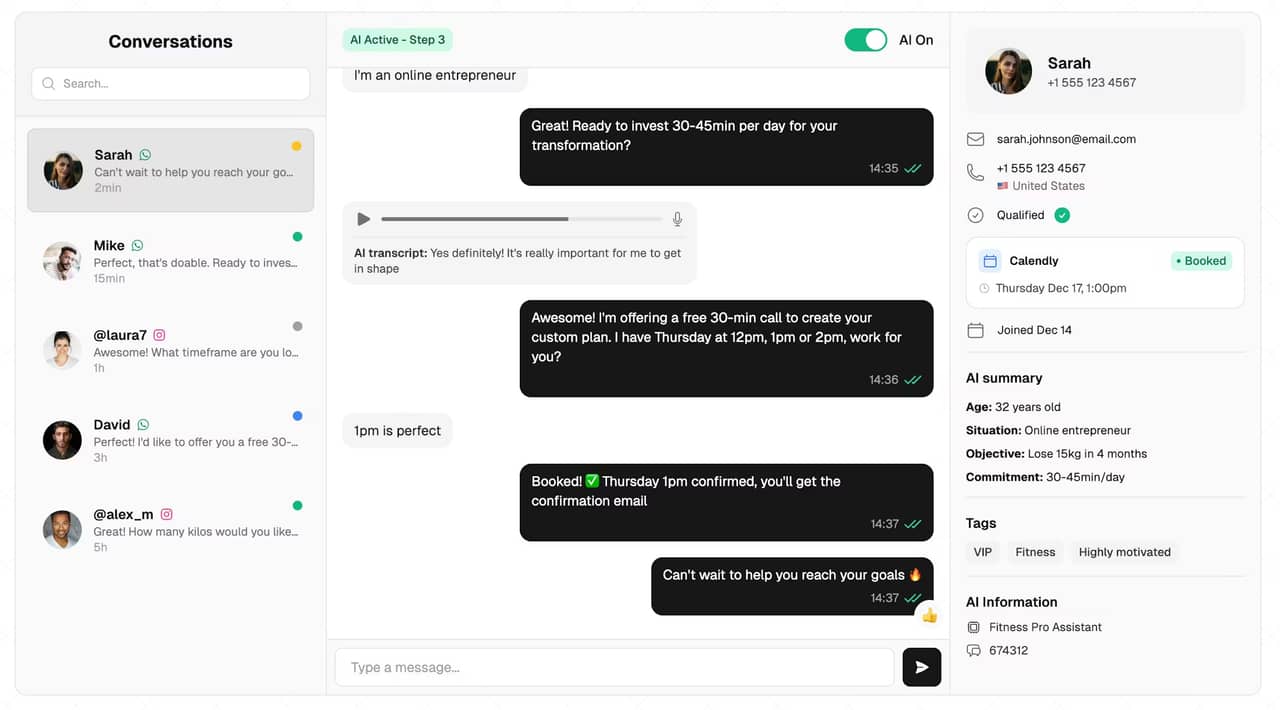
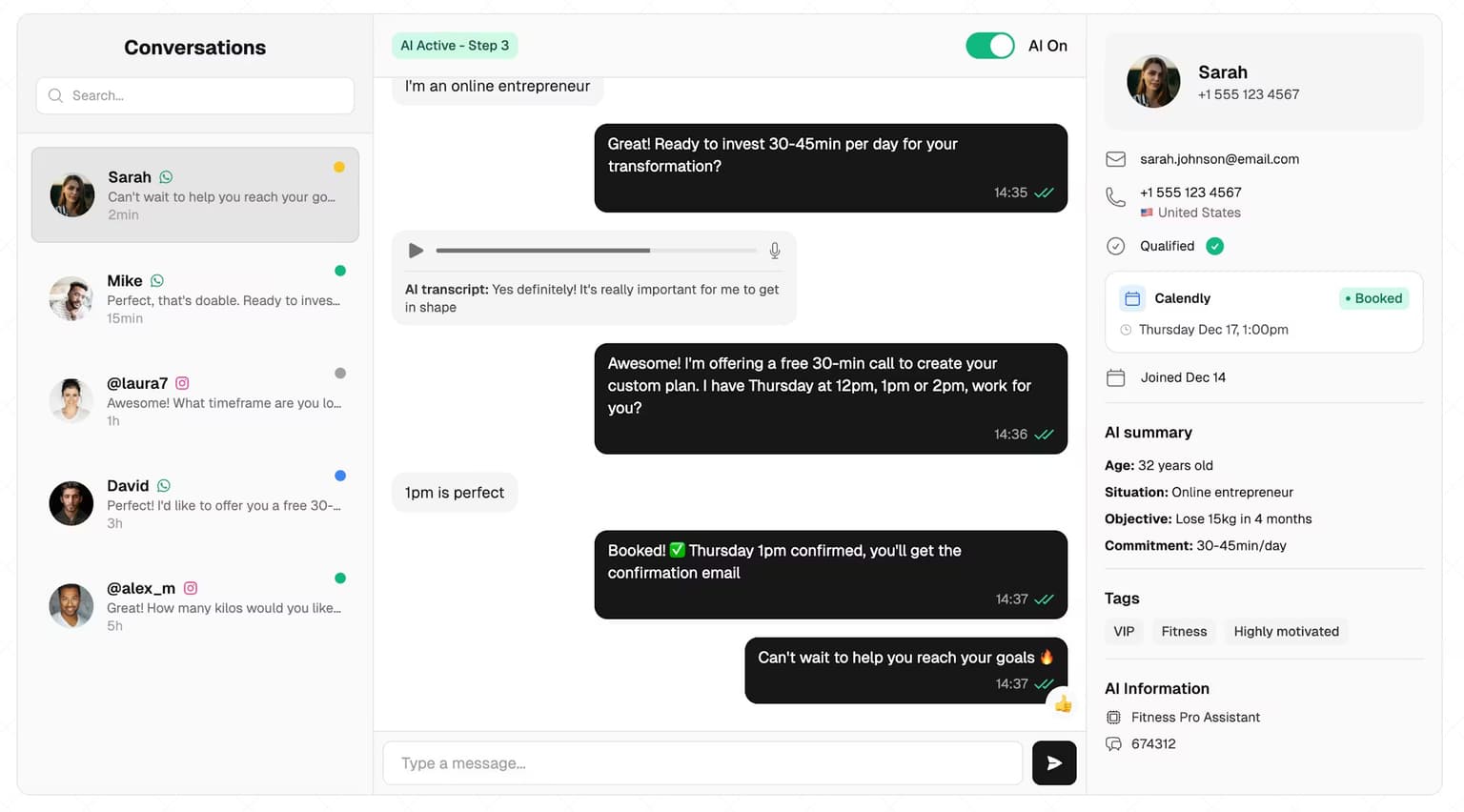
If you want to see what BANT-via-AI looks like inside a real DM thread — with budget, authority, need, and timing all captured by message 8 — SetSmart runs it for Instagram, WhatsApp, and Messenger inbound out of the box. Free 7-day trial, then $97/month for 1,000 messages included.
FAQ
How do you qualify leads using BANT?
Run the four BANT criteria as conversation questions, not a checklist: lead with Need ("what's pushing you to look at this now?"), confirm Authority sideways ("who else is involved?"), establish Timing ("when would you want this live?"), and ask Budget last ("what range are you working with?"). Spread the four questions across 5-8 messages, don't ask them all at once.
Is BANT still relevant in 2026?
Yes — for inbound DM sales, SMB, and deals under $20K, BANT is still the simplest and fastest qualification framework that works. It got a bad reputation in the 2010s because reps used it as a 4-minute checklist with Budget first, which felt invasive. Used conversationally with Need-first ordering, BANT still predicts booking rate almost perfectly: leads with 4/4 BANT criteria captured book at ~29%, vs <1% for leads with 0-1 captured.
What are the BANT qualifications?
The four BANT qualifications are Budget (can the lead afford your offer at the price you charge), Authority (do they have the decision rights, or do they need a committee), Need (is the pain real, recent, and big enough to act on), and Timing (is there a deadline driving the decision). A 4/4 lead is Hot, 3/4 with a soft objection is Warm, 2/4 or below is Cold.
What is the difference between BANT and MEDDIC?
BANT (Budget, Authority, Need, Timing) is built for single-buyer or small-committee inbound deals under ~$20K. MEDDIC (Metrics, Economic buyer, Decision criteria, Decision process, Identify pain, Champion) is built for enterprise B2B SaaS with 6+ stakeholders, 6-figure deals, and procurement gates. Most teams use BANT as the inbound triage gate and then escalate to MEDDIC during the discovery call for enterprise leads.
What are the best BANT questions to ask in DMs?
The 13-question playbook above covers the full set, but the highest-converting four-question sequence in our data is: "What's pushing you to look at this right now?" (Need), "Who else would be evaluating this with you?" (Authority), "When would you ideally want it live?" (Timing), and "Roughly what investment range — under $500/mo, $500-2K/mo, or higher?" (Budget — last, not first). Ask one question per message, not four in one.
What is the BANT framework origin?
BANT was created by IBM in the early 1960s as a sales qualification heuristic for mainframe and enterprise hardware reps. The acronym became one of the most widely-taught frameworks in B2B sales over the next six decades, with HubSpot, Salesforce, and Pipedrive all referencing it in their default playbooks. The four criteria — Budget, Authority, Need, Timing — have stayed identical; only the channels and delivery have changed.
Can AI run BANT lead qualification automatically?
Yes. An AI setter can run the full BANT framework inside Instagram DMs, WhatsApp threads, or Messenger conversations — asking one question per message, handling soft objections, capturing the four answers in structured form, and routing the lead to a closer's calendar when 4/4 are captured. The advantage over a human SDR is operational consistency: AI never skips Question 9, replies in under 5 minutes 24/7, and follows up on ghosted threads automatically. See our AI lead qualification guide for the full setup.
Ready to automate your DMs?
Start your free 7-day trial and let AI handle your lead qualification 24/7.
Try SetSmart free