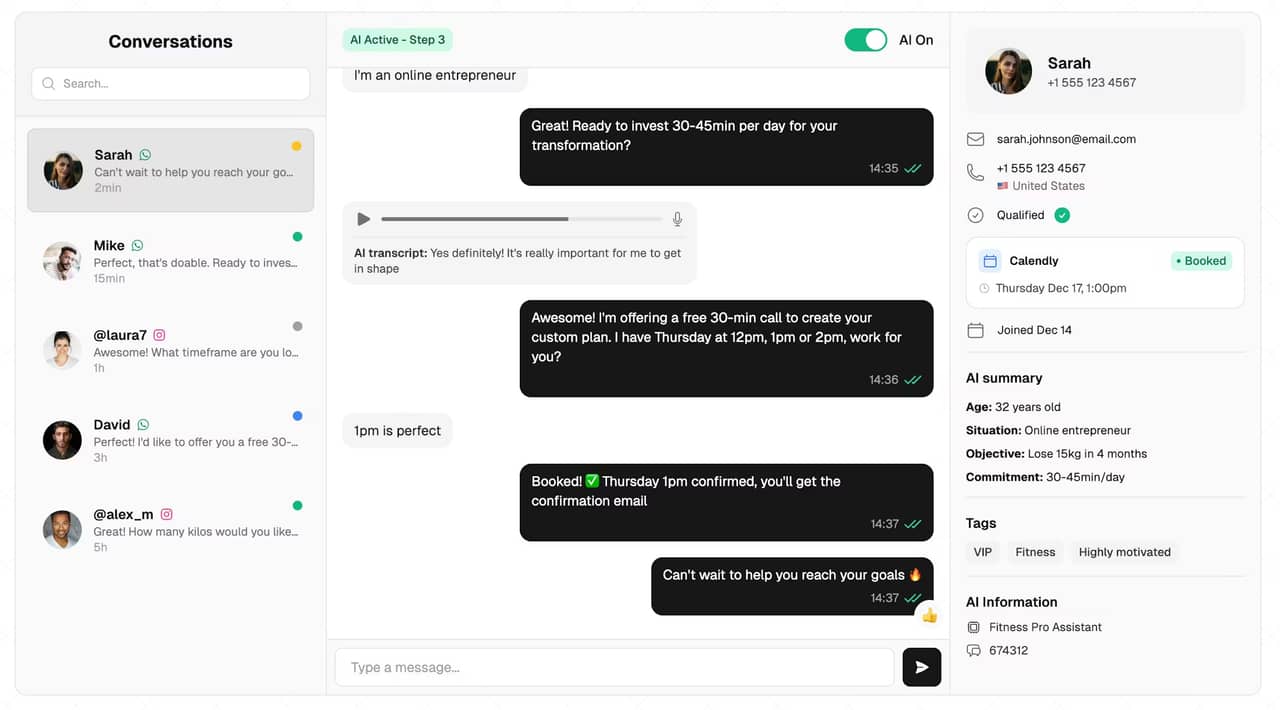
Lead Qualification Process: 7 Steps (2026)

Most "lead qualification process" articles read like a 2008 sales-textbook chapter: BANT, MEDDIC, an org chart, three flowchart icons, done — they skip the basic definition of what lead qualification actually is and never walk you through what actually happens between a lead saying "hi" and a closer picking up the phone.
After analyzing 828,761 AI-driven sales conversations across Instagram, WhatsApp, and web chat, we have a much sharper view of what the modern lead qualification process looks like — including the exact stages where leads die, the messages that revive them, and the shortcuts AI now makes possible. This guide maps the 7 steps end-to-end, with benchmarks at each stage and the framework choices that actually matter in 2026.
Short version: most teams fail at steps 3 (speed) and 6 (follow-up), not at step 4 (the questions). Fixing those two lead qualification stages alone usually doubles qualified-lead volume without hiring a single SDR or signing on with one of the bigger appointment setter companies.
TL;DR — the 7-step lead qualification process
| Step | What you do | Owner | Where teams fail |
|---|---|---|---|
| 1. Define ICP & disqualifiers | Write 4-6 fit traits + 2-3 hard rejects | Founder / RevOps | Skipped — "everyone" is the ICP |
| 2. Capture the lead | Name, channel, source, first message | Marketing | Forms too long — drops 50%+ |
| 3. Reply in under 5 minutes | Auto-acknowledge + first qualifying question | AI setter / SDR | Median reply time is 47h — leads die |
| 4. Ask 3-5 qualifying questions | Confirm fit, pain, timing, decision | AI setter / SDR | Interrogation in one message — kills the thread |
| 5. Score the lead | Hot / Warm / Cold based on fit + intent | AI / SDR / CRM | Subjective scoring — no rubric |
| 6. Follow up at least once | +4h, +23h, +3d (channel-specific) | AI setter / sequencer | Single touch, then ghost — wastes 50%+ pipeline |
| 7. Hand off (or close in DM) | Pass transcript + notes to closer | AI → AE / Closer | No context handoff — closer starts from scratch |
The rest of this guide breaks each step down with benchmarks, scripts, and the AI shortcuts that work in 2026. If you'd rather see the tools that automate this end-to-end, jump to our ranked list of lead qualification tools.
What is the lead qualification process — and why it's broken in most companies
The lead qualification process is the structured sequence of steps a business uses to decide whether a new lead is worth pursuing — capturing the lead, contacting them quickly, asking the right questions, scoring fit and intent, following up if needed, and handing qualified leads to a closer. Done well, it filters 100 raw leads down to the 10-30 who deserve a sales conversation. Done badly, it just slows down a closer who could have qualified faster on their own.
The reason it's broken in most companies is rarely the framework. BANT, MEDDIC, GPCT and CHAMP all work fine when used as guardrails. The breakage is operational:
- The first reply takes hours (or days), so 53% of leads have already moved on by message 3 — a consistent pattern across the conversations we analyzed.
- Reps ask all five qualifying questions in a single message, which feels like an interrogation and tanks reply rates.
- Nobody follows up after the first dropped thread, even though a single follow-up +106% of booked calls among engaged leads.
- The "qualification" is a gut-feel tag (
hot,warm,cold) with no rubric, so handoffs are noisy and closers waste time on bad leads.
If those four issues sound familiar, this guide is for you. We'll fix them step-by-step.
Why speed and depth matter more than frameworks
Two variables predict almost the entire variance in qualification outcomes: speed and depth. Speed is how fast you reply. Depth is how many messages you exchange before disqualifying.
The data is brutal. Leads contacted in under 5 minutes are 21x more likely to qualify than those contacted after 30 minutes. Conversations that reach 21+ messages (~10 back-and-forth exchanges) book a call 29% of the time — almost 1 in 3. Conversations that die at message 3 book at well under 2%.
The implication: a "qualification process" that triggers 4 hours after the lead lands and stops after a single unanswered DM has already lost the math. Before you optimize the framework, fix the timing and the persistence. Frameworks are tiebreakers — speed and follow-up are the game.
Step 1 — Define ICP and hard disqualifiers
Before any process can run, you need a one-page Ideal Customer Profile and a list of hard disqualifiers. The ICP describes the lead you'll spend time on; disqualifiers describe the leads you'll politely reject in 30 seconds.
A useful ICP captures 4 to 6 traits, no more:
- Industry / niche (e.g. "online coaches selling 1:1 programs $2K+")
- Stage / size (e.g. "$5K-$50K MRR, 1-3 person team")
- Geography (e.g. "US, UK, EU, AU — English speakers")
- Channel where they bought (e.g. "Instagram organic or paid")
- Behavioral trigger (e.g. "actively running ads or posting weekly")
- A non-obvious negative (e.g. "not currently using a setter or VA")
Then add 2-3 hard disqualifiers that immediately reject anyone matching them:
- Wrong country (e.g. "outside top-tier markets")
- Below revenue floor (e.g. "pre-launch, no offer yet")
- Wrong product fit (e.g. "selling physical products only — we serve service businesses")
For B2B teams, a b2b lead qualification process usually adds firmographic filters (company size, tech stack, decision-maker title). For SMB and creator economies, the filter is closer to revenue stage and offer type.
Without this step, every other step gets noisier. Step 4 questions become guesses. Step 5 scoring becomes vibes. Don't skip it.
Step 2 — Capture the lead with the minimum useful data
The capture stage is the first place leads die unnecessarily. Long forms feel "professional" but they cut conversion in half. The 2026 best practice is to capture only what you need to start the conversation:
- Name (or display name from the channel)
- Channel + source (Instagram DM from a specific ad, WhatsApp from website, organic comment-to-DM, etc.)
- The first message itself (this is the most predictive signal you'll get)
Everything else — budget, team size, deadline, decision authority — is gathered during the qualification conversation in step 4, not at the form level. Treat the form like a doorway, not an exam.
For Instagram-led capture, the comment-to-DM pattern is currently the highest-converting top-of-funnel: a lead comments a keyword on a post or ad, gets a DM, and the qualification thread starts. For WhatsApp, click-to-WhatsApp ads play the same role. Both feed into the same qualification process from step 3 onward.
Step 3 — Reply in under 5 minutes (24/7)
This is the single highest-leverage step in the lead qualification process. Leads decay fast. The Harvard study and our own lead response time statistics both confirm the same curve: from 0-5 minutes to 30+ minutes, qualification probability drops by an order of magnitude.
The implication for staffing is brutal. A human SDR working 9-to-5 covers maybe 8 hours a day, leaves leads to wait overnight, and physically cannot hit a 5-minute SLA when leads land in batches. The only way to hit speed-to-lead at scale in 2026 is an AI setter on the inbound channels (DMs, WhatsApp, web chat), with the human SDR layered on top for objections and call booking.
The first reply doesn't have to be the smart one. It has to be the fast one. A useful 2-message opener:
AI: Hey name 👋 thanks for reaching out about topic from their first message. Quick one before I send you the right info — what made you reach out today?
That single message acknowledges the lead, references context, and asks a low-friction qualifying question. It buys you the next 24 hours of attention. Without it, you're competing with TikTok for the lead's brain.
Step 4 — Ask 3-5 qualifying questions, spread across messages
Most "lead qualification process steps" guides hand you a 12-question BANT script and tell you to ask all of it. That works in a discovery call. It does not work in a DM thread. Ask all your questions at once and the lead ghosts. For a tested catalogue of 21 lead qualification questions you can mix and match per channel, see our dedicated playbook — or the operational lead qualification checklist for a 15-step pass/fail spine you can drop into your CRM.
The DM-friendly version is to ask 3 to 5 questions, spread across 5-10 messages, mixed with value (a tip, a stat, a relevant case study). The exact framework matters less than the cadence. Pick whichever fits your business:
- BANT — Budget, Authority, Need, Timing. Classic, works for B2B with explicit budgets.
- GPCT — Goals, Plans, Challenges, Timeline. Better for consultative/coaching offers.
- CHAMP — Challenges, Authority, Money, Prioritization. Modern reorder of BANT.
- PIF (proprietary) — Pain, Intent, Fit. The minimum viable framework. Works in DMs.
For a deeper breakdown of how AI specifically applies these frameworks to messaging threads, see AI lead qualification. For an opinionated tool ranking, our review of lead qualification tools maps each tool to the framework it implements best.
The questions themselves should pull double-duty: each one should both qualify the lead and move them emotionally toward the offer. Bad: "What's your budget?" Good: "If we could get you to outcome in 90 days, what would that mean for your business?" The good question reveals timing, urgency, and pain at once — and it makes the lead more invested in the conversation.
Step 5 — Score the lead (Hot / Warm / Cold)
Once you have answers to your qualifying questions, score the lead. The mistake here is using one dimension. Modern scoring uses two: fit and intent.
| Score | Fit (matches ICP) | Intent (asked about pricing, demo, deadline) | Action |
|---|---|---|---|
| 🔥 Hot | High | High | Book a discovery call now |
| ☀️ Warm | High | Medium | Nurture sequence + call invite within 7 days |
| ☀️ Warm | Medium | High | Send case study + qualify deeper |
| ❄️ Cold | Low | Any | Polite decline + alternative resource |
| ❄️ Cold | High | Low | Long-form nurture service (newsletter, retargeting) |
Two operational rules around scoring:
- Always assign a score, even if it's "Cold". Untagged leads stay in limbo forever and clog your CRM.
- Re-score on every meaningful reply. A "Cold" lead who comes back 30 days later asking about pricing is now Hot. Most teams miss this because they tag once and never revisit.
For B2B revenue teams, scoring is usually wired into the CRM (a crm lead qualification process typically syncs the score field on the lead record so dashboards reflect pipeline quality in real time). For solo founders and SMB teams, a Notion table or a Trello board is fine — the scoring discipline matters more than the tool.
Step 6 — Follow up at least once before disqualifying
This is the second highest-leverage step, after speed. The data:
- 53% of conversations die before message 3.
- Among engaged leads, a single follow-up doubles booked calls (+106%).
- Instagram follow-ups nearly triple qualification (+182%) — because Instagram inboxes are noisier and the first message gets buried.
- WhatsApp follow-ups also lift qualification dramatically (+784% lift on the responder cohort), because WhatsApp leads expect business-grade persistence.
The cadence we've validated across both channels:
- +4 hours: a soft re-engage. "Hey, didn't want this to slip — were you still curious about topic?" Hits before the lead falls asleep.
- +23 hours: a value-add. Send the case study, the relevant blog post, or the ICP-matched testimonial. Resets the conversation without asking anything.
- +3 days: a gentle exit. "I'll let this one go for now — feel free to ping me when you're ready." Triggers loss-aversion in 5-15% of leads who reply with intent.
A full AI lead follow-up sequence runs all three touches automatically without human intervention. If you only implement one new thing from this guide, implement step 6.
Step 7 — Hand off (or close in the DM)
The final step is where the qualification process becomes revenue. Two patterns:
- Sub-$5K offers — close inside the DM thread itself. The qualified lead has already invested 10+ messages into the conversation; pulling them onto a Zoom call adds friction without adding conversion. AI setters that can take payment links or Stripe checkout in DM run this play well.
- High-ticket ($5K+ to enterprise) — book a discovery call. Pass the full conversation transcript + qualification notes to the closer or AE so they don't restart from zero. This is where most teams fumble: a 200-message qualification thread arrives in the closer's calendar with zero context, and the closer asks the same five questions the AI already answered. The lead — rightly — gets annoyed.
A clean handoff packet contains:
- Conversation transcript (full, not summary)
- ICP fit notes (which traits matched, which didn't)
- Stated pain + desired outcome
- Stated timing + budget signal (if revealed)
- AI's recommended approach for the call ("they're worried about implementation time, lead with our 7-day setup case study")
Tools like Best AI setters auto-generate this packet and drop it into the calendar event so the closer arrives prepared. For teams using a generic AI sales assistant or even a manual handoff Slack message, the same hygiene rules apply: never make the closer re-qualify.
Lead qualification process by channel — what actually changes
The 7 steps are constant. What varies is the timing, message density, and follow-up cadence per channel. Here's how the numbers shift across the three channels we have direct data on:
| Channel | Avg. messages to qualify | Best follow-up cadence | Qualification rate | Note |
|---|---|---|---|---|
| Instagram DM | 14-22 | +4h, +23h, +3d | ~18% | Inbox is noisy — assume lead missed first DM |
| 8-14 | +1h, +24h | ~34% | Stronger intent — opt-in already implies qualification | |
| Web chat / forms | 5-10 | +15min, +24h | ~12% | Highest intent at moment of capture, fastest decay |
| Outbound email | 3-6 (per touch) | +3d, +7d, +14d | ~2-4% | Cold start, multi-touch sequence required |
The two takeaways: WhatsApp qualifies almost twice as fast as Instagram with half the messages (which is why a WhatsApp automation layer is usually the highest-ROI investment for teams that already have inbound DM volume), and outbound email needs an entirely different sales cadence — never apply the DM playbook to cold email.
Manual vs AI lead qualification process
The same 7 steps run either manually or with AI. The difference is throughput and consistency, not structure. Here's the honest comparison:
| Step | Manual (1 SDR) | AI-powered |
|---|---|---|
| 1. Define ICP | Owner writes ICP doc once | Same — AI consumes the doc as a system prompt |
| 2. Capture | Form / DM / Calendly | Same — AI sits behind whatever capture you have |
| 3. Reply < 5 min | Impossible at scale, especially nights/weekends | < 30 seconds, 24/7 |
| 4. Ask qualifying Qs | High quality but slow throughput | Same quality at unlimited concurrency |
| 5. Score | Subjective gut-feel | Rubric-based, consistent across leads |
| 6. Follow up | Forgotten 60-80% of the time | Always fires on schedule |
| 7. Hand off | Slack message + link, often no context | Auto-generated handoff packet w/ transcript |
The honest read: AI doesn't replace the qualification thinking — it replaces the operational discipline. A great human SDR who hits steps 3 and 6 reliably will outperform a mediocre AI setup. But a great human SDR is rare, expensive, and capped at ~50 conversations/day. AI hits 1,000/day at the same quality once you've tuned the system prompt. For most teams, the right model is hybrid: AI runs steps 2-6, humans handle complex objections and discovery calls in step 7.
SetSmart pricing and how the qualification process is wired in
If you want to skip the build and use a working AI lead qualification process out of the box, SetSmart runs all 7 steps natively across Instagram, WhatsApp, and Messenger. Free 7-day trial, then $97/month (1,000 messages included). The setup pulls in your ICP and FAQ, generates the qualifying questions, runs the +4h / +23h / +3d follow-up sequence, and writes a handoff packet to your CRM or Calendly when a lead qualifies.
Three real client outcomes from teams using this process at scale:
"Booked 47 calls in our first 30 days from Instagram DMs alone — we used to get 8-12. The follow-up sequence is what unlocked it." — Théo Riffault, online coach.
"We replaced two SDRs with the AI setter on WhatsApp inbound. Qualification rate went from 14% to 31%, and we sleep at night now." — Edouard Clerc, e-commerce founder.
"The handoff packet is the killer feature. My closers used to spend the first 10 minutes of every call re-asking what the AI already knew. Now they walk in prepared." — Mathis Ladoué, agency owner.
The setup is the same across all three: define ICP once, plug in the channels, let the qualification process run. The compound effect over 60-90 days is usually a 2-3x lift in qualified-lead volume without hiring.
Common mistakes that quietly kill the lead qualification process
A short list of things we see go wrong on practically every audit:
- No disqualifiers. Teams "want every lead" and end up burning closer time on people who'll never buy. Reject early, reject politely.
- Asking budget in message 1. Budget questions go in message 5-7, after some rapport. Asking too early reads as pushy and reply rates collapse.
- One follow-up, then silence. If the lead doesn't reply to follow-up #1, follow-up #2 still has a 30-50% reply rate. Silence after the first nudge is leaving money on the table.
- Using "are you still interested?" as a follow-up. This is the worst follow-up message in sales. It implies the lead disengaged, which makes them disengage. Use a value-add nudge instead (case study, stat, mini-tip).
- No re-scoring. Lead tagged "Cold" in January, asks about pricing in March, gets routed to the cold sequence. Re-score on every reply.
- Closer re-qualifies on the call. Wastes 10 minutes, irritates the lead, signals chaos. Hand off the transcript, train the closer to skip ahead.
- Process documented in 1 person's head. The qualification process should be a living document or system prompt. If your top SDR leaves and qualification rates drop 40%, you didn't have a process — you had a person.
FAQ
What is the process of lead qualification?
The lead qualification process is the 7-step sequence used to decide whether a new lead is worth selling to: define your ICP, capture the lead, reply within 5 minutes, ask 3-5 qualifying questions across messages, score the lead by fit and intent, follow up at least once, and hand off qualified leads to a closer (or close in DM for sub-$5K offers).
What are the lead qualification process steps in order?
The 7 steps in order are: (1) define ICP and disqualifiers, (2) capture the lead with minimum data, (3) reply in under 5 minutes, (4) ask 3-5 qualifying questions, (5) score the lead Hot/Warm/Cold by fit + intent, (6) follow up at least once at +4h, +23h, +3d cadence, (7) hand off the transcript and notes to a closer or close in the DM. Skipping steps 3 or 6 is what most often breaks the process.
What is the difference between BANT and the modern lead qualification process?
BANT (Budget, Authority, Need, Timing) is a question framework — it sits inside step 4 of the broader process. The modern process wraps BANT (or GPCT, CHAMP, PIF) with a speed layer (step 3, < 5 min reply), a follow-up layer (step 6, multi-touch cadence), and a scoring layer (step 5, fit × intent rubric). BANT alone tells you what to ask. The process tells you when to ask, how often to follow up, and what to do with the answers.
How does AI change the lead qualification process?
AI doesn't change the 7 steps — it makes steps 3 (speed), 4 (asking questions consistently), 5 (scoring with a rubric), and 6 (follow-up cadence) operationally reliable. A human SDR can't hit a 5-minute SLA at 3am or remember to send the +23h follow-up to 200 leads. An AI lead qualification process layer runs all four 24/7, so the human team focuses on closing in step 7.
What's a good qualification rate for inbound leads?
Channel benchmarks: ~12% on web chat, ~18% on Instagram DM, ~34% on WhatsApp, and ~2-4% on outbound cold email. The top 10% of teams hit 31.78% qualification across all channels combined; the bottom 25% sit at 0.67%. The biggest delta isn't the channel — it's whether the team runs steps 3 and 6 reliably.
What does a lead qualification process flowchart look like?
A clean flowchart has 7 nodes mirroring the steps: ICP filter → capture → speed-to-lead reply → 3-5 qualifying questions → score (Hot/Warm/Cold) → follow-up loop (+4h, +23h, +3d) → handoff or close. Each "Cold" or no-reply path loops back into the follow-up sequence at least once before disqualifying. Visualize it as a single funnel with one feedback loop on the follow-up step — that's where most pipeline is recovered.
Do I need a CRM to run the lead qualification process?
For solo founders and SMB teams under ~200 leads/month, a Notion table or a kanban board is fine. Once you cross ~500 leads/month or have a closer team handling handoffs, a CRM becomes worth the overhead. The CRM doesn't run the process for you — it stores the score, transcript, and handoff packet so qualified leads don't fall through the cracks. The process discipline matters more than the tool.
Ready to automate your DMs?
Start your free 7-day trial and let AI handle your lead qualification 24/7.
Try SetSmart free