Lead Qualification Checklist: 15 Tested Steps (2026)

Most articles called "lead qualification checklist" hand you a 25-item PDF that no one in sales has ever opened twice — they skip the basic definition of what lead qualification is and jump straight to a checklist that gets bookmarked, never used, while the actual qualification still happens in someone's head 30 seconds before the call.
The reason is simple: a checklist that lives outside the conversation is dead weight. A checklist that runs INSIDE the conversation — one that ships with the message templates, the channel rules, the pass/fail criteria, and the routing logic — is the only kind that survives contact with real leads.
After analyzing 828,761 AI-driven sales conversations across Instagram and WhatsApp, we have conversation-level data on which checklist items actually correlate with a booked call, which ones leak revenue, and which ones only matter on certain channels. The headline finding: accounts that ran every step of the checklist (capture → trigger → persona → BANT → routing) booked at roughly 13.6%; accounts that skipped the routing step booked at roughly 0.39%. Same leads, same offers — different checklist discipline.
This guide gives you a 15-step lead qualification checklist with pass/fail criteria, BANT mapping, channel-specific tweaks for Instagram DMs and WhatsApp, and a downloadable spine you can plug into your AI setter, your CRM, or a notepad. No filler — every step earns its place because it changes the booking rate.
TL;DR — The 15-step checklist (with pass criteria)
The shape of the checklist matters as much as its contents. Run the 15 steps in order; do NOT skip Phase 1 to get to Phase 3 faster. A lead who fails Phase 1 is not a lead, no matter how much they like your offer.
| # | Step | Phase | Pass criteria | If fail |
|---|---|---|---|---|
| 1 | Serviceable market | Pre-qual | In country + language | Polite decline |
| 2 | Channel hygiene | Pre-qual | Real human, opt-in valid | Block / archive |
| 3 | Trigger event | Need (N) | Specific event in last 30d | Nurture |
| 4 | Pain quantified | Need (N) | $ / hours / leads number | Probe deeper |
| 5 | Already tried what? | Need (N) | Names competing tools / methods | Educate |
| 6 | Persona / role | Authority (A) | Founder / VP / manager | Map up the chain |
| 7 | Buying committee | Authority (A) | Names 1-3 stakeholders | Ask sideways |
| 8 | Approval flow | Authority (A) | Procurement / sign-off path known | Surface in call |
| 9 | Budget anchor | Budget (B) | Confirms range fits | Disqualify or downsell |
| 10 | Funding source | Budget (B) | Approved budget / P&L line | Probe Q timing |
| 11 | Timeline anchor | Timing (T) | Calendar event < 90d | Nurture queue |
| 12 | Decision deadline | Timing (T) | Self-stated by lead | Ask once, accept |
| 13 | Fit recap | Sync | Lead confirms fit in own words | Re-qualify |
| 14 | Lead score (Hot/Warm/Cold) | Routing | Tagged in CRM | Route blind |
| 15 | Routing + handoff | Routing | Booked / nurtured / archived | Dead lead |
The four phases — Pre-qual, BANT, Sync, Routing — are the only useful grouping. Skip Pre-qual and you waste 14 steps on a lead you can't bill. Skip Routing and you've qualified a lead nobody ever calls.
What a lead qualification checklist actually does (and what most don't)
A lead qualification checklist is the operating playbook your team — or your AI setter — runs on every inbound and outbound conversation to decide: should this lead get a call, a nurture sequence, or a polite decline. That's it. It is not a "scoring spreadsheet" you keep in a tab nobody opens. It is not a 50-question discovery script. It is the smallest set of steps that reliably routes leads to the right next action.
Most checklists circulating in 2026 fail for one of three reasons.
They confuse data collection with qualification. A checklist that asks for company size, headcount, industry vertical, and "biggest challenge" before establishing whether the lead has a budget and a timeline is filling out a CRM, not qualifying. It feels productive; it doesn't move the booking rate.
They were written for outbound cold calls in 2010. Most "ultimate checklists" still assume a 30-minute discovery call where you have time to ask 25 questions and watch facial expressions. In a DM thread, you have 5-8 messages before the lead ghosts. A checklist with 25 items doesn't fit. Cut to 15.
They never define pass/fail. A checklist item like "understand their budget" is theatre. A checklist item like "lead confirms range $5K-$15K fits, OR self-positions in/around it after a price anchor" is operable. Your team — or the AI — actually knows when to stop probing and route.
The 15 steps below pass all three tests. Each one has a single, binary pass/fail criterion you can verify from the conversation transcript.
Why a checklist matters more in 2026 than ever
The cost of running an unqualified lead through a sales call has gone up, even as the cost of qualifying a lead has crashed. Three forces are pushing in the same direction.
Qualification rate spread across 391 businesses. Top performers are 47x better at qualifying — almost entirely because they run a tighter checklist.
The 47x spread between top and bottom isn't a talent gap — both groups run the same kind of offers, the same kind of leads, often the same channel mix. It's a process gap. Top accounts qualify with a discipline (checklist) that bottom accounts don't.
Three reasons the checklist matters more right now:
- DMs are the new front door. WhatsApp responders qualify at 33.96% (the engaged-rate) on accounts running a tight playbook — roughly 1.9x the Instagram rate. The cost of a bad opening question is a dead thread, not a wasted call slot. The checklist has to be DM-shaped: short, paced one-question-per-message, channel-aware. See our Instagram DM scripts and WhatsApp automation guide for shape.
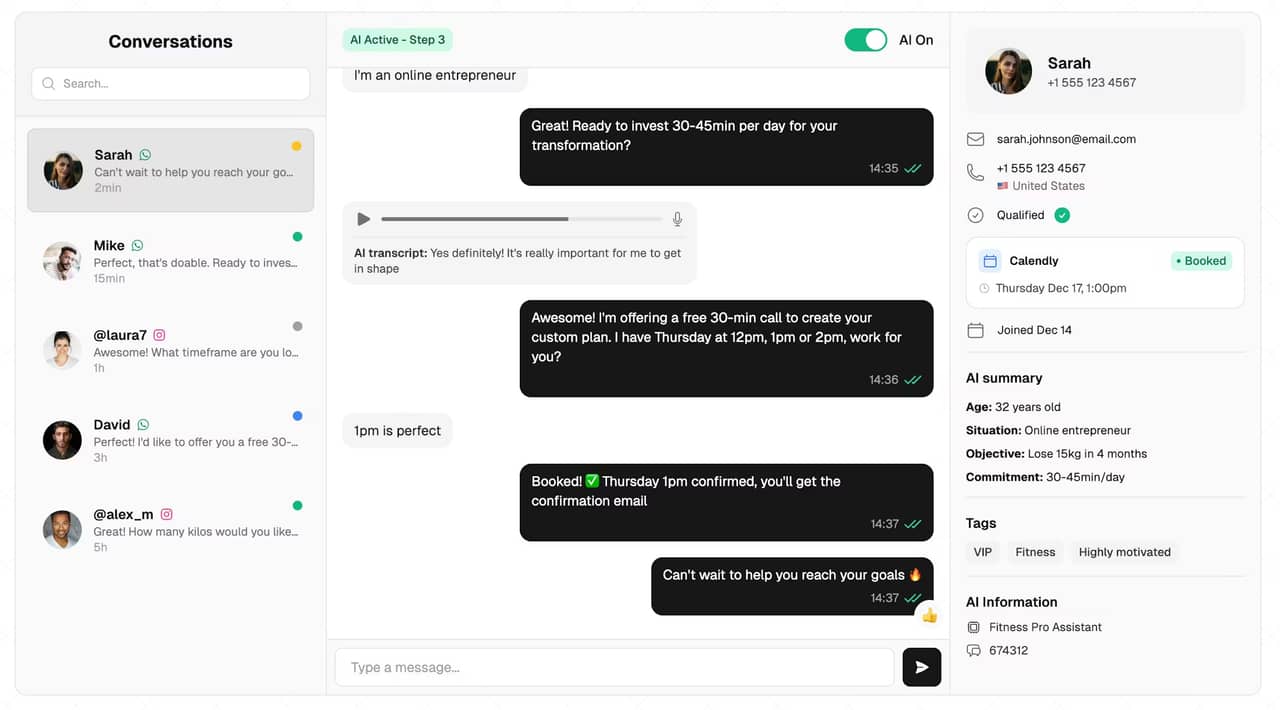
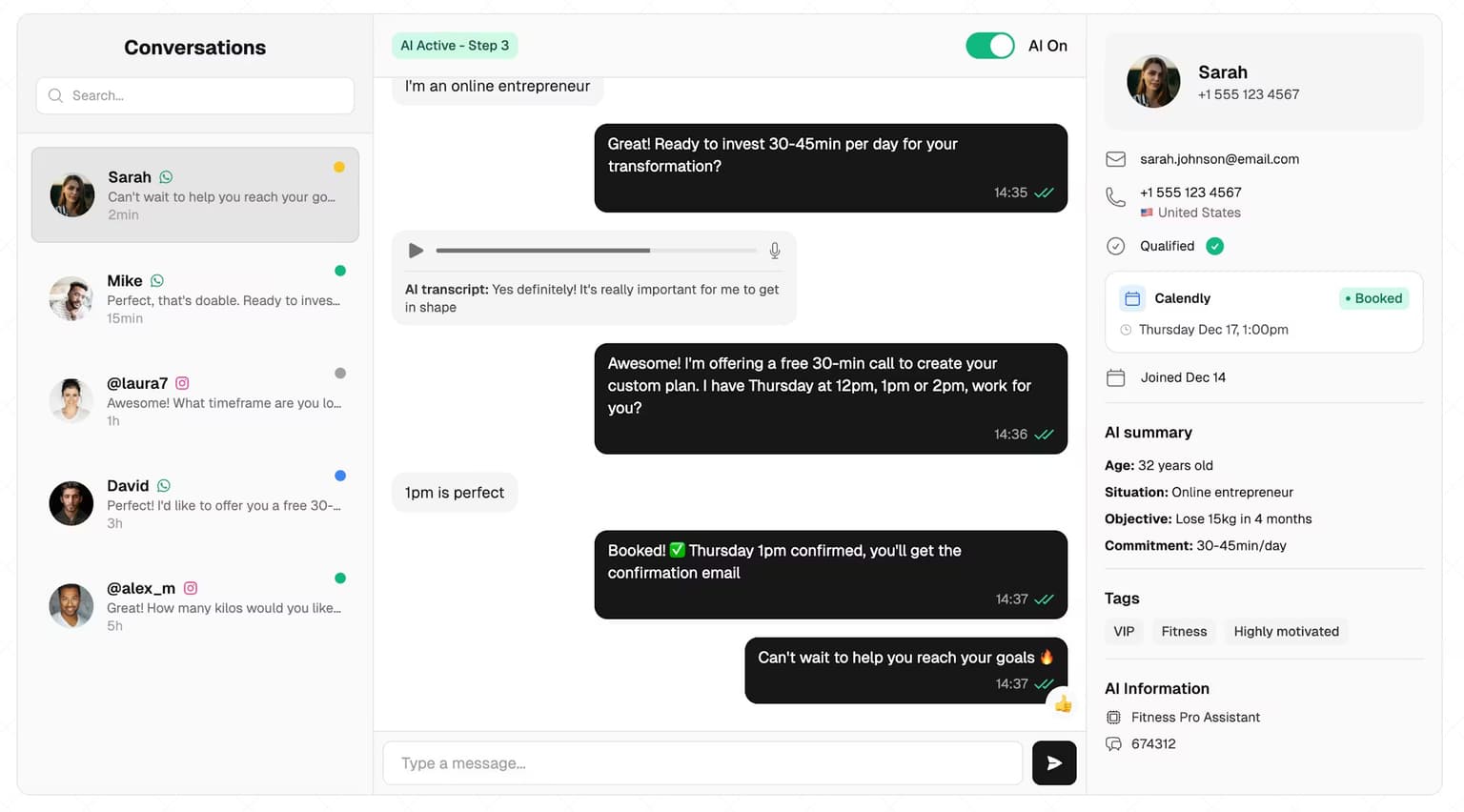
- AI setters made qualification cheaper. A modern AI setter can run all 15 steps across hundreds of conversations in parallel, 24/7, with sub-5-second response time vs the industry's ~42-hour average. That removes the "we don't have time to qualify properly" excuse from the playbook.
- The cost of an unqualified call has gone up. Closer time is more expensive (B2B AE base + commission has been rising), no-shows from poorly-qualified DM-to-call handoffs cost the entire calendar slot, and your CRM gets clogged with dead-weight leads that distort future forecasting. A 15-step checklist that filters 30-50% of unqualified leads OUT before the call has direct revenue impact.
The 4-phase checklist, step by step
Phase 1 — Pre-qualification (steps 1-2)
You can't qualify a lead you can't sell to. Phase 1 takes 30 seconds and gates the next 14 steps.
Step 1 — Confirm serviceable market
Pass criteria: lead is in a country, language, and regulatory zone you serve. Fail = polite decline + offer the closest alternative if you have one.
In DMs, the cheapest way to check is to look at the IG/WhatsApp profile (country flag, bio language, account location). If you sell B2B SaaS in EN/FR/ES across EU + NA and the lead writes from a profile that's clearly outside, decline in message 1. Don't run BANT on a lead you can't invoice.
Step 2 — Channel hygiene
Pass criteria: real human, opt-in valid (they messaged YOU first OR you have a documented Click-to-WhatsApp ad source / lead magnet opt-in). Fail = block / archive without reply.
Bots, scrapers, and outbound prospects who didn't opt in fail Phase 1. Running a qualification checklist on them inflates your "engaged" volume but never produces a booking.
Phase 2 — BANT signals (steps 3-12)
Need → Authority → Budget → Timing. The order matters: leading with Need preserves the conversation, leading with Budget collapses it. (See our deep-dive on BANT lead qualification for the framework's full history and the modern adaptations.)
Step 3 — Trigger event (Need)
Pass criteria: lead names a specific event in the last 30 days that prompted them to reach out today. "We just lost two SDRs", "We launched on Product Hunt last week", "Our Q3 number is at 60%". Fail = "just looking" → nurture queue.
The trigger question — "what made you reach out now?" — is the single most predictive question in the playbook. A lead with a fresh trigger has a 5-7x higher booking probability than a "just curious" lead in the same week.
Step 4 — Pain quantified (Need)
Pass criteria: a number, in dollars / hours / leads / percent. "We're losing about 40 leads a week to slow follow-up." "It's eating ~10 hours of my week."
A pain that can't be quantified can't be priced. If the lead can't or won't put a number on it, probe deeper before moving on. Don't accept "it's painful" as a pass.
Step 5 — Already tried what?
Pass criteria: lead names 1-3 competing tools, agencies, or DIY approaches they've evaluated.
This is your fastest competitive intel and the only honest read on how serious the lead is. A lead who has tried ManyChat, Chatfuel, and "a freelancer on Fiverr" and is still shopping is qualified. A lead who says "we haven't really looked into this yet" is in research mode — nurture, don't book.
Step 6 — Persona / role (Authority)
Pass criteria: lead identifies as founder, VP, head, manager, or operator. Fail = intern, "researcher", student, or unknown → map up the chain before booking.
The sideways version of "are you the decision maker?" is "what's your seat on the team?" or "what would you be using this for in your role?". You'll learn role without prompting an ego answer.
Step 7 — Buying committee (Authority)
Pass criteria: lead names 1-3 stakeholders who'll weigh in.
In B2B, every deal under $5K is solo and every deal over $20K has a committee. If the lead says "it's just me", confirm with "and is anyone else going to want to look at this with you?". You're saving your closer from a Mutual Action Plan that surprises them on call 2.
Step 8 — Approval flow (Authority)
Pass criteria: lead can describe how the purchase actually happens — procurement? CFO sign-off? Self-serve credit card?
You don't need a perfect answer in DMs. You need to know whether you're handing off to an AE who needs to bring procurement onto the call or to a closer who can take a card on the same call. Two very different prep packets.
Step 9 — Budget anchor (Budget)
Pass criteria: lead self-positions in or around your range after you anchor with a price band.
Never ask "what's your budget?" — it kills DM threads at 3-4x the rate of other Budget questions. Instead anchor: "Teams your size usually invest somewhere in the $500-$2,500/month range — does that match what you've been thinking?". The lead's response qualifies Budget AND gives you a downsell signal if needed.
Step 10 — Funding source (Budget)
Pass criteria: lead confirms there's an approved budget line, a P&L bucket, or owner/founder discretion.
A lead with a clear funding source ("comes out of marketing", "I sign off on it") is 4-5x more likely to close than a lead who "needs to figure out where the money would come from". Score that signal.
Step 11 — Timeline anchor (Timing)
Pass criteria: a calendar event within 90 days that's pulling the decision (launch date, renewal date, end of quarter, hiring deadline). Fail = "soon" or "this year" → nurture queue, not booking queue.
Vague timing leads go to nurture. Precise-timing leads get the calendar invite. The mistake most reps make is treating a "soon" answer as a Hot lead because the lead sounded enthusiastic. They're not Hot, they're warm — and your closer's calendar will hate you for not flagging it.
Step 12 — Decision deadline (Timing)
Pass criteria: lead self-states a "decide by" date.
Ask once, accept the answer, do not negotiate. A lead who says "I'd want to decide in the next 2-3 weeks" is qualified for a call this week. A lead who says "no rush, just exploring" is qualified for the nurture sequence. Both are wins — the wrong move is forcing a Hot label on a Warm lead because you want to feel productive.
Phase 3 — Sync (step 13)
Step 13 — Fit recap
Pass criteria: lead confirms fit in their own words.
Before booking, mirror back what you heard: "Sounds like you're looking for an AI setter that can run Instagram + WhatsApp, your trigger is the Q3 push, you can sign off on the call, and you'd want to decide in the next 2 weeks. Did I get that right?". A "yes, exactly" passes the step. A "well, actually..." sends you back to whichever step they're correcting.
The fit recap is the single biggest no-show preventer. Leads who confirmed fit in their own words show up to calls at meaningfully higher rates than leads who were silently scored qualified by the rep.
Phase 4 — Routing (steps 14-15)
Step 14 — Score Hot / Warm / Cold
Pass criteria: lead is tagged in the CRM with one of three labels.
| Tier | BANT signals captured | Trigger | Next step |
|---|---|---|---|
| Hot | 4 / 4 | < 30 days | Book a call this week |
| Warm | 3 / 4 (missing 1) | 30-90 days | 14-day nurture, re-qualify |
| Cold | ≤ 2 / 4 | > 90d or unknown | Drip / archive |
The mistake here is having more than 3 tiers. Five-tier scoring (A/B/C/D/F or 1-100 numeric) makes the routing decision worse, not better, because it forces the rep into hairsplitting. Three tiers force a real decision.
Step 15 — Routing + handoff
Pass criteria: Hot leads booked, Warm leads in nurture, Cold leads archived. CRM updated with tier + verbatim BANT answers.
This is the step that separates the top 10% of accounts (13.6% booked rate) from the bottom 25% (0.39%). Most teams do steps 1-14 and then drop the lead because the handoff is manual, painful, or owned by no one. Build the handoff into the same workflow that ran qualification — not a separate "ops" task.
If you're using an AI setter, the handoff happens automatically: the AI tags the lead, books the meeting in the closer's calendar, and ships a structured BANT recap to the CRM. If you're running this manually, build a 5-minute end-of-day routine to clear all 14-passed leads into the right queue. Don't let qualified leads die in the inbox.
BANT mapping at a glance
The 15 steps map cleanly onto BANT, with two pre-qualification gates and one routing tail. If your team already runs BANT, you can layer the 15 steps on top of your existing playbook without retraining anyone.
| BANT letter | Steps | Headline question | DM-friendly? |
|---|---|---|---|
| N — Need | 3, 4, 5 | "What made you reach out now?" | Yes — open with this |
| A — Authority | 6, 7, 8 | "Who else weighs in?" | Yes — sideways only |
| B — Budget | 9, 10 | Anchor a range, don't ask | Risky — anchor only |
| T — Timing | 11, 12 | "Anything tied to a date?" | Yes — pin to event |
A common variation: teams in mid-market B2B SaaS layer MEDDIC or CHAMP on top of BANT. The 15-step checklist still works — Metrics goes under step 4, Decision Process under step 8, Identified Pain stays under step 4. You don't need a different checklist; you need the same checklist with one or two additional pass criteria for each step.
Channel-specific tweaks
The same 15-step checklist runs differently on Instagram DMs, WhatsApp, and email. Tweak the wording and the pacing, never the steps.
| Channel | Pacing | Best opener | Watch out for |
|---|---|---|---|
| Instagram DM | 1 question / message, 5-8 msg arc | Trigger Q (step 3) only | Multi-Q openers, voice notes too early |
| 1-2 questions / message, 7-12 msg arc | Trigger + persona | Sending templates with bad variables | |
| 2-3 questions / message, 3-5 msg arc | Trigger + persona + brief context | 25-question discovery checklists | |
| Phone | All 15 in 15-25 minutes | Trigger + persona | Asking Budget in first 5 minutes |
The most expensive mistake on Instagram is treating a DM thread like an email. In DMs, three questions in one message will get you ghosted; in email, three questions in one message is normal. The same person reads both inboxes differently.
WhatsApp is the highest-converting channel for qualification — the response rate is roughly 23%, and engaged WhatsApp responders qualify at about 34%. The reason isn't magic, it's intent: people who reach out on WhatsApp are typically responding to a Click-to-WhatsApp ad, a saved-business-number trigger, or an existing relationship — they self-pre-qualified before sending the first message. Your checklist has to honor that signal: shorter arc, faster booking, less pre-qual probing.
Vertical cuts: 3 worked examples
The same 15-step checklist looks different in 3 verticals because the trigger questions change shape. Below is what steps 3-12 look like for each.
B2B SaaS (mid-market)
- Trigger (step 3): "What's the metric pushing this conversation? Quota miss, leadership change, renewal coming up?"
- Pain quantified (step 4): ARR at risk, hours per week, leads-per-rep
- Already tried (step 5): Outreach, Apollo, RB2B, manual SDR teams
- Buying committee (step 7): AE + CMO + RevOps almost always
- Budget anchor (step 9): "Most teams your size are at $1.5K-$5K/month for this category"
- Timeline (step 11): Quarter end, FY planning cycle, board update
B2C high-ticket (coaching, consulting)
- Trigger (step 3): "What's been going on for you that made you reach out today?"
- Pain quantified (step 4): Money left on the table per month, hours per week
- Already tried (step 5): Other coaches, programs, courses, freelancers
- Buying committee (step 7): Solo decision (or spouse for $5K+ deals)
- Budget anchor (step 9): Self-position in / around your stated range — never ask cold
- Timeline (step 11): Personal deadline (next launch, contract end, life event)
For coaching specifically, see our deep-dive on how to get coaching clients — the 15-step checklist plugs directly into a high-ticket DM funnel.
Insurance / mortgage (regulated)
- Trigger (step 3): "What's the date you'd want this in place by?" (closing date, policy renewal, life event)
- Pain quantified (step 4): Coverage gap in $, current premium, loan size
- Already tried (step 5): Other brokers, online aggregators
- Buying committee (step 7): Co-applicant / spouse / business partner
- Budget anchor (step 9): Confirm income range or down-payment range that fits product tiers
- Timeline (step 11): Closing date, policy expiry, regulated deadline
Insurance and mortgage have a hard regulatory layer on top of the checklist — verify SSN/EIN, KYC, licensed-agent disclosures. The 15 steps still apply; the pre-qual phase just gets longer.
Common mistakes that quietly kill the checklist
We've watched dozens of teams adopt a 15-step checklist and break it the same way every time.
Asking Budget in message 1 or 2. Budget questions in the opening 2 messages collapse Instagram threads at 3-4x the rate of Need-led openers. Move Budget to message 5-6, after Need + Authority are captured.
Stacking 3 questions per message. Single-question messages get answered far more often than multi-question messages. Pace yourself across 5-8 exchanges instead of trying to qualify in 2 messages.
Asking "are you the decision maker?". Everyone says yes, the answer is useless, and you've signaled to the lead you're "qualifying" them — which puts them on guard. Use sideways framing: "what's your seat on the team?", "who else would weigh in?".
Skipping the fit recap (step 13). This is the cheapest no-show preventer in the playbook. 30 seconds of "did I get that right?" before booking is worth 2-3 saved no-shows per week.
Having 5+ scoring tiers. A/B/C/D/F or 1-100 numeric scoring sounds rigorous and ruins routing. Three tiers — Hot, Warm, Cold — force a real decision.
Owning the checklist in someone's head, not in the system. A checklist that lives in a Notion doc nobody opens is dead weight. Embed it into the message templates, the AI setter prompts, the CRM stages. If it's not in the system, it doesn't run.
No follow-up on partials. Most leads ghost halfway through the checklist. A single follow-up at the 4-hour and 23-hour marks doubles booked calls. Use the follow-up to ask the missing step, not to re-pitch the offer. (See our AI lead follow-up guide for the cadence.)
Treating "soon" as a Timeline pass. "Soon" is a Timeline you don't have. Pin it to a calendar event or accept the lead is in the nurture queue, not the booking queue.
How AI runs the 15-step checklist
A modern AI setter runs the entire 15-step checklist on every conversation, in parallel, in real time. The shape is the same — Pre-qual → BANT → Sync → Routing — but the operational reality is different.
Pre-qual (steps 1-2) runs in the first 200 ms of the conversation. The AI checks profile country, language, and opt-in source before composing a reply. Failed leads get a polite decline and don't enter the BANT funnel.
BANT (steps 3-12) runs across 5-12 messages, paced one question per message, channel-aware (shorter on Instagram, slightly longer on WhatsApp). The AI listens for verbatim trigger words ("renewal", "Q3", "deadline") that pre-qualify steps 3 and 11 simultaneously. Budget anchors are produced from a config the operator sets; the AI never asks "what's your budget?" cold.
Sync (step 13) is automatic — the AI mirrors back the captured BANT recap before any booking action and asks the lead to confirm. Confirmations get logged with timestamps for downstream attribution.
Routing (steps 14-15) is where AI dwarfs manual checklists. Hot leads get a calendar slot offered in the same message. Warm leads get a tagged 14-day nurture sequence kicked off automatically. Cold leads get archived without any rep action. The verbatim BANT answers ride into the CRM tagged on the lead record, so the closer who picks up the call already knows what was asked and answered.
The reason this matters: AI runs all 15 steps with sub-5-second response time vs the industry's ~42-hour average for human-run checklists. Lead-response speed is one of the highest-leverage variables in qualification — see our lead response time stats for the curve. A checklist that runs in 5 seconds qualifies a lead before they've finished comparing you to the next tab in their browser.
For teams who want this off-the-shelf, SetSmart ships the 15-step checklist baked into the default AI setter prompt, with a Free 7-day trial then $97/month for the Pro plan (1,000 messages included). No multi-tier pricing maze; no per-conversation surprises.
What customers say after adopting the checklist
"We were qualifying maybe 15% of inbound DMs before. After plugging the 15-step checklist into our AI setter, we're at 31% on Instagram and over 40% on WhatsApp. The checklist is the unlock — the AI just runs it faster than we ever could." — Théo Riffault
"The biggest change wasn't the qualification rate, it was the routing. Cold leads stopped ending up on my calendar. I went from 8 calls a week with 60% no-shows to 5 calls a week with 90% show. That's a checklist outcome, not a magic outcome." — Mathis Ladoué
"My closer used to spend the first 10 minutes of every call re-qualifying. Now the BANT recap is in the calendar invite and we go straight to the offer. Saved me roughly 4 hours a week of closer time." — Edouard Clerc
Decision matrix: which version of the checklist do I run?
| Your situation | Run all 15 steps? | Channel mix | Recommended tooling |
|---|---|---|---|
| Solo founder, < 50 leads/mo | Yes, manual | DM + email | Notion checklist + CRM |
| Coach / consultant, 50-300 leads/mo | Yes, AI-assisted | Instagram-heavy | AI setter for steps 3-12 |
| Agency, 300-2K leads/mo | Yes, automated | Multi-channel | AI setter + CRM webhook |
| B2B SaaS sales team | Yes + MEDDIC overlay | Email + LinkedIn + DM | AI setter + RevOps |
| Insurance / regulated | Yes + KYC overlay | WhatsApp + phone | Compliant AI + agent |
The pattern: every team runs all 15 steps. The differences are tooling and overlays, not the steps themselves. A solo founder running 30 leads/month a week is doing the same checklist as an agency running 2,000 leads/month — just at a different scale and with different leverage.
Where to plug the checklist into your stack
You'll get the most ROI when the checklist isn't a separate document but a layer on top of your existing tools.
Forms / lead capture. Steps 1, 2, 3, and 11 can be partially captured at the form stage — country dropdown, opt-in box, "what brings you here today?" field, "when would you want this in place?" date. Pre-filling from the form means your AI setter or rep starts at step 4 instead of 1.
AI setter prompt. Embed the 15 steps directly into the system prompt. The AI runs the checklist as it composes each reply. See our guides on Instagram DM automation, WhatsApp automation, and the AI setter pillar for the full setup.
CRM stages. Map the 15 steps to CRM stages: Pre-qual / BANT-in-progress / Synced / Hot / Warm / Cold. If you want a more standard MQL → SAL → SQL → SAO model, see our guide to lead qualification stages. Every contact has a clear stage — no orphans.
Calendar invites. When a Hot lead books, ship the BANT recap into the invite description. Closer sees it 30 seconds before the call. No re-qualification on the call.
Reporting. Track what % of leads pass each step. The biggest leak in the funnel is usually one or two specific steps — once you see it, you can fix the script in those steps without rewriting the whole playbook.
FAQ
What is a lead qualification checklist?
A lead qualification checklist is a short, ordered set of pass/fail steps your team or AI setter runs on every inbound and outbound conversation to decide whether the lead gets a sales call, a nurture sequence, or a polite decline. The most useful checklists have 10-20 steps, defined pass criteria for each step, and live inside the message workflow itself — not in a separate document nobody opens.
What are 5 important factors to consider for a qualified lead?
The 5 factors that matter most are: (1) trigger event — a specific reason they reached out today, (2) need quantified — a number for the pain in dollars, hours, or leads, (3) authority — the role and the buying committee, (4) budget — confirmed via anchor, not asked cold, and (5) timeline — pinned to a calendar event in the next 90 days. A lead with all 5 captured is Hot; a lead missing 2 or more is at best Warm.
What's a good lead qualification checklist template I can copy?
The 15-step checklist in this guide IS the template — pre-qual (2 steps), BANT (10 steps), sync recap (1 step), routing (2 steps). To make it copy-paste-ready, drop the steps into a Notion table, a Google Sheet, or your CRM stages with the pass criteria column from the TL;DR table above. For an AI-driven version, embed the same 15 steps into your AI setter system prompt.
How do you determine if a lead is qualified or not?
A lead is qualified when (a) all four BANT signals are captured (Need + Authority + Budget + Timing), (b) the lead has confirmed fit in their own words at the sync recap, and (c) the timeline is within 90 days. If all three are true, route Hot — book a call this week. If 3 of 4 BANT signals are captured but Timing is fuzzy, route Warm — 14-day nurture and re-qualify. If 2 or fewer signals, route Cold — drip / archive.
What's the difference between a B2B and B2C lead qualification checklist?
The 15 steps are identical; the questions in steps 3, 5, 7, 9, and 11 differ. B2B leans on metrics, buying committees, procurement, and quarterly budgets. B2C leans on personal triggers, solo decisions, self-positioning on price, and personal deadlines (next launch, life event). The biggest structural difference is step 7 — B2C is almost always solo (or spouse for $5K+ deals), B2B almost always has a 2-4 person committee.
How do you run a lead qualification checklist in DMs without sounding interrogative?
Three rules: (1) one question per message, never stack three; (2) use sideways questions for Authority and Budget — "what's your seat on the team?", "teams your size usually invest $X-$Y, does that match?"; (3) lead with Need (the trigger question), not Budget. A DM checklist that follows these three rules reads like a normal back-and-forth conversation, not a sales interrogation. Pace it across 5-8 exchanges and the lead barely notices they were qualified.
Should I use a lead qualification checklist if I only get 10 leads a week?
Yes — especially if you only get 10 leads a week. Every closer hour you save by not running unqualified leads through a discovery call is worth more, in $/hour terms, when your lead volume is low. A 15-step checklist filters out 30-50% of unqualified inbound, which means at 10 leads/week you book 3-4 calls that actually convert instead of 6-7 that mostly waste your time. Low volume = high cost per wasted call = high ROI on a checklist.
Ready to automate your DMs?
Start your free 7-day trial and let AI handle your lead qualification 24/7.
Try SetSmart free