Outbound Lead Qualification: A 2026 SDR Playbook

Outbound is harder than inbound for one reason: when a lead raises a hand on your pricing page, they've already qualified themselves a little. When you cold email a stranger, you're starting at zero. Outbound lead qualification is what separates the SDRs who book real opportunities from the ones who flood AEs with garbage demos.
This is a working playbook, not theory. We'll cover what outbound qualification actually is in 2026, the four-stage filter most teams skip, the exact frameworks (BANT/MEDDIC/CHAMP) re-applied to cold outreach, scripts for email/LinkedIn/cold call/outbound DM, the SLA you should defend, the AI signals that now decide who's even worth a touch, and three real failure patterns we see every week.
By the end you'll have a single decision tree for "is this lead worth a meeting?" — and a kill rule so you stop wasting AE calendar time on prospects that were never going to buy.
TL;DR — outbound lead qualification at a glance
| Stage | What you're filtering | Owner | Realistic pass rate |
|---|---|---|---|
| Pre-touch (Account & Contact fit) | Wrong company / wrong person | Ops + AI enrichment | 30-50% of total list |
| Touch 1-3 (Intent + Reachability) | No reply, hard pass, "remove me" | SDR | ~5-15% open a conversation |
| Discovery (Need + Timing + Authority) | Pain unclear, no compelling event, low priority | SDR | ~30-50% of conversations |
| Handoff (Budget + Process + Next step) | Window > 90 days, no budget, no champion | SDR → AE | ~40-60% of qualified |
| AE-accepted opportunity | Real pipeline | AE | All of the above × ~3-5% end-to-end |
End-to-end conversion from a raw outbound list to an AE-accepted opportunity is 2-5% in most B2B teams. That's why the qualification gates are not a nice-to-have — they're the difference between a 1.2x and a 4x quota attainment. The same anatomy applies whether you run cold email, LinkedIn DMs, outbound Instagram setting, or pure phone — only the channel mechanics change.
| Channel | Avg reply rate | Best at qualifying | Where it leaks |
|---|---|---|---|
| Cold email | 1-3% | Fit + first-pass interest | Slow signal, easy to ghost |
| LinkedIn DM | 5-12% | Authority/role check | No phone, slow back-and-forth |
| Cold call | 3-8% conversation | Discovery in one touch | Connect rate decay |
| Outbound DM (IG/WA) | 8-20% | Speed + low-friction reply | Platform limits, persona mismatch |
Industry-typical ranges (HubSpot, Salesloft, Outreach 2024-2025 outbound benchmark reports). Your numbers will differ by ICP and offer.
What outbound lead qualification actually means
Outbound lead qualification is the process of deciding, before an AE picks up the phone, that a cold prospect is worth a sales conversation. It runs in four layers — fit, reachability, intent, fit-to-buy — and each layer kills off most of the previous one.
Two things make it different from inbound:
- You created the demand, not them. Inbound qualification asks "do you fit our ICP?" Outbound qualification has to ask that and "is now a reasonable moment to interrupt you?" The compelling-event question is non-optional.
- The qualification work is front-loaded. With inbound you can let a lead self-qualify by booking a demo, watching a video, asking a pricing question. With outbound, if your SDR sends 100 emails to a poorly-built list, no qualifier on the call can save it.
If you've already mapped the difference between MQL/SAL/SQL/SAO, see lead qualification stages — outbound mostly skips the MQL gate (no marketing engagement) and runs SAL → SQL inside the SDR conversation. For the broader definition, the what-is-lead-qualification primer applies; this article narrows it to cold outbound only.
Why outbound qualification is harder in 2026
Three forces have made outbound qualification more expensive than it was in 2020:
- Reply rates are down across every channel. Cold email reply has roughly halved since GDPR enforcement and Google/Microsoft sender reputation tightening. LinkedIn InMail is throttled. Cold-call connect rates on mobile-only contacts sit between 2% and 6% per dial in most reports.
- Buyers research silently. Gartner-style research consistently shows B2B buyers spend the majority of their journey doing independent research before talking to sales. By the time they take a call, they've already shortlisted 2-3 vendors. If your qualification doesn't surface that competitive context, you're walking blind.
- AI flips the workload. SDRs no longer do enrichment by hand — AI does. The qualification work that mattered in 2018 (call 100 dials, ask BANT) now matters less than choosing the right 100 prospects in the first place. The new SDR job is closer to "intent operator" than "dialer".
These three together mean two things for your team: spend more on pre-touch qualification (account scoring, signals), and spend less on mid-conversation qualification (long discovery scripts that scare buyers off in week 1).
Where qualification value lives in modern outbound. The list/signal layer dominates — discovery confirms what the data already implied. Estimates based on observed pipelines across SaaS / DTC / agency teams.
The 4 layers of outbound lead qualification
Layer 1 — Pre-touch: account fit + contact fit
Direct answer: before any SDR touches a name, two filters must pass: the account is in your ICP, and the contact is the right buyer / influencer at that account.
Account fit signals (must-have):
- Industry / sub-vertical fits your offer
- Headcount or revenue inside your sweet spot
- Tech stack indicates a likely use-case (e.g. they run a CRM, not a spreadsheet)
- Geography / language match
- Not already a customer / not in active opportunity
Account fit signals (nice-to-have, often AI-derived):
- Funded recently / hiring sales roles / new exec hire
- Posted a job description that names a pain you solve
- Mentioned in a 10-K, podcast, or LinkedIn post about a relevant problem
- Visited your site / engaged with your content
- Lookalike of your top 20 customers
Contact fit signals:
- Title sits inside your decision-making committee (economic, champion, end-user)
- Has been in role 3+ months (new hires move slow; very new hires sometimes move fast — depends on your offer)
- Is on the platform you'll outreach on (LinkedIn-active, mobile-reachable, email-deliverable)
If an account fails 2+ must-haves, drop it before adding it to a sequence. The single biggest leak we see in outbound is teams sequencing accounts that should never have been on the list. The lead qualification checklist has the full pre-touch audit you can run line-by-line.
Layer 2 — First touch: reachability + minimum interest
Direct answer: of the contacts who reply at all, you keep the ones whose first reply contains either a question, an interest signal, or a soft objection. Hard "remove me" replies kill the contact.
This is the noisiest layer. Most contacts won't reply. Among those who do, you'll see:
- Yes / interested / send more info — promote to discovery
- Not now, maybe Q3 — drop into nurture with a calendar trigger
- Why are you contacting me / how did you get my info — usually a polite re-engage; sometimes a hard pass
- Wrong person, talk to X — a referral; always request the warm intro
- Remove me / not interested / unsubscribe — kill, don't re-engage
The mistake here is treating "not now" identically to "interested". They're different lifecycles. The first one needs a 30/60/90-day re-engage cadence; the second goes straight to discovery. Mixing them is how you train your AEs to expect garbage from outbound.
Layer 3 — Discovery: Need + Timing + Authority + Pain
Direct answer: the SDR call (or DM-equivalent thread) confirms four things: there's a real pain, the prospect knows it, they have authority or access to it, and the timing window opens in <90 days. Anything else is a no-meeting.
This is where the classic frameworks come back — but applied with cold-context discipline. Instead of full discovery on touch 1 (which kills cold conversations), you use a 3-question filter that the buyer can answer in 60 seconds:
- Pain question: "When you think about outcome, where do you currently lose the most time / money / leads?"
- Compelling event question: "What changed recently that made pain start to actually hurt — or are you just doing diligence?"
- Process question: "If you decided this was worth solving, who else has to weigh in besides you?"
If they answer 2 of 3 cleanly, book the AE call. If they dodge all three, do not book — instead offer a piece of relevant content and re-engage in 30 days. The single most expensive mistake in outbound is forcing a meeting from a low-information thread.
The full set of tested questions sits in 21 lead qualification questions. Most of them work in cold conversations as long as you ask one at a time, not all at once.
Layer 4 — Handoff: budget + process + a real next step
Direct answer: before the AE call lands on the calendar, the SDR confirms a usable budget reality (not a number — a plausible window), the buying process (steps + people), and a defined next step ("what would you need to see on the call?").
The handoff filter is what separates SDRs who hit quota from SDRs who hit calendar. It's normal to lose 30-50% of "qualified" leads at this gate, and that's a feature, not a bug — it keeps the AE pipeline clean.
For a deeper breakdown of how AI-first teams run this layer, the lead qualification process walks through the 7-stage path from lead capture to AE handoff.
BANT, MEDDIC, CHAMP — re-applied to cold outbound
Outbound isn't a sales-stage exercise; it's a filter. The classic frameworks were designed for warm inbound or post-discovery deal review. Here's how each maps to cold outreach:
BANT (Budget, Authority, Need, Timing) — the SDR baseline
The simplest framework, still useful for cold conversations because it's fast. In outbound, you flip the order:
- Need — confirm pain first, so you don't get hung up on (people will talk about pain when budget questions would chase them away).
- Timing — surface the compelling event ("what's making this matter now?"). No event = no urgency = no meeting.
- Authority — figure out where they sit in the buying committee, never assume.
- Budget — last and lightest in cold conversations. Ask "do you have an existing budget line for this, or would this be net-new?" instead of "what's your budget?".
For a deeper BANT walkthrough adapted for AI-driven teams, see the BANT lead qualification guide.
MEDDIC / MEDDPICC — for enterprise outbound
MEDDIC adds Metrics, Economic buyer, Decision criteria, Decision process, Identify pain, Champion (with optional Paper process, Competition in MEDDPICC). It's heavy. In cold outbound, you don't try to capture all 6-8 elements on touch 1 — you capture Metrics and Identify pain in discovery, then expand inside the AE call.
Use MEDDIC if your ACV is >$25K and your sales cycle is >60 days. For SMB / mid-market outbound, BANT is enough.
CHAMP (Challenges, Authority, Money, Prioritization)
CHAMP is essentially BANT with the order corrected — Challenges first. For outbound that's almost always the right starting move because it leads with the buyer's reality, not your offer.
Pick one framework, document it, and use it consistently. Mixing frameworks across SDRs is how you end up with discovery notes that no AE can compare.
Outbound qualification scripts by channel
Cold email (3-touch sequence)
Touch 1 — observation + hypothesis:
Hi , saw . Most we talk to at that point are running into . Worth a quick comparison of how 3 similar teams solved it?
Touch 2 (day +3) — proof + softer ask:
— quick follow-up. We helped in . Open to a 15-min walkthrough next week or am I off-base?
Touch 3 (day +7) — break-up + qualifier:
, last note. If isn't actually a 2026 priority, totally fair — I'll close the loop. If it is and the timing's just bad, when would be a better month to revisit?
The break-up email reliably surfaces the Timing answer in 24 hours.
LinkedIn (relationship first, qualifier second)
, not pitching — saw your post on . Curious how you're handling now that ? Happy to compare notes.
If they reply, the next message is a soft qualifier:
Helpful — thanks. Quick question: when you think about , is this on a quarterly objective or more of a "it'd be nice" thing? Trying to figure out if a 15-min call would be useful or if I should just send a 2-page summary.
The "objective vs. nice-to-have" wording reliably sorts qualified from unqualified leads in two messages.
Cold call (one-touch BANT-lite)
Hi , this is from . I'll be quick — we work with on . Two questions and then I'll either book us a longer call or get out of your hair: (1) when happens, who at owns the fix? (2) is solving it on your roadmap before , or further out?
That's the entire cold-call qualifier. Two questions, 60 seconds. Anything more and you've lost the call.
Outbound DM (Instagram / WhatsApp)
The fastest channel — but the most prone to platform throttling. The qualifier looks like this:
Hey , noticed . We help fix — quick check, are you actively looking to solve this in the next month or two, or just exploring?
The "in the next month or two" anchor turns a vague conversation into a Timing answer immediately. The full DM scripts library is in Instagram DM scripts — most translate directly to outbound LinkedIn or WhatsApp. For the AI side of multi-channel outbound DMs, see the AI setter overview.
SLA: how fast you must qualify and respond
Direct answer: when an outbound prospect replies, you have minutes — not hours — to convert that reply into a discovery thread. Speed compounds.
This isn't a soft heuristic. The classic Harvard study (Oldroyd, McElheran, Elkington, 2011) showed that companies contacting leads within 5 minutes are roughly 21× more likely to qualify them than those waiting 30 minutes. The same effect applies whether the lead is inbound or outbound — once they've raised a hand by replying, the same 5-minute window determines if you keep the thread alive.
Most outbound teams ignore this because their SDRs work in batches: "I'll process replies at 2 PM." That's a structural quota cap. The fix is usually one of: (a) a real-time reply notifier on the SDR's phone, (b) AI auto-acknowledge while a human takes over, or (c) shifted shifts so reply windows are always covered. The full numbers and what they mean for outbound desks are in lead response time statistics.
What AI changes in outbound qualification
AI doesn't replace the SDR — it changes which 80% of the SDR's day is automatable. Three places where the change is largest:
- List building / pre-touch scoring. Instead of buying a 50K-row list and sequencing all of it, AI scores each contact against your top customers' patterns. The list shrinks 5-10× and the reply rate moves up 2-3×.
- Multi-channel reply handling. When a prospect replies on LinkedIn at 11 PM, AI can acknowledge inside the SLA window, ask the first qualifier, and queue the human SDR for the morning. This is the same pattern as inbound DM setting — see the AI sales assistant breakdown for what AI does and doesn't own.
- Discovery summarisation + handoff. AI listens to the cold call (or reads the email thread) and pre-fills a BANT/MEDDIC card for the AE in 30 seconds, instead of an SDR writing 5-minute notes 90 seconds before the AE picks up.
The teams that adopt AI for the list-building layer outpace teams that adopt it for the call-summary layer — because the first one shifts where qualification value lives. We dug into the conversation-side numbers in our DM conversation study of 5.6M sales messages, and the same depth-of-conversation principle applies in outbound: shallow back-and-forth = no qualification, sustained conversations = real opportunities.
Outbound qualification: manual vs AI-assisted
| Step | Manual SDR | AI-assisted SDR |
|---|---|---|
| List build | Buy lists, dedupe by hand | Lookalike scoring + intent signals |
| Personalization | 15-30 min per prospect | 2-3 min review of AI-drafted opener |
| First reply | Hours-to-days latency | Seconds — auto-acknowledge + first qualifier |
| Discovery | Live cold call | Live call (still human) |
| Handoff notes | 5-10 min, often missing | Auto-summary in CRM, BANT pre-filled |
| Re-engage cadence | Manual reminders, frequently dropped | Trigger-based (job change, funding, post) |
The point of the table isn't "fire your SDRs". It's that the qualification layer where humans add the most value is discovery and handoff — the rest moves to AI. Teams that don't make this shift end up with SDRs spending 70% of their time on activities AI can do faster and more consistently. The best AI setter tools roundup compares the platforms that handle the multi-channel side.
How to score outbound leads (a working rubric)
A simple 100-point outbound score that works for SMB and mid-market:
| Dimension | Points | Signal |
|---|---|---|
| Account fit | 0-30 | ICP match: industry, size, geo, stack |
| Buying-intent signals | 0-25 | Recent funding, exec hire, job posting, content engagement |
| Contact fit | 0-15 | Title within decision committee |
| Reply quality | 0-15 | Asked a question / mentioned timing / referred you |
| Discovery answers | 0-15 | 2+ of 3 BANT-lite questions answered cleanly |
Thresholds:
- Below 50 → drop into low-touch nurture (newsletter / quarterly check-in only)
- 50-69 → continue cadence, do not promote to AE
- 70-84 → SDR call, then re-score
- 85+ → book AE meeting
Recalibrate the weights after 3 months of pipeline data — every team's mix differs. For a tools-side breakdown of how this scoring runs across CRMs and sales engagement platforms, see lead qualification tools.
Common mistakes that kill outbound conversion
- Sequencing without pre-qualifying the account. If your list is bad, no SDR script saves it. Spend 2× more on pre-touch scoring before you spend a dollar on cadences.
- Asking for budget on touch 1. Cold prospects will never tell you a number. Ask about priority, timing, and existing line items instead.
- Treating "not now" as "no". A prospect who says "not now, ask me Q3" is a calendar entry, not a kill. Most outbound CRMs have no proper Q3 trigger.
- One framework per SDR. When BANT-trained and MEDDIC-trained SDRs send notes to the same AE, the AE can't compare them. Pick one and standardize.
- Discovery on touch 1 of cold email. Cold readers don't fill in 8-question surveys. The first email asks one thing — interest. Discovery happens on the call.
- Skipping the disqualification step. The fastest way to lift quota attainment is to un-qualify worse — not chase every reply. AEs should reject ~20-30% of SDR-booked meetings as "not yet ready". If yours never reject any, the bar is too low; if they reject most, the bar is too low elsewhere.
- No SLA on inbound replies to outbound campaigns. A reply to a cold email is an inbound moment for the next 60 minutes. Treat it that way.
- Same script across channels. Cold calls aren't cold emails read out loud. The qualifier formats are channel-native — the 21 lead qualification questions library has channel-specific scripts.
What "good" looks like — three real patterns
Pattern 1 — coaching / education vertical, outbound DM
Cold outbound on Instagram + LinkedIn for high-ticket coaching offers. The pre-touch filter is brutal (looks at follower count, engagement rate, niche fit), the SDR layer is replaced by an AI setter. SDRs are now closers — they only take handed-off threads where the lead has answered 3 qualifier questions. The result: AE-accepted opportunity rate rises 2-3× because the calendar contains only pre-qualified threads. See how to get coaching clients for the demand-side pattern.
Pattern 2 — B2B SaaS, mid-market, outbound email + cold call
Account list scored against top 50 customers (similar ICP, recent hires, recent funding). Cold email sequence of 3 touches with break-up. SDRs only call accounts with email-reply or LinkedIn engagement. Discovery is BANT-lite, handoff is to AE with a pre-filled MEDDIC card. The SDR-to-AE meeting accept rate is the leading indicator the team uses — anything below 70% triggers a cadence audit.
Pattern 3 — DTC / agency outbound on social
Outbound DM at scale on Instagram for agency services. The qualification work happens before the SDR is even involved — AI runs the first 4-6 messages, asks the timing question, and only escalates to an appointment setter when the lead is showing buying signals. Conversions improve because the human time is spent on real qualified threads, not on the 8-out-of-10 tire-kickers.
How SetSmart wires up outbound qualification
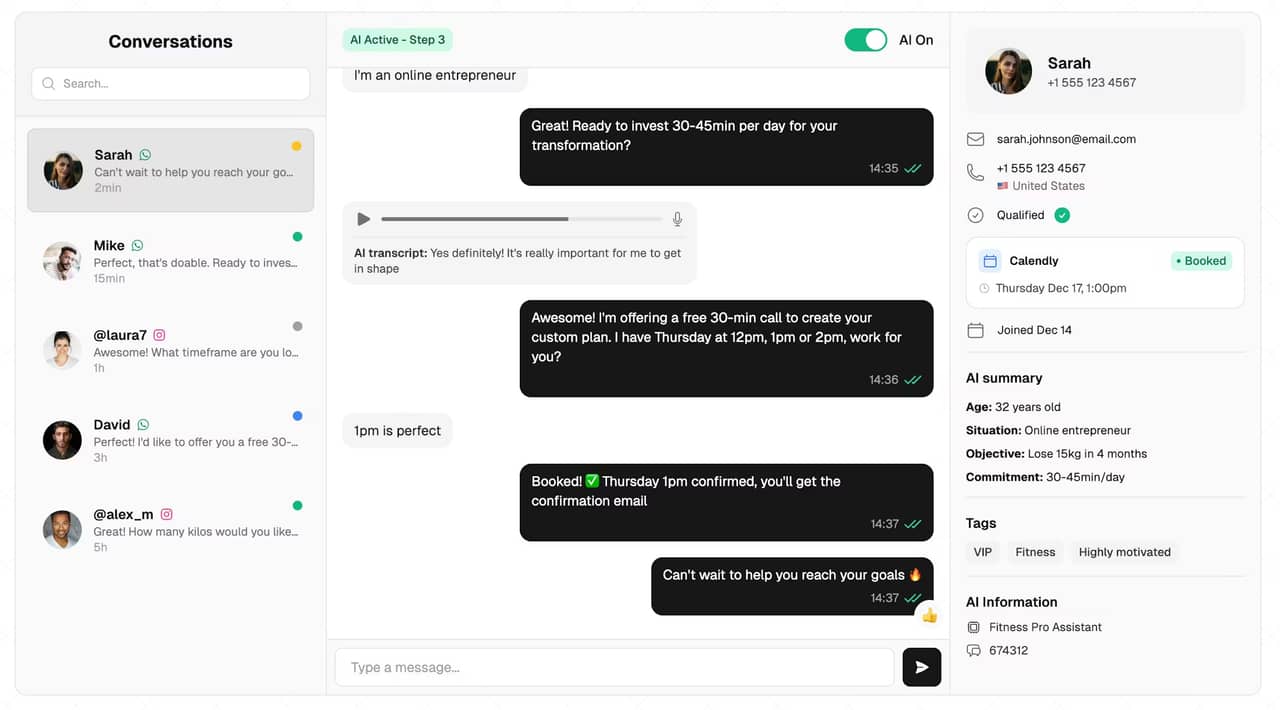
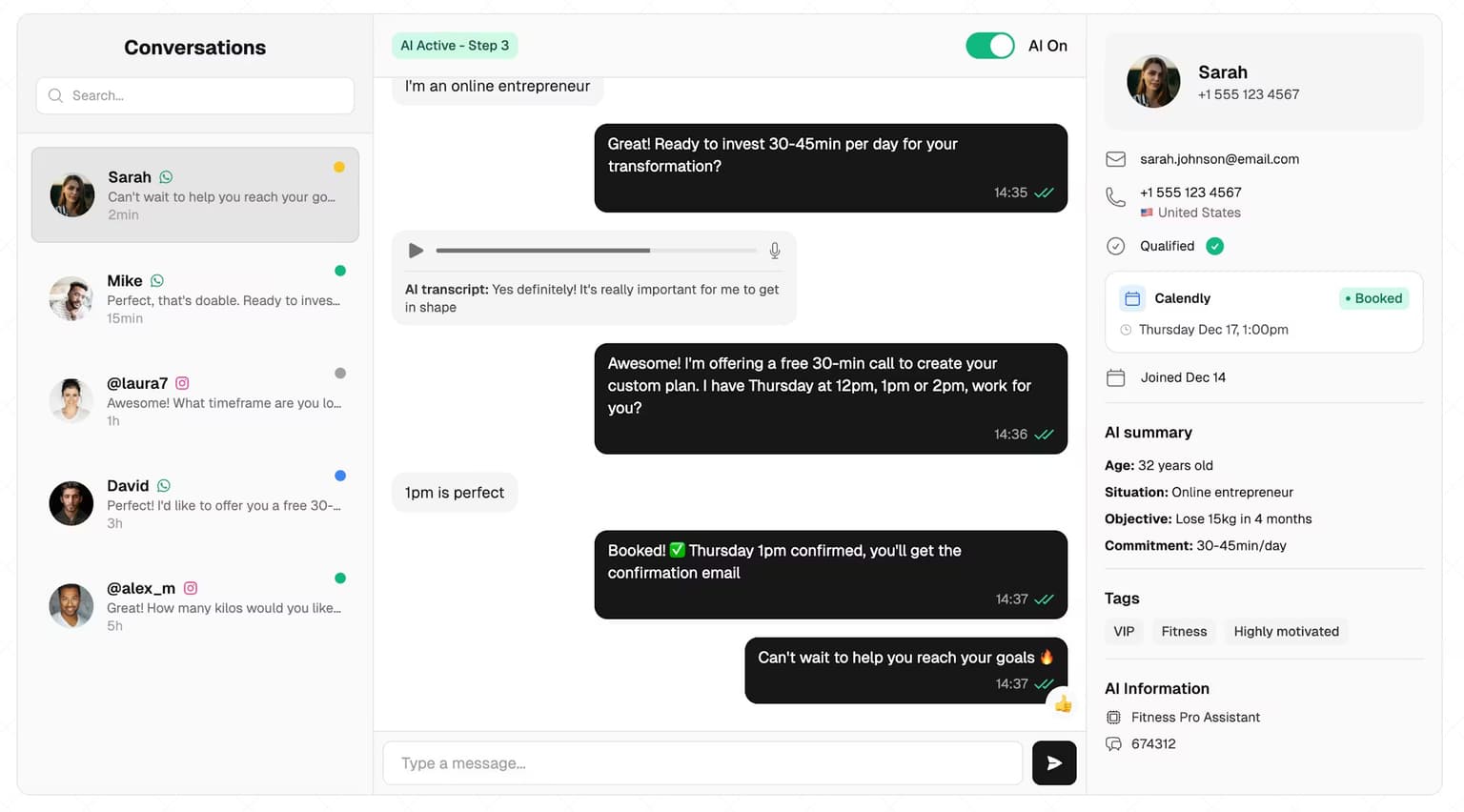
SetSmart sits at the first-touch + multi-channel reply layer of outbound. When a cold lead replies on Instagram or WhatsApp (or hits a click-to-DM ad), our AI setter acknowledges in seconds, runs the BANT-lite qualifier, and only escalates qualified threads to a human closer. That's the same speed-and-depth principle we documented in our analysis of 391 businesses — qualification is mostly a function of speed-to-first-reply and conversation depth, not script wizardry.
For pricing context: SetSmart is Free 7-day trial, then $97/month (1,000 messages included), with no per-seat or per-contact billing.
What our customers say about the qualification quality:
"Our SDR team was drowning in unqualified DMs from outbound campaigns. SetSmart filters them in the background and only books real prospects on the calendar." — Théo Riffault
"We doubled our outbound reply-to-meeting rate without adding a single SDR. The AI handles the first 5 messages, our humans take it from there." — Mathis Ladoué
"It's like having a 24/7 SDR that never misses a reply. Our outbound runs while we sleep." — Edouard Clerc
When outbound qualification doesn't apply
A short list of cases where the playbook above is the wrong frame:
- Pure inbound funnels. If 100% of your leads come from forms, demos, and content — different mechanics. See the AI lead qualification walkthrough instead.
- Account-based selling at 6-figure ACVs with a multi-stakeholder buying committee. You'll need MEDDPICC and a champion-development plan, not a 3-touch SDR cadence. The 4-layer model still applies, but the depth multiplies.
- Transactional / e-commerce outbound to consumers. No B2B buying committee — the qualification is closer to "are they in market this week?" than "what's the procurement process?".
- Cold call-only desks (no email/social). The pre-touch layer matters even more (because you're paying per dial), and the discovery layer compresses to a 90-second pitch + 2-question filter.
FAQ
What is outbound lead qualification, exactly?
Outbound lead qualification is the process of filtering cold prospects before, during, and after first contact, so only prospects with real fit, intent, and buying capacity end up on an AE's calendar. It runs in four layers: pre-touch (account/contact fit), first touch (reachability + interest), discovery (need/timing/authority), and handoff (budget/process/next step).
What's the difference between outbound and inbound lead qualification?
Inbound qualification asks "do they fit our ICP and want to talk to us?" — the prospect raised their hand. Outbound qualification has to ask the same question plus "is now even a reasonable moment to interrupt them?". Outbound is more front-loaded: list quality, intent signals, and SDR scripts decide most of the outcome before discovery even starts.
Which framework should I use for outbound — BANT or MEDDIC?
For SMB / mid-market outbound (ACV under ~$25K), BANT-lite (Need first, Timing second, Authority third, Budget last) is fast enough and works on cold calls. For enterprise outbound with multi-stakeholder buying committees and 60+ day cycles, use MEDDIC or MEDDPICC. Pick one framework and use it consistently across all SDRs — mixing frameworks makes AE handoff impossible to standardize.
How many qualifying questions should I ask on a cold call?
Two to three, no more. Cold prospects haven't agreed to discovery — they agreed to a 60-second sanity check. Ask: (1) who owns the pain at the account, (2) is solving it on the roadmap this quarter, (3) what would they need to see on the next call. If they answer 2 of 3, book the AE call. Long discovery scripts kill cold calls — save them for the AE meeting.
What's the right SLA for replies to outbound campaigns?
Treat any reply to an outbound touch as inbound for the next 60 minutes. The classic Harvard data showed contacting leads within 5 minutes vs. 30 minutes makes them roughly 21× more likely to qualify — the same compounding speed effect applies on outbound replies. If your SDR processes replies in batches at 2 PM, you've structurally capped your conversion. Either route to a real-time notifier, or use AI to auto-acknowledge inside the window.
What outbound lead qualification questions should I ask first?
Lead with pain or compelling event, never with budget. Three high-yield openers: "Where do you currently lose the most time/money on ?", "What changed recently that made actually start to hurt?", and "If you decided this was worth solving, who else has to weigh in?". The full library is in our 21 lead qualification questions post — most translate cleanly to cold conversations.
How do I qualify outbound leads using AI?
AI changes three layers of outbound qualification: (1) pre-touch — scoring contacts against lookalike patterns and surfacing intent signals, (2) first reply — auto-acknowledging inside the 5-minute SLA and asking the first qualifier, (3) handoff — auto-summarising the conversation into a BANT/MEDDIC card for the AE. The discovery call itself is still mostly human. The teams that win are the ones using AI for list-building first, not call-summary first.
Ready to automate your DMs?
Start your free 7-day trial and let AI handle your lead qualification 24/7.
Try SetSmart free