ManyChat Integrations 2026: Connections & Gaps

ManyChat integrates with your calendar, email tool, CRM, ecommerce store and 6,000+ apps through Zapier, on top of a shorter list of native connections, so the leads it captures in your Instagram, Messenger and WhatsApp DMs land in the tools you already run. The catch worth knowing before you build: connecting ManyChat to another app only moves data around. It does not have the sales conversation for you.
That distinction runs through this whole guide. For a coach or creator running inbound DMs, the integrations that matter are the ones that get a lead from "commented on a Reel" to "booked on your calendar" without you copy-pasting anything. Below is the honest map: what connects natively, what needs Zapier, which integrations genuinely help you book more sales calls, and the one gap no integration closes.
TL;DR - ManyChat integrations at a glance
| Question | Short answer |
|---|---|
| How many integrations does ManyChat have? | Roughly 25-30 native connections plus 6,000+ apps reachable through Zapier and Make. The native list is short, the indirect list is huge. |
| What are the most useful integrations for coaches? | Calendar (Google Calendar, Calendly), email (Mailchimp, ActiveCampaign, Kit), Google Sheets, and Zapier as the universal bridge. |
| Are integrations free? | Native ones need a paid ManyChat plan. Zapier and Make add their own subscription. See ManyChat pricing. |
| Does ManyChat integrate with a real CRM? | It pushes contacts and tags into CRMs via Zapier, but it is not a CRM itself. Tags are flat, with no pipeline stages or scoring. |
| Can an integration qualify and book a lead for me? | No. Integrations move data. Qualifying the lead and booking the call in-chat needs an AI setter, not a connector. |
How ManyChat integrations actually work
ManyChat integrations come in three flavours, and knowing which one you are using saves hours of debugging.
Native integrations
These are the connections ManyChat builds and maintains itself, listed under Settings then Integrations. They are the most reliable because ManyChat controls both ends. The native list is short but covers the essentials: Google Sheets, Calendly, Mailchimp, ActiveCampaign, Klaviyo, ConvertKit (now Kit), Shopify, PayPal, Stripe, Zapier, Make, Google Calendar and a handful more. When a native connection exists, use it. It syncs faster, breaks less, and needs no third-party subscription.
Zapier and Make (the universal bridge)
Everything ManyChat does not connect to natively, it reaches through Zapier or Make. This is where the "6,000+ apps" number comes from: you are borrowing Zapier's directory, not ManyChat's. A typical Zap looks like "new ManyChat subscriber tagged BOOKED, then create a row in a spreadsheet, then send a Slack ping." It works, but every hop is one more subscription and one more thing that can silently fail.
The ManyChat API and webhooks
For anything custom, ManyChat exposes an API and webhook actions. Inside a flow you can fire a webhook to your own endpoint (or to a service like OpenAI) and read the response back into the conversation. This is powerful and maintenance-heavy. Most creators never touch it. If you are wiring generative replies this way, you are rebuilding what an AI setter does out of the box, by hand.
The rule of thumb: native first, Zapier second, API only if you genuinely have a developer. The full mechanics of how these fire inside a flow are covered in ManyChat automation.
The ManyChat integrations that matter for coaches and creators
Not every integration earns its place. If you sell coaching, courses or services through your DMs, these are the categories that actually move the needle on booked calls.
| Category | Popular integrations | Native or Zapier? | Why it matters |
|---|---|---|---|
| Calendar / booking | Google Calendar, Calendly, Cal.com | Native (Calendly, Google Calendar) | Drops a booking link into the DM so the lead can grab a slot. |
| Email marketing | Mailchimp, ActiveCampaign, Klaviyo, Kit, GetResponse | Native (most) | Moves the email you captured in the DM into your nurture list. |
| Spreadsheets | Google Sheets | Native | The simplest lead log: one row per DM, no CRM cost. |
| CRM | HubSpot, Salesforce, Pipedrive, Zoho, GoHighLevel | Zapier (mostly) | Pushes contacts and tags into a pipeline. ManyChat is not the CRM. |
| Ecommerce | Shopify, WooCommerce | Native (Shopify) | Abandoned-cart DMs and order updates for product sellers. |
| Payments | Stripe, PayPal | Native | Collect a deposit or sell a low-ticket product inside the flow. |
| Automation bridge | Zapier, Make, Pabbly | Native | The universal connector for everything with no native option. |
| Ads | Meta (Click-to-Messenger, Click-to-WhatsApp) | Native | Routes paid ad clicks straight into a DM flow. See Click to WhatsApp ads. |
For a coach, the four that carry most of the weight are the calendar, the email tool, Google Sheets and Zapier. Everything else is situational. The ecommerce and payment integrations matter more if you sell products than if you sell high-ticket programs booked on a call.
Calendar integrations: the closest ManyChat gets to booking
The Calendly and Google Calendar integrations are the ones coaches ask about most, because booking the call is the whole point. ManyChat handles them well as a link-dropper: at the end of a flow, it sends your Calendly link, the lead clicks out to Calendly, picks a slot, and the event lands on your calendar.
That works. It also leaks. Every time the lead has to leave the DM and load a separate booking page, you lose a slice of them. The integration hands off the booking, it does not hold the lead's hand through it. This is the seam where flow-based tools and conversational tools separate, and we will come back to it.
Email and CRM integrations: moving the lead, not converting it
The email integrations (Mailchimp, ActiveCampaign, Kit and friends) are clean and native for most providers. Capture the email in the DM, push it to a list, tag the source. Solid.
CRM is where expectations outrun reality. People search "ManyChat CRM integration" hoping ManyChat becomes their pipeline. It does not. ManyChat pushes contacts and tags into a real CRM through Zapier, but its own data model is flat: a contact is tagged or not tagged. There are no stages, no lead scores, no last-touch decay. If you need a genuine pipeline view, you will connect an external CRM, and now you own a two-tool stack. Coaches who want a lighter setup often look at a purpose-built Instagram CRM instead of bolting one onto ManyChat.
Native vs Zapier vs Make: which route to use
The three routes are not interchangeable. Picking the wrong one is the most common reason a ManyChat integration turns into a maintenance headache.
- Use native whenever the connection exists. It is faster, free of a third-party subscription, and ManyChat fixes it when an API changes. Google Sheets, Calendly, Mailchimp, Shopify and Stripe are all native.
- Use Zapier when there is no native option and you want a no-code bridge. It reaches thousands of apps, but each Zap adds latency (a few seconds to a few minutes) and its own monthly cost as your task volume grows.
- Use Make when your workflow branches (multiple steps, conditions, loops). Make is cheaper than Zapier at high volume and better at complex logic, at the cost of a steeper learning curve.
- Use the API/webhooks only if you have developer help. This is the route for genuinely custom logic, and the one that breaks silently when nobody is watching it.
A practical example. You want: new Instagram DM lead, add to Google Sheet, add to your email list, and notify your closer in Slack. Google Sheets and the email tool are native, so do those inside ManyChat. Slack has no native ManyChat step, so bridge that one hop with Zapier. Do not run all three through Zapier just because it is familiar; you would be paying for tasks you could do natively for free.
Where ManyChat integrations fall short
Here is the honest part. ManyChat's integration layer is genuinely good at moving data. It is not built to do the thing that actually earns a coach money: have the qualifying conversation and lock in the booking.
Integrations move data, they do not sell
Every integration in the directory is a pipe. It takes a contact ManyChat already captured and drops it somewhere else. None of them read the lead's messages, decide whether the lead is a fit, ask the follow-up questions, handle the objection, or propose three specific times. That work happens in the conversation, and the conversation in a stock ManyChat flow is a button tree.
For depth, conversation length is what predicts a booking. In our analysis of 828K DM conversations, 53% of automated exchanges die before message 3, and qualification rates climb sharply once a conversation crosses 11 messages. A flow that ends by firing a Calendly integration rarely reaches that depth, because the buttons run out before the lead feels understood.
The calendar integration is a link, not a booking
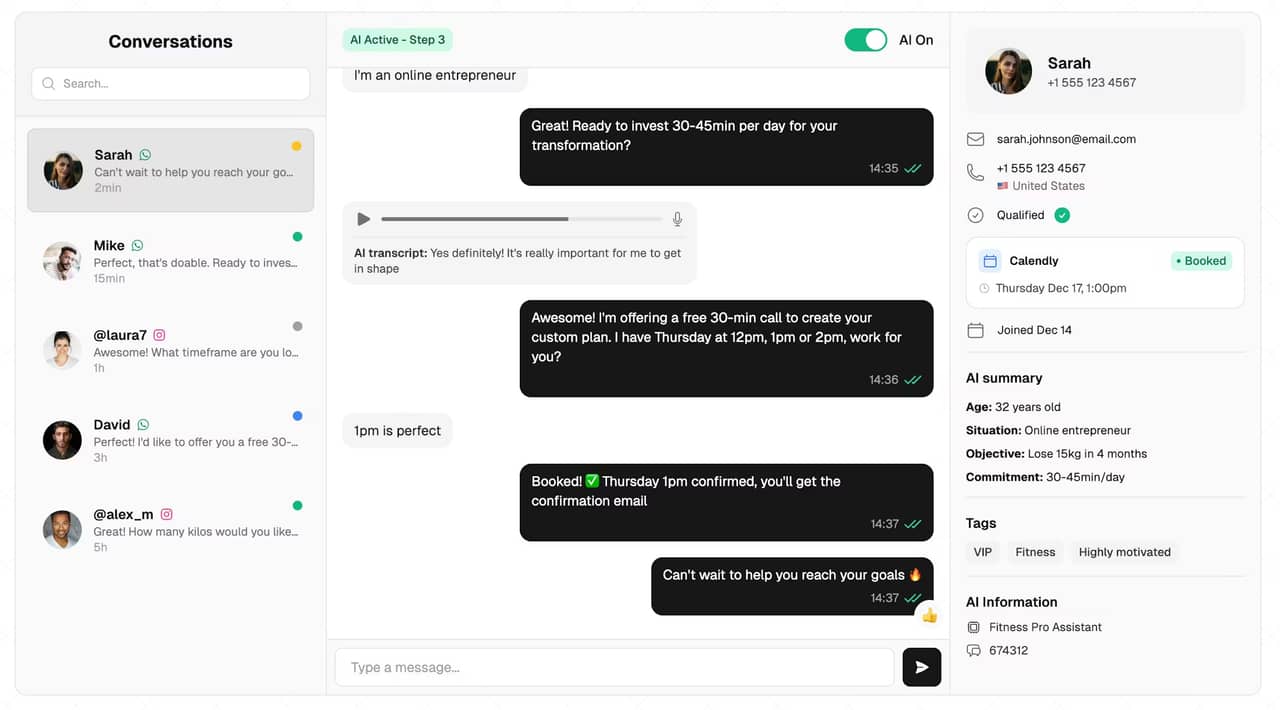
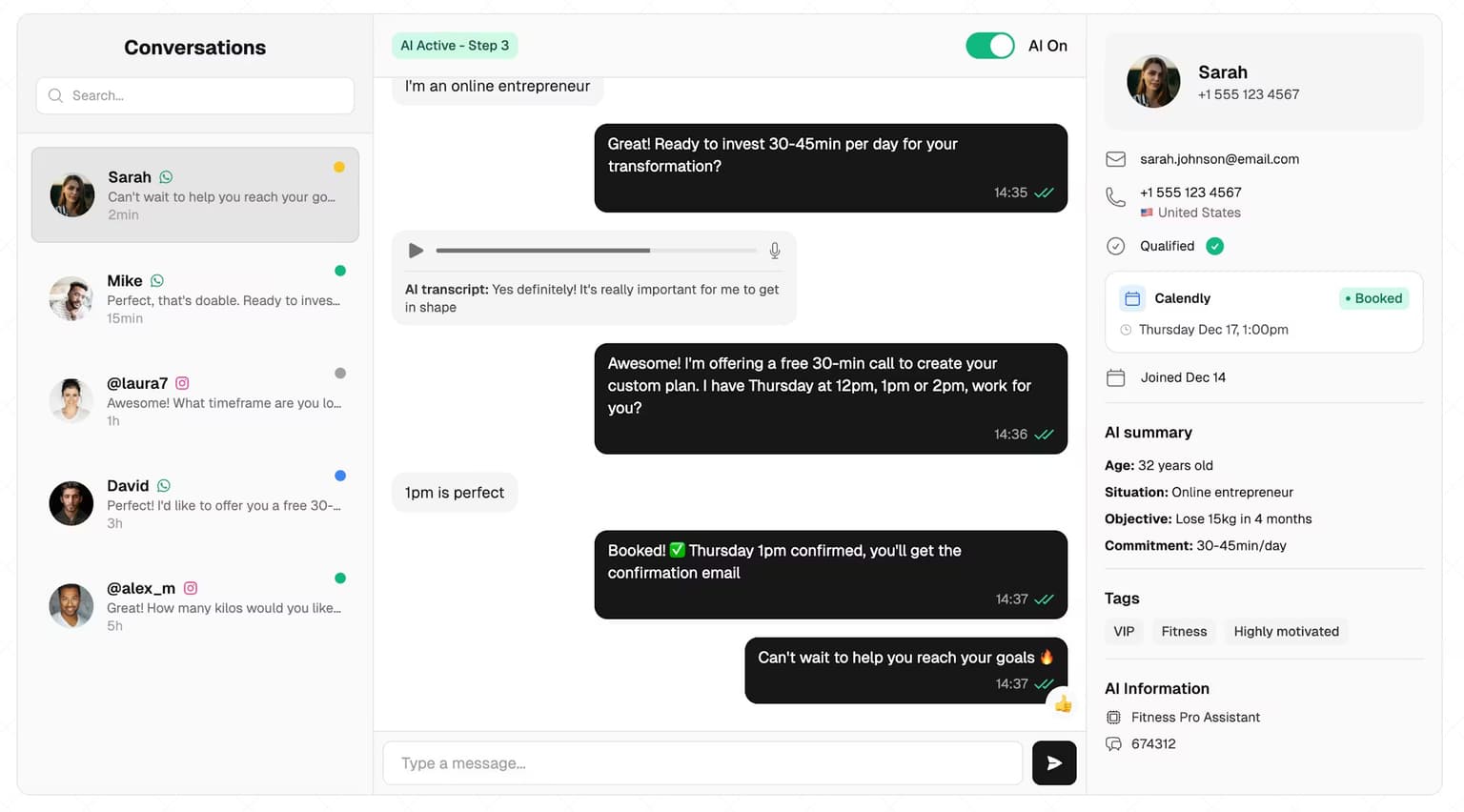
We flagged this above and it is worth stating plainly: dropping a Calendly link is not the same as booking the call. The lead still has to context-switch to a separate page. A conversational tool proposes the slots inside the chat ("I have Tuesday 3pm or Thursday 10am your time, which works?") and confirms without the lead ever leaving the DM. That single difference is where a lot of high-ticket bookings are won or lost.
The AI Step is not a real integration to AI
ManyChat's built-in AI Step answers free-text questions from a small knowledge base you upload. It is fine for FAQ deflection. It is not a connection to a reasoning model that can run a whole sales conversation. To get that, you either wire a webhook to OpenAI yourself and maintain it, or you use a tool whose entire architecture is conversational. That is the difference between a ManyChat bot and an AI setter, and no integration in the directory closes it.
ManyChat integrations vs an AI setter
The cleaner comparison is not "which integrations does ManyChat have" but "what am I trying to automate." If the answer is booking sales calls from your DMs, the integration list is beside the point.
| Job to be done | ManyChat + integrations | AI setter (SetSmart) |
|---|---|---|
| Capture a DM lead | Excellent (comment-to-DM, ads) | Excellent |
| Push lead to email / sheet | Native integrations | Native + Zapier |
| Qualify with real questions | Button tags only | Conversational, multi-criterion |
| Answer unscripted questions | Falls back to menu | Yes |
| Book the call in-chat | Sends Calendly link | Proposes slots, books in-chat |
| Follow up after silence | Static sequence | Context-aware re-engagement |
| Tools to maintain | ManyChat + Zapier + CRM | One tool for the conversation |
The pattern most coaches land on: keep ManyChat for the top of the funnel (comment-to-DM triggers, lead magnet delivery, ad capture) and hand the actual conversation to an AI setter. SetSmart runs the qualification and books the call natively across Instagram, WhatsApp and Messenger, so you are not stitching a Calendly link onto a button tree. If you want the ranked field, our best AI setters roundup and the broader ManyChat alternatives guide both cover where each tool fits.
Pricing: what ManyChat integrations actually cost
Integrations are not a separate line item, but they change your total bill in two ways.
- ManyChat plan. Native integrations and the AI Step require a paid ManyChat plan. The Free tier caps you at 25 contacts, which is enough to test and not to run a business. Essential starts around $15/month for 500 contacts, Pro starts around $25/month and unlocks integrations, custom fields and team features. Full breakdown in ManyChat pricing, and the free-tier limits in is ManyChat free.
- Zapier / Make. Any integration that runs through Zapier adds that platform's subscription on top, priced by task volume. A busy DM funnel can burn through a Zapier tier faster than you expect.
- WhatsApp. If you connect ManyChat WhatsApp, Meta charges per-conversation fees on top of everything, detailed in WhatsApp Business API pricing.
For comparison, SetSmart bundles the AI conversation, in-chat booking and follow-ups into one plan: a free 7-day trial, then $97/month including 1,000 messages, with no separate Zapier bill to run the core booking flow. The math changes once you realise a ManyChat-plus-Zapier-plus-CRM stack is often three subscriptions to do what one conversational tool does in one.
How to set up a ManyChat integration (step by step)
Whichever integration you are wiring, the process is the same five steps.
- Open the Integrations tab. In ManyChat, go to Settings then Integrations. You will see the native connections and a link to the Apps directory.
- Pick native or Zapier. If a native connection exists (Google Sheets, Calendly, Mailchimp), use it. If not, open Zapier or Make and start from a "New ManyChat subscriber" trigger.
- Map the data fields. Match ManyChat custom fields (name, email, phone, the tags you set) to the fields the destination app expects. Mismatched fields are the number-one cause of a sync that "runs" but writes empty rows.
- Trigger the sync inside a flow. Add the integration step at the exact point in your flow where the lead is captured, then tag the contact so you can segment follow-ups later. Placement matters: fire it too early and you log tyre-kickers, too late and you miss drop-offs.
- Test with a real DM. Send yourself a message through the trigger (comment the keyword on your own Reel), confirm the record lands in the destination app, and check the calendar event or email actually fired.
If you are setting up the comment-to-DM trigger that feeds all of this, the full mechanics live in Instagram comment-to-DM automation and the platform overview in what is ManyChat.
FAQ
How many integrations does ManyChat have?
ManyChat has roughly 25-30 native integrations (Google Sheets, Calendly, Mailchimp, ActiveCampaign, Klaviyo, Kit, Shopify, Stripe, PayPal, Google Calendar and similar), plus access to 6,000+ apps indirectly through Zapier and Make. The native list is short and reliable; the indirect list is enormous but adds a second subscription.
What is ManyChat compatible with?
ManyChat connects natively to major email tools, calendars, spreadsheets, ecommerce and payment platforms, and it bridges to almost everything else (CRMs, project tools, Slack and so on) via Zapier or Make. On the channel side it runs on Instagram DMs, Facebook Messenger and the WhatsApp Business API.
Does ManyChat have a CRM integration?
It pushes contacts and tags into external CRMs like Pipedrive, Zoho or GoHighLevel through Zapier, but ManyChat is not a CRM itself. Its tags are flat with no pipeline stages or lead scoring. If you want a lighter option, a purpose-built Instagram CRM or an AI setter with built-in lead tracking avoids the extra tool.
Is the ManyChat Zapier integration free?
The ManyChat side is included on a paid ManyChat plan, but Zapier charges its own subscription based on task volume. A low-traffic funnel may fit Zapier's free tier; a busy DM funnel will need a paid Zapier plan, which is why native connections are worth using wherever they exist.
Can a ManyChat integration book a sales call for me?
No. Integrations move data between apps. Even the calendar integration only drops a booking link into the DM; the lead still has to leave the chat to pick a slot. Qualifying the lead and booking the call inside the conversation needs a conversational AI setter, not a connector.
What is the best ManyChat integration for coaches?
For coaches booking calls from DMs, the highest-value native integrations are the calendar (Calendly or Google Calendar) and your email tool, backed by Google Sheets as a simple lead log. Beyond that, pairing ManyChat's capture with a dedicated AI sales assistant for the conversation itself outperforms adding more connectors.
Ready to automate your DMs?
Start your free 7-day trial and let AI handle your lead qualification 24/7.
Try SetSmart free