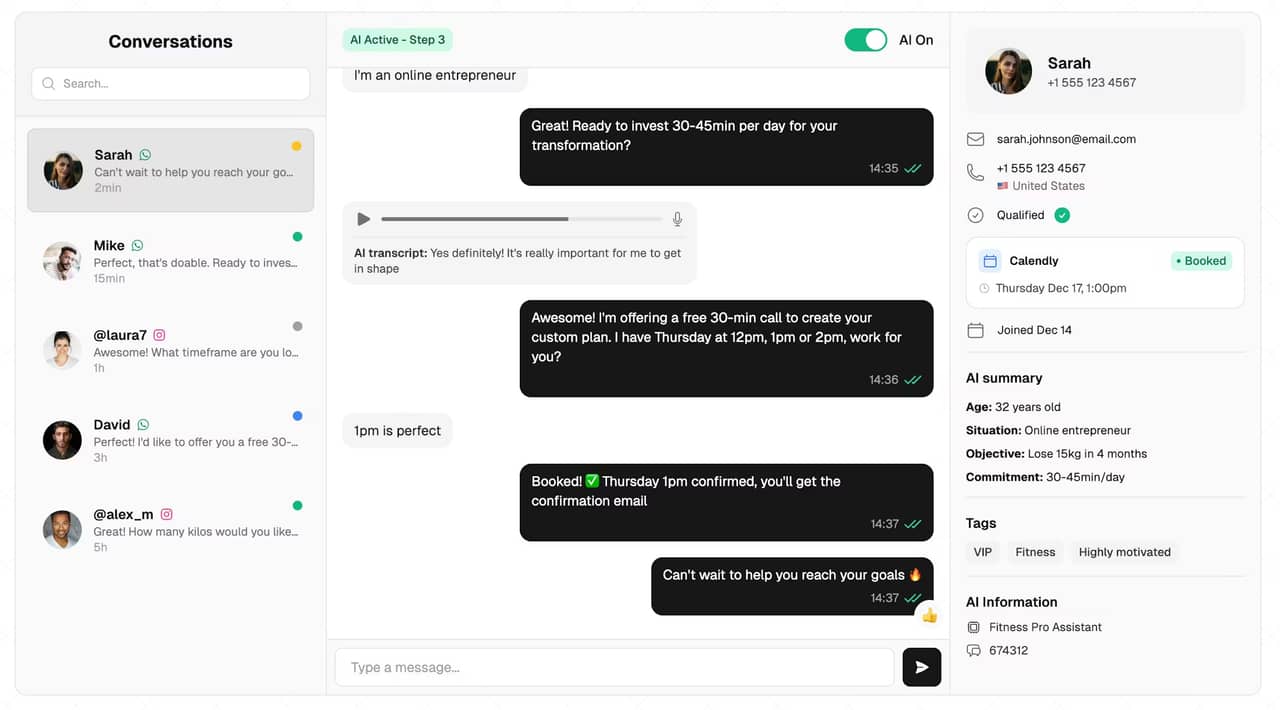
Sales Cadence: 7-Step DM-First Playbook (2026)
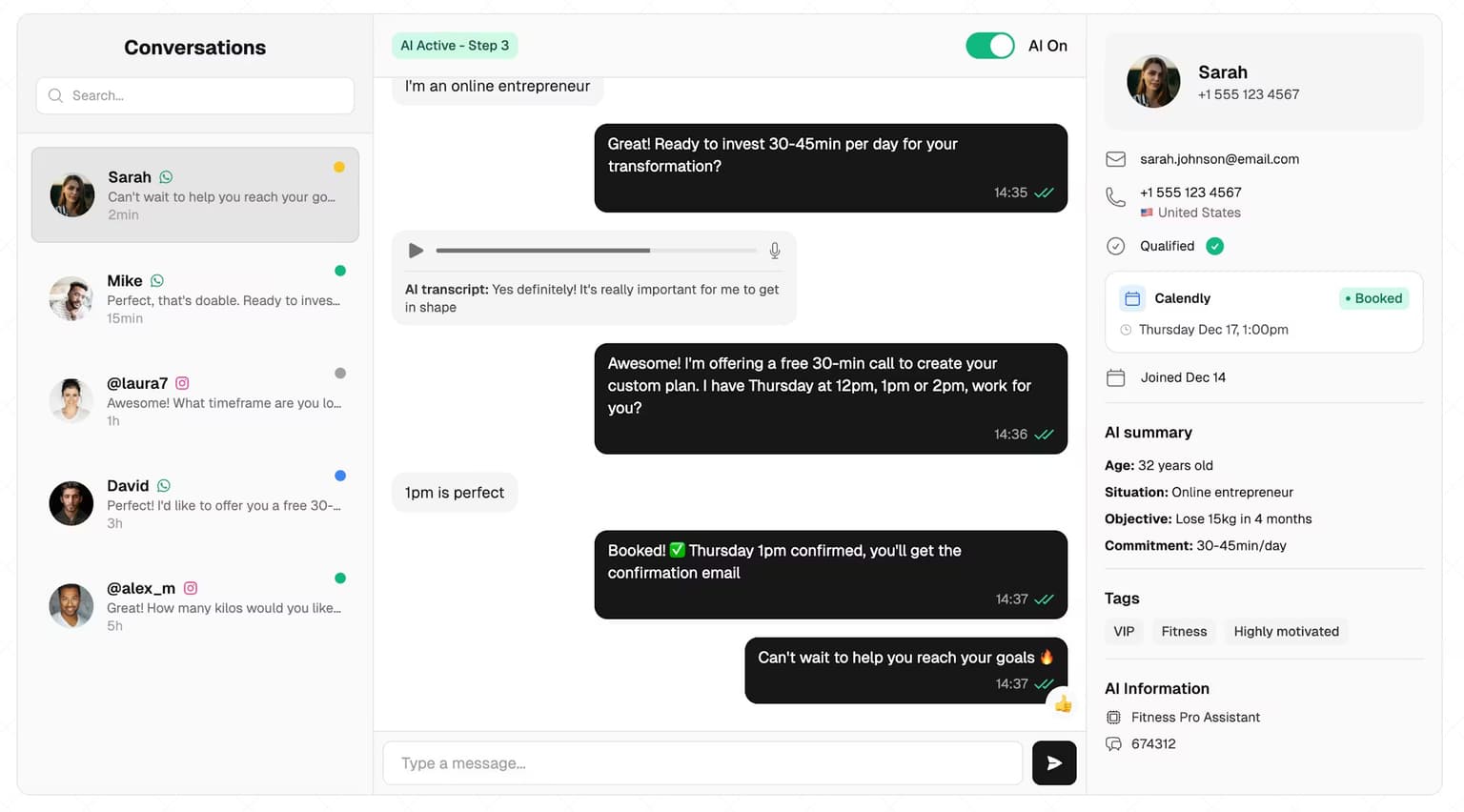
Most "sales cadence" articles in 2026 are still scripted around email and phone — Pipedrive, Salesforce, Highspot, and Revenue.io all give you 8-touch email-call sequences. Real buyers in 2026 reply on Instagram DM and WhatsApp first, email third. Below is what a sales cadence actually looks like when DMs are the primary channel: 7 steps, every one with a real script, the channel that wins, the timing rule, and what the data says about why it works.
A sales cadence is not "how often you email a prospect". It is the whole repeatable pattern of touches — what you send, on which channel, in what order, with how much spacing between each — that turns a cold lead into a booked call. Skip the table of contents — read the TL;DR table, then jump to whatever step you're stuck on.
TL;DR: 7-step DM-first sales cadence
| Step | Touch | Best channel | Timing | Goal |
|---|---|---|---|---|
| 1 | First-reply within 5 minutes | Instagram DM / WhatsApp | < 5 min | Open the conversation |
| 2 | One qualifying question | Same DM thread | Within 15 min | Surface need + intent |
| 3 | Value drop tied to the answer | DM (audio / pdf) | Within 1h | Build credibility |
| 4 | Soft call ask + slot link | Same DM thread | Same day | Book the call |
| 5 | Follow-up #1 (no reply) | Same DM thread | +4 hours | Re-engage same day |
| 6 | Follow-up #2 (next day) | Same DM thread | +23 hours | Catch the morning check-in |
| 7 | Long-tail "stay-warm" touch | Email + DM combo | +7 / +14 / +30 days | Re-open closed loops |
The whole cadence runs in 48 hours from first touch to booked call for warm leads. Cold leads enter the long-tail loop on day 7 and re-cycle every two weeks until they convert or unsubscribe.
What is a sales cadence?
A sales cadence is a structured, repeatable sequence of outreach touches a sales rep (or AI) makes to engage a prospect, with a defined order, channel mix, timing, and stop condition. The point is reliability: every lead gets the same disciplined treatment, no one gets forgotten, no one gets harassed.
Three things distinguish a sales cadence from random follow-ups:
- Order: each touch is numbered. Touch 3 always follows touch 2.
- Channel mix: a cadence specifies where each touch happens (DM, email, phone, LinkedIn). Single-channel cadences underperform multi-channel ones because attention has fragmented.
- Spacing: each touch has a defined wait time before the next one fires. Too tight and you spam; too loose and the lead forgets you exist.
A cadence ends when one of three things happens: the lead books, the lead opts out, or the cadence runs out of touches. Most modern cadences run 7-12 touches over 14-30 days.
If you're searching "what is a sales cadence" because you've been told to "follow up better", you're probably one or two touches in and giving up. The data is brutal here: the leads who book are the ones who get touch 5, 6, 7. Your competitors stop at touch 2.
Why DM-first sales cadences outperform email-only in 2026
The default sales cadence template you'll find on Pipedrive, Highspot, and Salesforce is built around email and the phone — typically 8 touches alternating "email, call, email, LinkedIn, email, call". That cadence still works for B2B mid-market and enterprise, where the inbox is the primary work surface and the phone is still answered. For SMB, creator-led, coach-led, agency-led, and consumer-facing brands, the picture changed:
- Inbox fatigue: B2B email open rates sit around 20-30%; reply rates are 1-3%. Most cold cadence emails get archived without being read.
- DMs land in the friend thread: an Instagram or WhatsApp DM is read on a phone, in the same app where your lead messages friends. It opens.
- Speed compounds. The lead response time statistics show a 5-minute reply qualifies leads at 21× the rate of a 30-minute reply. DM cadences run in seconds; email cadences run in hours.
- Follow-ups carry the cadence. From our analysis of 828K conversations, conversations that include even one follow-up qualify at +112% versus no follow-up — and bookings rise +106%. A cadence is, structurally, a follow-up engine.
- Conversation depth is what books. The leads who book are the ones who reach 11+ messages with you. Cadence touches that open a conversation (DM) outperform cadence touches that close a sentence (email blast).
Translation: if your audience lives on social, your sales cadence should be DM-led with email as a long-tail catcher. If your audience is a CIO at a Fortune 500, keep emailing. The 7-step playbook below works for the first audience — that's the gap nobody is covering.
The 3-3-3 rule (and why it doesn't fit DM cadences)
The 3-3-3 rule is a classic sales cadence framework: spend 3 minutes researching the lead, send 3 touches across 3 channels. It's a useful mental model for outbound SDRs working a list, but it under-specifies modern DM cadences in two ways:
- 3 touches is too few. Modern cadences average 7-12 touches because depth predicts qualification. Stopping at 3 leaves money on the floor.
- 3 channels is too generic. A working DM cadence picks two channels, sequences them tightly, and only adds a third for re-engagement. Rotating across three channels per lead reads as spam.
What actually works: 5-minute first reply + 4h follow-up + 23h follow-up, all in one DM thread, then a long-tail email-and-DM loop for non-responders. That's the rhythm in steps 5-7 below.
The 4 types of sales cadences
Most "sales cadence" content lumps every sequence together. They split cleanly into four types, each with a different goal:
- Inbound DM cadence (this article's focus): triggered when a lead DMs your brand or comments on a post. Runs in real-time, designed to convert intent into a booked call within 48 hours.
- Outbound prospecting cadence: cold outreach to a built list, typically email + LinkedIn + phone. See outbound lead qualification for the SDR playbook version.
- Nurture cadence: long-form, education-led, fires over weeks for unqualified-but-fit leads. Covered in lead nurturing examples.
- Customer / post-sale cadence: onboarding, upsell, and renewal sequences for existing customers.
The 7 steps below describe the inbound DM cadence because that's where modern lead flow lives — Instagram comment-to-DM, WhatsApp click-to-chat ads, story replies, link-in-bio funnels. Inbound DM cadences also outperform outbound on raw conversion because the lead has already expressed interest.
Step 1: First reply within 5 minutes (Instagram DM / WhatsApp)
Trigger: A lead DMs your brand, comments a keyword on a post, or clicks a click-to-WhatsApp ad. Channel: The same channel they reached out on. Don't redirect to email yet. Goal: Open the conversation while attention is still high.
Hey {first name} 👋 thanks for reaching out about {topic}.
I want to make sure I point you the right way — got 30 sec for a quick question?
Why it works: The opener anchors on what the lead just did ("about {topic}"). It promises a low-effort next step ("30 sec for a quick question") instead of pushing for a call right away. Asking permission to ask makes the next message feel earned.
Timing: Under 5 minutes. The single biggest predictor of whether a sales cadence converts at all is whether step 1 landed before the lead got distracted. The industry average response time is 42 hours — by then your prospect has DMed three competitors. AI replies in under 5 seconds, which is why DM-first cadences increasingly run on AI for step 1, not human SDRs.
For a deeper look at speed economics, see lead response time statistics — the difference between a 5-minute and a 30-minute first reply is a 21× qualification gap.
Step 2: One qualifying question (same DM thread)
Trigger: The lead said "yes" or replied at all to step 1. Channel: Same thread. Goal: Surface need + intent in one question, three options.
Awesome — quick one:
are you looking for help with (a) {pain point 1},
(b) {pain point 2}, or
(c) something else?
Why it works: A three-option multiple-choice question outperforms an open-ended "what are you looking for?" because the lead doesn't have to think. They pick. This is the foundation of every DM-led qualification flow — see ai lead qualification for the longer version with BANT/MEDDIC adapted for DMs, and instagram dm scripts for more script patterns.
Timing: Within 15 minutes of step 1's reply. If the lead replied at 4pm, step 2 should fire by 4:15pm.
Branch logic: Tag the lead by chosen option in your CRM. Step 3's value drop is keyed to that answer.
Step 3: Value drop tied to the answer
Trigger: Lead picked an option in step 2. Channel: Same DM thread, audio note or short PDF. Goal: Build credibility before asking for the call.
Got it — {option (a) interpreted}.
The biggest unlock for that is usually {one specific tactic}.
Here's a 90-second voice note showing exactly how:
[voice note attached]
Why it works: The value drop pre-qualifies the call. By the time you ask for time (step 4), the lead already trusts your competence on this specific problem. Voice notes outperform text on Instagram DM because they feel personal and most senders don't use them. WhatsApp tolerates short PDFs as well, but voice still wins for warmth.
Timing: Within 1 hour. Same-day delivery keeps the conversation in the lead's mental cache.
Variation by channel: On Instagram DM, send a 60-90 second voice note. On WhatsApp, voice or a short doc. On Messenger, a short looped video. Avoid attaching a heavy webinar replay at this step — saves that for step 6.
Step 4: Soft call ask with one-tap slot link
Trigger: Lead reacted, replied to, or even just opened the value drop. Channel: Same DM thread. Goal: Book the call.
If it'd help to map this out specifically for {their context},
I do free 20-minute strategy calls — here are 3 slots this week:

🗓️  Tue 2pm
🗓️  Thu 10am
🗓️  Fri 4pm

Pick one or DM me a better time?
Why it works: Three concrete slots beat "let me know when works for you" because it removes the calendar-coordination tax. "Pick one or DM me a better time" preserves the lead's autonomy — they don't have to commit to your slots, but they also don't have to do the scheduling work.
Timing: Same day as steps 1-3, ideally within 4 hours of the value drop.
Channel-specific: On WhatsApp Business API you can send an interactive list message instead of plain text. On Instagram DM, plain text with emoji slot bullets converts best. The tools that handle this in-DM scheduling are covered in best ai setters and ai sales assistant.
Step 5: Follow-up #1 — 4 hours later (no reply path)
Trigger: Lead saw step 4 but didn't reply within ~4 hours. Channel: Same DM thread. Goal: Re-engage same-day before the lead exits the platform.
Hey {first name} — totally get if today got busy 🙏
If those 3 slots don't work, I've got Mon afternoon and Wed morning open too.
Why it works: The 4-hour mark is when the lead has likely opened DMs again on their phone. The message acknowledges the silence ("if today got busy") without sounding accusatory, and offers two more slots to reduce friction.
Timing: Exactly +4 hours from step 4. Don't follow up faster — it reads as anxious. Don't wait until tomorrow — by then they've forgotten the conversation.
This is the first half of the 4h + 23h pattern that anchors most DM cadences. The pattern was tuned from real data — see ai lead follow-up for the full breakdown of why those exact intervals beat the typical "every 2 days for a week" cadence.
Step 6: Follow-up #2 — 23 hours later (catch the morning check-in)
Trigger: Still no reply after step 5. Channel: Same DM thread. Goal: Catch the lead in their morning check-in window.
Morning! Last note from me on this 👋
If a strategy call isn't the right fit right now, no worries —
want me to send the {short asset, e.g., audit checklist} so you have it for later?
Why it works: Three things stack here. First, "last note from me on this" sets a clear cadence-end signal — the lead doesn't feel cornered. Second, it offers a graceful exit ("if it's not the right fit") that paradoxically increases reply rate. Third, it offers a low-stakes alternative (the asset) that re-opens the loop without re-asking for the call. About 1 in 5 leads who didn't book in steps 4-5 will accept the asset and re-engage from there.
Timing: +23 hours from step 5. Why 23 and not 24? Because most leads check DMs in the same window every day; firing at 23h shifts each successive cadence touch slightly earlier, which gives you 7 days of "morning catches" before you cycle around.
The 4h + 23h follow-up rhythm is the default in whatsapp automation flows and the ai-setter playbook, and it's why DM cadences book more calls than email cadences spaced 48 hours apart — the lead hasn't had time to forget who you are.
Step 7: Long-tail "stay-warm" touch (+7 / +14 / +30 days)
Trigger: Lead never replied to steps 4-6, but never opted out either. Channel: Email + DM combo. This is where email earns its place in a DM cadence. Goal: Re-open the conversation in 1-4 weeks when context might have changed.
Day 7  → DM: short value-add reply to a story or post they made (manual or AI-detected)
Day 14 → Email: 1-paragraph value email with a single soft CTA
Day 30 → DM: "Hey, where did you land on {topic}? Curious."
Why it works: Most prospects don't book in week one because they're not ready in week one. They're researching, comparing, internally selling. The 7/14/30 long-tail catches the "now I'm ready" moment without burning the relationship. Day 7's manual touch (engaging with their content) re-establishes you as a real person in their feed. Day 14's email lands somewhere your DM didn't reach. Day 30's DM closes the loop with a curiosity-frame question.
Stop condition: If no reply by day 30, drop the lead into a quarterly newsletter and remove from active cadence. Don't keep retouching forever — Meta enforces strict messaging windows on Instagram and WhatsApp Business API, and burning frequency tarnishes the brand.
For long-cycle B2B sales (90+ days), this step expands into a full nurture sequence — see lead nurturing examples for 14 patterns.
Sales cadence by channel: what works where
| Channel | Avg open rate | Best for | Cadence speed | Watch out for |
|---|---|---|---|---|
| Instagram DM | ~90% | Inbound from creators, coaches, B2C | Minutes-to-hours | 24h messaging window after no-reply |
| ~95% (templated) | Click-to-chat ads, ecommerce, B2C+B2B SMB | Minutes | Per-conversation Meta fees | |
| Messenger | ~80% | Click-to-Messenger ads | Minutes | 24h re-engagement window |
| 20-30% | B2B mid-market, enterprise, long cycles | Hours-to-days | Inbox fatigue, deliverability | |
| LinkedIn DM | ~50% (InMail) | B2B, account-based | Hours | Connection limits, daily caps |
| Phone / SMS | ~10% pickup | High-ticket B2B, inside sales | Real-time only | Time-zone & opt-in laws |
The pattern: start where the lead opted in. If they DMed Instagram, the cadence runs in Instagram. If they clicked a WhatsApp ad, it runs in WhatsApp. Never silently switch a lead to email in step 3 — that's where most "multi-channel cadences" lose people.
Sales cadence vs sales sequence vs nurture sequence
These three terms get used interchangeably. They're not.
- Sales cadence: a structured outreach pattern aimed at booking a meeting or closing a sale. Driven by a sales rep or AI. Time-bounded (typically 14-30 days).
- Sales sequence: a Salesforce-coined term that mostly means the same thing as a cadence. In Salesforce / HubSpot UIs, "sequence" is the product name for the automated cadence engine.
- Nurture sequence (or marketing nurture, drip campaign): a longer-form pattern that runs over weeks-to-months, mostly value content, no aggressive call asks. Owned by marketing, not sales. Lead gets a nurture if they're not yet sales-ready. See lead nurturing examples.
A clean handoff: leads enter a nurture until they hit a buying-intent signal (visited pricing, replied "interested", booked a demo). At that point they get pulled into a sales cadence. Most teams blur the two and end up with cadences that are too soft (nurture-style) or nurtures that are too pushy (cadence-style).
How AI runs a sales cadence (and where humans still win)
A sales cadence is a textbook AI workload: deterministic timing, repeatable scripts, multi-channel orchestration, never-forget follow-ups. The 7 steps above can be 100% AI-handled for inbound DM leads. Where humans still earn their seat:
- Step 4 high-ticket exception: when the offer is $5K+, swap the soft AI ask for a human DM at step 4. The conversion lift on a personal voice note from the founder beats the AI auto-CTA.
- Step 6 negotiation: if the lead replies to step 6 with an objection ("price is high"), AI pings a human for that one reply. Cadence resumes after.
- Step 7 manual engagement: the day-7 "engage with their content" touch needs a human (or a human-supervised AI) — engagement quality matters more than volume.
For inbound DM cadences with deal sizes under $5K, full AI handling is the norm. SetSmart, the ai-setter the rest of this blog covers, runs steps 1-6 end-to-end on Instagram, WhatsApp, and Messenger. The 4h + 23h follow-up pattern is its default cadence.
For developer teams that want to wire a custom cadence on top of Meta APIs, the whatsapp mcp server and instagram mcp server guides cover the building blocks.
Common sales cadence mistakes
- Stopping at touch 2. The single most common — and most expensive — mistake. The lift from a single follow-up is the largest in any cadence; cutting it costs you half your booked calls.
- Mixing channels in one step. Sending an email and a DM at the same time reads as desperate. Pick one channel per step.
- Spacing too tight. A second touch 30 minutes after the first reads as automation gone wrong. Stay at 4h minimum for the first follow-up.
- Spacing too loose. Waiting 48 hours between touches in a DM cadence kills urgency. The 4h + 23h pattern is tight on purpose.
- Same script for every lead. Cadences should branch on step 2's qualifying answer. A lead who said "(a) {pain point 1}" gets a different step 3 from one who said "(b)".
- No stop condition. A cadence with no end point becomes spam. Set 7-12 touches max, then drop to a quarterly newsletter.
- Generic CTAs. "Book a call" loses to "3 slots: Tue 2pm / Thu 10am / Fri 4pm". Specificity converts.
- Forgetting timezone. A 23-hour follow-up that fires at 4am local time gets ignored. Modern cadence tools schedule per-lead local time.
3 sales cadence templates (proven)
Template 1: Coach / creator inbound DM cadence (high-volume, low-ticket)
| Step | Channel | When | Touch |
|---|---|---|---|
| 1 | IG DM | <5 min | "Welcome + 30sec question?" |
| 2 | IG DM | <15 min | "(a)/(b)/(c)?" multiple-choice |
| 3 | IG DM voice | <1h | 60-sec value note |
| 4 | IG DM | same day | Soft ask + 3 slots |
| 5 | IG DM | +4h | "totally get if busy" + 2 more slots |
| 6 | IG DM | +23h | "last note + asset offer" |
| 7 | DM/email loop | +7/14/30d | Long-tail re-engagement |
Template 2: WhatsApp click-to-chat-ad cadence (B2C / e-com)
| Step | Channel | When | Touch |
|---|---|---|---|
| 1 | WA | <5 min | Welcome + product question |
| 2 | WA list msg | <15 min | 3-option product picker |
| 3 | WA voice/doc | <1h | Short personalized recommendation |
| 4 | WA | same day | Direct call/booking ask + slot link |
| 5 | WA | +4h | Soft check-in |
| 6 | WA template | +23h | Re-engagement template (Meta-approved) |
| 7 | Email + WA | +7/14d | Asset + check-in pair |
Template 3: Hybrid B2B SMB cadence (DM-led with email backup)
| Step | Channel | When | Touch |
|---|---|---|---|
| 1 | IG/WA DM | <5 min | Reply on the channel they used |
| 2 | DM | <30 min | Qualifying question (BANT-lite) |
| 3 | DM + email follow | <2h | Short loom + email summary |
| 4 | DM | same day | Soft ask + slots |
| 5 | DM | +4h | Re-ask |
| 6 | +23h | Slot recap email | |
| 7 | +7d | Connection req with personal note |
Real teams running this cadence
"We went from manually replying within 2-3 hours to AI replying within 30 seconds. Booked calls per week tripled in the first month and we didn't add a single hire." — Théo Riffault
"The 4h + 23h follow-up rhythm is the part nobody told us. We had email cadences spaced 2 days apart and were losing leads in between. Tightening the spacing on DM was the biggest single change." — Mathis Ladoué
"Our SDRs hated step 1 — they couldn't reply to inbound DMs fast enough at midnight or weekends. Now AI runs steps 1-6 and SDRs only see leads that booked or asked for a human." — Edouard Clerc
When NOT to run a sales cadence
A sales cadence is overkill in three situations:
- The lead just booked. Stop the cadence the second a calendar slot is reserved. Continuing reads as an automation bug.
- The deal is purely transactional (e.g., a $19 product). One DM + one re-ask is enough; a 7-step cadence is over-engineered.
- The lead explicitly asked for time. "Send me something in October" means stop until October. Honoring that beats hammering the cadence.
Also avoid running a sales cadence when you don't actually have a sales motion to support it. A cadence that books a call you can't take, or routes to a human you can't pay, is worse than no cadence.
Sales cadence software in 2026
The market splits into three layers:
- Outbound email/phone cadence tools — Outreach, SalesLoft, Apollo, Reply, Klenty. Built for SDRs running cold lists. Email + phone + LinkedIn focus.
- CRM-native sequences — Salesforce Sales Engagement, HubSpot Sequences, Pipedrive. Cheaper if you're already on the CRM, but channel coverage is mostly email + phone.
- DM-native AI cadences — SetSmart and a small handful of competitors. Runs cadences directly inside Instagram DM, WhatsApp, Messenger. The default 4h + 23h pattern is built in.
For tool-by-tool comparisons in adjacent categories, see ai sales assistant and best ai setters. For inbound DM-driven sales cadences specifically, the DM-native layer is the only category that handles steps 1-6 without a Zapier-glued bolt-on.
SetSmart's pricing for that layer: Free 7-day trial, then $97/month with 1,000 messages included. The full cadence engine and channels are available on day one.
Common sales cadence questions
FAQ
What is an example of a sales cadence?
A sales cadence example is the 7-step DM-first pattern in this article: 5-minute first reply, qualifying question within 15 minutes, value drop within 1 hour, soft call ask the same day, 4-hour follow-up if no reply, 23-hour follow-up the next morning, and a long-tail re-engagement loop at +7/+14/+30 days. Total cadence length: 14-30 days.
What is the 3-3-3 rule in sales?
The 3-3-3 rule is a classic sales prospecting framework: spend 3 minutes researching the lead, then send 3 touches across 3 channels. It's a useful starter mental model for outbound SDRs but under-specifies modern DM cadences, which need 7+ touches and tighter channel discipline. Real DM cadences run 4-hour and 23-hour spacing in a single thread, not three rotating channels.
What are the 4 types of cadences?
The four types are: inbound DM cadence (real-time, designed to convert intent into a booked call within 48 hours), outbound prospecting cadence (cold outreach, mostly email + LinkedIn + phone), nurture cadence (long-form education sequence over weeks), and customer / post-sale cadence (onboarding, upsell, renewal). Each has different timing, channel mix, and stop conditions.
How long should a sales cadence be?
A working inbound DM sales cadence is 7-12 touches over 14-30 days. The first 6 touches happen in 48 hours (steps 1-6 above). Touch 7 is a long-tail loop that fires on day 7, day 14, and day 30. After day 30 with no reply, leads drop into a quarterly newsletter, not the active cadence — running cadences past 30 days is what gets you flagged as spam.
What is a sales cadence in Salesforce?
In Salesforce Sales Engagement (formerly High Velocity Sales), a "cadence" is the product name for the automated outreach sequence engine. It sequences emails, calls, and LinkedIn touches with defined timing and branching. Salesforce's native cadences are still email-and-phone heavy; for Instagram DM, WhatsApp, and Messenger cadences you currently need a DM-native layer like SetSmart on top of (or instead of) Salesforce.
What is the best outbound sales cadence?
The most-tested outbound cadence is 8-12 touches over 21 days, mixing email (60%), phone (20%), and LinkedIn (20%), with first-touch personalization and follow-ups every 2-3 business days. For SDR-style outbound to a built list, see outbound lead qualification for a deeper playbook. For inbound DM-driven sales, the 7-step DM-first cadence in this article outperforms the classic email-led pattern on speed-to-book.
Can AI fully run a sales cadence?
For inbound DM cadences with deal sizes under $5K, yes — modern AI setters handle steps 1-6 (welcome, qualify, value drop, call ask, two follow-ups) end-to-end on Instagram DM, WhatsApp, and Messenger. Above $5K deal size, the call ask in step 4 still benefits from a personal human voice note. Step 7's long-tail manual engagement also reads better when a human (or a human-supervised AI) runs it.
Ready to automate your DMs?
Start your free 7-day trial and let AI handle your lead qualification 24/7.
Try SetSmart free