Sales Automation: 9 AI Use Cases for 2026

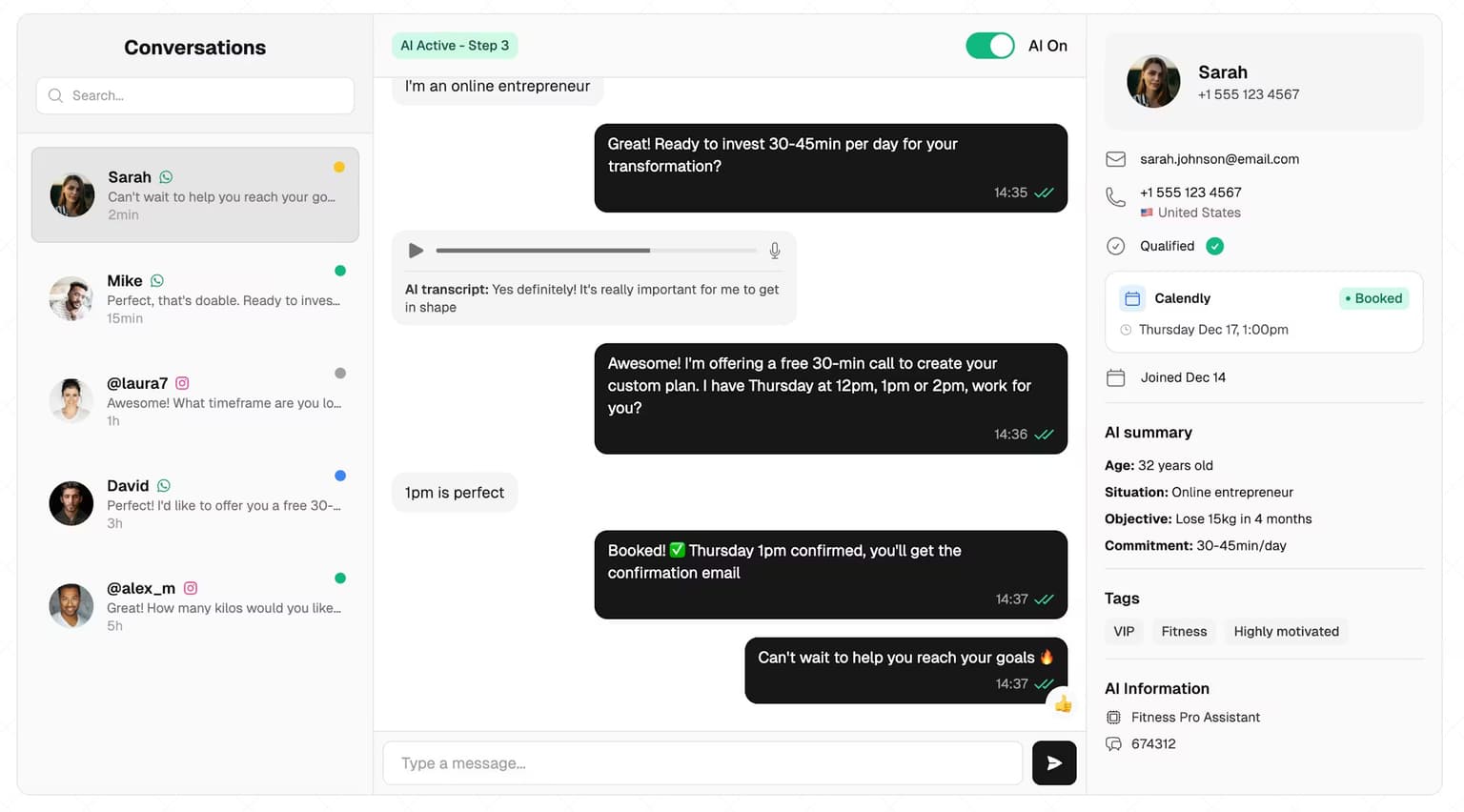
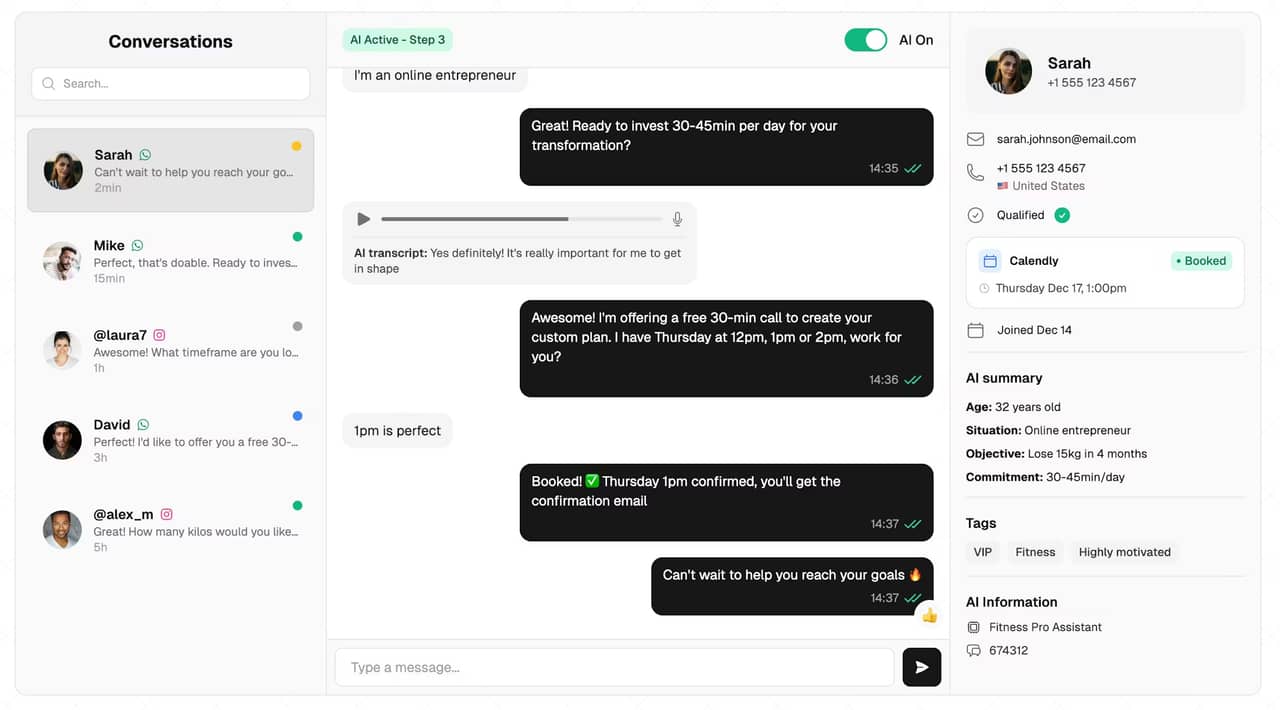
Most "sales automation" articles in 2026 still picture a CRM updating itself — Salesforce, HubSpot, Zendesk Sell, Pipedrive — and an outbound email tool firing 8 templates in a row. That's one slice of it. The slice that actually moves revenue in 2026 is the inbound DM thread: a lead clicks an Instagram ad, sends a question, and an AI replies in five seconds, qualifies them, and books the call before a human ever opens the conversation. This article ranks the 9 sales automation use cases by real revenue impact, compares the tools that own each layer, and gives you a setup playbook that ships in a week.
Sales automation is the layer of software that does the repeatable parts of selling so a human only handles the parts that need judgement. In 2026 it spans CRM updates, outreach sequences, lead routing, follow-up, meeting booking, call summaries, and — increasingly — full DM conversations on Instagram and WhatsApp. Skim the TL;DR table, then jump to the use case you're trying to automate first.
TL;DR: 9 sales automation use cases ranked by revenue impact
| Rank | Use case | Where the money is | Best fit for | Tool layer |
|---|---|---|---|---|
| 1 | Inbound DM qualification | Highest — converts existing demand | Coaches, agencies, SMB, e-commerce | DM AI (SetSmart) |
| 2 | Lead routing & sub-5-min response | High — speed compounds | Any team with inbound | Routing layer |
| 3 | AI follow-up sequences | High — recovers half the pipeline | Everyone | DM AI / outreach |
| 4 | Outbound sequence (cadence) | Medium — works only with research | B2B SDRs | Outreach |
| 5 | Auto-research & lead enrichment | Medium — multiplier on outbound | B2B SDRs / RevOps | Data + AI |
| 6 | CRM data hygiene | Medium — quiet money | Mid-market+ | CRM (SFA) |
| 7 | Meeting booking automation | Medium — kills no-shows | Everyone | Calendar layer |
| 8 | Call summaries & next steps | Low-medium — reduces drop-off | Closers | Call AI |
| 9 | Quote & proposal generation | Low — only B2B custom-priced | B2B mid-market | CPQ |
The single biggest mistake teams make in 2026 is buying use cases #4-#9 first. Those are the ones every CRM vendor demos. The money is in #1-#3 — the messy, conversational, sub-5-minute parts that human reps simply cannot cover at scale. Skip down to "How to set up sales automation in a week" if you want the order to ship them in.
What is sales automation?
Sales automation is software that takes the repeatable, rule-bound, or pattern-bound work out of selling — so reps spend their time on the parts that still need a human. It covers six broad domains: outreach, conversation, qualification, scheduling, CRM updates, and reporting. A platform is "sales automation software" when it removes manual steps in at least three of those domains.
The three things that distinguish modern sales automation from a 2018 CRM workflow:
- Conversational AI replaces flow-builders. Instead of a tree of if/else nodes a marketer drags into ManyChat or Pipedrive, a large language model reads the actual message and writes a real reply. The lead never feels they are inside an automation — and that's the point.
- DM channels matter. Instagram DM and WhatsApp now carry more 1-to-1 sales conversations for SMB, creator-led, and agency-run businesses than email does. Sales force automation that ignores DMs is automating the smaller part of the funnel.
- Automation runs the conversation, not just the data update. Old-school SFA updated a contact record after a rep sent an email. New-school sales automation sends the email itself, reads the reply, and decides whether to book or follow up — all without a human touching it.
If you're searching "what is sales automation" because somebody on your team said "we need to automate sales", the practical answer is: pick the layer that's leaking revenue today. For most SMBs, that's inbound DMs going unanswered for 42 hours. For most B2B mid-market teams, it's outbound research and CRM hygiene. Different layers, different tools.
Why sales automation is having a moment in 2026
Three trends collided in 2024-2025 to make this the year sales automation actually delivers:
- LLMs got reliably good at sales conversations. Reply quality, tone matching, and objection handling on a real DM thread crossed the "indistinguishable from a junior setter" threshold sometime in late 2024.
- Buyers reply on DMs first. A 2026 buyer is more likely to reply to an Instagram DM in 5 minutes than to an email in 5 days. The whole funnel shifted into the inbox of a chat app — and email-only generative AI for sales misses that.
- Speed is now table-stakes. From the lead response time statistics, the 5-minute window has been documented since the 2011 Harvard study (Oldroyd, McElheran, Elkington) that found a 21× qualification advantage for sub-5-minute responses. A human team can't hit that consistently. AI can.
Real DM behaviour now drives the rule of thumb: roughly half of all DM exchanges die before message 3, and the leads who reach 11+ messages with you qualify at far higher rates than short ones. Sales automation is, at its core, the discipline of getting more conversations past message 3.
The 9 sales automation use cases ranked by revenue impact
1. Inbound DM qualification (#1 by ROI)
What it is: an AI reads the incoming Instagram, Facebook Messenger, or WhatsApp DM, asks two or three qualifying questions in the lead's language, decides whether the lead matches your ICP, and either books the call or hands off to a human closer.
Why it ranks #1: this is the only use case that converts existing inbound demand. The leads are already raising their hand — they DM'd you. A 5-minute reply at 2am beats a 9am-Monday email by orders of magnitude. The whole point of AI lead qualification is removing the "we'll get back to you in 24 hours" gap that costs you the deal.
Tool layer: a DM-native AI like SetSmart, plugged directly into Meta Business and the WhatsApp Business API. Avoid flow-builders here — they break the moment a lead types something off-script.
Realistic impact: top-performing accounts hit 31.78% qualification rates; bottom-quartile accounts sit at 0.67%. The gap is rarely the product — it's whether qualification happens within minutes or never.
2. Lead routing & sub-5-minute response time
What it is: the moment a lead lands in a form, ad, or DM, a routing layer assigns it to the right rep (or AI) and triggers the first reply automatically. Round-robin for human teams, instant for AI teams.
Why it ranks #2: speed is the cheapest revenue lever you have. Most SMB teams have a 24-48h response gap that no rep effort can close — only automation can. Whether you route to a human or an AI is a budget decision; routing in under 5 minutes is the prerequisite either way.
Tool layer: Chili Piper, HubSpot, Salesforce routing rules — or, for DM channels, an AI setter that is the first reply. See the lead response time statistics breakdown for the underlying math.
3. AI follow-up sequences
What it is: when a lead doesn't reply, the system automatically sends a follow-up at +4 hours, then +23 hours, then +7 days — with messages that read like a human wrote them, not a Mailchimp blast.
Why it ranks #3: roughly half of all booked calls in our data require at least one follow-up. Manual follow-up is the part reps drop first when they get busy. From our analysis of 828K conversations, conversations that include even one follow-up qualify at +112% versus no follow-up — and bookings rise +106%. Automating this single behavior often doubles a team's pipeline without adding leads.
Tool layer: AI lead follow-up on the same DM thread (SetSmart) for SMB; Outreach.io / Salesloft for B2B email cadences. Don't run both on the same lead — pick the channel they replied on first.
4. Outbound sequence (cadence)
What it is: a defined number of touches across email, LinkedIn, and DM, fired in a fixed order with fixed spacing. Modern cadences are 7-12 touches over 14-30 days. See the full sales cadence playbook for the DM-first variant.
Why it ranks #4: cadence works, but only when the input list is enriched and the messages are personalized. Cold outbound to an unenriched list with a generic cadence is the textbook way to burn a domain reputation.
Tool layer: Outreach, Salesloft, Apollo, Reply.io for email + phone; SetSmart and Manychat alternatives for DM cadences. The outbound lead qualification layer is what makes a cadence stop spamming and start converting.
5. Auto-research & lead enrichment
What it is: an AI reads a company website, LinkedIn profile, recent news, hiring data, tech stack, and writes a one-paragraph "why-now" intro for the rep — or directly drafts the first cold email.
Why it ranks #5: it's a multiplier on outbound. Without enrichment, your cadence is generic. With enrichment, your reply rate triples. But it costs money per lead, so it only ROIs when the average deal value is high enough to justify it.
Tool layer: Clay, Apollo, ZoomInfo, Lemlist + LinkedIn enrichment, custom OpenAI workflows. Stack them; one provider rarely covers everything.
6. CRM data hygiene (sales force automation)
What it is: the classic SFA layer. Auto-creating contacts from email signatures, deduplicating accounts, updating deal stages from email/calendar activity, logging calls into the right opportunity.
Why it ranks #6: the money here is prevention — bad CRM data costs you forecast accuracy, attribution, and the reps' trust. Quiet money, but real.
Tool layer: native to Salesforce (Einstein Activity Capture), HubSpot (AI Auto-Logging), Microsoft Dynamics. For SMB stacks, Zapier and Make handle this layer, often glued to the AI sales assistant that's having the actual conversations.
7. Meeting booking automation
What it is: a calendar link the AI sends inside the conversation when the lead is ready, with timezone detection, conflict checks, reminder DMs, and rescheduling.
Why it ranks #7: the booking step is small but no-shows kill it. Automated reminder DMs the day-of and 2 hours before cut no-shows by half for most SMB teams.
Tool layer: Calendly, Cal.com, SavvyCal, native SetSmart booking. Pair the booking link with the appointment setter flow that qualified the lead in the first place.
8. Call summaries & next-step generation
What it is: an AI joins the Zoom/Meet call, transcribes it, summarizes objections and next steps, drafts the follow-up email, and updates the deal stage.
Why it ranks #8: it's nice-to-have for closers but doesn't move the needle on lead-to-call conversion (where the money actually is). Buy after #1-#7 are stable.
Tool layer: Gong, Chorus, Fathom, tl;dv, Fireflies. Salesforce Einstein has a native version.
9. Quote & proposal generation (CPQ)
What it is: configure-price-quote software that takes deal parameters, applies pricing rules, and spits out a clean PDF proposal.
Why it ranks #9: only relevant if you have custom-priced deals (B2B mid-market+). For SMB / coaching / agency / e-commerce, your "proposal" is a checkout link and you don't need this layer.
Tool layer: Salesforce CPQ, PandaDoc, DealHub, HubSpot CPQ.
CRM-led, outreach-led, and DM-led sales automation: the 3-layer split
Almost every sales automation conversation in 2026 boils down to this 3-way split. Different problems, different stacks, different vendors.
| Layer | Job to be done | Best fit | Representative tools |
|---|---|---|---|
| CRM-led (SFA) | Keep the system of record clean and reportable | Mid-market + enterprise B2B | Salesforce, HubSpot, Pipedrive, Zendesk Sell, Microsoft Dynamics |
| Outreach-led | Send touches at scale, track replies, score | B2B SDR teams | Outreach.io, Salesloft, Apollo, Lemlist, Reply.io |
| DM-led | Run real 1-to-1 conversations on Instagram, WhatsApp, Messenger | SMB, coaches, agencies, e-commerce | SetSmart, ManyChat, Chatfuel |
Most teams need two of the three layers, never all three. A coaching business needs DM-led + a light CRM. A B2B SaaS company needs CRM-led + outreach-led. The mistake is buying all three on day one and never actually using two of them.
AI sales automation vs flow-based automation
This is the single biggest decision a 2026 buyer makes. Both call themselves "sales automation". They behave very differently the first time a lead types something off-script.
| Dimension | Flow-based (ManyChat-style) | AI-based (SetSmart-style) |
|---|---|---|
| Setup | Drag-drop flow editor, hours to days | Plain-English brief, minutes |
| Off-script reply | "Sorry, I didn't get that" | Understands and responds |
| Qualification depth | Multiple-choice buttons | Free-text Q&A, BANT-aware |
| Tone | Reads like a bot | Reads like a setter |
| Objection handling | None | Native |
| Maintenance | Edit nodes whenever a script changes | Edit the brief in plain English |
| Best for | Lead capture, simple FAQ | Real qualification & booking |
If you're buying flow-based sales automation in 2026, you're buying lead capture — not lead qualification. That's fine if your sales team handles qualification on a call. It's not fine if your goal is to replace the qualification call. For a wider tool comparison, see the ManyChat alternative breakdown that covers both flow-based and AI-based contenders.
Sales automation tools in 2026: the 7 categories
You don't buy one sales automation tool. You buy a stack. The seven categories that matter:
- DM AI — runs Instagram and WhatsApp conversations end-to-end. Picks: SetSmart, ManyChat (flow-based), Chatfuel.
- Outbound sequencing — fires email + LinkedIn + phone cadences. Picks: Outreach.io, Salesloft, Apollo, Lemlist.
- CRM (SFA) — system of record, deal tracking. Picks: Salesforce, HubSpot, Pipedrive, Zendesk Sell.
- Routing & meeting booking — gets the lead to the right rep fast. Picks: Chili Piper, Cal.com, Calendly.
- Enrichment & data — fills in the contact / company picture. Picks: Clay, Apollo, ZoomInfo, ZoomInfo Engage.
- Call AI — transcribes, summarizes, drafts follow-ups. Picks: Gong, Chorus, Fathom, tl;dv.
- Lead qualification overlay — sits across DM, web, ads to qualify before handoff. Picks: SetSmart, Drift, Intercom, Qualified. See the full lead qualification tools ranking.
The cheapest mistake to avoid: buying category #6 (call AI) before category #1 (DM AI). You'll have beautiful summaries of calls that never had to happen — because the call itself was the leak you should have automated.
How to set up sales automation in a week (5 steps)
Day 1 — pick the leakiest layer
Look at the last 30 days of your funnel. Where does volume drop most? Three honest answers:
- "Half my Instagram DMs go unanswered." → start with #1 inbound DM qualification.
- "We respond to leads in 24h." → start with #2 routing & speed.
- "Reps stop following up after touch 2." → start with #3 follow-up automation.
Don't pick three. Pick one.
Day 2 — pick the tool layer
Match the leak to the tool category from the list above. For DM-led teams, that's a DM AI like SetSmart. For B2B email-led teams, that's an outreach platform plus a CRM. Skip the call-AI / CPQ purchase decisions for now.
Day 3 — write the brief, not the flow
The single hardest mental shift in 2026. Stop drawing flowcharts. Write a 1-page brief that explains:
- What you sell, in plain English
- Who your ideal lead is, in plain English
- What 3 questions qualify them, in plain English
- What disqualifies them, in plain English
- How and where to book the call, in plain English
That brief is what an AI setter reads to do its job. It is not a flow.
Day 4 — pilot on a single source
Don't flip the AI on for every channel at once. Start with one — your busiest Instagram ad, or one inbound form. Run for 24h, read every transcript, fix the brief.
Day 5 — add the second layer
Once #1 ships clean, add the second-leakiest layer. Most teams' second layer is the follow-up sequence. Some need routing first. The ordering is wrong only if you tried to ship layers 4 through 9 first.
When sales automation backfires
- Auto-replying with a flow that pretends to be human. Buyers spot it in two messages and the brand takes the hit. If you're using flow-based automation, label it as a bot. If you're using real AI, the question goes away.
- Automating outbound to a cold, unenriched list. Domain reputation collapses inside two weeks. Enrich first, automate second.
- Stacking three competing layers. A flow-based bot, an AI bot, and a human team all replying on the same DM thread is what we've seen at "we have a lot of automation" companies. Pick one driver per channel.
- Buying a CRM workflow product to fix an inbound DM problem. Salesforce will not answer your Instagram DM. The vendor categories matter.
- Skipping the human escalation rule. Every automation pipeline needs a clear "kick to human" trigger — refund requests, complaints, off-topic emotional messages. AI handles 80% cleanly; the 20% needs a person.
Real outcomes from SetSmart customers
"We installed SetSmart on a Friday and by Monday it had already booked 7 calls from leads that came in over the weekend. None of those would have happened with our old setup." — Théo Riffault, coach
"I used to dread Mondays because of the DM backlog. Now I open Instagram and the qualified leads are already in my calendar." — Mathis Ladoué, agency owner
"We tried ManyChat for a year and it never qualified anyone — it just collected emails. Switched to a DM-led AI setter and the booking rate quadrupled in the same ad budget." — Edouard Clerc, e-commerce founder
"The follow-up automation alone paid for the platform in the first week. Half my pipeline used to go cold at message 2." — Thuan Aime, consultant
"I run two coaching brands. SetSmart handles the DM funnel for both at the same time. I haven't hired a setter in eight months." — Manuel Nani, coach
Sales automation pricing: what you'll really pay
The honest 2026 price ranges, by category:
- DM AI: $97-$300/month per brand. SetSmart is Free 7-day trial, then $97/month with 1,000 messages included. ManyChat starts at $15/month for the basic flow tier.
- Outbound sequencing: $80-$120/seat/month for Outreach, Salesloft. Apollo starts around $59/seat. Lemlist around $59.
- CRM: HubSpot Sales Hub Starter $20/seat, Pro $100/seat. Salesforce $25-$165/seat across editions. Pipedrive $15-$80/seat. See CRM sales automation workflows ranked for the workflow side.
- Routing & calendar: Chili Piper $30-$60/seat. Calendly $10-$20/seat. Cal.com has a free tier.
- Enrichment: Clay $149+/month. Apollo $59-$149/seat. ZoomInfo enterprise pricing.
- Call AI: Gong $1,200-$1,600/seat/year. Fathom has a free tier. tl;dv $20-$30/seat.
A typical SMB stack is DM AI + CRM + calendar = ~$130-$200/month total. A typical B2B mid-market stack is CRM + outreach + enrichment + call AI = ~$300-$500/seat/month.
Sales automation vs marketing automation vs AI BDR
Three terms people use almost interchangeably. They aren't.
- Sales automation = software for the sales team's daily work — qualification, follow-up, CRM updates, booking. Output is a booked call or a closed deal.
- Marketing automation = software for the marketing team's lead-nurture work — email sequences, lead scoring, segmentation. Output is an MQL handed to sales.
- AI BDR = a specific application of sales automation focused on outbound prospecting (research + cold message + follow-up) replacing or augmenting a junior BDR seat. See the full AI BDR breakdown.
Where they overlap: a high-volume marketing-automation drip, an outbound AI BDR sequence, and an inbound sales-automation DM thread can all touch the same lead. The discipline is making sure only one of them owns the conversation at any given moment.
FAQ
What is sales automation in simple terms?
Sales automation is software that handles the repetitive parts of selling — sending follow-ups, replying to DMs, updating the CRM, booking meetings — so a sales rep can focus on the parts that need human judgement. In 2026 it spans CRM updates, outbound sequences, inbound DM qualification, and meeting booking.
What is the difference between sales automation and CRM?
A CRM is the database where contacts, deals, and activity history live. Sales automation is the layer that acts on that database — sending messages, updating fields, routing leads. Most CRMs include some sales automation, but real automation work has shifted to specialized tools: outreach platforms for cadences, DM-AI for inbound chat, call-AI for transcripts.
What are the best sales automation tools in 2026?
It depends on the leak you're plugging. For inbound DM qualification: SetSmart. For outbound email sequences: Outreach.io, Salesloft, or Apollo. For CRM-side automation: HubSpot or Salesforce. For meeting booking: Cal.com or Calendly. The "best" answer is whichever covers the layer where your funnel is currently dropping leads.
What is AI sales automation and how is it different from regular sales automation?
Regular sales automation runs fixed rules and flows ("if lead opened email, fire follow-up #2"). AI sales automation reads the actual content of replies and writes new responses on the fly — it can qualify a lead, handle objections, and book a call without anyone defining a flow. The difference shows up the moment a lead types something the flow author didn't anticipate.
Can sales automation replace a human sales rep?
It replaces specific tasks, not the rep. Inbound DM qualification, follow-up, scheduling, CRM updates, and call summaries can run end-to-end without a human. Closing a high-trust call, handling complex objections, and key-account relationships still need a human. The teams that win in 2026 use automation for tasks 1-5 of the funnel and humans for tasks 6-7.
What is the difference between sales automation and sales force automation (SFA)?
"Sales force automation" is the older industry term, coined in the 1990s, for the CRM-side workflow layer — auto-logging emails, deduplicating contacts, updating deal stages. "Sales automation" in 2026 usage is broader and includes outreach, DM AI, and AI follow-up. SFA is one slice of sales automation, not a synonym.
What are the 5 D's of automation in sales?
The 5 D's are a common framework: Discover (find leads), Decide (qualify them), Direct (route to the right channel/rep), Do (run the conversation), and Document (log everything to the CRM). Modern sales automation hits all five — DM AI covers Discover-Decide-Do, CRM hygiene covers Document, routing covers Direct.
How long does it take to set up sales automation?
For a single-layer pilot (e.g. inbound DM qualification on Instagram), 1-3 days end-to-end with a brief-driven AI tool. For a full stack (CRM + outreach + DM AI + booking + call AI), 6-12 weeks across procurement, integration, and adoption. The fastest ROI comes from one-layer-at-a-time rollouts that ship in a week, not multi-tool transformations that ship in a quarter.
Ready to automate your DMs?
Start your free 7-day trial and let AI handle your lead qualification 24/7.
Try SetSmart free