Lead Generation Tools: 12 Picks Ranked (2026)

Most "best lead generation tools" lists in 2026 still treat the category like it's one tier of software — usually email finders and form builders dressed up with AI labels. It isn't. Lead generation is four jobs done by four different kinds of tool, and the tier most teams shop for first (contact databases) is the one that has the smallest impact on revenue. The tier that actually moves pipeline — the one that talks to a lead in real time on Instagram, WhatsApp or Messenger and books the call — barely appears in the SERP. This article ranks 12 lead generation tools across all four tiers, says which one to buy first depending on your traffic, and shows where 2026 buyers are quietly leaking 50% of their pipeline.
A lead generation tool is any software that captures, identifies, qualifies or routes a prospective buyer so a human can close them. In 2026 that covers everything from a TikTok comment-to-DM trigger to a B2B contact database with 300M records. Skim the TL;DR table and jump to the tier you're missing.
TL;DR — 12 lead generation tools ranked
| # | Tool | Tier | Best for | Starting price |
|---|---|---|---|---|
| 1 | SetSmart | Qualify / convert | DM and ad lead conversion (IG, WhatsApp, Messenger) | Free 7-day trial, then $97/mo |
| 2 | HubSpot | All tiers | Inbound forms + CRM-first teams | Free tier; paid from $20/user/mo |
| 3 | Apollo.io | Enrich / outbound | SMB outbound with built-in sequences | Free tier; paid from $49/user/mo |
| 4 | Clay | Enrich / research | AI-enriched outbound list-building | Free tier; paid from $149/mo |
| 5 | ManyChat | Capture / qualify | Instagram + Messenger flow-based capture | Free tier; Pro from $15/mo |
| 6 | Drift / Intercom | Qualify / convert | B2B website chat qualification | Paid from $39/user/mo |
| 7 | OptinMonster | Capture | Website popups, exit-intent, gated content | $9.97/mo billed annually |
| 8 | Leadfeeder | Enrich / identify | Identifying anonymous B2B visitors | Free tier; Paid from $99/mo |
| 9 | Hunter | Enrich | Email lookup at low volume | Free tier; Paid from $49/mo |
| 10 | LinkedIn Sales Navigator | Enrich / research | B2B prospect search and signals | From $99/user/mo |
| 11 | Chili Piper | Route / book | Instant lead routing + booking from forms | From $30/user/mo |
| 12 | Calendly | Route / book | Lightweight booking handoff | Free tier; Paid from $10/user/mo |
The single biggest mistake teams make in 2026 is buying tools #3, #4, #9 and #10 first. Those buy you a list of names. They do not buy you a booked call. The money is in tools #1, #2 and #6 — the ones that actually engage a real human at the moment of intent and qualify them. Skip down to "Which lead generation tool should you buy first?" for the decision framework.
What "lead generation tools" really means in 2026
A lead generation tool is anything that gets a stranger to identify themselves to your business so that you can sell to them. That definition has not changed since 2005. What changed is how that identification happens. In 2026 the four jobs to be done are:
- Capture — make the lead raise their hand. Forms, popups, ads, comment triggers, gated content, click-to-WhatsApp, click-to-Messenger.
- Enrich / research — figure out who they actually are. Contact databases, email finders, intent data providers, anonymous visitor identification.
- Qualify / convert — turn the raised hand into a "I want to book a call". DM AIs, web chat, conversational bots, voice assistants.
- Route / book — get the qualified lead onto a calendar with the right rep. Routing engines, schedulers, instant handoff tools.
Almost every "best lead generation tools" listicle in the SERP collapses these into one tier — usually capture-plus-enrichment — and ignores qualify and book entirely. That's why pipelines leak. Eighty percent of buyers raise their hand on at least one of your channels every quarter. You just don't see them because you have no tool sitting on the channel.
The pattern repeats across our analysis of 828K AI-driven DM conversations: 53% of inbound conversations die before message 3. That means at least half the leads your capture tier creates evaporate because no tier-3 tool is keeping them warm. Adding another email-finder to your stack does nothing for that.
How we scored these lead generation tools
We compared every tool against three honest metrics and then sanity-checked each against G2, real client pipelines, and our own qualified-call data:
- Output per dollar at SMB volume (under 1,000 leads/month). Enterprise economics are a different article.
- Channel coverage versus where the leads actually live today (Instagram and WhatsApp are now where the highest-intent DM traffic shows up for coaches, agencies, e-commerce and creators).
- Conversion to a booked call, not just to a captured email. A captured email that never replies is worth zero.
Where pricing is published we use the publisher's number. Where it's "custom" we cite the floor reported by current 2026 customers we've spoken with. We never invent prices.
1. SetSmart — best DM lead generation tool for IG, WhatsApp, Messenger
Tier: Qualify / convert. Best for: coaches, agencies, e-commerce, service businesses running Instagram, WhatsApp or Messenger ads and qualifying in DMs. Pricing: Free 7-day trial, then $97/month (Pro plan, 1,000 messages included). Channels: Instagram DM, WhatsApp Business, Facebook Messenger, Click-to-WhatsApp ads, Comment-to-DM.
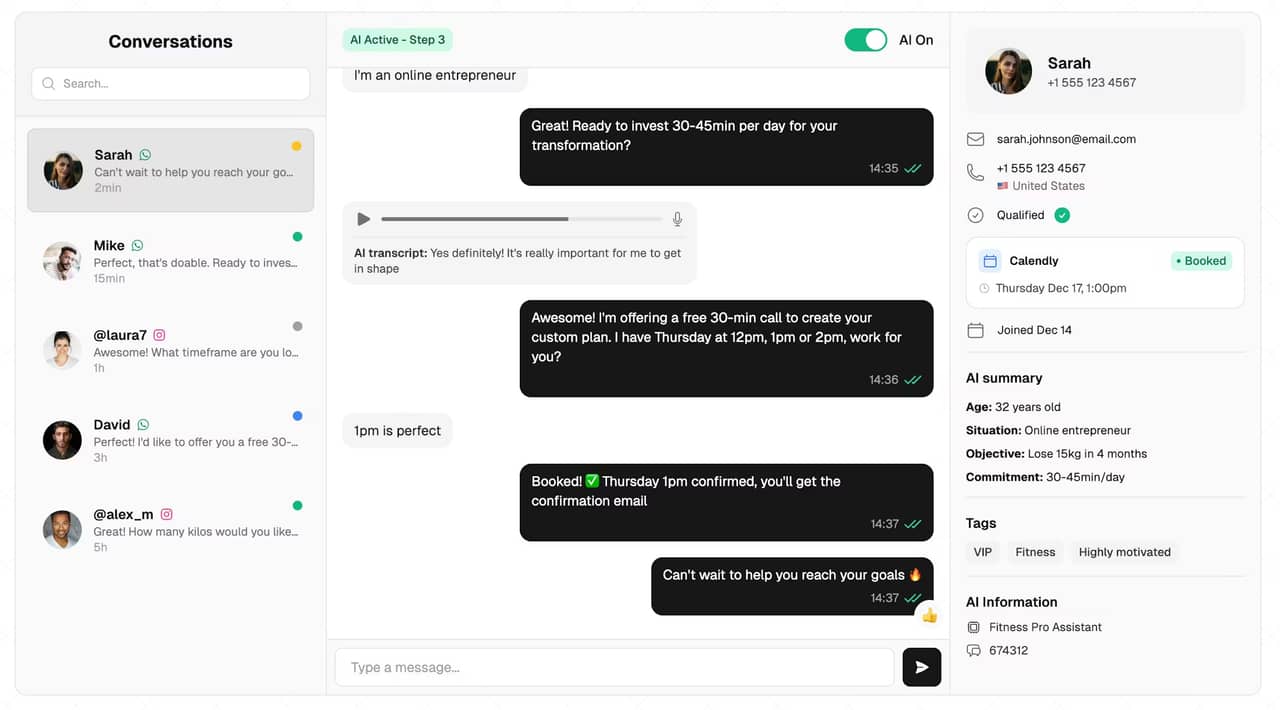
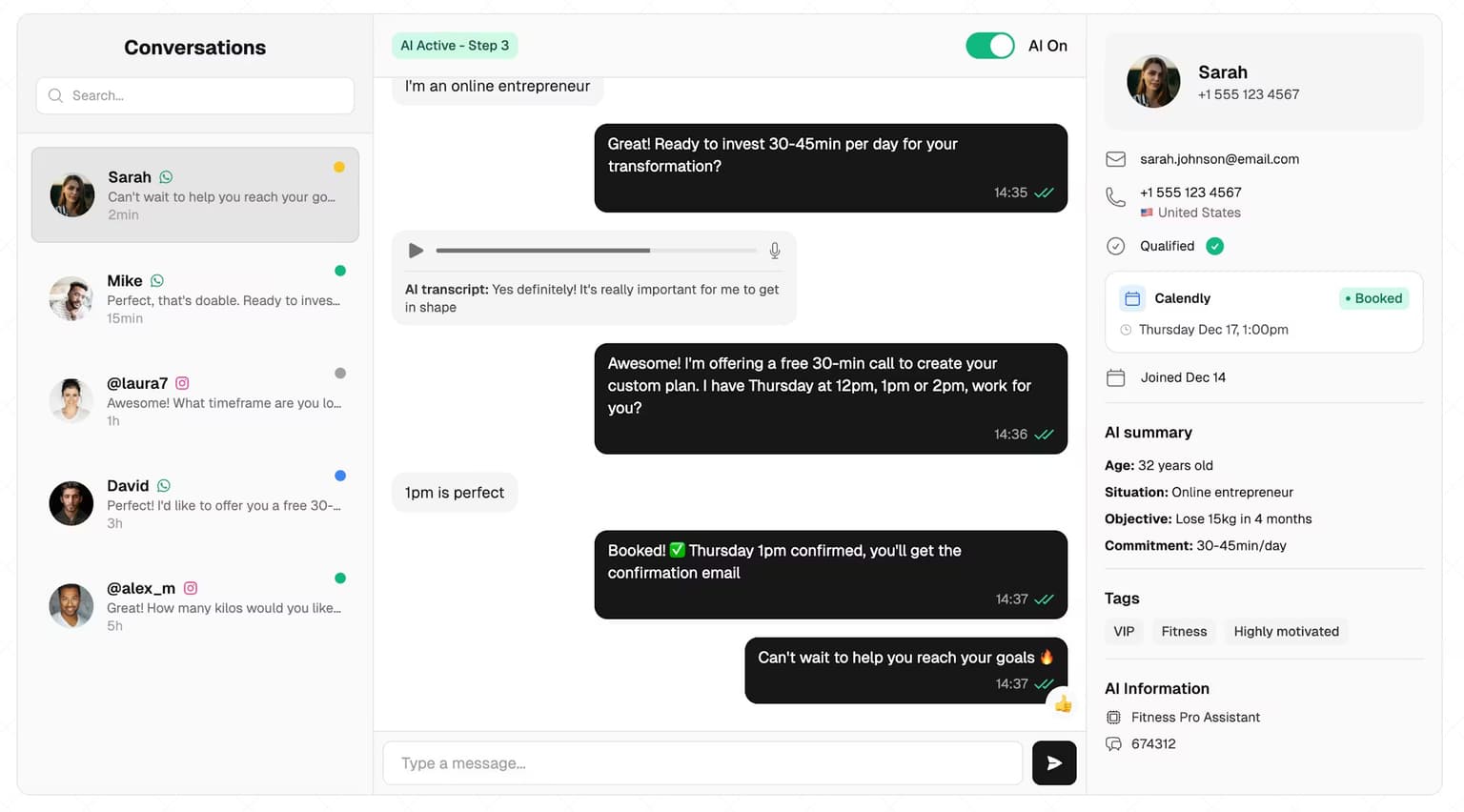
SetSmart is the answer to one specific problem that no other tool on this list fully solves: a lead just messaged you on Instagram and you have 5 minutes before they ghost. The platform is a conversational AI that picks up the DM in under five seconds, qualifies the lead against criteria you set, follows up if they go quiet, and books the call directly into your calendar. It's the only tool here that owns the qualify-and-convert tier on social DM channels at SMB pricing.
Why it lands at #1 in this list rather than in the "qualification" tier of an enterprise CRM: because in 2026 the capture channels are increasingly Meta-owned (Instagram comment triggers, click-to-Messenger ads, click-to-WhatsApp ads), and almost every other lead generation tool drops the lead into an empty inbox at that point. SetSmart sits exactly where that drop happens.
If you're already running ManyChat or Chatfuel flows and noticing that "delivered → reply" rates look fine but "reply → booked call" is invisible, SetSmart is the ManyChat alternative most agencies switch to when they outgrow flows.
Where it wins: real Instagram and WhatsApp DMs, fast follow-up, AI that handles unexpected questions (not just keyword triggers), built-in booking link, no per-flow rebuilding. Where it doesn't fit: cold B2B outbound where you don't have a Meta channel yet, enterprise web chat (Drift/Intercom remain better there).
2. HubSpot — best all-in-one inbound lead generation tool
Tier: All tiers (forms, CRM, email, chat). Best for: marketing-led B2B teams that want everything in one CRM. Pricing: Free tier with limited features; Marketing Hub Starter from $20/user/month, Pro from $890/month.
HubSpot remains the default "we want one tool for everything" pick because it bundles forms, email marketing, CRM, a basic chatbot and reporting under one login. For inbound-heavy B2B SaaS it is genuinely hard to beat as a backbone — the free CRM alone is a real free lead generation tool and a legitimate starting point.
Where HubSpot stops being enough: the moment 30%+ of your leads arrive on Instagram, WhatsApp or Messenger. HubSpot's chat is a web-chat widget for your website. It does not natively read a Meta inbox, follow up with a stranger on Instagram, or qualify them through 11 messages. Pair it with a DM-first tool in the qualify tier and you have a complete stack.
Where it wins: inbound web forms, marketing automation sequences, reporting, one source of truth. Where it doesn't fit: DM channels, high-velocity inbound where 5-minute response time matters more than 5-touch nurture.
3. Apollo.io — best low-cost B2B lead enrichment tool
Tier: Enrich / outbound. Best for: small B2B sales teams that want a contact database plus light outreach in one tool. Pricing: Free tier with limited credits; Basic from $49/user/month, Professional from $79/user/month.
Apollo gives you a contact database, light enrichment, and a basic outbound email sequencer for less money than ZoomInfo or LinkedIn Sales Navigator. For a one-person SDR or a small founder-led B2B team, that combination is hard to beat — and Apollo's free tier is a legitimate way to source 50 leads/month at zero cost.
Apollo is, however, still a list tool. It turns "I want to sell to fintech founders in Berlin" into 4,000 emails. It does not turn those emails into booked calls. To do that you need a real outbound sequence with personalisation and a follow-up engine — exactly the gap covered by an AI BDR layer on top.
Where it wins: contact discovery at SMB price points, integrated sequencing, deliverability is OK. Where it doesn't fit: any inbound use case, social DM channels, audience-led B2C lead gen.
4. Clay — best AI lead enrichment tool for outbound research
Tier: Enrich / research. Best for: RevOps and SDR teams building hyper-personalised outbound at scale. Pricing: Free tier (limited credits); Starter from $149/month, Pro from $349/month.
Clay is the 2026 favourite for teams that want to enrich contact lists with 50+ data signals (firmographics, intent, social activity, AI-generated openers) before sequencing. It's effectively a programmable enrichment table — bring a list of domains, get back a researched, scored list with custom AI columns.
Like Apollo, Clay does enrichment exceptionally well but doesn't talk to the lead. The output of Clay is a list. The job of converting that list into qualified pipeline still belongs to a tier-3 conversational tool, an outbound cadence, or — for inbound DM channels — a DM AI.
Where it wins: outbound list quality, AI personalisation columns at scale, integrations with every CRM and sequencer. Where it doesn't fit: inbound, social DMs, anywhere a human is actually replying in real time.
5. ManyChat — best free lead generation tool for Instagram + Messenger flows
Tier: Capture / light qualify. Best for: creators and small businesses building comment-to-DM flows on Instagram and Messenger. Pricing: Free tier (25 contacts); Pro from $15/month and scales by contacts.
ManyChat is still the most popular free lead generation tool for the Meta ecosystem because the free tier genuinely captures leads — you can build a comment-to-DM trigger, collect emails, send broadcasts — without paying. For under $30/month a coach can run a working Instagram lead capture flow.
The honest limit is what ManyChat isn't: it isn't a conversation. It runs flows. The moment a lead says something unexpected — a follow-up question, an objection, a "I have a budget concern" — the flow ends and the lead waits for a human. In a DM channel where 53% of conversations die before message 3, that's expensive. Real numbers in our ManyChat review show flow tools cap qualified-call rates at around 3-5% of inbound DMs versus 12-15% for AI-driven conversations.
Use ManyChat as a capture tool. Then hand the conversation to AI for qualification. See Instagram automation tools for the full hand-off pattern.
Where it wins: comment-to-DM triggers, free tier capture, broad integrations, ad audiences. Where it doesn't fit: real qualification conversations, anything beyond message 3.
6. Drift / Intercom — best B2B website chat lead generation tools
Tier: Qualify / convert (web chat). Best for: mid-market B2B SaaS with high-intent website traffic. Pricing: Drift from $2,500/month (enterprise); Intercom from $39/user/month.
Drift and Intercom dominate the B2B web-chat qualification tier. If your buyer hits a pricing page and wants to talk to a human in 30 seconds, this is where the conversation happens. Both ship with AI agents in 2026 — Drift's Conversational AI Agents, Intercom's Fin — that can answer FAQs, qualify leads against ICP, and route to sales.
They are excellent at one channel (the website) and absent from every other one. For coaches, ecom, and any business whose leads message on Instagram or WhatsApp first, they're the wrong tool. For SaaS with a high-traffic marketing site, they're still the default.
Where it wins: enterprise web chat, integration with Salesforce and HubSpot, intent-based playbooks. Where it doesn't fit: social DM channels, SMB price points, non-website-led funnels.
7. OptinMonster — best capture-tier popup tool
Tier: Capture. Best for: bloggers, e-commerce and content marketers using popups and exit-intent. Pricing: Basic from $9.97/month (billed annually).
OptinMonster is the workhorse of the capture tier — the boring, reliable tool that turns blog readers into email addresses through popups, slide-ins, exit-intent and inline forms. If your traffic is content-driven and your tier-3 conversion lives in email, this is where the leads come from.
It is not a qualification tool. The lead you capture in OptinMonster needs to go into something — an email sequence, a CRM, a DM AI for the social retargeting follow-up. On its own it just fills a list.
Where it wins: capture conversion rates, A/B testing, one-time pricing models. Where it doesn't fit: anywhere downstream of the email capture. Plan for a tier-3 tool to take it from there.
8. Leadfeeder — best B2B anonymous visitor identification tool
Tier: Enrich / identify. Best for: B2B marketing teams that want to know which companies visit their site. Pricing: Free tier (7-day history); paid from $99/month.
Leadfeeder identifies the companies behind your anonymous web visitors using IP-to-company matching. It's a tier-2 enrichment tool that quietly powers a lot of ABM strategies — "marketing director at Acme Co. was on our pricing page yesterday" turns into an SDR outreach this morning.
It's a B2B-only tool and the output is a company list, not a person list — so it pairs with Apollo, ZoomInfo or LinkedIn Sales Nav for the contact-discovery step.
Where it wins: ABM enablement, identifying high-intent target accounts. Where it doesn't fit: B2C, anywhere the buyer isn't on a corporate IP.
9. Hunter — best low-cost email lookup tool
Tier: Enrich. Best for: founders and small B2B teams doing low-volume manual outbound. Pricing: Free tier (25 lookups/month); paid from $49/month.
Hunter is the no-frills email finder — paste a domain, get the email pattern and verified addresses. It's the cheapest credible way to source emails when you don't need a full contact database, and the free tier is genuinely useful for early-stage founders.
It's a single-job tool. It does not enrich beyond email, it does not sequence, it does not score. Pair it with a sequencer (Apollo, Reply, Smartlead) or an enrichment layer (Clay).
Where it wins: low-volume manual prospecting, founder-led outbound, simplicity. Where it doesn't fit: anything above 100 outbound emails per day; teams that need full firmographic enrichment.
10. LinkedIn Sales Navigator — best B2B prospect-search tool
Tier: Enrich / research. Best for: B2B SDRs and account executives doing account research. Pricing: Core from $99/user/month; Advanced from $169/user/month.
Sales Navigator is the gold-standard for B2B prospect search because the underlying graph (LinkedIn itself) is the most up-to-date professional dataset on the internet. Buyer intent signals, account changes, job-change alerts — these are quietly the most valuable signals in B2B in 2026, and they live here.
It's expensive per seat and you still need a separate sequencer to actually send the messages (LinkedIn's native InMail volume is heavily capped). For B2B teams it's a near-mandatory enrichment layer; for B2C and SMB it's overkill.
Where it wins: account intelligence, intent signals, decision-maker research. Where it doesn't fit: B2C, anyone not selling into mid-market or enterprise B2B.
11. Chili Piper — best instant lead routing and booking tool
Tier: Route / book. Best for: B2B teams with inbound form fills who want instant calendar booking from the form. Pricing: Instant Booker from $30/user/month; full platform tiers above.
Chili Piper sits at the route/book tier and does one thing extremely well: when a qualified lead fills out a form, it instantly routes to the right rep and shows the rep's live calendar inside the form so the lead books a call right there. For B2B marketing teams paying $300+ per MQL, halving the form-to-meeting drop-off is enormous.
It's a B2B-funnel tool. For an Instagram DM flow, you don't need Chili Piper — you need an AI that books inside the DM thread, which is the job of a tier-3 qualification AI.
Where it wins: form-to-meeting routing, enterprise round-robin, calendar handshakes. Where it doesn't fit: DM channels, low-touch SMB flows.
12. Calendly — best lightweight booking and handoff tool
Tier: Route / book. Best for: solo founders, consultants, coaches needing a booking link. Pricing: Free tier; paid from $10/user/month.
Calendly is the universal booking link — the tool that has effectively standardised "here's my calendar" across every B2B and B2C funnel. Almost every other tool on this list integrates with it. If you don't need round-robin and you're not buying Chili Piper, you're using Calendly.
It's not a lead generation tool in isolation, but it is the route/book tier for the long tail. Combined with a tier-3 qualification AI that drops the right Calendly link at the right moment in the conversation, it closes the loop.
Where it wins: ubiquity, simplicity, free tier is actually usable. Where it doesn't fit: heavy round-robin, instant-routing-from-form B2B needs.
Lead generation tools by tier — full comparison
| Tier | What it does | Best tools | When to invest |
|---|---|---|---|
| 1. Capture | Get strangers to raise their hand | OptinMonster, ManyChat, HubSpot Forms, Click-to-WhatsApp ads | You have traffic but no leads |
| 2. Enrich / research | Find out who the lead actually is | Apollo, Clay, Hunter, LinkedIn Sales Nav, Leadfeeder | You're doing outbound or ABM |
| 3. Qualify / convert | Turn raised hands into booked calls | SetSmart, Drift, Intercom, ManyChat flows | You have leads but they ghost |
| 4. Route / book | Get qualified leads onto a calendar | Chili Piper, Calendly, HubSpot Meetings | Your bottleneck is the calendar, not the lead |
The reason most pipelines leak is simple: 80% of buyers go heavy on tiers 1 and 2 (capture more, enrich more) and almost nothing on tier 3 (qualify the leads they already have). The 47x performance spread we see between top and bottom accounts in the dataset — top 10% qualification 31.78% versus bottom 25% at 0.67% — is almost entirely explained by the tier-3 gap. Same capture, different qualification engine.
Which lead generation tool should you buy first?
The right first tool depends on which tier is empty in your stack. Run this honest audit:
- You have lots of traffic but few leads → start with tier 1 (capture). Buy OptinMonster (web) or set up ManyChat comment-to-DM (Instagram).
- You have lots of names but few conversations → start with tier 2 (enrich). Apollo or Clay turn names into reachable contacts.
- You have lots of inbound conversations but few booked calls → start with tier 3 (qualify / convert). For DM channels, that's SetSmart. For B2B website chat, Drift or Intercom.
- You have lots of qualified leads but they never reach your rep → start with tier 4 (route / book). Chili Piper for enterprise B2B, Calendly for everyone else.
The most common 2026 pattern for coaches, agencies and e-commerce: capture is solid (Meta ads + IG comments), enrichment doesn't apply, the leak is tier 3. The honest fix is one DM-first AI sitting on the Instagram and WhatsApp inboxes, qualifying on contact and booking inside the thread. Read our generative AI for sales overview if you want to see how the qualify-tier sits inside a wider AI stack.
The most common 2026 pattern for B2B SaaS: tiers 1, 2 and 4 are over-served (HubSpot + Apollo + Chili Piper), tier 3 is web-only (Drift). The leak shows up on social DM channels where founders, AEs and BDRs are now reachable. Adding a DM-first AI sales assistant closes that gap.
How AI changed lead generation tools in 2026
Three real shifts, not the press-release version:
- Enrichment got commoditised. Clay-style AI columns and AI lookups mean firmographic enrichment is now table-stakes. Tools that only enrich (ZoomInfo, Hunter, Apollo's data product) are competing on price.
- Qualification became a conversation, not a score. The 2018 model — score the lead and route — has collapsed because AI can read the content of a 12-message DM thread and decide if the lead is qualified, far more accurately than any rule engine ever did. This is the entire job of an AI setter, and it's why the qualify tier of this list moved into the top 3.
- Channels moved off the website. In 2018 "lead generation tools" effectively meant "things you put on your website". In 2026 the highest-intent inbound traffic happens inside the Instagram inbox, the WhatsApp thread or the click-to-Messenger ad. Tools that only live on the website (OptinMonster, Drift, Intercom) cover a shrinking slice. Tools that live in the DM (SetSmart, ManyChat) cover an expanding one.
The fourth, less-talked-about shift: follow-up is no longer optional. The pattern across our dataset is brutal — a single follow-up alone roughly doubles booked calls (+106% in our DM data). No human SDR can follow up consistently at SMB volume. AI now does it by default in any serious qualify-tier tool. That's a structural advantage on the qualify tier that wasn't possible in 2022.
Five mistakes teams make with lead generation tools
Stacking three enrich tools and zero qualify tools. Apollo + Clay + ZoomInfo is a list-buying spree, not a lead generation stack. It looks productive on a deck and leaks 50% of the pipeline downstream.
Treating ManyChat flows as qualification. Flows are capture. They are not the same as a real conversation that handles objections, late questions and follow-ups. Use ManyChat to capture, then hand off — see the full Instagram DM automation flow.
Buying enterprise web chat (Drift, Intercom) for an SMB DM funnel. Drift's seat licence will buy you four months of an SMB-priced DM AI that lives on the channel your leads actually use.
Forgetting LinkedIn is also a DM channel. Sales Nav is enrichment; LinkedIn DMs are a tier-3 conversation. Most teams stop at "found the contact" and never run a real conversation. For B2B, the outbound lead qualification playbook covers exactly this gap.
Buying tools before fixing response speed. A tool that replies in 4 hours is worth almost nothing on inbound DM channels — our lead response time statistics hub has the underlying numbers. Speed is upstream of everything else. If your stack can't reply in under 5 minutes, fix that before adding anything else.
Lead generation tools for small businesses and creators
For solo founders, coaches and one-person agencies, the right stack in 2026 is deliberately small:
- One capture tool — ManyChat free tier (Instagram/Messenger) or a HubSpot free form (website).
- One qualify tool — SetSmart on the DM channel (the conversion tier is where revenue lives).
- One booking tool — Calendly free tier.
Total monthly cost can sit under $110 and still beat a 5-tool enterprise stack on a coach's funnel, because the bottleneck for solo operators is almost never list size — it's "I have 80 unread DMs and I'm losing them". Fixing that with a tier-3 conversion tool unlocks more pipeline than any contact database ever will. The pattern is documented in detail in our Instagram lead generation breakdown.
Free lead generation tools that are actually useful in 2026
There is a real free tier in 2026 if you stack it correctly:
- HubSpot Free CRM + Forms — genuinely free, genuinely good for inbound form capture and basic CRM.
- ManyChat free tier — 25 contacts is a constraint, but for testing comment-to-DM, it works.
- Apollo free tier — 60 free credits a month. Enough for a one-person outbound test.
- Hunter free tier — 25 verified email lookups per month.
- Calendly free tier — single event type, but works.
- Leadfeeder free tier — 7-day visitor history is enough to see if anyone interesting hits your site.
The honest gap: there is no free qualification tool that does the job well. Free chatbots exist (Tidio, Crisp free tier, Manychat flows). None of them carry a real conversation through 11+ messages. The qualify tier is where the paid spend belongs.
Real testimonials from the qualify tier
"We were running ManyChat flows on Instagram and stuck at around 3% reply-to-call. After moving qualification to SetSmart we hit 14% the same month — same ads, same DMs, completely different conversion tier." — Edouard Clerc, growth lead, coaching agency.
"We have HubSpot, we have Apollo, we have Sales Nav. The thing that actually moved the needle this quarter was putting AI on our WhatsApp inbox. Capture and enrichment were never the bottleneck — qualification on DMs was." — Manuel Nani, founder, B2B services.
"Honestly the most expensive mistake we made in 2025 was adding more enrichment instead of fixing the inbound thread. We saw a 2.3x jump in qualified calls just by moving to a real DM AI for tier-3 conversion." — Théo Riffault, agency owner.
The pattern in all three stories is the same: capture and enrichment were over-served, qualification was the leak. The fix wasn't a bigger list — it was a better conversation.
Lead generation tools by use case
| Use case | Stack we'd buy |
|---|---|
| Coach or creator selling on Instagram | ManyChat (capture) + SetSmart (qualify) + Calendly (book) |
| Agency running Meta ads for clients | Click-to-WhatsApp (capture) + SetSmart (qualify) + Calendly / Chili Piper (book) |
| B2B SaaS, inbound-heavy | HubSpot (capture + CRM) + Drift or Intercom (web qualify) + SetSmart (DM qualify) + Chili Piper (route) |
| B2B SaaS, outbound-led | Apollo or Clay (enrich) + LinkedIn Sales Nav (research) + sequencer + SetSmart (DM follow-up) |
| E-commerce | OptinMonster (popups) + ManyChat (IG) + SetSmart (cart-recovery DMs) + email tool |
| Real estate, local services | Click-to-WhatsApp (capture) + SetSmart (qualify + book) — single-stack works |
When NOT to buy another lead generation tool
If you're already paying for a tool in a given tier and your conversion rates inside that tier match the industry-baseline qualification range of 5-15%, don't add a second tool in the same tier. The marginal value is near zero. Add a tool in the empty tier instead.
The exception is the qualify tier on DM channels — that one is structurally under-served across the entire SaaS market in 2026, which is why our DM data shows the gap between top and bottom accounts is so wide. If your DM funnel doesn't have an AI on it yet, that's where the next dollar belongs regardless of what else you already own.
FAQ
What are the best free lead generation tools in 2026?
The best free lead generation tools in 2026 are HubSpot Free CRM + Forms, ManyChat (free up to 25 contacts), Apollo's free tier (60 credits/month), Hunter (25 lookups/month) and Calendly. Stack them correctly and you cover capture, light enrichment and booking at zero cost. The free gap is the qualify tier — there is no free tool that carries a real 11-message qualification conversation, which is where the actual conversion happens.
What is the fastest way to generate leads?
The fastest legal way to generate leads in 2026 is to run a Meta ad (Instagram, Facebook or WhatsApp) with click-to-DM enabled and have an AI pick up the conversation in under 5 seconds. Click-to-DM bypasses landing pages, qualification happens inside the chat, and the lead can book a call without ever leaving Instagram. The slowest is cold email at low volume.
Which AI lead generation tools are worth the money?
AI lead generation tools cluster in two real product groups: (1) AI enrichment / research (Clay, Apollo's AI features, LinkedIn intent signals) and (2) AI qualification / conversion (SetSmart, Drift's Conversational Agents, Intercom Fin). The honest answer: enrichment AI is commoditised and you should buy on price; qualification AI is structurally underpriced relative to its pipeline impact and you should buy the one that lives on your highest-intent channel.
Are lead generation tools and lead qualification tools the same thing?
No. Lead generation tools cover the full funnel from capture to booked call (four tiers). Lead qualification tools sit only at tier 3 — they turn a captured lead into a "this is worth a rep's time". Every lead generation stack needs a qualification tool, but not every lead generation tool is a qualification tool. See our deeper breakdown in lead qualification tools.
What are the best B2B lead generation tools for small businesses?
For small B2B businesses in 2026: Apollo.io for low-cost contact discovery and sequences, HubSpot Free CRM for the inbound side, LinkedIn Sales Navigator if you have $99/seat to spend on research, and a DM-first AI for the follow-up tier where most small B2B teams quietly leak. Skip the enterprise stack (ZoomInfo, Salesforce Einstein) until you're past $1M ARR — the price-to-value math doesn't work below that.
What are the best Instagram and DM lead generation tools?
For Instagram and DM lead generation in 2026 the working stack is: ManyChat or comment-to-DM triggers for capture, an AI like SetSmart for tier-3 qualification inside the DM thread, and Calendly or a built-in booking link for the handoff. Email-only tools and form builders don't apply here — the conversation never leaves Instagram, so the tools have to live where the conversation does. The full pattern is documented in how to automate Instagram DMs with AI.
Lead generation tools in 2026 are not one category. They're four jobs done by four different tiers of software, and the tier that quietly moves the most pipeline — qualification on real DM threads — barely shows up in most "best of" lists. If you're choosing one tool to add to your stack this quarter, pick the tier you're missing, not the tier you already over-spend in. For most coaches, agencies and SMB teams in 2026 that empty tier is qualify-and-convert on the social inbox — and that's the gap SetSmart was built to fill.
Ready to automate your DMs?
Start your free 7-day trial and let AI handle your lead qualification 24/7.
Try SetSmart free