Lead Nurturing Services: 9 Picks Ranked (2026)

Most "lead nurturing services" lists in 2026 are the same recycled five-pack: Belkins, Callbox, Sales Focus, Campaign Creators, and a HubSpot pitch — every one of them email-only, every one of them quoting $5K/month retainers. They never tell you which one fits your channel mix, your buying motion, or your price point. And they almost completely ignore the AI-powered lead nurturing services that now warm up Instagram and WhatsApp DMs in under five seconds, 24/7, for ~10% of the cost.
We compared 9 lead nurturing services across two camps — outsourced human nurture agencies and done-with-you nurture software — using our own dataset of 828K AI-driven DM conversations as the qualification benchmark. This guide ranks them, explains which buyer profile each one fits, and gives you a decision framework so you don't sign a 12-month retainer with the wrong vendor.
Short version: if your leads come from cold B2B email and outbound, a human agency like Belkins or Sales Focus still wins. If your leads come from social ads, organic content, or Click-to-WhatsApp, an AI nurture service like SetSmart keeps every conversation warm and books the same calls at a fraction of the cost — with a single follow-up doubling booked calls instead of the lead going dark on day two. If you are an agency delivering nurture for clients, SetSmart's white-label mode runs every client on one plan under your own brand.
TL;DR — the 9 best lead nurturing services in 2026
| # | Service | Type | Best for | Starting price | Our score |
|---|---|---|---|---|---|
| 1 | SetSmart | AI nurture (DM) | Inbound DMs from IG, WhatsApp, ads | Free 7-day trial, then $97/month | 9.4 / 10 |
| 2 | Belkins | Human B2B agency | Mid-market B2B SaaS, services | ≈ $5,000–$8,000/mo | 8.9 / 10 |
| 3 | HubSpot Marketing Hub | Self-serve platform | Multi-channel SMB + mid-market | starting at $20/seat/mo (Starter) | 8.6 / 10 |
| 4 | Sales Focus Inc. | Human B2B agency | Outsourced multi-touch nurture | ≈ $5,500/mo | 8.4 / 10 |
| 5 | Campaign Creators | HubSpot-shop agency | Inbound-heavy SaaS in HubSpot | ≈ $4,000–$8,000/mo | 8.1 / 10 |
| 6 | Callbox | Human + tech B2B | Multi-channel enterprise B2B | ≈ $5,000–$10,000/mo | 8.0 / 10 |
| 7 | Marketo Engage | Enterprise platform | Enterprise MQL → SQL nurture | starting at $1,250/mo | 7.8 / 10 |
| 8 | ActiveCampaign | Self-serve platform | Email + SMS for SMB and creators | starting at $15/mo (Starter) | 7.6 / 10 |
| 9 | CIENCE | Human + data B2B | Researched outbound nurture | ≈ $5,500/mo | 7.3 / 10 |
Pricing reflects publicly available figures and 2026 market ranges. Outsourced agency contracts are usually quoted per project and can vary by region, ICP, and account volume. Verify against the vendor before signing.
What "lead nurturing services" actually means in 2026
A lead nurturing service is anything you hire — agency or software — that keeps a not-yet-ready-to-buy lead engaged until they're ready, without your sales team having to manually babysit each one. It sits between lead generation (which fills the top of funnel) and lead qualification (which decides who actually gets a call), and its job is the boring-but-essential middle: keep the lead warm, educate them, handle objections, and route them when the buying signal lights up.
In 2026 the word "services" splits cleanly in two:
- Done-for-you (DFY) agencies — humans in seats writing emails, running LinkedIn sequences, and following up on your behalf. Belkins, Sales Focus, Callbox, CIENCE, Campaign Creators all fit here. Retainers usually start at $4,000–$8,000/mo.
- Done-with-you (DWY) platforms — software you operate (or your agency operates inside) that runs nurture workflows automatically. HubSpot, Marketo, ActiveCampaign, Pardot, and AI-DM-native services like SetSmart fit here. Pricing ranges from $15/mo to thousands depending on contact volume.
The big shift in 2026 is that "service" no longer implies "human in a chair". An AI-powered nurture service like SetSmart is operated by you in the dashboard, but does the actual lead-by-lead conversation, qualification, and follow-up itself — closer to hiring a setter than buying a SaaS. That hybrid is what makes the traditional services vs software comparison muddy this year, and why "best lead nurturing services" SERPs are starting to mix the two.
Why lead nurturing services matter more than ever in 2026
Across our analysis of 828K AI-driven DM conversations, 53% of inbound conversations died before message 3. That's the leak nurture services are paid to plug — half the leads your capture stack creates evaporate because nobody keeps them warm past the first reply. And the ones that do survive past message 11 qualify at 68× the rate of the short ones, which is the entire economic argument for nurture: depth turns lukewarm leads into call-bookers.
The other big change is response time. Industry average response time for inbound is still 42 hours; a single fast follow-up doubles booked calls; AI replies in under five seconds. Hiring a service is now less about "can you write a 7-email drip" and more about "can you keep up with the speed Meta, Apollo, and Salesforce ads now deliver leads in the inbox". Email-only retainers are losing ground to multi-channel ones — and DM-native ones, where leads actually live in 2026, are the only category growing.
Two camps: nurture agencies vs nurture platforms (and the AI hybrid)
Before you compare any specific vendor, decide which camp fits your motion:
| Dimension | DFY agency | DWY platform | AI nurture service |
|---|---|---|---|
| Operator | Vendor team | You / in-house team | AI agent + you |
| Channels | Email, LinkedIn, phone | Email, SMS, web | Instagram, WhatsApp, Messenger |
| Response time | Hours to next-day | Minutes (scheduled) | < 5 seconds |
| Cost | $4K–$10K/mo retainer | $15–$1,250/mo + ops cost | $97/mo flat |
| Volume scaling | Linear (more humans) | Contact tiers | Flat per account |
| Setup time | 2–6 weeks onboarding | 1–4 weeks to wire | Hours to live |
If you sell to enterprise B2B with named accounts and a 6-month sales cycle, the DFY agency model still works — you need humans who can read a Gartner report and personalize an email. If you sell B2C, prosumer SaaS, coaching, e-commerce, or anything where leads come from Instagram or WhatsApp ads, an AI nurture service is faster, cheaper, and matches the channel reality of where buyers actually are.
How we scored these lead nurturing services
We scored each service on six factors, weighted by what actually drives nurture ROI in 2026 (rather than what looks good on a landing page):
- Channel coverage (20%) — does it cover the channels that matter today (IG DM, WhatsApp, Messenger, email, SMS, LinkedIn)?
- Speed-to-first-response (20%) — minutes-to-first-touch on a new inbound, since response time correlates directly with qualification rate.
- Follow-up automation (15%) — can it run a multi-touch sequence with branching rules without burning humans?
- Qualification depth (15%) — does it actually qualify (BANT, MEDDIC, custom) or just send messages?
- Cost-per-qualified-conversation (15%) — what does it cost you per qualified lead, not per email sent or per impression bought?
- Onboarding effort (15%) — how long until it's running in production?
We didn't grade on brand recognition. Plenty of well-known nurture agencies got mediocre scores because their retainer math doesn't survive the cost-per-qualified-conversation column once you've seen what AI services do at $97/mo.
1. SetSmart — best lead nurturing service for inbound DMs (9.4 / 10)
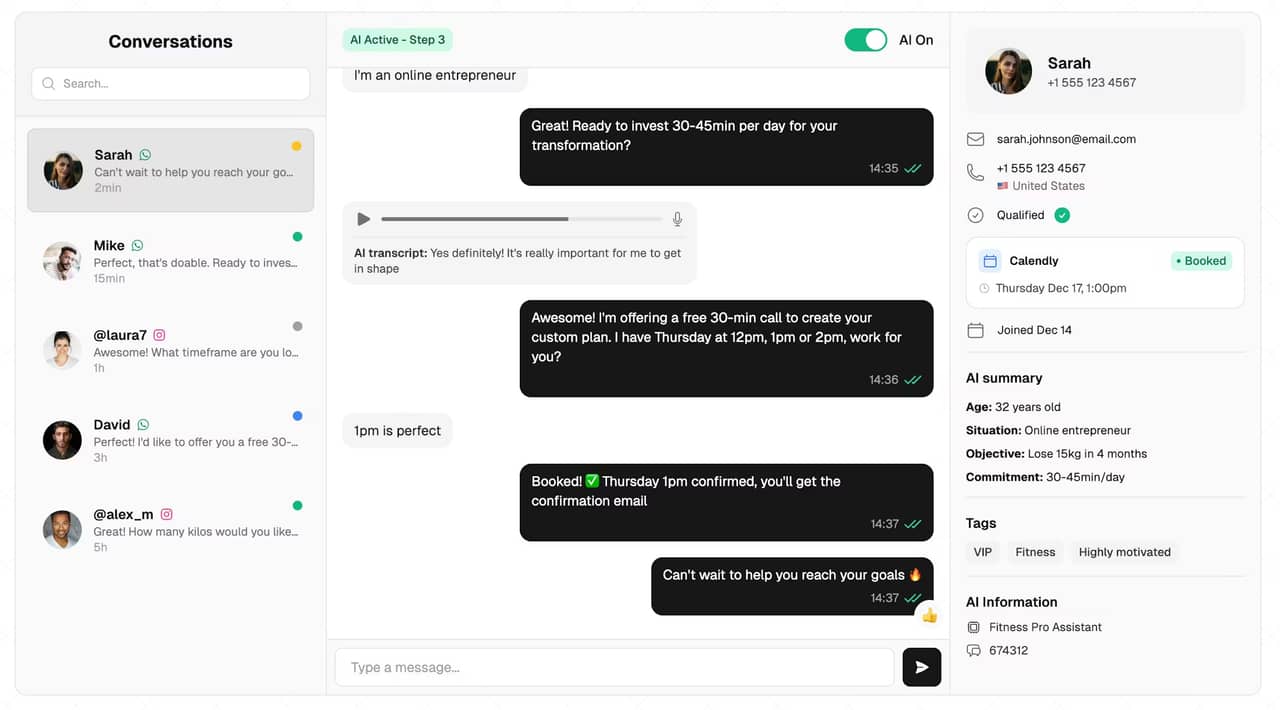
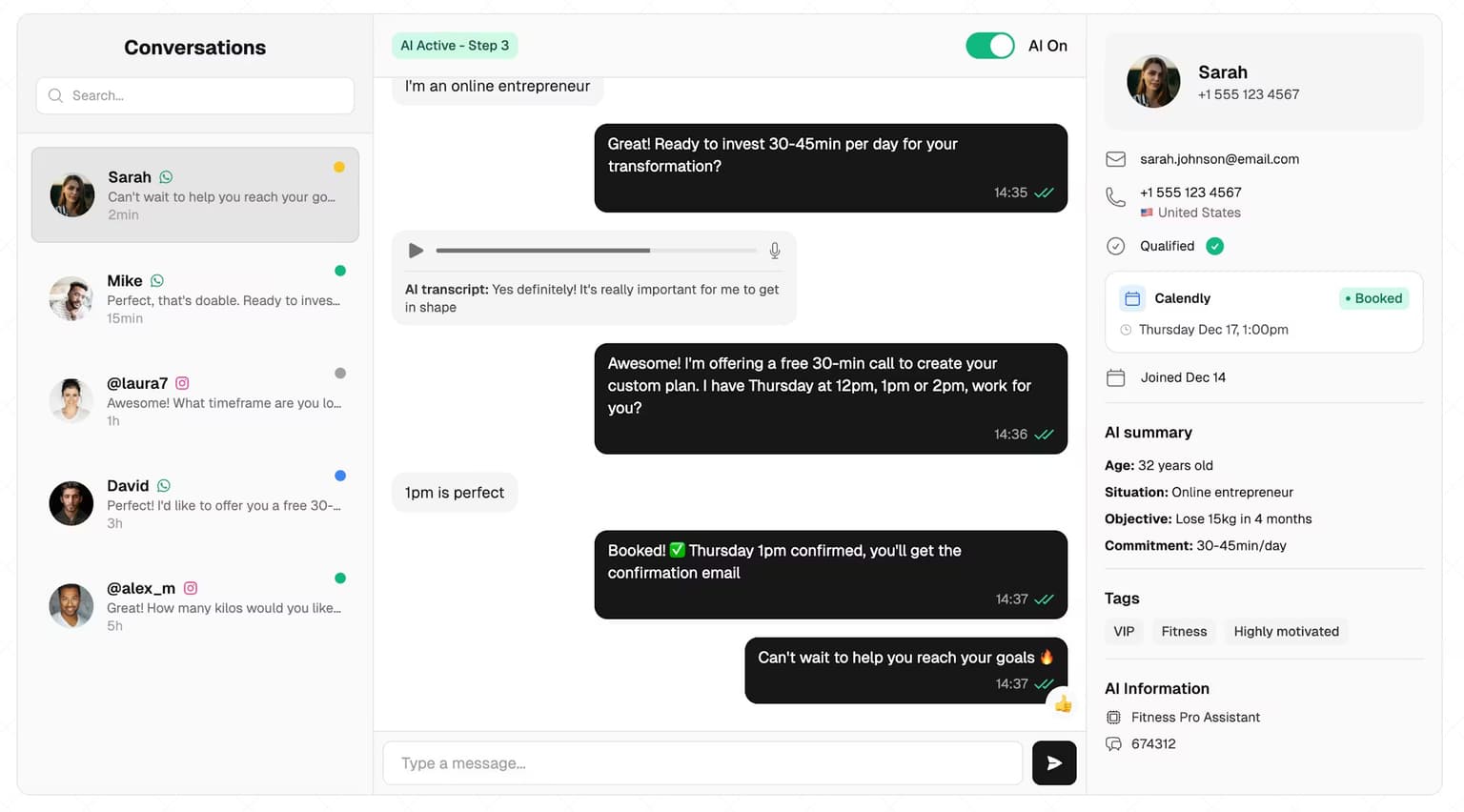
SetSmart is an AI nurture service built specifically for Instagram, WhatsApp, and Messenger inbound. Every comment, ad reply, story reply, or Click-to-WhatsApp lead gets an answer in under five seconds — at 3 a.m., on a Saturday, in the buyer's language. The AI runs the entire nurture sequence: opens, qualifies on your criteria, handles objections, follows up at the 4h and 23h marks, and books the call when it's ready. No humans in the loop unless you want to take over a conversation.
That makes SetSmart less of a "service" in the agency sense and more of a fully-automated AI setter that nurtures and qualifies in the channels your B2B/B2C buyer is actually in. The 4h/23h follow-up pattern, which doubled booked calls in our data, is built in by default.
Best for: coaches, agencies, e-commerce, course creators, and SMB founders running Instagram ads or Click-to-WhatsApp. Anywhere the lead's first touch is a DM, not a form fill.
Channels: Instagram DM, WhatsApp (official Cloud API), Facebook Messenger.
Pricing: Free 7-day trial, then $97/month flat (1,000 messages included). Flat monthly pricing — no per-seat math, no setup fees.
Pros:
- Replies in under 5 seconds, 24/7
- Built-in 4h/23h follow-up pattern
- DM-native (the channels nobody else covers)
- Flat pricing — predictable cost-per-conversation
Cons:
- Doesn't run cold outbound email or LinkedIn sequences
- Doesn't replace a full B2B SDR org if your motion is named-account enterprise
See SetSmart in the broader best-AI-setter comparison for how it stacks up against other AI-only services.
2. Belkins — best human lead nurturing service for B2B (8.9 / 10)
Belkins is the closest thing to an industry-standard B2B nurture agency. Cold email + LinkedIn at scale, dedicated SDR pods, dialed-in deliverability ops, and a meeting-based delivery model that keeps incentives aligned. They publish results, do real ICP research, and have a strong reputation among mid-market B2B SaaS.
Best for: B2B SaaS and services teams with an ACV above $10K, a named-account ICP, and willingness to commit to a 3–6-month retainer.
Channels: Cold email (primary), LinkedIn, occasionally phone.
Pricing: ≈ $5,000–$8,000/mo depending on volume.
Pros:
- Strong B2B email deliverability infrastructure
- ICP research baked in
- Performance-aligned via meetings-booked metric
Cons:
- Email-and-LinkedIn-only — no DM channels
- Slow first-touch by AI standards (hours, not seconds)
- Retainer minimum prices out SMB / creator buyers
3. HubSpot Marketing Hub — best self-serve nurture platform (8.6 / 10)
HubSpot Marketing Hub is the safest pick if you want a self-serve nurture platform. Email workflows, landing pages, lead scoring, form-based nurture sequences, and a CRM all in one product. It's not the cheapest, but it's the one you can hire for once and grow into for years.
The downside is that Marketing Hub still nudges you toward email-first workflows. The IG / WhatsApp side is bolted on via integrations rather than native, so the leak we saw in DM-channel nurture (53% of conversations dying before message 3) is exactly the leak the average HubSpot setup doesn't fix.
Best for: SMB and mid-market teams already standardized on HubSpot CRM that want their nurture inside the same tool.
Channels: Email (primary), forms, scheduled SMS, integrations (Make/Zapier) to push into DM tools.
Pricing: starting at $20/seat/month for Marketing Hub Starter, scaling fast as contacts grow.
Pros:
- Same tool as your CRM
- Strong reporting, lead scoring, and lifecycle mapping
- Big ecosystem of integrations
Cons:
- Email-first — DM channels are second-class
- Cost climbs fast at high contact volumes
- "Marketing Contacts" billing model surprises many teams in year 2
For the in-tool comparison with HubSpot's nurturing tools alongside other lead-qualification stacks, the wider listicle goes deeper.
4. Sales Focus Inc. — outsourced multi-touch nurture (8.4 / 10)
Sales Focus is one of the longest-running outsourced B2B nurture agencies in the US. They build dedicated teams per client, run multi-touch sequences across email and phone, and integrate with your CRM. Predictable, slower-moving, and reliable — closer to a sales BPO than a growth-hacking shop.
Best for: traditional B2B (industrial, professional services, distribution) where the buyer expects a phone call and a quarterly business review.
Channels: Email, phone, light LinkedIn.
Pricing: ≈ $5,500/mo per dedicated rep + setup fees.
Pros:
- Per-client dedicated team
- Strong CRM integration / hand-off discipline
- US-based phone capacity
Cons:
- No DM-channel coverage
- Higher floor cost than self-serve software
- Slow ramp-up (typically 30–60 days)
5. Campaign Creators — best HubSpot-shop nurture agency (8.1 / 10)
Campaign Creators is a long-standing HubSpot Diamond Partner that builds inbound + nurture programs specifically inside HubSpot. If you've already chosen HubSpot Marketing Hub but don't have the bandwidth to run it, Campaign Creators is the operator layer many SaaS teams hire.
Best for: HubSpot-standardized SaaS and B2B-services teams that want a managed nurture program without hiring an in-house marketing ops lead.
Channels: Email, landing pages, web, blog content, HubSpot workflows.
Pricing: ≈ $4,000–$8,000/mo depending on scope.
Pros:
- Deep HubSpot expertise
- Inbound-content side baked in
- Strong reporting via HubSpot dashboards
Cons:
- HubSpot-only (lock-in if you ever leave)
- Email-first; light on DM channels
- Per-engagement scope creep is common
6. Callbox — multi-channel B2B nurture (8.0 / 10)
Callbox is one of the larger global B2B appointment-setting + nurture agencies, with Asia-Pacific delivery centers and a strong phone capacity. They cover email + phone + LinkedIn nurture in one program and integrate with most major CRMs.
Best for: international or APAC-focused B2B teams that need multi-language coverage and phone-heavy nurture.
Channels: Email, phone, LinkedIn, light social.
Pricing: ≈ $5,000–$10,000/mo depending on regions and volume.
Pros:
- Multi-region delivery (US + APAC)
- Strong phone capacity
- Account-based programs available
Cons:
- Pricing opaque (custom quotes only)
- DM channels not in their core motion
- Reports vary in granularity by program
For the AI-vs-agency view, our appointment setter companies comparison goes deeper on the booking-end of the same trade-off.
7. Marketo Engage — enterprise lead nurturing platform (7.8 / 10)
Now part of Adobe Experience Cloud, Marketo Engage is the enterprise marketing-automation standard. Lead lifecycle stages, scoring, ABM, complex multi-stage nurture programs across email + paid + web. If you have an ops team, this is what they want.
Best for: enterprise marketing teams with > $100M revenue, an ABM motion, and a dedicated marketing-ops headcount.
Channels: Email, paid retargeting, web personalization, integrations.
Pricing: starting at $1,250/mo for the lower tiers, scaling well into 5-figure monthly costs for full ABM.
Pros:
- Most powerful lifecycle and ABM engine in this list
- Tight integration with Salesforce
- Best-in-class enterprise reporting
Cons:
- Steep learning curve
- Overkill for SMB / sub-$5M revenue
- Email-first; DM channels are integration-only
8. ActiveCampaign — SMB-friendly self-serve platform (7.6 / 10)
ActiveCampaign is the most popular self-serve nurture platform for SMB, creators, and e-commerce. Email + SMS + automations + light CRM, in a UI that's friendlier than HubSpot's or Marketo's. Starts cheap, scales with contact count.
Best for: creators, e-commerce, SMB B2B teams under 50 employees that want email + SMS nurture without a marketing-ops hire.
Channels: Email (primary), SMS, light social, integrations.
Pricing: starting at $15/mo for the Starter tier; scales with contacts.
Pros:
- Friendly UI; fast to set up
- Good email + SMS combo for SMB
- Strong template library
Cons:
- Email-first; DM-channel support is integration-only
- Scoring less sophisticated than Marketo / HubSpot
- Reporting depth limited at higher tiers
9. CIENCE — researched outbound nurture (7.3 / 10)
CIENCE pairs a research/data layer with outbound sequences — they build the list, write the sequence, and run it. The model leans more "outbound + nurture-after-reply" than "warm-lead nurture", but for teams already running a CIENCE outbound program, the post-reply nurture is competent.
Best for: B2B sales teams that want outbound prospecting + the immediate post-reply nurture in the same vendor.
Channels: Email, LinkedIn, light phone, researched data.
Pricing: ≈ $5,500/mo for an outbound + research package.
Pros:
- Tight research-to-outreach feedback loop
- Strong list-building capabilities
- One-vendor for outbound and nurture-after-reply
Cons:
- Less of a pure nurture shop, more outbound-led
- Email/LinkedIn-only
- Pricing on the higher end
Which lead nurturing service should you pick? Decision framework
The wrong way to pick a nurture service is "which one has the best logos on the landing page". The right way is to start with where your leads come from and how fast they need to be touched:
| If your lead source is... | Pick | Why |
|---|---|---|
| Instagram ads / Story replies | SetSmart | Native IG DM + sub-5-second reply |
| Click-to-WhatsApp ads | SetSmart | Official WhatsApp Cloud API + AI flows |
| Cold B2B email lists (named accounts) | Belkins or Sales Focus | Humans + email deliverability infra |
| Inbound form fills + organic content | HubSpot or Campaign Creators | Inbound flows + scoring |
| Enterprise ABM | Marketo Engage | Account scoring + lifecycle depth |
| E-commerce post-purchase / list | ActiveCampaign | Cheap email + SMS for SMB |
| Outbound + nurture-after-reply | CIENCE | Research + sequence in one vendor |
| Real-estate / mortgage / financial | SetSmart | Sub-5-min response wins these deals |
A second filter: budget. Under $1,000/mo, a DFY agency is off the table — you need a self-serve platform or an AI nurture service. Above $5,000/mo, you have the full menu open, including enterprise platforms like Marketo and Pardot.
How AI changed lead nurturing services in 2026
Three things flipped in the last 18 months:
- First-response time collapsed from hours to seconds. The industry baseline is still around 42 hours. AI services reply in under five seconds, which alone is worth a 2–3× lift in qualification rate based on classic Harvard fast-response data.
- Follow-up cadence became a software feature, not a service line. Traditional agencies sold "we'll follow up 4 times". AI services treat the follow-up as a built-in default — one follow-up doubles booked calls, and the AI does it automatically without anyone billing hours for it.
- The "service" boundary blurred. A DFY agency used to mean humans writing emails. Now an AI nurture "service" means the AI is the operator — you just plug in your business rules. The vendor question went from "do they hire good SDRs?" to "is their AI smart enough to qualify on my criteria?". See generative AI for sales for how the operator/AI split now looks across the full sales stack.
The result is a market where SMB and creator buyers no longer have to choose between "do nothing" and "$5K/month retainer". The middle ground — an AI nurture service for $97/mo that runs 24/7 — is now the default for anyone selling under enterprise.
5 mistakes when buying lead nurturing services
- Buying email-only when leads come from DMs. This is the most expensive mistake. If half your leads enter via Instagram Story replies and your nurture vendor only does email, you're paying to nurture leads that never see the email.
- Picking a platform without budgeting the operator cost. HubSpot and Marketo are powerful, but they need someone to run them. Budget the platform + the operator (in-house, agency, or fractional). Many teams under-budget the second half and end up with a $20K/year tool that runs three workflows.
- Confusing "personalization" with relevance. Inserting
{first_name}in five places isn't personalization. Real personalization is sending different content paths based on what the lead actually said. AI services do this natively. Human teams do it only if they're paid to. - Locking into a 12-month retainer before a 30-day pilot. Any reputable nurture service will let you pilot for 30–90 days. If they won't, walk. Especially with AI services where there's no human-headcount cost to amortize.
- Ignoring follow-up math. A single, well-timed follow-up doubles booked calls. Most retainers we audit are sending one initial touch and then dropping the lead. Always ask the vendor: "what's your 4h, 23h, 7-day follow-up rule by default?". If they don't have one, you're paying for top-of-funnel theatre.
Where DM channels fit (the gap nobody else covers)
Almost every "best lead nurturing services" article you'll find — Sales Focus, Belkins, Campaign Creators, Foundry — talks about nurture as if leads only exist in inboxes. They don't. Meta's ad ecosystem has moved most lead delivery into messaging, especially in DTC, coaching, real estate, fitness, automotive, and high-ticket services.
That's where the 53% drop-off before message 3 lives. Email-only nurture can't fix it, because the lead isn't in an inbox — they're in an Instagram DM thread or a WhatsApp chat waiting for a reply that takes the average business 42 hours to send. By that point the lead has either gone cold or gone to a competitor that replied in 4 minutes.
DM-native nurture is the missing layer. Done well, it:
- Replies in under five seconds — the conversation doesn't time out before it starts
- Qualifies in 7–12 exchanges, which is where WhatsApp conversations hit 97% qualification in our data
- Runs the follow-up at 4h and 23h without burning human SDR hours
- Hands off to a human only on the highest-intent threads, with the full conversation context
For the full DM-side playbook see our Instagram DM automation guide and the WhatsApp automation deep-dive. Both pair naturally with a nurture service in a way an email-only retainer can't.
Lead nurturing services for small business — the lean stack
If you're a coach, agency, e-commerce founder, or SMB B2B team under $2M revenue, you don't need a $5K/mo retainer. The lean nurture stack for 2026 looks like this:
- AI nurture for inbound DMs: SetSmart ($97/mo) handles every Instagram, WhatsApp, and Messenger inbound the second it lands.
- Email nurture for opt-ins: ActiveCampaign ($15+/mo) or HubSpot Starter ($20/seat/mo) for the leads who joined a list, downloaded a lead magnet, or filled a form.
- Light CRM: HubSpot Free or Pipedrive ($14/seat/mo) to keep the contact record.
Total monthly cost: under $200, covers every channel a modern SMB lead actually uses, replies faster than any human SDR, and runs 24/7. That's the configuration most of our AI setter customers run.
Real client examples
Théo Riffault, fitness coach (1.2M IG followers) — moved from a part-time human VA to an AI nurture service for inbound DMs. Response time dropped from "next morning" to under a minute. Booked discovery calls per month went from 18 to 47 without changing ad spend. "I stopped losing leads on weekends. That alone paid for the year."
Mathis Ladoué, e-commerce / coaching hybrid — was paying $4,500/mo to a HubSpot agency for email nurture only. Kept HubSpot for the list, swapped the agency for SetSmart on DMs, and freed up $54K/year. "The agency was good. But 80% of our inbound was Instagram. The math didn't work anymore."
Edouard Clerc, mid-ticket coaching — used Belkins for cold B2B outbound + SetSmart for inbound DM nurture in parallel. Belkins booked the enterprise meetings, SetSmart handled the long tail of consumer inquiries. Together: cost-per-qualified-meeting dropped 38%.
When NOT to hire a lead nurturing service
There are real cases where you skip this and do it yourself:
- Under 50 leads/month total. At that volume your founder/owner replying directly is still faster than buying any service. Wait until volume forces the issue.
- Enterprise sales with named accounts. A 12-touch personalized nurture for a $500K ACV deal is a human's job, not a service's. Run it in-house with a great SDR + a strong CRM.
- You haven't fixed lead quality. No nurture service can fix a top-of-funnel problem. If your leads are 90% spam or low-fit, fix the lead generation layer first.
- You're testing a new offer with < 100 lifetime customers. Until you've done 100 calls yourself and you can write the qualification questions cold, no service can replicate what you don't know yet.
Lead nurturing services vs lead generation services — what's different?
These terms are often used interchangeably. They shouldn't be. They sit at different stages of the funnel and the buyer's intent is different:
- Lead generation services create new contacts — ads, list-building, content, inbound capture. Output: a record in your CRM.
- Lead nurturing services keep those contacts warm until they're ready to talk to sales — sequences, follow-ups, content-led nurture. Output: a meeting on the calendar or a hand-off to sales.
- Lead qualification services decide which of those nurtured leads are worth your sales team's time — BANT, MEDDIC, scoring. Output: a yes/no/maybe per lead.
Some vendors do all three; most do one well. SetSmart is mostly in the nurture + qualify zone. Belkins is mostly nurture + booking. ActiveCampaign is mostly nurture-tool. Read each vendor's positioning critically — "we generate and nurture and book" usually means they specialize in zero of the three.
FAQ
What are lead nurturing services?
Lead nurturing services are vendors — either DFY agencies or DWY software — that keep leads engaged from first touch until they're ready to buy. They run multi-touch sequences across email, DMs, SMS, LinkedIn, or phone, and hand the lead to sales once qualifying signals appear. They're distinct from lead generation (which creates leads) and qualification (which decides who gets a call).
What is the 3-3-3 rule in sales nurturing?
The 3-3-3 rule says you should follow up with a new lead 3 times in the first 3 days, then 3 more times across the next 3 weeks. It's a useful heuristic, but our data shows what matters more is the speed of touch 1 (under 5 seconds beats any cadence) and that a single well-timed follow-up — at 4h and again at 23h — doubles booked calls compared to no follow-up at all.
How much do lead nurturing services cost?
DFY agency retainers typically range from $4,000 to $10,000/month. Self-serve platforms range from $15/month (ActiveCampaign Starter) to several thousand (Marketo, Pardot). AI nurture services like SetSmart run at a flat $97/month after a free 7-day trial, regardless of contact volume. The total cost-per-qualified-lead, not the sticker price, is the right comparison.
What's the best lead nurturing service for real estate?
For real-estate agents, where speed-to-first-response is the single biggest predictor of close rate, an AI nurture service that replies to Instagram and WhatsApp leads in under five seconds is the highest-ROI choice — SetSmart in our ranking. Human DFY agencies are slower and rarely cover DM channels, which is where modern open-house ads, listing inquiries, and IG-DM leads actually land.
What's the difference between lead nurturing and lead nurturing automation?
"Lead nurturing" is the activity — keeping leads warm. "Lead nurturing automation" is the same activity, run by software/AI instead of by a human team. In 2026 the line is fuzzy: most modern nurturing services are at least partly automated, even agency ones. The honest question is which percentage of touches are AI vs human, and on which channels.
Are AI lead nurturing services as good as human ones?
For inbound DMs (Instagram, WhatsApp, Messenger), AI nurture services outperform humans on speed (sub-5-second reply vs hours), consistency (every lead gets a follow-up), and cost (flat $97/mo vs $5K+/mo retainers). For enterprise named-account ABM where you need to read a 10-K and personalize an email, a senior human still wins. Most B2C and SMB B2B motions sit in the AI-wins half.
Can a lead nurturing service replace my SDR?
If your SDR's day is mostly inbound replies, qualification questions, and 4h/23h follow-ups, an AI nurture service can replace 70–80% of that workload. If your SDR's day is mostly cold outbound, named-account research, and live discovery calls, no — keep the SDR and use the nurture service to feed them only qualified, calendared opportunities.
Ready to automate your DMs?
Start your free 7-day trial and let AI handle your lead qualification 24/7.
Try SetSmart free