CRM Sales Automation: 9 Workflows Ranked (2026)

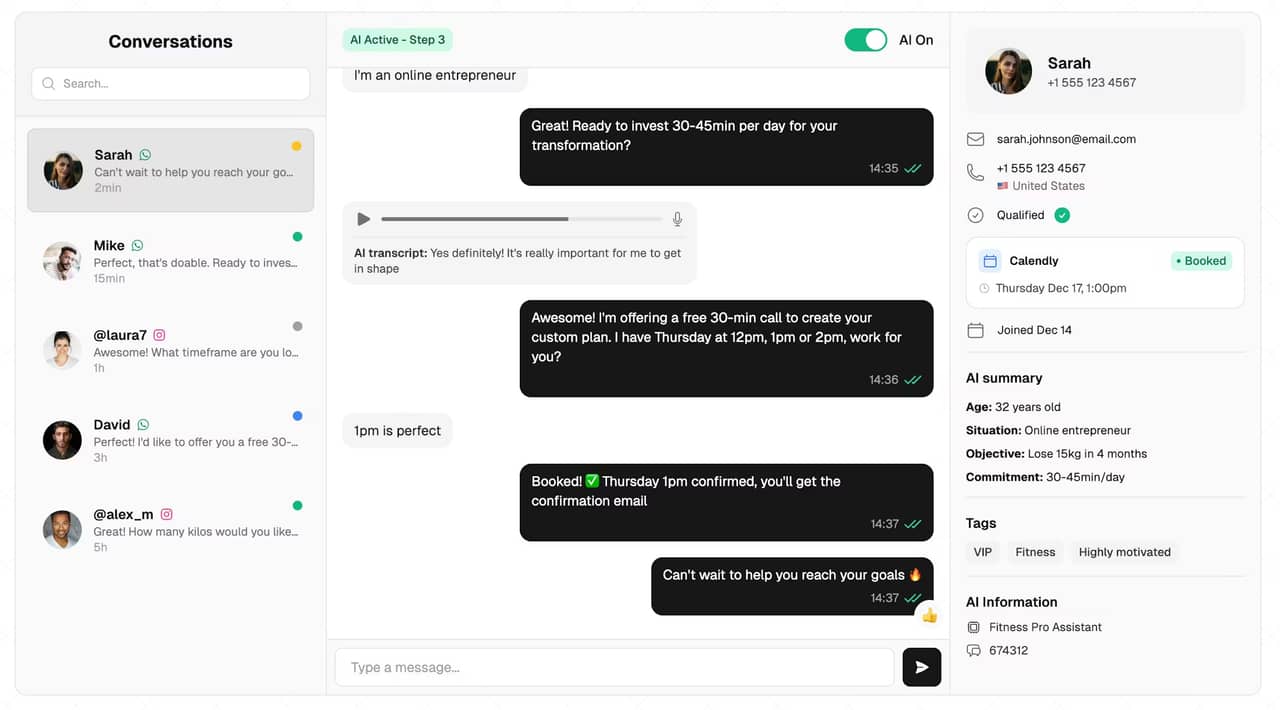
CRM sales automation is the layer of your CRM that picks up repetitive sales work — capturing a lead, routing it to the right rep, enriching the contact, logging the activity, moving the deal stage, sending the follow-up — and runs it without a human pressing a button. In 2026 the gap is no longer "do you automate inside the CRM" — every CRM does that. The gap is whether your CRM automates the conversation tier (Instagram DMs, WhatsApp, comment-to-DM flows) where most leads now actually live, or whether it still assumes every prospect arrives via a web form. Below: 9 CRM sales automation workflows ranked by ROI, the right CRM for each, and the DM layer most CRM-automation roundups still forget to wire up.
TL;DR — 9 CRM sales automation workflows ranked by 2026 ROI
| # | Workflow | Best CRM for it | Time saved / week | ROI tier |
|---|---|---|---|---|
| 1 | DM-to-CRM lead capture & hand-off | SetSmart + HubSpot / Pipedrive | 8-12h | Highest |
| 2 | Inbound lead routing | HubSpot Sales Hub | 3-5h | High |
| 3 | Sequenced follow-ups | Close, HubSpot Sequences | 5-8h | High |
| 4 | Activity logging (calls, emails, DMs) | Pipedrive, Salesforce | 4-6h | Medium-High |
| 5 | Deal stage progression | Pipedrive, HubSpot | 2-4h | Medium |
| 6 | Contact enrichment | HubSpot Breeze, Salesforce Data Cloud | 2-3h | Medium |
| 7 | Lead scoring & prioritization | HubSpot, Salesforce Einstein | 2-3h | Medium |
| 8 | Tasks & reminders | Any CRM | 1-2h | Medium |
| 9 | Reporting & forecasting | Salesforce, HubSpot | 2-4h | Medium |
The ranking is built on the 2026 reality that more sales conversations now happen in DMs than in inboxes for SMB, creator-led, and agency-run businesses. So the workflow that pulls those conversations into the CRM (#1) outranks anything happening once the deal is already in the pipeline.
What CRM sales automation actually means in 2026
CRM sales automation is the use of rules, triggers, AI, and integrations inside or attached to a CRM to perform repetitive sales work without human input. Three things distinguish it from generic "sales automation":
- The CRM is the system of record. Every action either reads from or writes to the CRM contact, deal, or activity object. If the work happens entirely outside the CRM (a standalone outbound tool, a Zapier flow that never updates a record), it's outreach automation — not CRM automation.
- The triggers are CRM events. New contact created. Lead status changed to "Marketing Qualified". Deal stuck in "Proposal Sent" for 7 days. These events fire the workflow.
- The output is recorded. Sent emails, logged calls, DM exchanges, score changes, stage moves, reminder tasks — all visible on the contact timeline. If the action is invisible to the next rep who opens the record, it doesn't count.
The Salesforce, IBM, and Affinity definitions all converge on this — repetitive tasks inside the CRM, automated. What the 2026 market keeps under-covering is what counts as a "CRM event" now: it's no longer just lead.created, it's also instagram_dm.received, whatsapp_message.replied_to, comment.posted_on_ad. CRM sales automation in 2026 means automating around DM events — not just web forms.
For the broader picture across all sales tooling (not just CRM-anchored automation), see our sales automation pillar, which covers the 9 use cases beyond the CRM layer.
Why CRM sales automation matters more than ever in 2026
Three forces compress the time you have to react in 2026:
- Lead expectations. A prospect who sent an Instagram DM at 2pm expects an answer before they close the app. Not tomorrow morning when an SDR triages the inbox. The industry-standard 42-hour response time loses ~80% of these leads outright.
- Channel fragmentation. A single buyer's journey now touches an Instagram ad, a comment-to-DM flow, a WhatsApp follow-up, an email, a calendar invite, and a sales call — all before the first call. The CRM is the only artifact that survives all of those touchpoints. If automation doesn't keep it updated in real time, the next rep is reading a stale record.
- AI everywhere. Every CRM (HubSpot Breeze, Salesforce Einstein/Agentforce, Pipedrive AI Sales Assistant, Zoho Zia, Monday AI) shipped agentic features in 2025-2026. The competitive question stopped being "do you have AI" and became "do you let AI execute, or just suggest". Automation that only suggests still requires a human click — which means it doesn't actually save time.
Across our analysis of 828K AI-driven DM conversations, 53% of inbound conversations died before message 3. That's the leak CRM automation has to plug — most of those conversations are still happening outside the CRM today, never logged, never followed up, never scored.
1. DM-to-CRM lead capture & hand-off — the workflow nobody sets up
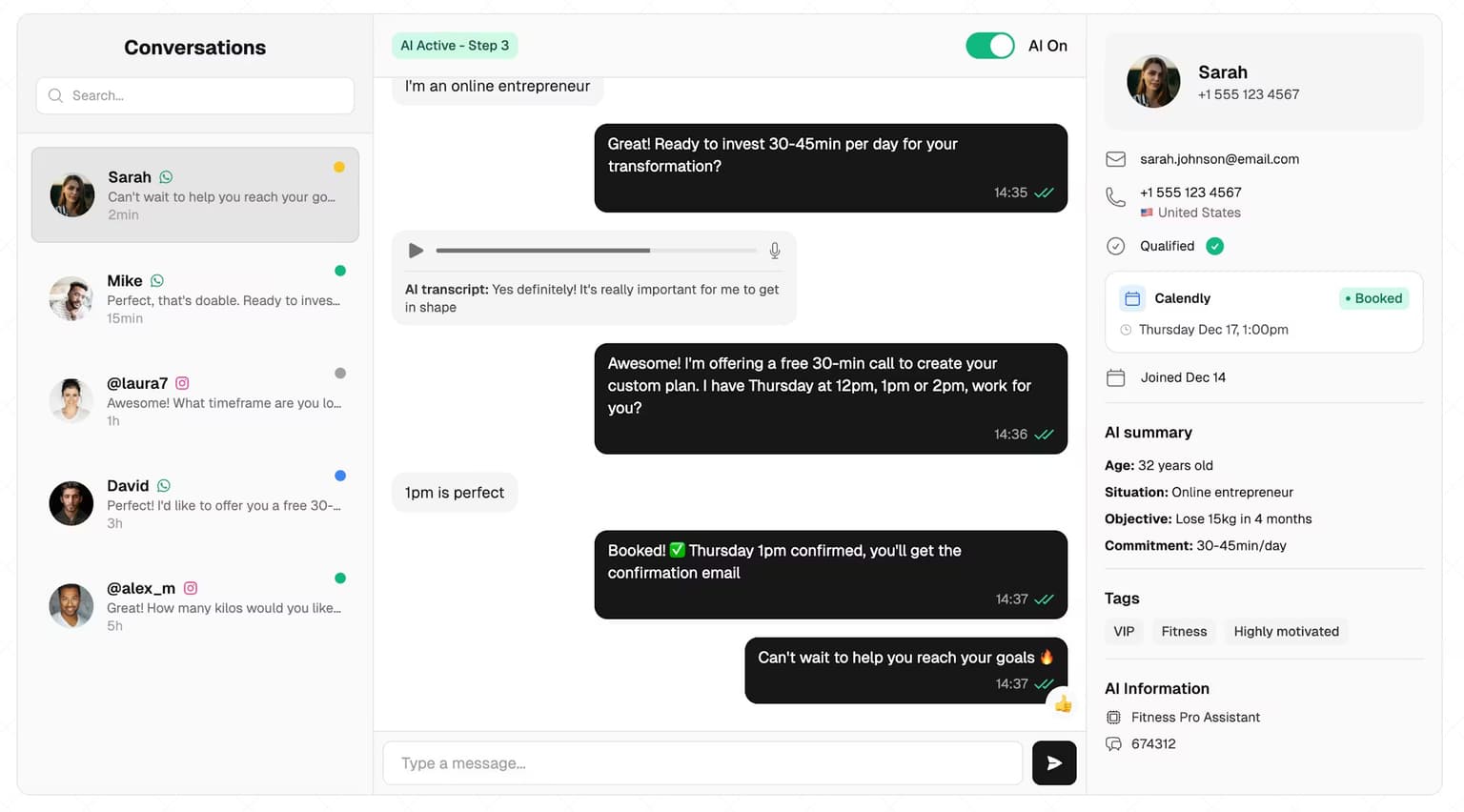
What it does. Every Instagram DM, WhatsApp message, Facebook Messenger thread, and comment-to-DM trigger creates or updates a contact in the CRM. The conversation transcript, the qualification status (hot / warm / cold), the next-step intent (wants demo / wants pricing / not now), and the channel are all written to the CRM record.
Why it ranks #1. This is the only workflow that adds new pipeline the rest of the CRM never sees. Every other CRM automation works on contacts already in the system. If your buyers DM first (the default for SMB, creators, agencies, e-com brands, coaches), every conversation you don't log is a lead that simply never existed in your CRM.
How to set it up.
- Pick a DM AI that reads, replies, qualifies, and exposes a contact + conversation object via API or a native CRM app — see our best AI setters comparison for the candidates.
- Map the DM AI's qualification states to your CRM's lifecycle stages. "Qualified by AI" → MQL. "Asked for a call" → SQL.
- Push the full transcript to a custom field or an activity record so the human closer can read it before the meeting.
- Trigger a routing rule when a contact crosses into "SQL".
ROI. A coach handling 200 inbound DMs/week saves 8-12h per week and stops losing every "warm" lead that fell through the cracks. For an agency handling 5 client accounts, the math compounds 5×.
2. Inbound lead routing — make the right rep get the right lead in 30 seconds
What it does. When a new contact is created (web form, ad lead, manual import, DM hand-off), routing rules assign the lead to a rep based on territory, deal size, product line, source, language, or round-robin.
Best CRM for it. HubSpot's Sales Hub Pro (Workflows + Lead rotation) is the most flexible without a developer; Salesforce's Lead Assignment Rules cover anything HubSpot doesn't but require admin setup; Pipedrive's automations are simpler and ideal for teams under 15 reps.
Common rules:
- Round-robin across the SDR team for new MQLs
- Geographic territory routing (US-East, EMEA, APAC)
- Account-based routing (existing customers go to AM, not AE)
- Source-based (Instagram DM leads → coach team, web form → enterprise team)
- Language routing (FR leads → FR-speaking rep)
Watch out for: routing without an SLA. The classic mistake is to assign a lead to "Sarah" but never check whether Sarah opened the record. Add an automation that re-routes if the lead isn't touched within 1 hour.
3. Sequenced follow-ups — the workflow that doubles booked calls
What it does. When a lead enters a specific stage (e.g. "Demo Booked", "No-Show", "Sent Proposal", "Stuck 7 days"), a sequence of 3-7 timed messages fires automatically. The sequence pauses when the lead replies and resumes if the rep doesn't respond within an SLA.
Why it matters. A single follow-up doubles booked calls (+106%) — this is the single highest-ROI automation in any sales stack and it's still under-used in CRMs because reps default to "I'll get to it tomorrow". Tomorrow never comes.
Best CRM for it. Close has the cleanest native sequence UX (built for outbound sales teams). HubSpot Sequences (Sales Hub Pro+) is the inbound-friendly equivalent. Pipedrive's "Smart Docs + Automations" combo works for simpler cadences.
The DM layer. Email sequences are table stakes. The under-built layer is DM sequences — a follow-up DM 4 hours after the first message and a second one 23 hours later. Wire your AI lead follow-up into the same trigger and the conversion math jumps materially. See our sales cadence playbook for the full DM-first 7-step cadence.
4. Activity logging — calls, emails, and DMs
What it does. Every email sent or received from the CRM-connected mailbox, every call dialed through the integrated dialer, every meeting booked through the connected calendar, every DM exchanged through your AI setter — all logged automatically on the contact timeline.
Best CRM for it. Pipedrive logs the cleanest by default (no admin setup needed). Salesforce is the most thorough but takes Einstein Activity Capture or a paid add-on to actually populate without manual log entries. HubSpot logs emails and meetings out of the box; calls require Sales Hub Pro+.
The 2026 gap. DM activity logging is still mostly a custom integration. Your CRM logs the email exchange but not the 12-message Instagram DM that actually qualified the lead. The fix: route DMs through an AI sales assistant that posts to your CRM via webhook on every reply, so the timeline shows the full conversation.
5. Deal stage progression — the automation reps secretly want
What it does. When a triggering event happens (proposal sent, contract signed in DocuSign, payment received in Stripe, demo completed on Calendly), the deal stage advances automatically.
Why it's lower than you'd expect. It saves time but doesn't add pipeline. It's an internal-hygiene win, not a revenue win. Still worth it — clean stages keep forecasting honest and prevent the "deal sat in Negotiation for 90 days" zombie problem.
Best CRM for it. Pipedrive built its UX around this. HubSpot Workflows handles it via "Set deal property" actions. Salesforce uses Process Builder / Flow.
Patterns to wire up:
- Calendly meeting completed → stage = "Discovery Done"
- DocuSign envelope signed → stage = "Closed Won"
- Stripe payment captured → stage = "Closed Won" + create customer record
- 14 days no activity → flag "At Risk" + create rep task
6. Contact enrichment — fill the CRM with data the rep didn't ask for
What it does. When a new contact lands in the CRM, an enrichment service appends company name, employee count, revenue band, technologies used, LinkedIn profile, role, seniority, and other firmographic data. AI agents can also infer industry, ICP fit, and propensity-to-buy signals.
Best CRM for it. HubSpot Breeze Intelligence does this natively at the Pro tier. Salesforce Data Cloud handles enterprise-level enrichment; for SMB the Apollo, Clearbit (now part of HubSpot), or ZoomInfo integrations are more cost-effective. See our lead generation tools roundup for the full enrichment-tier comparison.
Watch out for: stale enrichment. Job changes, funding rounds, and tool changes age fast. Re-enrich every 90 days, not once at lead creation.
7. Lead scoring & prioritization — turn a CRM into a triage queue
What it does. Every contact gets a numeric score based on demographic fit (right industry, right company size, right role) plus behavioral signals (email opens, page visits, DM replies, demo requests). Reps work the highest scores first.
Best CRM for it. Salesforce Einstein Lead Scoring (legacy) and Agentforce (the 2025-2026 evolution) are the deepest. HubSpot's predictive scoring (Pro+) is the easiest to set up. Pipedrive's "Smart contact data" handles basic scoring but you'll outgrow it past 50 reps.
The DM scoring upgrade. A traditional scoring model adds 10 points for "opened a marketing email". A 2026 model adds 50 points for "replied 3+ times in WhatsApp" — because conversation depth predicts qualification far better than open rates. Make sure your scoring model can ingest DM event data, not just email and form fills. For the full framework, see our AI lead qualification guide.
8. Tasks & reminders — the automation everyone underestimates
What it does. When a contact, deal, or activity matches a rule, the CRM creates a task on the right rep's list with a due date.
Why it's last on a "ranked by ROI" list. Reps who already work their pipeline don't need it. Reps who don't work their pipeline ignore the tasks too. It's a hygiene tool — useful, but rarely the difference between hitting quota and missing it.
Useful patterns:
- 24h after a demo: "Send recap email"
- 48h after a proposal: "Follow up on proposal"
- 7 days no activity on a Stage 3+ deal: "Re-engage or move to Lost"
- Anniversary of a closed-lost deal: "Try again — circumstances may have changed"
Best CRM for it. Any of them. Pipedrive's task UX is the cleanest; HubSpot's task queues are the most flexible.
9. Reporting & forecasting — the automation that runs every Monday
What it does. Pipeline by stage, conversion rates between stages, time-in-stage, win rate by rep / source / segment, weighted forecast. The CRM crunches it on a schedule and ships a dashboard or email.
Best CRM for it. Salesforce Reports + Einstein Forecasting is the gold standard at enterprise scale. HubSpot Custom Reports + Forecast tool covers 90% of SMB use cases. Pipedrive Insights is the lightest and easiest to read.
The 2026 add-on: AI commentary. Most CRMs now ship a "what changed this week" narrative on top of the dashboard. Useful for VPs of Sales who want the why, not just the what. Less useful for reps doing the work.
Best CRM for sales automation in 2026 — comparison
| CRM | Best for | Automation strengths | Pricing (entry) | DM channel support |
|---|---|---|---|---|
| HubSpot Sales Hub | Inbound-led SMB & mid-market | Workflows, Sequences, Breeze AI, scoring | Free CRM, paid from $20/seat | Via integration |
| Salesforce Sales Cloud | Enterprise & complex orgs | Flow, Einstein, Agentforce, Data Cloud | From $25/seat, real cost much higher | Via integration |
| Pipedrive | Outbound-led SMB | Automations, AI Sales Assistant, Smart Docs | From $15/seat | Via integration |
| Close | Outbound + inside sales teams | Sequences, built-in dialer, calling/SMS automation | Starting at ~$49/seat | Via integration |
| Zoho CRM | SMB cost-conscious teams | Workflows, Zia AI, Blueprint, SalesIQ chat | Starting at ~$14/seat | Partial (WhatsApp via Twilio) |
| Monday Sales CRM | Cross-functional teams already on Monday | Visual automations, Monday AI | Starting around $12/seat | Via integration |
Every major CRM ships strong automation for the contact / deal / activity layer. Where they all converge is the DM-channel gap: none of them treats Instagram, WhatsApp, or Messenger as first-class trigger sources. To close that gap you wire in a dedicated DM AI (SetSmart) that pushes events to the CRM via webhook — pricing for the DM tier is free 7-day trial, then $97/month for 1,000 messages, which sits under even one extra Sales Hub seat.
Which CRM should you pick for sales automation? — decision framework
Pick HubSpot Sales Hub if: you're inbound-led, you want one platform for marketing + sales + service, and you'd rather pay for ease-of-setup than pay for raw flexibility.
Pick Salesforce if: you have a 30+ rep sales org, you need fine-grained territory and approval logic, you have an admin who can own Flow, and "we built it ourselves" is a feature, not a bug.
Pick Pipedrive if: your team is outbound-heavy, under 25 reps, and your VP of Sales wants the team to actually use the CRM — Pipedrive's UX wins reluctant adopters fastest.
Pick Close if: you make 50+ outbound calls per rep per day. The dialer integration alone justifies the price.
Pick Zoho if: your budget is the binding constraint. Zia handles 70% of what Einstein does at 10% of the cost.
Pick Monday Sales CRM if: your ops team already lives in Monday and you want a single source of truth across CS, marketing, and sales without buying another seat.
Pick none of the above (or any of them, plus this) if: more than 30% of your conversations happen in DMs. Then the binding constraint isn't your CRM — it's the layer feeding the CRM. Solve that first with a DM AI like SetSmart, then layer the CRM automation on top of clean conversation data.
How AI changed CRM sales automation in 2026
Three concrete shifts:
- From rule-based to agentic. Pre-2024 CRM automation needed a human to write the rule ("if lead source = LinkedIn AND title contains 'VP' THEN assign to Senior AE"). Agentforce, Breeze, and Zia agents now write the rules themselves based on outcome data. They notice that LinkedIn-VP leads convert 3× better when assigned to Sarah and propose the rule. You approve.
- From notify-the-rep to do-it-for-the-rep. Pre-2024 AI in CRMs suggested — "this lead looks promising" / "consider following up". 2026 AI executes — drafts and sends the follow-up email, books the meeting on the calendar, updates the deal stage, posts the recap in Slack. The human approval threshold moved from "every action" to "exceptions only".
- From one channel to all channels. The biggest CRM-AI launches of 2025-2026 added native or near-native handling for chat, voice, DM, and meeting transcripts. The CRM is becoming the orchestration layer across every conversation, not just the email-and-form ledger it was a decade ago.
The catch: AI in your CRM is only as good as the data you give it. If your DM channels never make it into the CRM, even the best AI will under-predict because half the buyer's journey is invisible to it. This is why workflow #1 — DM-to-CRM hand-off — sits above every AI feature on this list.
5 mistakes to avoid in CRM sales automation
- Automating the symptom, not the cause. A "lead stuck in Stage 3 for 7 days → notify rep" automation is a band-aid for "we don't have a real next-step framework". Fix the framework first; automate the reminder second.
- Routing without an SLA. Assigning a lead to a rep who never opens the record is worse than no automation — at least with no automation, the lead sits in the queue where someone else might grab it. Always pair routing with a "re-route if untouched in 60 minutes" rule.
- Letting the marketing team own automation. Sales automation built by marketers tends to over-emphasize email and under-emphasize the conversation tier. Have the head of sales own the workflow design.
- Scoring on opens. Email opens have been broken since iOS 15 (privacy-protect mail prefetches everything as an "open"). Score on replies, demo requests, page visits to pricing/demo pages, and DM replies — not opens.
- Forgetting the DM tier. This is the headline mistake of 2026. If 30%+ of your inbound now comes via Instagram comment-to-DM, comment-to-WhatsApp ads, or organic DMs, and your CRM treats that channel as "manual entry only", you're shipping CRM sales automation that automates the wrong half of the funnel.
Where DM channels fit in CRM sales automation
DM channels (Instagram, WhatsApp, Messenger, comment-to-DM ads) are the fastest-growing inbound source for SMB, creator-led, and agency-run businesses in 2026 — but they're also the channel CRMs handle worst out of the box. Three things you can wire up:
1. Inbound capture via comment-to-DM. A comment trigger on an Instagram or Facebook ad opens a DM. An AI replies, qualifies, books. The CRM record is created at the moment qualification crosses the threshold (not at first comment — that floods the CRM with low-intent contacts). See Instagram DM automation and the comparison with ManyChat alternative for the capture-tier setup.
2. Conversation-as-activity sync. Every DM exchange shows up on the contact timeline as an activity, with the full transcript searchable. The next rep who opens the record reads the conversation before the call instead of asking the lead to "remind me what we talked about".
3. Cross-channel hand-off. A lead replies on Instagram, doesn't book, replies again 3 days later on WhatsApp — the CRM stitches it into one contact and one conversation thread, not two orphan records. This requires either a CRM with native cross-channel identity (HubSpot's contact merging works for known emails; weaker for handles) or a DM AI that owns the identity layer before pushing to the CRM.
For the underlying performance numbers across DM channels — which qualify faster, which respond more, which convert at higher rates — see our lead response time statistics hub.
CRM sales automation for small business — the lean stack
Most "best CRM for sales automation" lists assume you're a 50-rep mid-market team with a Salesforce admin and a budget approval committee. For a 1-5 person team, the right stack is dramatically simpler:
- CRM: HubSpot Free CRM (free up to 1,000 contacts) or Pipedrive ($15/seat) — both ship enough automation for an SMB.
- DM AI: SetSmart (free 7-day trial, then $97/month, 1,000 messages included) — covers the channel your buyers actually use.
- Calendar: Calendly (free tier or $10/seat) — wired to the CRM so completed meetings auto-progress the deal.
- Email sequences: HubSpot Sequences (Sales Hub Starter $20/seat) or your CRM's native sequences.
- Reporting: built-in CRM dashboards. Skip the BI tool.
Total: under $250/month for a 1-2 person operation that automates the DM tier, the CRM tier, and the calendar tier. Most of the $2,000+/month "lean sales stacks" you see online over-spend on the outbound and enrichment tiers SMBs don't actually need yet.
What real teams say
"We were drowning in Instagram DMs from our $20K coaching offer. Half the conversations died because we couldn't reply fast enough on weekends. Wiring a DM AI into HubSpot pushed every qualified lead onto our pipeline automatically — booked calls went from 4-5/week to 12-15/week without hiring." — Théo Riffault, online coach
"I run an agency with 6 client accounts. Each client has its own CRM (HubSpot, Pipedrive, GHL). Setting up DM-to-CRM automation per client was the highest-leverage thing I did in 2025 — saved roughly 20 hours/week across the agency." — Mathis Ladoué, agency owner
"We tried building our own scoring model in Salesforce that ingested Instagram DM events. It took our admin 3 weeks. We swapped to a DM AI that pushes pre-scored leads to Salesforce and we were live in two days." — Edouard Clerc, sales ops
When NOT to add another CRM automation
- You're under 100 contacts in your CRM. Manual is faster than automated until you have enough volume to amortize the setup time.
- Your reps don't trust the data. Adding more automated writes to a CRM nobody trusts makes the trust problem worse. Fix the trust problem (clean fields, deduplicate, agree on what each stage means) first.
- The workflow you're automating is wrong. If your current sales process is broken, automating it makes it broken faster. Run the playbook manually for 4 weeks before you automate it.
- You haven't named an owner. CRM automations that nobody owns drift into chaos within 6 months. Before adding the rule, name the human responsible for it.
CRM sales automation vs sales force automation (SFA)
Quick disambiguation, since the terms get mixed up. Sales force automation (SFA) was the 1990s industry term for the CRM-side workflow layer — auto-logging emails, dedup, deal stage updates, basic reminders. CRM sales automation in 2026 is broader — it includes SFA, but also outreach sequences, AI scoring, conversation-tier integrations, and agentic workflows that execute on behalf of the rep. SFA is one slice of CRM sales automation, not a synonym. For the wider enterprise picture beyond the CRM-anchored layer, see our sales automation pillar.
FAQ
What is sales automation in CRM?
Sales automation in CRM is the use of triggers, rules, and AI inside (or attached to) your CRM to perform repetitive sales work — capturing a lead, routing it, enriching the contact, logging activity, advancing a deal stage, sending follow-ups, scoring leads, generating reports — without a human pressing a button each time. The CRM is both the trigger source (a new contact, a stage change, an inactivity threshold) and the system of record (every action gets written back).
What is the difference between CRM and sales automation?
A CRM is the database of contacts, deals, and activities. Sales automation is what makes that database act on its own. You can have a CRM with no automation (a glorified spreadsheet) or a sales automation layer with no CRM (a standalone outbound tool that never updates a record), but the value compounds when both run together — the CRM gives the automation memory, and the automation makes the CRM keep itself current.
What is the best CRM for sales automation in 2026?
There is no single best — it depends on your motion. HubSpot Sales Hub is the safest pick for inbound-led SMB and mid-market teams who want one platform. Salesforce wins for 30+ rep enterprises that need deep customization. Pipedrive wins for outbound-led teams under 25 reps. Close wins for high-volume calling teams. Zoho wins on price. Monday Sales CRM wins for ops teams already on Monday. None of them solve the DM channel out of the box — that requires a dedicated DM AI layered on top.
What is sales force automation (SFA) and how is it different from CRM automation?
Sales force automation is the older 1990s term for the CRM-side workflow layer — auto-logging emails, deduplicating contacts, advancing deal stages, generating reminder tasks, basic forecasting. It's a slice of what we now call CRM sales automation, which has grown to include outreach sequences, AI scoring, agentic workflows, and conversation-tier integrations. Practically: SFA = the CRM doing CRM things automatically. CRM sales automation = SFA + everything AI added in the last three years.
What are some examples of CRM sales automation?
The most common examples in 2026: lead routing rules that assign a new contact to the right rep in seconds, sequenced follow-ups that fire when a deal sits in a stage too long, contact enrichment that fills in company data the moment a lead is created, deal-stage progression triggered by Calendly meetings or DocuSign signatures, predictive lead scoring based on email opens and demo requests, and DM-to-CRM hand-off where every Instagram or WhatsApp conversation is logged on the contact timeline. The last one is the workflow most teams still don't have set up.
How do you automate sales activities in a CRM?
Three steps. (1) Map the workflow on paper first — what triggers it, what the steps are, where it ends. (2) Pick the right tool for the trigger — most CRMs (HubSpot Workflows, Salesforce Flow, Pipedrive Automations) handle CRM-internal triggers natively, but DM events need a dedicated AI like an AI sales assistant feeding the CRM via webhook. (3) Add an SLA — if the automation routes work to a human, add a fallback that re-routes when the human doesn't act within X minutes. Without the SLA, you've automated half the workflow and left the other half rotting in someone's queue.
Ready to automate your DMs?
Start your free 7-day trial and let AI handle your lead qualification 24/7.
Try SetSmart free