Lead Nurturing Examples: 14 DM-First Templates (2026)
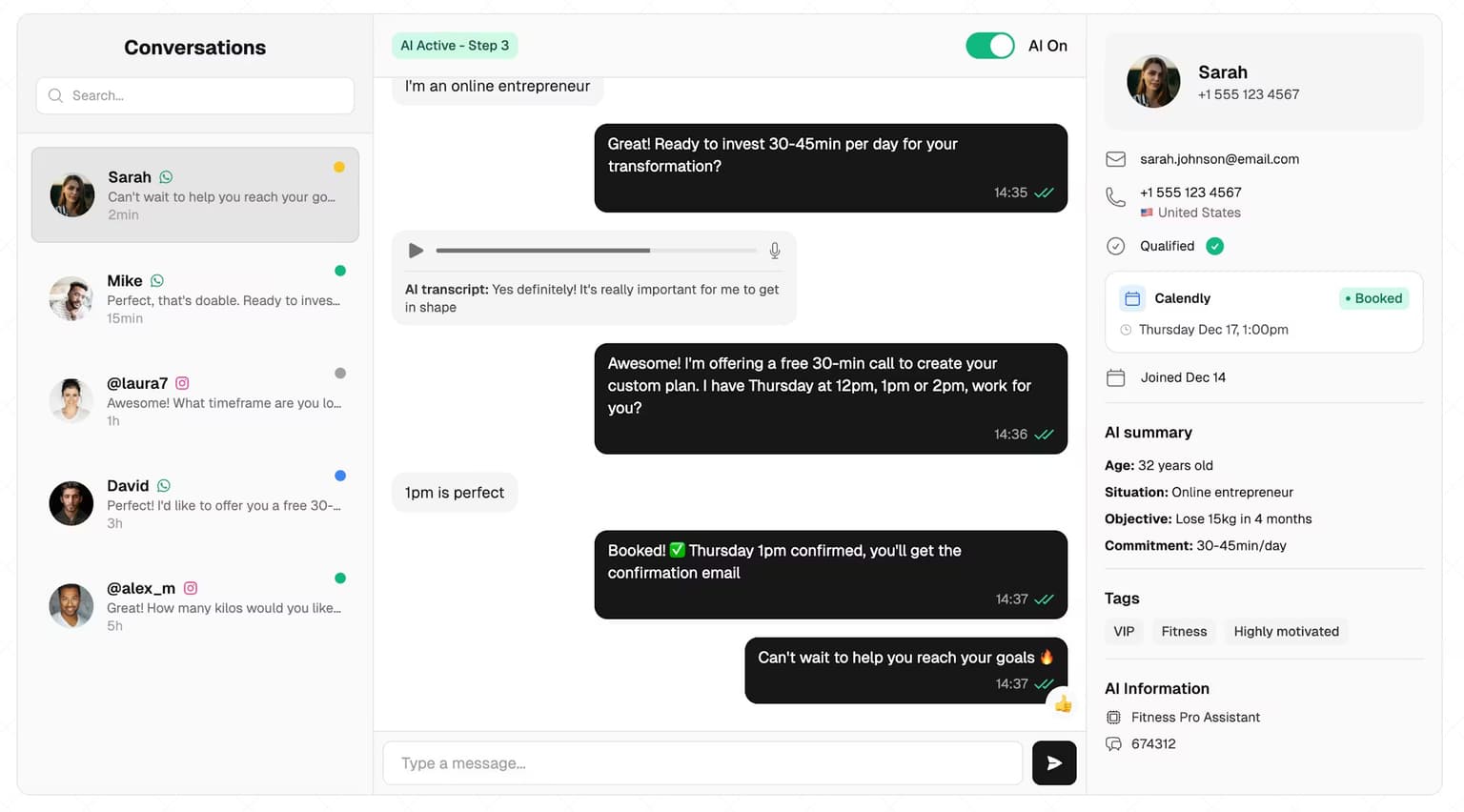
Most "lead nurturing examples" articles in 2026 are still email-only — Adobe, Salesforce, MyEmma, HubSpot all give you welcome emails, drip emails, re-engagement emails. Real buyers in 2026 nurture in DMs. Below are 14 lead nurturing examples — every one with a real script — covering Instagram DM, WhatsApp, Messenger, and email. They come from how creators, coaches, agencies, and SMB teams actually warm leads up today.
The 14 examples are grouped by intent: educate, re-engage, convert, retain. Each one shows the trigger, the channel that wins, the message itself, and the timing rule. Skip the table of contents — read the TL;DR table, then jump to whatever stage you're stuck on.
TL;DR: 14 lead nurturing examples ranked by who needs them
| # | Example | Best channel | Best for |
|---|---|---|---|
| 1 | Welcome + qualify in one DM | Instagram DM | Coaches, creators |
| 2 | Comment-to-DM lead magnet drop | Instagram DM | Content-led brands |
| 3 | Educational mini-series (3 parts) | Email + WhatsApp | Course creators |
| 4 | Demo no-show recovery | WhatsApp + email | B2B SaaS, agencies |
| 5 | Cart / checkout abandonment | Ecommerce, info products | |
| 6 | Free trial onboarding sequence | Email + in-app | SaaS |
| 7 | Long-cycle "stay in touch" cadence | Email + LinkedIn DM | B2B sales (90+ day) |
| 8 | Webinar / live event nurture | Coaches, B2B | |
| 9 | Re-engagement of dormant leads | Instagram DM | Creators, coaches |
| 10 | Objection-handler nurture | DM (any) | High-ticket sellers |
| 11 | Post-purchase upsell sequence | Coaches, ecommerce | |
| 12 | Referral / word-of-mouth nurture | DM + email | Service businesses |
| 13 | VIP / hot-lead fast-track | DM (live human or AI) | Agencies, B2B |
| 14 | Industry / event-trigger nurture | Email + LinkedIn | B2B, account-based |
Eight of the fourteen are DM-first because that's where attention has moved — open rates on Instagram DM run 90%+ vs 20-30% on email, and WhatsApp templated messages clear 95%+ when the lead has opted in.
What is lead nurturing? (and what it isn't)
Lead nurturing is the multi-touch process of building enough trust and clarity with a known lead that they choose, on their own, to take the next sales step. Translated: someone gave you their handle, email, or DM. They are not buying yet. Nurturing fills the gap between "interested" and "ready to talk".
It is not:
- Lead generation (creating brand-new contacts)
- Lead qualification (sorting fit and intent — see what is lead qualification)
- Hard selling (one push, one yes/no)
- Scheduled blast newsletters with no personalization
It is:
- Sequenced touches (3-12 messages spread over days or weeks)
- Mostly value, occasional ask
- Triggered by lead behavior (clicked, commented, opened, replied, visited a page)
- Multi-channel — email is one channel, but Instagram DMs, WhatsApp, Messenger, and SMS are now equally important
The job-to-be-done of nurturing is to shorten the gap between "first touch" and "qualified opportunity" while filtering out unfit leads cleanly.
For where nurturing fits in the broader pipeline, see lead qualification stages — nurturing is what happens between MQL and SQL.
Why DM-first lead nurturing outperforms email in 2026
The default "lead nurturing example" you'll find on Adobe, Salesforce, or MyEmma is an email drip. Email still works for B2B mid-market and enterprise, where inboxes are the primary work surface. But for SMB, creator-led, coach-led, and consumer-facing brands, the picture changed:
- Inbox fatigue is real. Average B2B email open rates sit around 20-30%; click rates are 2-3%. Most "nurture emails" are deleted unread.
- DMs are personal. An Instagram or WhatsApp DM lands in the same thread your lead uses to talk to friends. It gets opened.
- Conversation depth is what books. From our analysis of 828K conversations, 53% of DM exchanges die before message 3 — but the ones that reach 11+ messages qualify at 68× the rate of short ones. Nurturing is the act of getting from message 2 to message 11.
- Speed compounds. The lead response time data shows a 5-minute reply qualifies leads at 21× the rate of a 30-minute reply. DM nurturing runs 24/7 in seconds; email nurturing runs in hours or days.
- Follow-ups double conversion. A single follow-up message lifts qualification +112% and bookings +106% in DM channels. Email follow-ups typically lift open rates 5-15%.
Translation: if your audience lives on social, DM-first nurturing will outperform an email drip by a wide margin. If your audience is a CIO at a Fortune 500, keep emailing.
The 14 examples below span both — but eight of them are DM-native because that's where the gap in coverage is.
Example 1: Welcome + qualify in one DM (Instagram)
Trigger: A new follower DMs your brand asking about a service or replies to a story. Channel: Instagram DM. Goal: Welcome warmly, ask one qualifying question, surface their need.
Hey {first name} 👋 thanks for the DM. Quick question so I can point you the right way:

are you looking for help with (a) getting more leads on Instagram,
(b) booking calls from the leads you already get, or
(c) something else?
Why it works: One question, three options, low friction. Most leads reply within minutes because it's clearly written by a human (or feels like one). Three-option questions outperform open-ended ones because the lead doesn't have to think — they pick.
Timing: Send within 5 minutes of their first message. Speed is the single biggest predictor of whether the conversation continues — see lead response time statistics for the data.
What you do with the reply: Tag the lead in your CRM by chosen option. Branch the next message accordingly. This is the foundation of every DM nurture flow.
Example 2: Comment-to-DM lead magnet drop
Trigger: A lead comments a specific keyword on one of your posts (e.g., "GUIDE", "AUDIT", "TEMPLATE"). Channel: Instagram DM, triggered by the comment. Goal: Deliver the promised resource, then immediately open a qualifying conversation.
{first name}, here's the {asset name} I promised in the comments 👇

[link]

Quick check — what made you stop on the post? Curious which part of {topic} you're working on right now.
Why it works: You give first, ask second. The lead is already micro-committed (they commented). The follow-up question turns a one-shot lead magnet into a real conversation. Conversion to call from this flow runs 3-8× higher than a lead magnet sent by email with a "watch your inbox" landing page.
For the full mechanic, see Instagram comment-to-DM automation. Pair it with Instagram DM scripts for variations on the second message.
Example 3: Educational mini-series (3 parts)
Trigger: Lead opts into a free guide / lead magnet. Channel: Email + WhatsApp (parallel for highest reach). Goal: Deliver three pieces of value over 7 days. End with a soft call invite.
Day 0 (delivery): "Here's the guide. Read part 1 first — page 4 has the most useful template."
Day 2 (deepen): "How did the {topic} template land? Most people struggle with {common pain}. Here's a 4-minute video on how to fix it."
Day 5 (case study): "Saw {client name} apply this last month and double their {metric}. Two-paragraph breakdown of what they did differently."
Day 7 (soft call invite): "If you want me to apply this to your {situation}, happy to do a 15-minute audit. Reply 'audit' if you want a slot."
Why it works: Each touch teaches something. The ask only comes after three deposits. By day 7, the lead has either engaged (warm) or stayed quiet (low intent — drop them into a longer 30-day cadence).
This is the closest example to the classic "B2B lead nurturing email examples" you'll find on HubSpot — except routed via WhatsApp where the lead actually opens it.
Example 4: Demo no-show recovery
Trigger: Lead booked a call, didn't show. Channel: WhatsApp first, email backup. Goal: Reschedule without guilt-tripping.
{first name}, no worries — life happens. Want to grab another slot
this week? Here are 3 that work my side:

🗓️ Wed 2pm
🗓️ Thu 11am
🗓️ Fri 4pm

Just reply with the one that fits, or send a time that works better.
Why it works: No "you missed our call" framing. Three times offered (decision shortcut). One-tap reply. No-show recovery rates jump from ~20% (passive email) to 50-65% (active WhatsApp message within 1 hour).
Important caveat for SetSmart users: SetSmart books calls and sends reminders, but it does not auto-reschedule no-shows for you. The reschedule message above is a template for your own outreach, not a feature claim.
Example 5: Cart / checkout abandonment
Trigger: Lead added a product or course to cart and bounced. Channel: WhatsApp (primary), email (secondary). Goal: Recover the sale within 24 hours.
Sequence:
- 30 min after abandon: "Hey {first name}, saw you were checking out {product}. Anything I can answer? Common questions: shipping (3-5 days US), returns (30 days), bundle pricing."
- 4 hours later: "Quick reminder — your cart is still saved here: link. Want me to apply the welcome bundle 10%?"
- 23 hours later: "Last nudge — cart expires tomorrow morning. Reply STOP if you want me off your back, otherwise here's the link one more time."
Why it works: The 4h + 23h cadence is the same pattern that doubles booked calls in service-business AI follow-up. Two well-timed touches outperform 5 random ones. The "STOP" opt-out keeps you compliant on WhatsApp Business API.
Example 6: Free trial onboarding sequence
Trigger: Lead signs up for a free trial of your software. Channel: In-app + email. Goal: Get the lead to their "aha moment" before the trial ends.
Day 0 (welcome): 1-paragraph email + a short Loom from the founder. "Here's the 60-second setup. Reply if you get stuck."
Day 1 (activation nudge): "Most teams hit value when they {key action}. Here's the 90-second guide on doing it." Link to a single help doc.
Day 3 (success check): "Quick check — has the trial done what you hoped? If not, hit reply and tell me where you got stuck. I'll help personally."
Day 5 (case study): "Wanted to share this — {customer name} did {result} in their first 7 days. Here's exactly how."
Day 7 (decide nudge): "Trial ends in 24 hours. Want me to extend it 7 more days, or upgrade you to paid?"
Why it works: Each email maps to a stage of the activation journey. The day-3 email is the most important: it's where you catch silent churn. Replies to it are gold — those are leads ready to convert with one human touch.
Example 7: Long-cycle "stay in touch" cadence (90+ day B2B)
Trigger: Demo or sales call happened, but the lead said "not now, maybe Q3". Channel: Email primary, LinkedIn DM secondary. Goal: Stay top-of-mind without nagging until the buying window opens.
Cadence: 1 touch every 14-21 days.
- Touch 1 (day 14): A useful link with no ask. "Saw this benchmark on {industry topic} and thought of you."
- Touch 2 (day 35): A relevant case study. "We just published how {peer company} cut {metric} by X — same problem you mentioned."
- Touch 3 (day 56): A short product update. "Released the {feature} you asked about. Here's a 2-min demo if useful."
- Touch 4 (day 77): A "still on your radar?" check-in. "Quick check — is {project} still scheduled for Q3? Happy to keep waiting or to scope sooner."
- Touch 5+ (every 21 days): Rotate value (article), proof (case study), and check-in.
Why it works: Most B2B "lost" deals weren't lost — they timed out. Discipline beats creativity. A 90-day cadence with five touches will surface 15-25% of "not now" deals when their window opens.
Example 8: Webinar / live event nurture
Trigger: Lead registers for your live webinar. Channel: WhatsApp (primary), email (backup). Goal: Get them to actually show up, then convert post-event.
Pre-event:
- Day -7: Confirmation + add-to-calendar.
- Day -1: "Tomorrow at {time}. Reply 'YES' if you'll be there live so I save your seat. Replay sent only to live attendees."
- Day 0, 1 hour before: "Starting in 60 min — link: {url}"
- Day 0, 5 min before: "We're live. Join: {url}"
Post-event:
- Day 0, 1h after: "Thanks for joining 🙏. Here's the slide deck + a private bonus on {topic} for live attendees only."
- Day 1: "Quick question: what was your single biggest takeaway? Want to make sure we covered the right stuff."
- Day 3: "If you want to apply this 1-on-1, I have 3 spots open this week for {offer}. Reply 'spot' if you want one."
Why it works: WhatsApp confirms get 80%+ show-up rates vs ~25% for email-only. The post-event "biggest takeaway" question doubles reply rates because it's open-ended but specific.
Example 9: Re-engagement of dormant leads
Trigger: Lead engaged 30-90 days ago, then went silent. Channel: Instagram DM (primary). Goal: Restart a conversation without sounding desperate.
{first name}, popping back in — last time we chatted you were {their context}.

Two questions:
1. did the {action they took} pan out?
2. is {pain point} still a thing for you?

If you've moved on, no problem — just say "all good" and I'll stop bugging you 🙏
Why it works: Specific (refers to their context), low-pressure (option to opt out), short (2 questions). Re-engagement reply rates run 18-30% on this template, dramatically better than "just checking in" which converts under 5%.
Example 10: Objection-handler nurture (high-ticket)
Trigger: Lead said no on a sales call (or in DMs) with a soft reason: "too expensive", "wrong timing", "need to talk to my partner". Channel: Whatever channel they prefer (usually DM for high-touch sales). Goal: Address the specific objection with one relevant case study, ask if anything changed.
Sequence:
- Day 3: Acknowledge the objection: "{first name}, totally heard you on {objection}. Wanted to share how {client name} thought the same and found a way around it." Send a 90-second case study.
- Day 10: "Curious if anything shifted on {objection}? No pressure — just checking."
- Day 21: A useful piece of content tied to their world (industry article, mini-tutorial). No ask.
- Day 30: One direct re-open: "Since we last spoke, anything change? Happy to scope a leaner option if budget is still tight."
Why it works: You take their reason seriously, then prove it can be solved. About 1 in 5 high-ticket "no" leads close on this exact pattern within 60 days — versus near-zero for leads who get added to a generic newsletter.
For where this fits inside your sales motion, see AI lead qualification.
Example 11: Post-purchase upsell sequence
Trigger: Lead bought your entry-level product or course. Channel: WhatsApp. Goal: Confirm value, set up the next purchase or renewal.
Sequence:
- Day 1: "Welcome aboard 🚀. The first 24 hours matter most — here's the one thing to do today: {action}."
- Day 7: "How's it going? Most people get stuck at {common point}. Reply if you're there and I'll send the fix."
- Day 14: A short results check-in. "What's the biggest result so far? Always want to know."
- Day 21: Soft upsell. "Now that you've got {result}, the natural next step is {next product/tier}. Want to hear how it works?"
- Day 30: A success story from someone who took that step. "Just shared {testimonial}. Let me know if you want a 15-min walkthrough."
Why it works: Customers who get a weekly check-in for the first 30 days renew or upsell at 2-3× the rate of customers left alone. WhatsApp wins because every one of these messages gets opened.
Example 12: Referral / word-of-mouth nurture
Trigger: Customer hit a milestone or gave you a positive testimonial. Channel: WhatsApp + email. Goal: Convert happiness into a referral.
Sequence:
- Day 0: Acknowledge the milestone publicly (if appropriate) and privately: "{first name}, that {result} is fantastic — congrats."
- Day 3: Ask for a quick written or video testimonial. "Would you be open to a 30-second video? Happy to script it for you."
- Day 7: After the testimonial, ask for the intro: "If anyone in your network is dealing with {problem}, who comes to mind? Happy to send them my best 1-pager so you don't have to do anything."
- Day 14: Send a thank-you (gift, credit, or shout-out). Even small touches lift referral conversion.
Why it works: The 7-day delay between testimonial-ask and referral-ask is critical — leading with both in the same message kills response rates. Spreading it lets each ask stand on its own.
Example 13: VIP / hot-lead fast-track
Trigger: A specific signal fires — they replied within 30 seconds, mentioned a high-value keyword, came from a paid ad, or matched your ideal-customer profile (ICP). Channel: Instagram or WhatsApp DM. Goal: Skip the slow nurture, route directly to a human or AI closer for booking.
Message:
{first name}, I caught your DM — sounds like you're ready to move fast.
Want me to grab us a 15-min call this week?

🗓️ Tue 3pm  /  🗓️ Wed 11am  /  🗓️ Fri 2pm

Or pick any time here: {calendar link}
Why it works: A small fraction of leads (5-15%) are ready to buy on first touch. Treating them with the same 7-day nurture as cold leads kills the deal. ICP routing or behavioral routing surfaces them and lets your closer (or AI setter) jump in immediately.
The signals to fast-track on (configure in your CRM):
- Instant reply (under 60 seconds)
- Mention of "buy", "pricing", "demo", "team of {N}"
- Source = paid ad / direct outreach / referral
- Profile matches ICP
Example 14: Industry / event-trigger nurture (B2B)
Trigger: A relevant event happens to the lead's company — funding round, exec hire, product launch, regulatory change. Channel: Email + LinkedIn DM. Goal: Reopen with relevance, not generic "checking in".
Email or DM:
{first name}, saw the news on {event} 👏 congrats.

When companies hit {milestone}, the next thing they usually
need to figure out is {pain you solve}. We've helped {2-3 peer
companies} navigate exactly that. Want me to send the 1-pager?
Why it works: The reason for reaching out is their news, not yours. Reply rates on event-triggered outreach run 4-8× higher than scheduled cadences. The ask is small ("want the 1-pager?") — a yes commits the lead to one email, not a 60-minute call.
Lead nurturing examples by channel: where each one wins
| Channel | Open / read rate | Best examples to use here | Watch out for |
|---|---|---|---|
| Instagram DM | ~90% | 1, 2, 9, 13 | 24-hour window after lead reply (Meta policy) |
| ~95% (template) / ~70% (free-form) | 4, 5, 8, 11, 12 | Per-message cost outside 24h window | |
| Messenger | ~80% | 2, 5, 9 | Audience smaller than IG/WA in most niches |
| 20-30% | 3, 6, 7, 14 | Spam / promo tab; needs many touches | |
| LinkedIn DM | 40-60% | 7, 14 | Slow reply rhythm (days, not minutes) |
| SMS | ~98% | 5, 8 | Strict opt-in; cost per message |
The big shift in 2026: serious teams now run nurture campaigns across 3-4 channels in parallel, not one. The lead gets the message wherever they're already paying attention.
How AI runs all 14 nurturing examples for you
Manually executing 14 nurture sequences across 3-6 channels is a full-time job for a marketing ops team. The reason most "best practices" articles don't get implemented is the same reason most lead nurturing examples stay theoretical: execution at scale is brutal.
AI lead nurturing solves this in three layers:
1. Trigger detection (no human watches inboxes)
The AI watches every inbound signal — Instagram DM, WhatsApp message, comment with keyword, cart abandonment webhook, calendar no-show, sign-up event. Each signal maps to one of the 14 example sequences above.
2. First reply in <5 seconds
Whichever sequence fires, the AI sends the first message instantly — well inside the 5-minute window where qualification rates are 21× higher than a 30-minute reply (the source data is here).
3. Sequenced follow-up with branching
The AI runs the sequence (Day 0, Day 2, Day 5, etc.) and branches based on what the lead actually says. If they reply "not interested", it pauses the cadence and shifts them to a 90-day re-engagement track. If they say "let's talk", it skips straight to booking. This is the part flow-builder tools (ManyChat, Chatfuel) cannot do, because real conversations are not yes/no buttons.
For a deeper take on the AI nurturing mechanics — qualification rules, follow-up cadence, branching logic — see AI lead qualification and AI lead follow-up. For a tool comparison, see lead qualification tools.
Common lead nurturing mistakes (and how to avoid them)
After looking at hundreds of nurture flows in production, the same five mistakes show up over and over:
1. Single-channel default. Email-only nurture in 2026 leaves 60-80% of attention on the table. Add at least one DM channel.
2. Same touch frequency for every lead. A hot lead gets the same 4-touch cadence as a cold lead. Hot leads need fast-tracking (example 13). Cold leads need patience (example 7).
3. No clear next step. Every nurture message should hint at what's coming or what action is available. "Just sharing" with no follow-up rails leads nowhere.
4. Asking too early. "Want to book a call?" in message 1 kills 70%+ of conversations. Most flows above wait until message 3-5 before any direct ask.
5. Auto-stop on "no". The lead who says "not now" today often becomes the buyer in 60-90 days. Move them to a longer cadence; don't drop them out of nurture entirely.
Pricing: what each lead nurturing tool costs in 2026
Quick orientation for anyone shopping for a tool to run these examples — prices verified at time of writing.
| Tool | Best for which examples | Channels covered | Starting price |
|---|---|---|---|
| SetSmart | 1, 2, 4, 5, 8, 9, 10, 11, 13 | Instagram DM, WhatsApp, Messenger | Free 7-day trial, then $97/month |
| ManyChat | 2, 5 (button-flow only) | Instagram DM, WhatsApp, Messenger, SMS, Email | Free / Pro $15/mo |
| HubSpot | 3, 6, 7, 14 | Email, in-app, basic WA / IG via add-ons | Free CRM / Marketing starting at $20/mo |
| Klaviyo | 5, 6, 11 (ecommerce) | Email + SMS | Free up to 250 contacts; usage-based |
| Outreach / Salesloft | 7, 14 (B2B email + LinkedIn) | Email, LinkedIn, phone | Quote only — typically $100+/seat/mo |
The right tool depends on which examples you actually need to run. If 80% of your nurturing happens in DMs (coaches, agencies, creators, SMB), an AI sales assistant built for DMs covers most of the list with one tool. If you're a B2B company nurturing email + LinkedIn, an enterprise sequencer is the better fit — different category.
Real client examples: what these sequences look like in practice
Théo Riffault (online coach): "We built example 1 (welcome + qualify) and example 9 (dormant re-engagement) as the backbone. The dormant flow alone re-opened 14 conversations in the first month — three of them booked."
Mathis Ladoué (agency): "Example 4 (no-show recovery) was the surprise winner. We were losing 40% of demos to no-shows. WhatsApp recovery within an hour took it down to 15%."
Edouard Clerc (consultant): "I run example 7 — the long-cycle B2B nurture — almost untouched. Five touches over 90 days, every other touch is pure value. About one in five "not now" leads come back."
Thuan Aime (creator): "Comment-to-DM (example 2) is now my main lead source. Comment a keyword, get the guide, then a follow-up question pulls me into a real conversation. Half my booked calls start there."
Manuel Nani (SMMA): "We use example 13 — the VIP fast-track — for any lead from paid ads. Instant reply, three time slots, calendar link. Booking rate from paid traffic is up 60%."
When NOT to nurture (and what to do instead)
A few cases where running a nurture sequence is the wrong move:
- Already-engaged lead ready to buy: skip the nurture, fast-track them (example 13).
- Bad-fit lead: don't nurture, disqualify cleanly. See lead qualification questions for soft disqualification scripts.
- Cold list with no opt-in: nurture only works on opted-in leads. Cold lists belong in outreach, not nurture — see outbound lead qualification.
- One-off purchase, no upsell potential: a transactional thank-you is enough; no 30-day cadence needed.
How to choose which examples to start with
Pick 3 — not 14. Most teams burn out trying to launch every sequence at once.
If you're a coach or creator: start with examples 1, 2, 9 (welcome, comment-to-DM, dormant re-engagement). All Instagram-DM. Smallest setup, fastest impact.
If you're an agency or B2B service: start with 4, 7, 13 (no-show recovery, long-cycle B2B, VIP fast-track). These pay back the fastest in booked calls.
If you're ecommerce: start with 5, 6, 11 (cart abandonment, onboarding, post-purchase upsell). The first one alone usually pays for the tooling.
If you're SaaS: 3, 6, 7 (mini-series, trial onboarding, long-cycle). Email-heavy because that's where the inbox is.
Add the next 3 examples once the first 3 are running cleanly — usually 30-45 days in.
What "lead nurturing examples" is NOT
To close the cannibalization gap with adjacent searches:
- It's not "lead generation examples" — that's how you create new leads (ads, SEO, partnerships).
- It's not "lead scoring" — scoring assigns a number; nurturing moves the lead toward the score that triggers handoff.
- It's not "drip campaigns" specifically — drip is one tactical pattern; nurturing includes drip, behavioral triggers, real-time DMs, and human follow-up.
- It's not the same as "follow-up" alone — see AI lead follow-up for the narrower follow-up mechanic.
A complete nurturing program contains drip, follow-up, behavioral triggers, and channel routing — running together.
FAQ
What is an example of lead nurturing?
The most common example is a 3-part educational mini-series: someone downloads a free guide, then receives three emails (or WhatsApps) over 7 days — first deepening the topic, then a case study, then a soft call invite. Example 3 above is the canonical version. The point of any nurture example is to give value before asking for the sale.
What are the four types of lead nurturing?
Most marketers group nurturing into four types: educational (teach the lead), engagement (re-spark dormant interest), conversion (move them to a sale), and retention / post-purchase (upsell, renew, refer). All 14 examples in this article fall into one of these four buckets — the table at the top is sorted in roughly that order.
What is the 3-3-3 rule in sales nurturing?
The 3-3-3 rule says you should reach out to a lead 3 times in the first 3 days, then 3 times over the next 3 weeks before classifying them as cold. It's a starting cadence template, not a law — DM channels often outperform with 2-touch (4h + 23h) patterns instead. Adjust to your channel's open and reply rhythm.
What are some good B2B lead nurturing email examples?
The best B2B email nurture sequences are example 3 (3-part mini-series), example 6 (free trial onboarding), example 7 (90-day stay-in-touch), and example 14 (event-trigger emails) above. They each rely on segmentation (only fire when the lead does something) and value-first content (case studies, benchmarks, useful links) before any direct ask.
How long should a lead nurturing sequence be?
Match it to the buying cycle. Short cycles (under $1K, impulse-driven): 3-5 touches over 7 days — examples 1, 2, 5. Medium cycles ($1K-$10K, considered): 7-10 touches over 21-30 days — examples 3, 6, 11. Long B2B cycles ($10K+, multi-stakeholder): 90-180 days with one touch every 14-21 days — example 7. Beyond 180 days, move the lead to a quarterly newsletter rather than active nurture.
Can lead nurturing be automated end-to-end?
Yes — and in 2026, most of it should be. AI agents can fire the right sequence based on a trigger, send the first message in seconds, branch based on the lead's reply, and book the call once a qualification threshold is met. What still benefits from a human is the last 5%: high-ticket objection handling, complex multi-stakeholder deals, and any deal above $25K ACV where rapport matters. For DM-based nurturing, an AI setter handles examples 1-13 above without manual intervention.
What's the difference between lead nurturing and lead qualification?
Lead nurturing is the multi-touch process of building trust and timing readiness. Lead qualification is the act of deciding whether a lead is a good fit and ready to buy. They overlap — nurturing the right lead surfaces qualification signals naturally. The cleanest split: nurture broadly, qualify continuously, hand off when both fit and intent clear the bar. See what is lead qualification for the qualification side of that equation.
Ready to automate your DMs?
Start your free 7-day trial and let AI handle your lead qualification 24/7.
Try SetSmart free