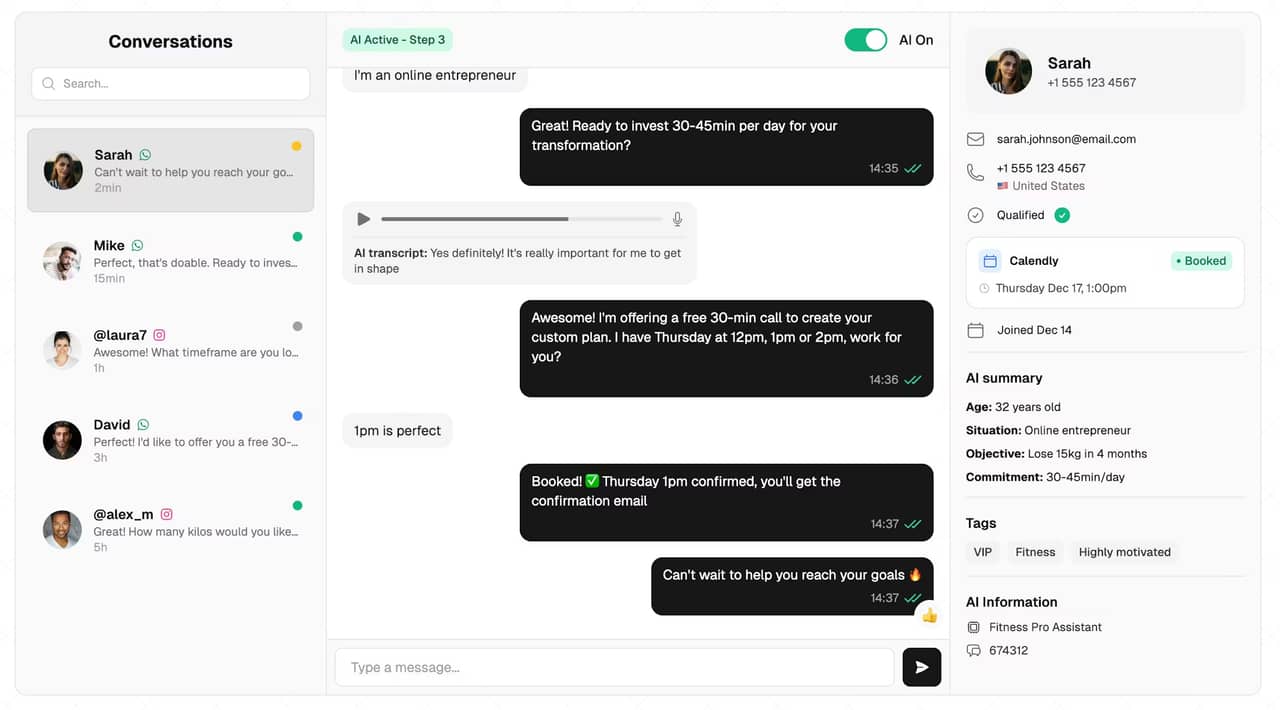
Lead Qualification Stages: MQL→SQL Mapped (2026)

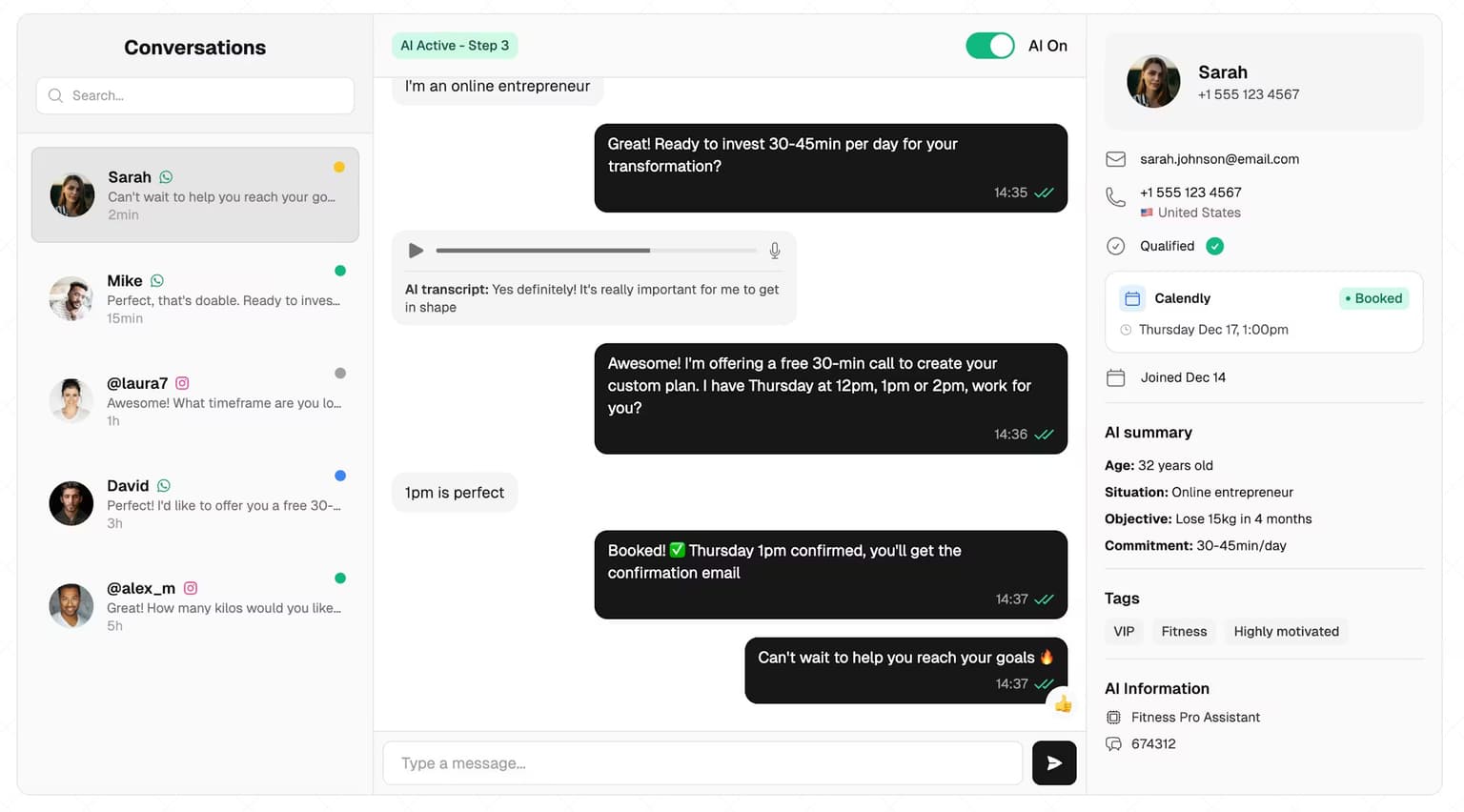
If you've ever asked "is this a lead, an MQL, or already an SQL?" — you're not alone. Half the sales handoffs we see fail because nobody agreed on what each stage means.
This guide maps every lead qualification stage a buyer passes through, from the first click to a closed deal. We'll define each stage in plain English, show what triggers the move to the next one, and ground every benchmark in real conversation data from 828,761 sales DMs across Instagram and WhatsApp.
By the end, you'll have a single shared vocabulary your marketing, AI setter, and closing team can all use — and a clear rule for when to move a lead forward, sideways, or out.
TL;DR — the 6 lead qualification stages
| # | Stage | Plain-English definition | Trigger to advance |
|---|---|---|---|
| 1 | Lead | Anonymous traffic that became a contact | Captured email/DM/phone |
| 2 | MQL (Marketing Qualified Lead) | Fits ICP on paper, showed intent | Asked a sales-ish question or hit a buying-intent page |
| 3 | SAL (Sales Accepted Lead) | Sales (or AI setter) agreed to work the lead | Setter responded and started qualifying |
| 4 | SQL (Sales Qualified Lead) | Need + timing + budget + authority confirmed | 3+ qualifying answers captured, no hard disqualifiers |
| 5 | SAO (Sales Accepted Opportunity) | Opportunity opened, call booked | Calendar slot held; deal stage set |
| 6 | Customer / Closed-Lost | Deal closed | Money in or formal "no" |
Most of the lift happens between MQL → SQL. That's where AI setters live, and where the data we collected shows the largest spread between top and bottom performers — see the response-time benchmarks for the speed half of the same story.
| Stage | Owner | Realistic conversion to next stage |
|---|---|---|
| Lead → MQL | Marketing | ~40% (the engagement rate we observed) |
| MQL → SAL | Marketing → Sales / AI | 85-100% (just an acceptance gate) |
| SAL → SQL | Setter (human or AI) | ~23% of engaged leads |
| SQL → SAO (booked) | Setter | ~45% of qualified leads |
| SAO → Customer | Closer | 15-30% (industry typical) |
What lead qualification stages actually are
A lead qualification stage is a named milestone in the buyer journey. Each stage answers one question: given everything we know right now, who owns this contact and what's the next action?
Three things make a stage useful:
- A precise definition — what does it mean for a lead to "be" in this stage?
- An entry trigger — what event flips a lead from the previous stage into this one?
- An exit rule — what makes the lead move forward (advance), sideways (recycle), or out (disqualify)?
Without those three, your CRM "Lifecycle stage" field is just a feeling. With them, you can run reports, train an AI lead qualification workflow, and finally agree on what counts as "marketing's job" vs. "sales' job".
If you've never named your stages explicitly, this is the place to start. If you have but they're causing arguments at handoff, this is the audit.
Why staged qualification matters more in 2026
Three forces are making well-defined stages harder to ignore:
- Channels collapse. A lead can open a DM, switch to email, then book a call from WhatsApp. Without stages, you can't reconcile the same person across channels. (See Instagram CRM for how to model this.)
- AI setters compress the funnel. A modern AI setter can take a lead from MQL to SAO in a single conversation that lasts 20-30 minutes. Old-school MQL → SQL → SAO scoring written for outbound email simply breaks.
- Speed dwarfs everything else. The classic Harvard study showed that responding within 5 minutes vs. 30 makes leads 21× more likely to qualify. The industry average response time is still around 42 hours. If your stages don't push the SLA, your funnel leaks at every gate.
Harvard Business Review (Oldroyd, McElheran, Elkington, 2011): qualification advantage when reaching out within 5 minutes vs. 30 minutes.
A few more numbers, before we go deeper:
- 53% of conversations die before message 3. If your "MQL → SAL" trigger is "first reply", you're losing more than half of MQLs at the very first gate.
- At 21+ messages (~10 exchanges), 1 in 3 leads books a call. The SAL → SQL gate is mostly about depth, not effort.
- A single follow-up doubles booked calls (+106% among engaged leads). Most teams stop after one missed reply — they're walking away from half of their SAOs.
These come from the conversations we analyzed — 5.6 million messages across 391 businesses. They reframe what each stage gate is worth.
The 6 lead qualification stages, defined
Stage 1 — Lead
Definition: anonymous traffic that became a known contact, but hasn't yet shown buying intent.
Entry trigger: an email submitted on a form, a comment on a comment-to-DM ad, a click-to-WhatsApp click, an inbound DM "yo what's the price".
Exit rule:
- → MQL if the contact matches your ICP and shows intent (asks a sales-ish question, visits a pricing page, replies to a qualifier).
- → Disqualified if they fail a hard ICP filter (wrong country, age, role, vertical).
A common mistake: treating every email capture as an MQL by default. If the only thing you know is "they downloaded a lead magnet", that's a Lead, not an MQL. Marking it "MQL" too early just shifts the qualification work to your closer — and inflates the MQL count for vanity reporting.
Stage 2 — MQL (Marketing Qualified Lead)
Definition: fits the ideal customer profile on paper and has shown a buying signal.
Entry trigger (any of):
- Filled a "demo / pricing / trial" form
- Answered the first qualifier in a DM with anything other than "no thanks"
- Visited 2+ pricing/feature pages
- Engaged with a sales-intent ad (e.g., "compare us to ManyChat")
Exit rule:
- → SAL when a setter (or AI setter) accepts the lead and starts the qualification conversation.
The MQL stage is where most B2B funnels accumulate the largest "false positive" pile. The fix is brutal: tighten the ICP filter, and require both fit and intent — not one or the other. A C-suite executive who never replied is not an MQL. A 19-year-old hobbyist who asked "how does it work?" is, depending on your business, probably not either.
Stage 3 — SAL (Sales Accepted Lead)
Definition: a sales rep (or AI setter) has accepted the MQL, said "I'll work this", and opened a conversation.
Entry trigger: the setter sends the first qualifying reply.
Exit rule:
- → SQL when the lead has answered enough qualifying questions to confirm need, timeline, capacity, and authority (or your version of BANT).
- → Recycle (back to MQL) if the lead goes silent or asks for "more info, I'll think about it" without committing.
- → Disqualified if you discover a hard blocker (no budget, wrong fit, won't book).
SAL is mostly a hygiene gate — it just means "sales agreed to work the lead". The real work happens in the next stage. But naming it explicitly matters: it's the first stage where sales (or your AI) is on the hook for a response time SLA. Most teams measure speed-to-lead from SAL acceptance, not from form submission.
Stage 4 — SQL (Sales Qualified Lead)
Definition: the lead has answered enough qualifying questions that the setter is confident this is a real, working opportunity.
Entry trigger: your minimum qualifying threshold is met. We recommend at least 3 of the 4 BANT-style answers captured naturally over the conversation:
- Need — a problem the product can solve
- Timing — a window in the next 90 days
- Capacity / Budget — they can afford or invest the time
- Authority — they can say yes (or bring in someone who can)
Exit rule:
- → SAO when a call is booked or a contract conversation begins.
- → Recycle if the lead stalls. Try one follow-up before disqualifying — that single follow-up doubles booked calls in our data.
- → Disqualified if a hard blocker appears.
This is where the lead qualification process earns its keep. We've seen the SAL → SQL conversion rate vary by 47× between top and bottom performers (top 10% qualify 31.78% of engaged leads; bottom 25% qualify 0.67%). Almost none of that gap is traffic — it's process, depth, and follow-up. See the breakdown in our lead qualification checklist.
Stage 5 — SAO (Sales Accepted Opportunity)
Definition: an opportunity is opened in the CRM. Usually this means a call is booked or a paid trial is in motion.
Entry trigger: calendar slot held + lead confirmed.
Exit rule:
- → Customer when the deal closes (paid).
- → Closed-Lost when the lead formally says no, or ghosts after 3+ follow-ups.
The SAO stage is where your closer takes over. From here on, qualification is no longer the goal — closing is. We won't go deep into closer mechanics here; for that, see high-ticket closing. But two notes:
- No-shows are part of the SAO stage, not a separate stage. Reschedule once. Then disqualify.
- A "yes I'll buy" without a payment is not yet Customer. Move it to "Verbal commit" or just keep it at SAO until cash hits.
Stage 6 — Customer (or Closed-Lost)
Definition: the deal closed. They paid, or they explicitly said no.
This stage is the cleanest one — but it's also where most teams stop tracking, which is a mistake. Customers who churn in 30 days are warning signals about your earlier qualification gates (you let in unfit ICPs). Closed-lost reasons are the highest-quality data for tightening ICP filters at the Lead → MQL gate.
The whole point of staged qualification is to close the loop: feed Closed-Lost reasons back into the entry filters at every gate.
Lead lifecycle stages vs. lead qualification stages — same thing?
You'll see two terms in the wild:
- Lead lifecycle stages (the HubSpot phrase) — typically: Subscriber → Lead → MQL → SQL → Opportunity → Customer → Evangelist.
- Lead qualification stages (the older sales phrase) — typically: Lead → MQL → SAL → SQL → SAO → Customer.
They cover the same ground with slightly different boundaries. HubSpot's "Subscriber" and "Evangelist" are marketing extensions on either side. Salesforce typically uses "Lead → Contact → Opportunity → Account" plus a Lead Status field for the inner gates.
For this guide we use the qualification phrasing because it makes the handoffs explicit. If you're on HubSpot specifically, map our SAL → SQL gate to HubSpot's "Lead → MQL" or "MQL → SQL" depending on how strict your team's MQL definition is.
| Our naming | HubSpot Lifecycle | Salesforce Lead Status |
|---|---|---|
| Lead | Lead | New / Open |
| MQL | MQL | Working |
| SAL | (custom) | Contacted |
| SQL | SQL | Qualified |
| SAO | Opportunity | Converted (Opportunity) |
| Customer | Customer | (Account / Won) |
What each stage looks like by channel
Stages don't change between channels — but the evidence you use to advance a lead does.
Email / B2B inbound
- Lead → MQL: form submit + correct title in enrichment data.
- MQL → SAL: SDR sends the first reply within 5 minutes.
- SAL → SQL: 3 qualifying questions answered across email + a discovery call.
- SQL → SAO: call booked.
Instagram DM
- Lead → MQL: comment on a "comment-to-DM" ad, or "yo" in DMs.
- MQL → SAL: the Instagram chatbot (or human setter) replies.
- SAL → SQL: 3-5 qualifying questions answered in the DM thread, spread across messages so you don't sound like a form. Examples in our Instagram DM scripts.
- SQL → SAO: link to a Calendly or, better, the AI books the slot inside the DM.
- Lead → MQL: click-to-WhatsApp ad, or inbound message via WhatsApp automation.
- MQL → SAL: AI / setter reply.
- SAL → SQL: in our data, WhatsApp responders qualify at 34% of engaged leads — about 1.9× the Instagram rate. The channel is just denser per message.
- SQL → SAO: voice memo + booked link, or direct AI booking.
Phone (outbound)
- Lead → MQL: lead provided by a list source + ICP-matched.
- MQL → SAL: SDR's first attempt.
- SAL → SQL: live discovery call answered the qualifying questions.
- SQL → SAO: a real second meeting on the calendar.
The point: same six gates, different proof artifacts. If your CRM treats Instagram and email leads identically, you're flattening data the AI setter could otherwise use.
Manual vs. AI lead qualification stages
The stages don't change. The speed and the quality of the SAL → SQL conversion change a lot.
| Gate | Manual setter (typical) | AI setter (SetSmart) |
|---|---|---|
| First-reply latency | 42 hours (industry avg) | <5 seconds, 24/7 |
| Qualifying-question depth | Often skipped under load | Always asks the full set |
| Follow-up | 1 follow-up at best | Pre-scheduled at +4h, +1d, +3d |
| SAL → SQL rate | 5-15% (industry baseline) | 22.9% on engaged leads |
| Stage transition logging | Manual, often missed | Logged on every message |
The biggest unlock isn't the AI being "smarter" — it's the AI being consistent about the depth. Manual setters skip questions when busy. They forget to follow up. They forget to log the stage change. AI doesn't.
Stage-by-stage benchmarks from real conversations
We pulled the SAL → SQL → SAO numbers from 5.6 million messages across 391 businesses. The headline:
- Overall qualification rate (of engaged leads): 22.9%
- Overall booked rate (of qualified leads): 44.7%
- Top-vs-bottom spread: top 10% of accounts hit 31.78% qualification; bottom 25% hit 0.67% — a 47× gap.
That gap is the entire game. Methodology and the full breakdowns are in our published study.
A few more cuts that matter for stage definitions:
- Conversation depth predicts the SAL → SQL flip more than anything else. At 1-4 messages, only 0.43% of conversations qualify. At 21-40 messages, it's 52.10%.
- Follow-up impact is huge at the SQL → SAO gate. With one follow-up, the booked rate goes from 8.66% to 17.84% — +106%.
- WhatsApp moves leads through stages faster than Instagram. Same gates, ~13% fewer messages on average.
If you're benchmarking your funnel, those are the numbers to beat. Our response-time stats hub has more detail on the speed side.
Common confusions about lead qualification stages
Lead qualification stages vs. sales pipeline stages
Qualification stages sit before the deal exists (Lead → SQL). Pipeline stages sit after (Discovery → Proposal → Negotiation → Closed). SAO is the bridge — the moment qualification ends and pipeline begins.
If you mash both into one field, your reports will be noisy. Keep two fields: lifecycle_stage (qualification) and deal_stage (pipeline).
Lead scoring vs. lead qualification stages
Lead scoring is a numeric prediction (0-100). Stages are discrete states. Scoring helps inside a stage ("which MQL should the AI work first?"). Stages help across the funnel ("how many SQLs did marketing produce this month?").
Use both, but don't substitute one for the other.
Lead qualification stages vs. lead nurturing
Nurturing is what you do while a lead is stuck in a stage — drip emails, retargeting, more DMs. It's not its own stage. It's the activity that pushes a lead from MQL → SAL or SAL → SQL when they stalled.
"We use BANT, do we still need stages?"
Yes. BANT is a framework for what to ask inside the SAL → SQL gate. Stages are the containers that say "this lead is at gate 3 of 6". You can run BANT inside any qualification stage system. Same for MEDDIC, CHAMP, GPCT.
How SetSmart wires up your lead qualification stages
We're not a CRM — we're an AI sales assistant that does the SAL and SQL stages for you, in the DMs.
Here's how it maps:
- Lead captured via Instagram comment-to-DM, click-to-WhatsApp, or inbound DM.
- MQL → SAL: the AI replies in under 5 seconds, in the lead's language, and starts the qualifying conversation.
- SAL → SQL: the AI asks the qualifying questions you defined, captures Need / Timing / Capacity / Authority, and updates the lead's status in the Instagram CRM view.
- SQL → SAO: the AI books the call (or pushes them to your Calendly with a pre-filled context block your closer reads in 30 seconds).
- Pre-scheduled follow-up at +4 hours and +1 day if the lead stalls.
Our team and our customers have kept this running for years across hundreds of accounts. The result is a consistent SAL → SQL conversion at the higher end of the benchmarks above, without burning a human on busy work.
Pricing: Free 7-day trial, then $97/month — 1,000 messages included, all channels, no per-seat fees.
When NOT to invest in formal stages
Two cases where a strict stage model is overkill:
- You're below ~50 leads per month. Manage the pipeline as a list. Adding a 6-stage model just creates ceremony.
- One person owns the whole funnel. If marketing, setting, and closing are the same human, you don't need handoff gates. You need a TODO list.
Once you cross either threshold, the math flips. Stages start saving you more time than they cost.
Real teams using staged qualification
"We went from 'who's working this lead?' Slack pings every 20 minutes to a single shared MQL → SQL gate that the AI runs. We doubled our SAL → SQL rate in 6 weeks." — Théo Riffault
"The single biggest unlock wasn't the AI's brain — it was the consistency. Every lead got the same 4 questions, every stage transition got logged. Pipeline reviews stopped being arguments." — Mathis Ladoué
"I used to think lead stages were corporate fluff. Then I realized my team and I were silently disagreeing on 'what counts as qualified' on every call. Naming the SAL → SQL gate fixed half my coaching problem." — Edouard Clerc
FAQ
What are the 5 stages of lead qualification?
The classic 5 are Lead → MQL → SQL → Opportunity → Customer. Some teams insert SAL between MQL and SQL (making it 6), and others insert "Subscriber" or "Evangelist" on either end. The 6-stage model in this guide (Lead, MQL, SAL, SQL, SAO, Customer) is the most explicit about handoffs and the easiest to operationalize.
What's the difference between MQL and SQL?
An MQL fits your ICP and has shown intent (e.g., asked a sales-ish question, hit a pricing page). An SQL has had a real qualifying conversation that confirmed need, timing, capacity, and authority. MQL is "looks promising on paper". SQL is "we've talked, this is real". The journey between them is the work the AI lead qualification layer automates.
What are the lead qualification stages in HubSpot?
HubSpot's built-in Lifecycle Stage values are: Subscriber, Lead, MQL, SQL, Opportunity, Customer, Evangelist, Other. You can map our 6-stage model to HubSpot one-to-one (use Lead Status for SAL since HubSpot doesn't have a built-in SAL value). The lead qualification process article has the operational steps that fit inside each HubSpot stage.
What are the lead qualification stages in Salesforce?
Salesforce uses a Lead object with statuses (New, Working, Qualified) until it converts to Contact + Opportunity. SAL maps to "Working", SQL maps to "Qualified", SAO maps to a converted Opportunity. The exact picklist values are configurable — what matters is that each value has a precise definition shared by marketing and sales.
How long should a lead stay in each qualification stage?
Speed matters more than tidiness. Industry-defensible SLAs: Lead → MQL within 24 hours of capture; MQL → SAL within 5 minutes (this single gate dwarfs all others); SAL → SQL within 1-3 days of conversation depth; SQL → SAO within 7 days. If a lead has been sitting in any stage for more than 14 days without movement, recycle them with a follow-up — a single one nearly doubles the booking rate.
Lead qualification stages vs. sales funnel stages — same thing?
Almost. The "sales funnel" is the whole picture from awareness to purchase. Qualification stages are the inner gates (Lead → SQL) where you decide who to work on. Below SQL, pipeline stages take over (Discovery → Proposal → Negotiation → Won). Use both: qualification stages for who, pipeline stages for where.
Do AI setters change how stages work?
The stages don't change. The transitions do. An AI setter compresses MQL → SAL → SQL into a single live conversation that lasts 20-30 minutes, with stage transitions logged on every message. Manual setters often skip the SAL stage entirely (they only log the lead once it's "qualified"), which makes pipeline reporting unreliable. AI fixes that by being consistent about the logging — see best AI setters for the tools that do this well.
Ready to automate your DMs?
Start your free 7-day trial and let AI handle your lead qualification 24/7.
Try SetSmart free