High Ticket Closing: Setter-Closer Playbook ($5K-$25K)

High ticket closing is the art of selling premium products and services — typically priced at $1,000 to $50,000+ — through one-on-one sales conversations, usually over phone or Zoom.
Unlike traditional sales where you chase hundreds of small transactions, high ticket closing focuses on fewer deals with higher value. One closed deal can generate what a traditional salesperson earns in a month.
This guide covers how high ticket closing works, the setter-closer model that powers it, how to get started, and how AI is reshaping the most critical role in the pipeline.
What Is High Ticket Closing?
High ticket closing is the process of converting qualified prospects into buyers of premium-priced offers. The "high ticket" refers to the price point — generally $1,000 and above — and "closing" refers to the final stage of the sales process where the prospect commits to buying.
Common high ticket offers:
- Online coaching programs ($2,000-$10,000)
- Business consulting packages ($3,000-$25,000)
- Agency services ($2,000-$10,000/month)
- Masterminds and group programs ($5,000-$50,000)
- Online courses with mentorship ($1,000-$5,000)
- Done-for-you services ($5,000-$50,000+)
High ticket closing is different from selling a $29 ebook or a $99 subscription. At these price points, people don't buy from a sales page — they buy from a person. The sale happens in a conversation, not on a checkout page.
The Setter-Closer Model Explained
Most high ticket sales operations run on a two-role system called the setter-closer model. Understanding this model is essential whether you want to sell high ticket, hire a sales team, or automate part of the process.
The setter
The setter (or appointment setter) is the front door. Their job is to:
- Respond to leads — when someone DMs, fills out a form, comments on a post, or clicks an ad
- Start a conversation — engage the prospect naturally and build initial rapport
- Qualify the lead — ask questions to determine if the prospect is a good fit (goals, budget, timeline, commitment)
- Book a call — schedule a sales call between the qualified prospect and the closer
The setter does NOT sell. They qualify and book. Their work happens in DMs — Instagram, WhatsApp, Messenger — through text conversations. For a complete breakdown of this role, read our guide on what a DM setter is.
The closer
The closer takes the call. Their job is to:
- Build rapport on the call (first 5-10 minutes)
- Understand the prospect's situation deeply (what they've tried, what's not working)
- Present the offer as the solution to their specific problem
- Handle objections (price, timing, spouse, "I need to think about it")
- Close the deal — get the commitment and payment
The closer IS the salesperson. They're skilled at reading people, handling pressure, and guiding someone from "I'm interested" to "I'm in."
How they work together
Lead sees content/ad
        ↓
Sends a DM or fills out a form
        ↓
SETTER qualifies via DM conversation
        ↓
Books a call with the CLOSER
        ↓
CLOSER sells on the phone/Zoom call
        ↓
Deal closed → Client onboarded
The setter handles volume (dozens of conversations per day). The closer handles depth (3-10 calls per day). The setter fills the closer's calendar with qualified prospects. The closer converts those prospects into paying clients. Many businesses choose between outsourced appointment setting services and hiring in-house — or increasingly, replacing the setter with AI. Data from our study of 828K AI conversations shows that leads who explicitly agree to a call are 9.7x more likely to actually book — making the setter's qualification question the single most predictive signal in the sales process. For a comparison of tools that automate the setter role, see our AI sales assistant guide.
Without a setter: The closer spends half their day in DMs qualifying tire-kickers instead of being on calls. Their time — the most valuable time in the business — is wasted on $0/hour work.
Without a closer: The setter books calls that nobody takes, or the business owner tries to close while also running everything else.
The model works because each person focuses on what they're best at.
How High Ticket Closing Works in Practice
Here's what a typical high ticket sales process looks like, step by step:
Phase 1: Lead generation
The coach, consultant, or agency generates leads through:
- Instagram Reels and Stories (organic content)
- Facebook and Instagram ads (paid traffic)
- YouTube videos and podcasts
- Referrals and word of mouth
- Webinars and live events
These leads enter the pipeline through DMs, form submissions, or direct messages.
Phase 2: Setting (qualification)
The setter engages each lead within minutes. The qualification conversation typically covers:
- Situation: What's your current business/fitness/financial situation?
- Goals: What are you trying to achieve? What does success look like?
- Timeline: How soon do you want to see results?
- Commitment: Have you tried solving this before? What happened?
- Budget: Are you ready to invest in a solution if it's the right fit?
This happens over 5-15 DM messages. The conversation is natural, not an interrogation. A skilled setter makes the prospect feel heard, understood, and excited about the possibility of change.
If the prospect qualifies → the setter books a call. If the prospect doesn't qualify → the setter ends the conversation politely.
For proven conversation frameworks, check our 7 Instagram DM scripts that book calls.
Phase 3: The closing call
The closer gets on a 30-60 minute call with the qualified prospect. A typical high ticket closing call follows this structure:
1. Rapport (5 minutes) Build connection. Ask about their day. Reference something from the DM conversation (the setter's notes help here).
2. Discovery (15-20 minutes) Deep dive into the prospect's situation, frustrations, goals, and what they've already tried. This is NOT a pitch — it's active listening. The better you understand their pain, the easier the close.
3. Transition (2 minutes) Bridge from discovery to the offer: "Based on everything you've told me, I think I have something that could really help. Want me to walk you through it?"
4. Presentation (10-15 minutes) Present the offer as the solution to their specific problems. Use their own words: "You said you want to their goal but their obstacle is holding you back. Here's how we solve that."
5. Close (5-10 minutes) Ask for the commitment. Handle objections. Common objections and how to address them:
- "I need to think about it" → "Totally understand. What specifically do you need to think about? Is it the investment, the timing, or something else?"
- "It's too expensive" → "I get it. Let me ask — what's it costing you to NOT solve this problem? If you stay where you are for another 6 months, what does that look like?"
- "I need to talk to my partner" → "Of course. What do you think they'd want to know? Let's go through those questions now so you can present it to them confidently."
6. Onboarding (5 minutes) If they say yes: take payment, welcome them, schedule their first session. Make the transition from prospect to client seamless.
Phase 4: Follow-up
Not everyone closes on the first call. The closer or setter follows up with:
- A recap message after the call
- Answers to lingering questions
- Social proof (testimonials, case studies)
- A deadline or urgency element ("The cohort starts Monday")
Remote High Ticket Closing
One of the biggest attractions of high ticket closing is that it's fully remote. Both setting and closing can be done from anywhere with an internet connection.
What remote high ticket closing looks like
- Setters work from their phone or laptop, managing DM conversations across Instagram, WhatsApp, and Messenger. Most setters work 4-6 hours per day, spread across morning and evening to cover different time zones.
- Closers take calls via Zoom or phone. A typical closer handles 3-8 calls per day, working 4-6 hours of actual call time plus preparation and follow-up.
Typical earnings
| Role | Compensation Model | Monthly Earnings |
|---|---|---|
| Setter (beginner) | $500-$1,000/month or per-appointment | $500-$1,500 |
| Setter (experienced) | $1,500-$3,000/month | $1,500-$3,000 |
| Closer (beginner) | Base + 5-10% commission | $2,000-$5,000 |
| Closer (experienced) | 10-20% commission | $5,000-$20,000+ |
Closers typically earn significantly more because they directly generate revenue. Top closers working with high-volume coaches or agencies can earn $15,000-$30,000/month on commission alone. Some closers go on to run their own setting agency; our guide on how to start an AI agency covers that path.
High Ticket Closing Jobs: How to Get Started
As a setter
Skills needed:
- Fast typing and ability to manage multiple conversations
- Empathy and active listening
- Basic sales understanding (qualification, objection handling)
- Platform knowledge (Instagram DMs, WhatsApp)
- Discipline and consistency
Where to find setter jobs:
- Twitter/X — search "DM setter hiring" or "looking for a setter"
- Facebook groups — coaching and SMMA communities frequently hire
- Upwork and Fiverr — list yourself as "DM setter" or "lead qualifier"
- Direct outreach — message coaches who run ads but clearly don't have a setter
How to start: Offer to set for a coach for free or at a reduced rate for 2 weeks. Prove results, then negotiate ongoing compensation. Build a track record of calls booked and show rates.
As a closer
Skills needed:
- Strong verbal communication and persuasion
- Ability to handle objections calmly and naturally
- Emotional intelligence and active listening
- Comfort with silence (letting the prospect think)
- Resilience (not every call closes)
Where to find closer jobs:
- Closer communities on Facebook and Twitter
- Direct outreach to coaches and agencies with large audiences
- Closer training programs (many include placement)
- Referrals from other closers
How to start: Invest in a closing training program or learn by role-playing with experienced closers. Start with lower-ticket offers ($1,000-$2,000) to build confidence, then move to higher price points.
The Setter Bottleneck: Why It's the Hardest Role to Fill
Here's the dirty secret of the setter-closer model: the setter role is the bottleneck in almost every high ticket business.
Why finding and keeping setters is so hard
- High turnover — setting is repetitive. Most setters burn out within 3-6 months. You're constantly recruiting and training replacements.
- Inconsistent quality — a setter's performance varies with their mood, energy, and motivation. Monday morning and Friday evening conversations are not the same quality.
- Limited availability — human setters work fixed hours. A lead who messages at 11 PM on Saturday sits unanswered until Monday. By then, they've moved on.
- Training costs — every new setter needs 2-4 weeks of training on your offer, qualification criteria, and brand voice. That's 2-4 weeks of suboptimal conversations.
- Speed of response — the Harvard Business Review found that responding within 5 minutes increases qualification chances by 21x. Most human setters can't maintain this speed consistently.
- Cost — a competent setter costs $1,500-$3,000/month. An agency running multiple closers might need 2-3 setters, costing $4,500-$9,000/month before the closer even picks up the phone.
The closer's calendar is only as full as the setter can fill it. If the setter misses leads, responds slowly, or qualifies poorly — the closer sits idle, and the business loses money.
How AI Is Replacing the Human Setter
This is where the high ticket closing model is evolving fastest. In 2026, AI setters are replacing human setters in the pipeline — not the closers, but the setters.
What an AI setter does
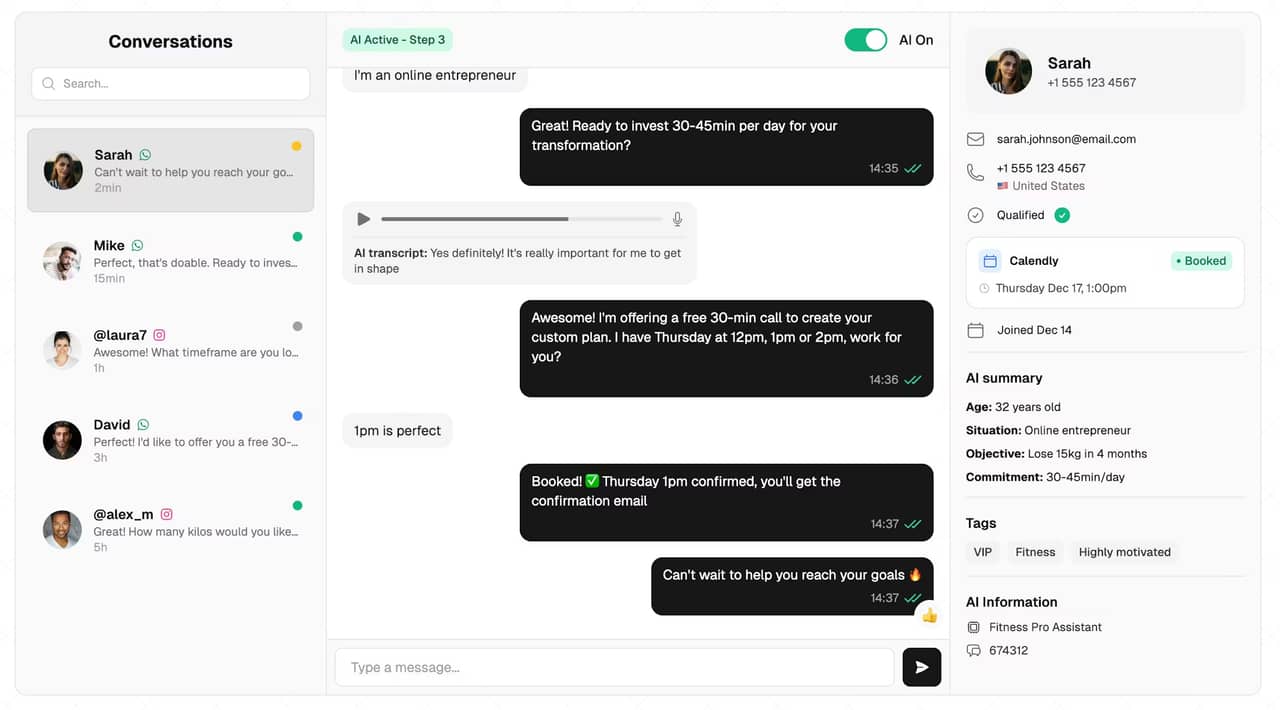
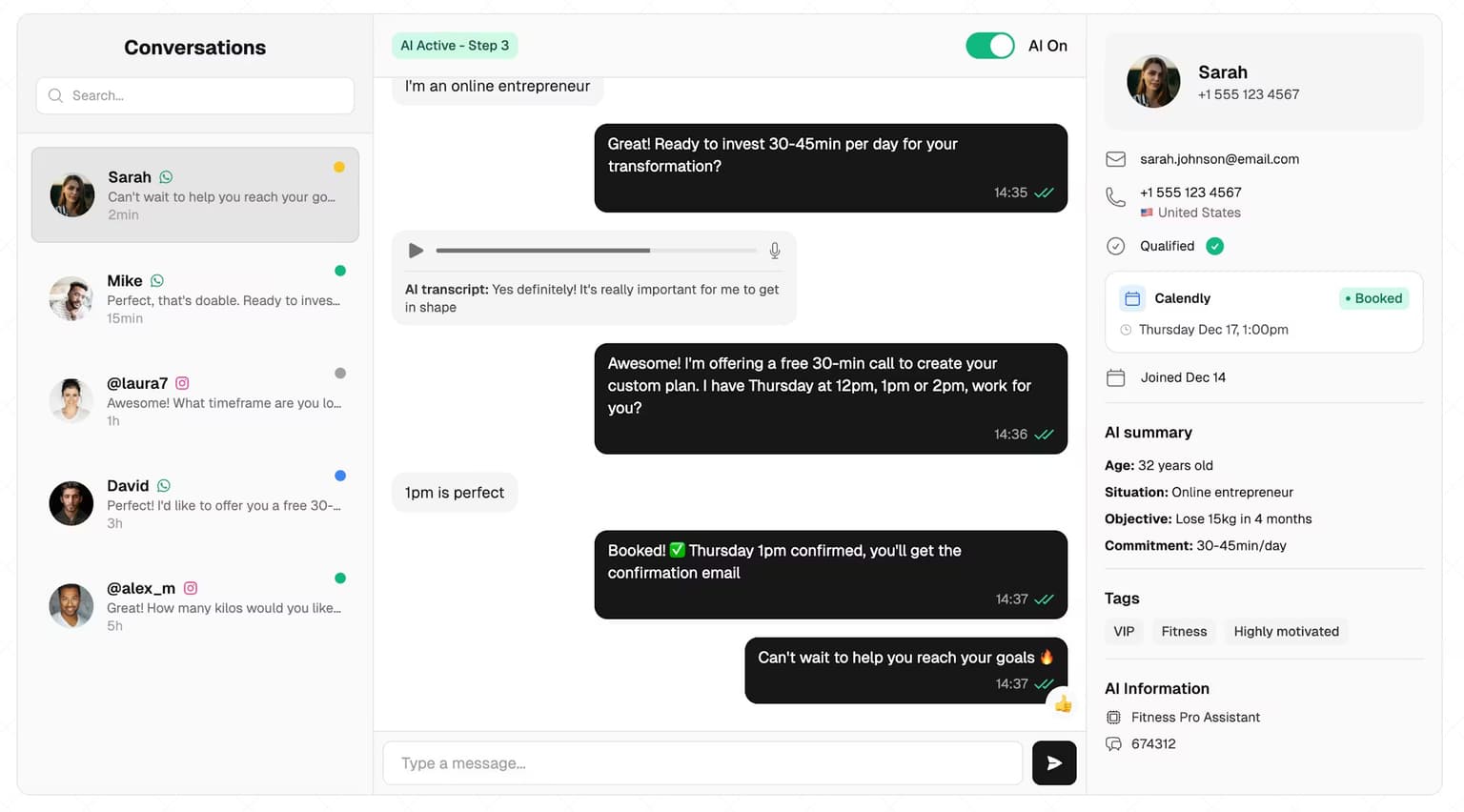
An AI setter is a conversational AI that handles the entire setting process automatically:
- Responds to every lead in under 30 seconds, 24/7
- Qualifies through natural, GPT-powered conversation (not chatbot flows)
- Asks the right questions based on your criteria
- Books calls directly in the DM conversation
- Sends smart follow-ups when prospects go silent
- Handles Instagram DMs, WhatsApp, and Messenger from one dashboard
The AI doesn't replace the closer. It replaces the setter — the high-turnover, inconsistent, availability-limited role that bottlenecks the entire sales operation.
Why AI setters outperform human setters for high ticket
| Human Setter | AI Setter | |
|---|---|---|
| Response time | 30 min to hours | Under 30 seconds |
| Availability | 8-12 hours/day | 24/7/365 |
| Consistency | Varies with mood | 100% consistent |
| Monthly cost | $1,500-$3,000 | From $97 |
| Turnover | Every 3-6 months | Zero |
| Training | 2-4 weeks | Setup in minutes |
| Capacity | 30-50 conversations/day | Unlimited |
The closer's perspective
For closers, AI setters are a massive upgrade:
- More calls on the calendar — the AI never misses a lead, so more qualified prospects get booked
- Better qualified leads — the AI follows the qualification criteria perfectly every time
- Context before each call — the AI provides a summary of the prospect's situation, goals, and concerns
- No more chasing setters — no training, no managing, no turnover headaches
"I book 15 to 25 calls per week... without managing a single setter." — Mathis Ladoué, Online Fitness Coach, 22.4K followers
"It's really crazy because our number of calls exploded, we went from 40 monthly calls to 120 monthly calls with Instagram and AI, we literally went from 15k to 60k in monthly revenue." — Théo Riffault, Fitness Coach, 46.3K followers
The new model: AI setter + human closer
The most effective high ticket sales team in 2026 looks like this:
Leads (Instagram, WhatsApp, ads, content)
        ↓
AI SETTER qualifies 24/7 via DM
        ↓
Qualified leads booked on calendar
        ↓
HUMAN CLOSER sells on the call
        ↓
Deal closed
The AI handles the high-volume, repetitive, time-sensitive part (setting). The human handles the high-value, nuanced, relationship-driven part (closing). Each does what they're best at.
For a full comparison of AI setter tools, see our 6 best AI setters in 2026.
Is High Ticket Closing Right for You?
As a business owner
High ticket closing works if:
- You sell a service or program priced at $1,000+
- Your sales process involves a phone or Zoom call
- You generate leads through social media, ads, or content
- You (or your team) currently spend hours qualifying leads in DMs
If you're spending 2-3 hours per day in DMs qualifying prospects, you're doing setter work. That's time you could spend coaching clients, creating content, or taking closing calls yourself. An AI setter gives you that time back. For coaching businesses specifically, we compared the tools that can carry that qualification conversation in our ManyChat alternative for coaches breakdown.
As a career
High ticket closing works if:
- You're a strong communicator who enjoys talking to people
- You can handle rejection and stay motivated
- You want location-independent income
- You're willing to invest in learning (courses, practice, mentorship)
Start as a setter to learn the sales process, then move to closing once you understand qualification and objection handling.
FAQ
What is high ticket closing?
High ticket closing is the process of selling premium products or services ($1,000-$50,000+) through one-on-one sales conversations. Unlike low-ticket sales that happen on checkout pages, high ticket deals require personal conversations — usually over phone or Zoom — where a skilled closer guides the prospect through the decision.
How much do high ticket closers make?
Beginner closers typically earn $2,000-$5,000/month (base + commission). Experienced closers earn $5,000-$20,000+/month, primarily on commission (10-20% of deal value). Top closers working with high-volume coaches or agencies can earn $15,000-$30,000/month.
What's the difference between a setter and a closer?
A setter qualifies leads and books calls through DM conversations (text-based, high volume). A closer sells on the phone call (voice-based, high value). The setter fills the closer's calendar. The closer turns those appointments into revenue.
Can I do high ticket closing remotely?
Yes. High ticket closing is fully remote. Setters work in DMs from anywhere with a phone. Closers take calls via Zoom from anywhere with internet. Most high ticket sales teams are 100% remote.
How do I get started in high ticket closing?
Start as a setter — it's easier to break into and teaches you the fundamentals of qualification and sales psychology. Offer to set for a coach for free for 2 weeks to build your track record. Once you understand the sales process, transition to closing.
What is the setter-closer model?
The setter-closer model is a two-role sales system where the setter qualifies leads through DM conversations and books sales calls, and the closer takes those calls and sells. It's the standard model for coaches, consultants, and agencies selling high-ticket services.
Is AI replacing high ticket closers?
No — AI is replacing setters, not closers. High ticket closing requires human judgment, empathy, and persuasion that AI can't replicate at the $5,000+ price point. But the setting role (qualifying leads in DMs, booking calls) is being automated by AI setters that respond faster, work 24/7, and cost a fraction of a human setter.
How many calls should a closer take per day?
Most closers handle 3-8 calls per day, depending on call length and energy levels. Quality matters more than quantity — a closer who takes 5 well-prepared calls per day will outperform one who takes 10 rushed calls.
The Future of High Ticket Closing
The setter-closer model isn't going away. High ticket offers still require human conversation to close. What's changing is HOW the setter role is fulfilled.
In 2025, a high ticket business needed 1-3 human setters to fill one closer's calendar. In 2026, one AI setter handles the same volume at a fraction of the cost, with better consistency and 24/7 availability.
The closers who adapt to working with AI setters — getting more calls, better qualified leads, and detailed prospect context before every conversation — are the ones closing more deals than ever.
Whether you're a coach looking to fill your closer's calendar, a closer looking for better-qualified leads, or someone exploring high ticket closing as a career — the model works. The only thing that's changed is that the setter doesn't have to be human anymore.
Ready to automate your DMs?
Start your free 7-day trial and let AI handle your lead qualification 24/7.
Try SetSmart free