How to Market Your Coaching Business (2026)
To market your coaching business in 2026, build one repeatable system instead of posting at random: sharp positioning, a content engine that starts conversations, a way to move that attention into Instagram and WhatsApp DMs, and a funnel that qualifies leads and books sales calls. The coaches who grow are not the ones posting the most. They are the ones who turn attention into a booked call on their calendar, predictably, every week.
This is a practitioner guide, written for the coach doing the marketing, not for someone shopping for a marketing coach to hire. Whether you run a fitness, nutrition, business, life, or health coaching practice, the marketing for coaches that actually moves revenue follows the same shape. Below is the full playbook: positioning, content, channels, the DM funnel that most coaches skip, paid ads, and a realistic budget. If you only want the fastest client-getting tactics, pair this with our how to get coaching clients guide; this article is the wider system those tactics plug into.
Does marketing for coaches actually work? Start with one system
Yes, but only when it is a system, not a scatter of tactics. Most coaches treat marketing as "post more, hope more." They chase reach, followers and likes, then wonder why a 20,000-follower account still cannot fill a calendar. The problem is not effort. It is that attention without a path to a conversation leaks away.
A working coaching marketing system has four jobs, in order:
- Positioning so the right person instantly knows the content is for them.
- Content built to earn a reply, not just a scroll.
- A channel move that pulls interested viewers into a DM on Instagram, WhatsApp or Messenger.
- A booking funnel that qualifies the lead and puts a sales call on your calendar.
Miss any one and the system stalls: great content with no DM move gets you famous and broke; a great funnel with weak positioning fills your calendar with the wrong people. The rest of this guide builds each layer. For the acquisition-specific angle, our lead generation for coaches breakdown maps nine DM systems that feed this exact funnel.
Step 1: Nail your positioning and offer before any tactic
Direct answer: fix positioning first, because every dollar and hour of marketing you spend is multiplied or wasted by it. Positioning is the answer to "who exactly do you help, and what specific result do you sell?"
Weak positioning sounds like "I'm a life coach helping people live their best life." Strong positioning sounds like "I help busy dads over 35 lose 20 pounds without giving up dinners out." The second one writes your content for you and repels the wrong leads before they waste your time.
Then package the result as one clear offer. Coaches who market a vague hourly rate struggle; coaches who sell a defined outcome in a defined container (a 12-week program, a 90-day transformation) convert far better. If your offer or pricing is fuzzy, sort that out first with our coaching packages guide, and if you sell a premium program, the high ticket coaching playbook covers how to structure and price it.
A quick positioning test before you market anything:
- Can a stranger tell in five seconds who your coaching is for?
- Do you name a specific, painful problem and a specific outcome?
- Is there one primary offer, not a menu of six?
If any answer is no, tighten it now. No amount of Instagram marketing for coaches rescues a muddy offer.
Step 2: Build a content engine that starts DM conversations
Direct answer: your content's job is not reach, it is to trigger a DM. Reframe every post around one question: what conversation should this start?
Content marketing for coaches works when each format has a job:
- Reels and short video: reach new people who have your problem. Hook in the first two seconds, teach one thing, end with a reason to DM ("comment PLAN and I'll send the 3-step framework").
- Carousels and posts: prove you can get the result. Case studies, client wins, before/afters, myth-busting.
- Stories: the daily relationship layer. Polls, questions and "reply to this" prompts that open one-to-one threads.
- Lives and long video: deepen trust with the warm audience who is close to booking.
The mistake is making content that earns applause but no reply. Every piece should point to a next step: a keyword to comment, a story to reply to, a link to click. That is the bridge from social media marketing for coaches to an actual conversation. For the full menu of hooks that pull people into your inbox, see our lead magnet ideas list, and to package attention into a repeatable path, the Instagram sales funnel guide.
Step 3: Turn attention into DMs on Instagram and WhatsApp
Direct answer: the DM is where coaching sells, so your whole content engine should funnel there. A view is rented from the algorithm; a DM thread is a relationship you own.
Here is how the channel move works in practice:
- Comment-to-DM: tell your audience to comment a keyword and automatically open a DM with everyone who does. This single mechanic turns a viral Reel into hundreds of conversations instead of a spike of likes. The setup lives in Instagram DM marketing and how to sell on Instagram.
- Story replies: prompts that invite a reply move warm followers into your inbox with zero friction.
- Click-to-WhatsApp: for coaches whose audience prefers WhatsApp (common outside the US), a click-to-WhatsApp button or ad drops the lead straight into a chat. Our WhatsApp marketing guide covers the DM-first version of this.
The catch every coach hits at scale: volume. When one video sends 300 people into your DMs, you cannot answer them all fast enough, and slow replies kill bookings. That is exactly the gap the next step solves.
Step 4: Qualify and book sales calls (the part most coaches skip)
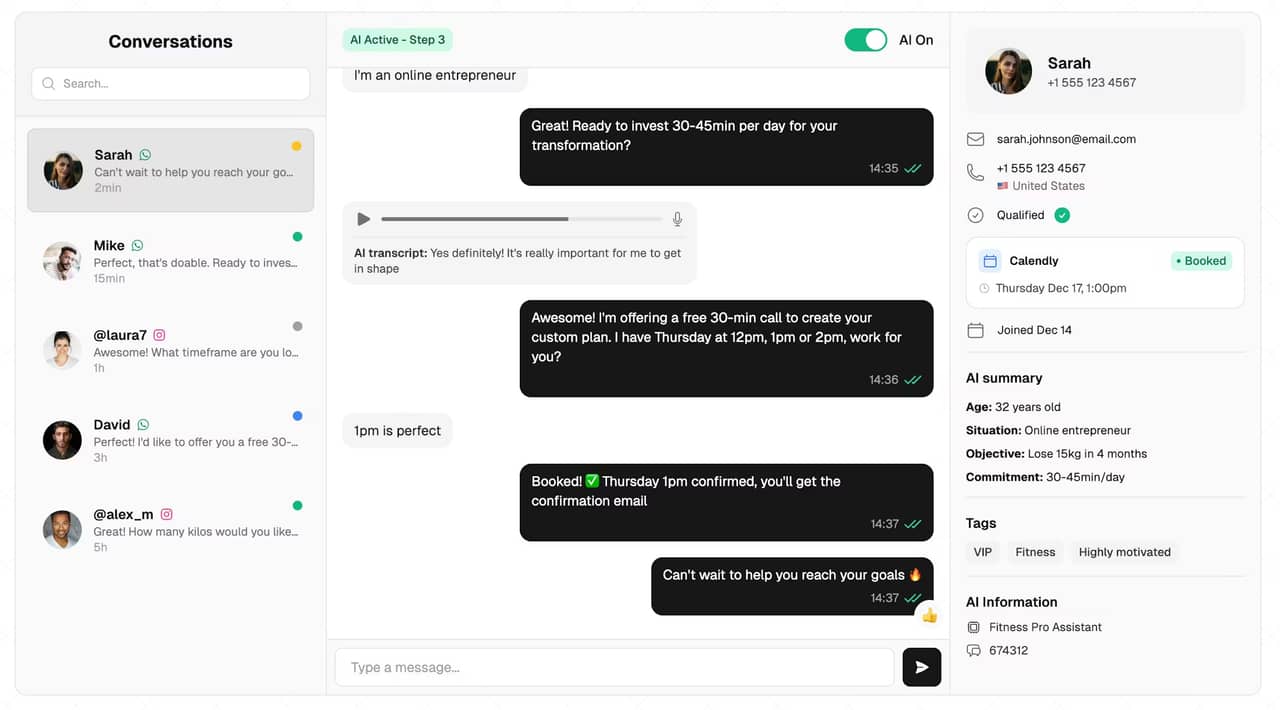
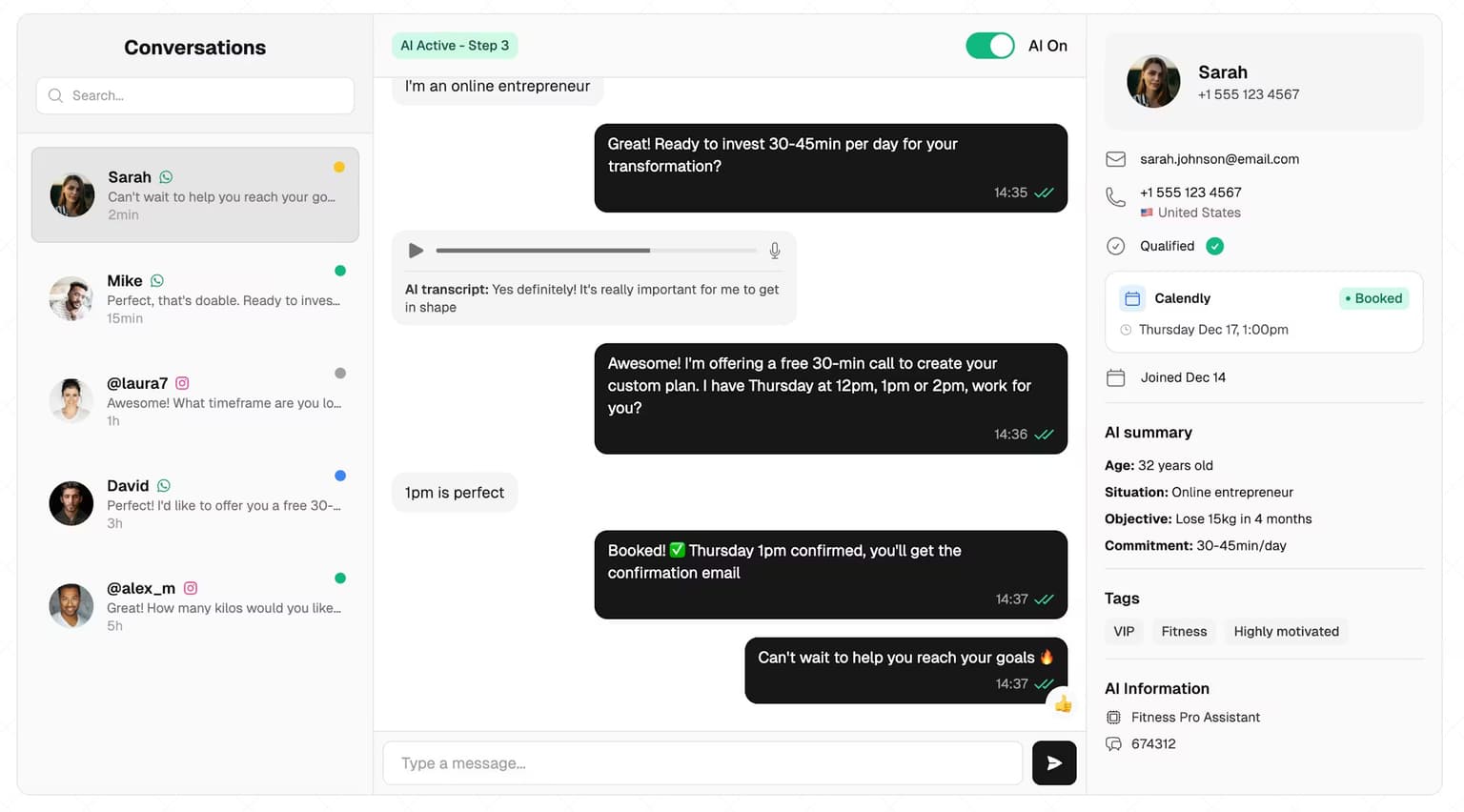
Direct answer: marketing does not end at "got a DM." It ends at "booked a qualified sales call." This is the step where most coaching marketing quietly breaks, because doing it by hand does not scale and doing it slowly loses the lead.
Two things have to happen in the DM before a call is worth your time:
- Qualify. Ask two or three questions that separate a serious buyer from a tyre-kicker: their goal, their timeline, and whether they can invest. A lead who answers these is worth a slot; one who ghosts is not.
- Book. Propose a specific time and get it on the calendar inside the chat, rather than dropping a scheduling link and hoping they follow through.
The reason this matters so much: conversations that go deeper and get followed up convert dramatically better than one-and-done replies. In our analysis of 828K DM conversations, a single follow-up message more than doubled booked calls (+106% among engaged leads), yet most coaches send zero follow-ups because they are drowning in their inbox. The study is blunt about it: depth and follow-up beat everything else.
This is where an AI setter changes the math. Instead of you personally answering 300 DMs, an AI DM setter holds the qualifying conversation, follows up automatically, and books the call on your calendar, across Instagram, WhatsApp and Messenger. Note the boundary: for high-ticket coaching the AI does not close the sale in the chat. It fills your calendar with qualified sales calls, and you (or your closer) close on the call. That call itself is covered in our discovery call and appointment setter guides.
Digital marketing channels for coaches, ranked
Not every channel deserves your time. Here is an honest ranking of digital marketing for coaches by effort-to-booked-call, for a solo or small coaching business.
| Channel | Best for | Speed to first call | Effort |
|---|---|---|---|
| Instagram DMs | Most coaches | Fast | Medium |
| Non-US, warm lists | Fast | Medium | |
| Short-form video | Cold reach | Medium | High |
| Email / newsletter | Nurture existing list | Slow | Medium |
| Paid ads | Scaling a proven funnel | Fast (paid) | High + budget |
| SEO / blog | Long-term authority | Very slow | High |
The takeaway for online marketing for coaches: start where the conversation is closest to the money. For most coaches that is Instagram (and WhatsApp for warm or non-US audiences), because a DM is one step from a booked call. Video feeds the top; email and SEO compound over months, and SEO is now the easiest channel to delegate: an AI SEO agent like Syted publishes researched posts to your blog daily, which also helps you get cited by ChatGPT when prospects ask it for coach recommendations. If you are still choosing where to run your whole business, the best online coaching platforms and how to start an online coaching business guides help you set the foundation.
Step 5: Add paid ads only after the organic funnel converts
Direct answer: do not run ads to a funnel that does not already convert organically. Ads amplify whatever exists. Point them at a leaky funnel and you pay to lose leads faster.
The right sequence for a coaching business:
- Prove your positioning and offer convert with organic content and DMs.
- Confirm your DM funnel reliably books calls (you qualify, follow up and book, or an AI setter does it for you).
- Only then put budget behind your best-performing content or a click-to-WhatsApp / lead-form ad, sending traffic into the same DM funnel that already works.
This order protects your money. A coach who nails Steps 1 to 4 can turn ads into a predictable pipeline; a coach who skips them just donates to Meta. Verticals like fitness follow the exact same path, laid out in our fitness marketing playbook.
How much should a coach spend on marketing?
Direct answer: in the early stage, spend time before money. Your first clients should come from organic content plus a tight DM funnel, not ad spend. The real cost early on is the hours you lose answering DMs and chasing no-shows, which is why automating the qualify-and-book layer often returns more than an ad budget would.
Once you have a proven funnel and want to scale, a common starting point is a small daily ad budget pointed at your best content, scaled only as your cost-per-booked-call stays profitable. The metric that matters is not cost-per-click or cost-per-follower; it is cost-per-qualified-call and, ultimately, cost-per-client. Track those two and you will always know whether your marketing for coaches is working.
To keep your pipeline organised as volume grows, tools like a purpose-built Instagram CRM and the wider Instagram automation tools field help you avoid losing leads in a chaotic inbox.
FAQ
How do I start marketing my coaching business with no audience?
Start with one platform, sharp positioning, and content built to earn a DM, not reach. Post consistently, use comment-to-DM and story replies to open conversations, and qualify plus book those leads by hand at first. You do not need a big audience to fill a calendar; you need a clear offer and a working DM funnel, then you scale what converts.
What is the best marketing strategy for coaches in 2026?
A DM-first funnel: content that starts conversations, a channel move (comment-to-DM, story replies, click-to-WhatsApp) that pulls interested people into your inbox, and a qualify-and-book step that turns those chats into sales calls. Everything else (email, SEO, ads) supports this core loop rather than replacing it.
How do life coaches and health coaches market themselves?
The same system applies across niches: life, health, fitness and business coaches all win by positioning around a specific person and result, publishing proof-driven content, and moving warm attention into DMs where they qualify and book calls. The niche only changes the message and the hook, not the underlying marketing machine.
Do coaches need paid ads to grow?
No, not to start. Most coaches can book their first clients with organic content and a tight DM funnel. Ads are a scaling tool: run them only once your positioning, offer and DM funnel already convert, so you amplify a system that works instead of paying to expose a broken one.
How do I get more sales calls from my Instagram content?
Point every post at a next step, then handle the DMs fast. Add a clear call to action (comment a keyword, reply to a story), open the DM automatically, ask two or three qualifying questions, and book a specific time in-chat. Speed and follow-up are decisive, which is why many coaches let an AI setter run the qualify-and-book step at scale.
What is the difference between marketing and lead generation for coaches?
Marketing is the whole system: positioning, content, channels and funnel. Lead generation is one part of it, the acquisition step that fills the top of the funnel with interested people. This guide covers the full system; for the acquisition tactics specifically, see lead generation for coaches.
Ready to automate your DMs?
Start your free 7-day trial and let AI handle your lead qualification 24/7.
Try SetSmart free