Instagram Sales Funnel: DMs to Booked Calls (2026)

Most coaches on Instagram do not have a traffic problem. They have a funnel problem. Followers come in from a good Reel, a few people comment, a handful slide into the DMs, and then most of them evaporate because there is no system to move them from "nice post" to "booked call." An Instagram sales funnel is that system: the repeatable path that turns a stranger who watched one video into a qualified lead sitting on your calendar.
This guide breaks the funnel down stage by stage for coaches, course creators, and creator-led businesses selling a real offer, not for ecommerce stores pushing a $20 product. The finish line here is a booked sales call, because that is how high-ticket coaching actually sells. We will show you what each stage does, where leads leak out, and how to automate the middle so you are not living in your DMs. If you want the broader selling playbook first, our how to sell on Instagram guide is the companion piece.
What is an Instagram sales funnel?
An Instagram sales funnel is the step-by-step journey a follower takes from first seeing your content to becoming a paying client. Direct answer: it has three jobs, in order, which are to attract the right people, engage and capture them into a DM conversation, and qualify and book them onto a sales call.
Marketers often describe this with the classic funnel language: top of funnel (TOFU, awareness), middle of funnel (MOFU, consideration), and bottom of funnel (BOFU, decision). On Instagram those map cleanly onto content that gets discovered, DMs that build a relationship, and a booked call that leads to a sale. The reason a "funnel" is the right mental model is that each stage is narrower than the last: not every viewer comments, not every commenter DMs, and not every DM books. Your job is to plug the leaks at each step so more of the traffic you already have makes it to the bottom.
The mistake most creators make is treating Instagram as a single action ("post and hope") instead of a funnel. They pour effort into reach at the top and have nothing built to catch the interest they create. A working Instagram lead generation system is really just a funnel with no gaps between the stages.
The Instagram sales funnel stages
Here is the full funnel mapped from awareness to a closed sale, with the goal, the tools, and where leads typically leak at each stage.
| Stage | Goal | Main tools | Where leads leak |
|---|---|---|---|
| Attract (TOFU) | Get discovered by the right people | Reels, carousels, stories | Reach the wrong audience |
| Capture (MOFU) | Move followers into the DM | Comment-to-DM, link in bio, lead magnet | No clear next step |
| Qualify (MOFU) | Separate buyers from browsers | DM conversation, AI setter | Slow or no reply |
| Book (BOFU) | Get the call on the calendar | Calendar link, in-chat booking | Friction and no follow-up |
| Close (BOFU) | Turn the call into a client | Human sales call | No-shows, weak offer |
Notice that three of the five stages happen in the DM. That is not an accident. Instagram is a conversation platform, and for a service business the DM is where the money is made. Let us go through the funnel one stage at a time.
Stage 1: Attract the right followers (TOFU)
The top of the funnel is content, and the only metric that matters here is whether you are attracting the right people. A Reel that goes viral with an audience that will never buy your coaching is a vanity spike, not a funnel input. Aim your content at the specific problem your offer solves so the followers you gain are potential buyers. Running Instagram collabs with a peer coach puts that top-of-funnel content in front of their audience as well.
Practically, that means most of your posts should speak to the pain, mistakes, and desires of your ideal client. If you are a nutrition coach for busy moms, your content is about realistic meal prep and undoing diet myths, not generic "5 abs exercises" clips that pull in teenagers. The goal of TOFU is qualified attention, not raw reach.
You do not need a huge account for this to work. A funnel converts a percentage of the traffic it gets, so a focused account of 3,000 of the right followers will out-earn a scattered account of 50,000 wrong ones. Once your content is pulling in the right people, the job shifts to getting them out of the feed and into a conversation.
Stage 2: Move followers into the DM (MOFU)
This is the stage almost everyone skips, and it is where most funnels break. A follower who watches your content but never messages you is stuck at the top forever. You have to give them an obvious, low-friction reason to open a DM. There are three reliable mechanisms.
Comment-to-DM triggers. You post a Reel and say "comment WORD and I'll send it to you," then an automation DMs everyone who comments. This is the single best top-of-funnel-to-DM bridge on Instagram, and it works because it converts a public micro-action (a comment) into a private conversation. Our comment-to-DM automation guide covers the setup, and you can pair it with an auto-DM flow to deliver the promised resource instantly.
Link in bio and story prompts. Your bio link should point to one clear next step, not a wall of options. Understanding what a link in bio is really for, and building a focused Instagram link in bio page, keeps this stage clean. Stories add a second capture surface: polls, question stickers, and "DM me X" prompts all pull viewers into the inbox.
A lead magnet worth trading a DM for. A free guide, a template, a mini-training, or a quiz gives people a reason to raise their hand. If you want ideas, our lead magnet ideas list and the quiz funnel format both work well as the "bait" that starts the conversation. A well-placed welcome message then greets new DMs so no one lands in silence.
However you do it, the outcome of Stage 2 is the same: a follower becomes a live DM conversation. Now the real work begins.
Stage 3: Qualify the lead in the DM (MOFU)
Getting a DM is not the same as getting a lead. Someone who comments a keyword might be a serious buyer or might be a tire-kicker who forgets you exist in ten minutes. Qualifying is the act of finding out, fast, without burning your time on people who will never buy.
Qualifying is a short, natural conversation that surfaces three things: the lead's goal (what they actually want), their timeline (how soon), and their fit (budget, situation, whether your offer matches). A good qualifying conversation feels like a helpful chat, not an interrogation. Done right, it does two jobs at once: it filters out the browsers and it warms up the buyers so they arrive at the call ready.
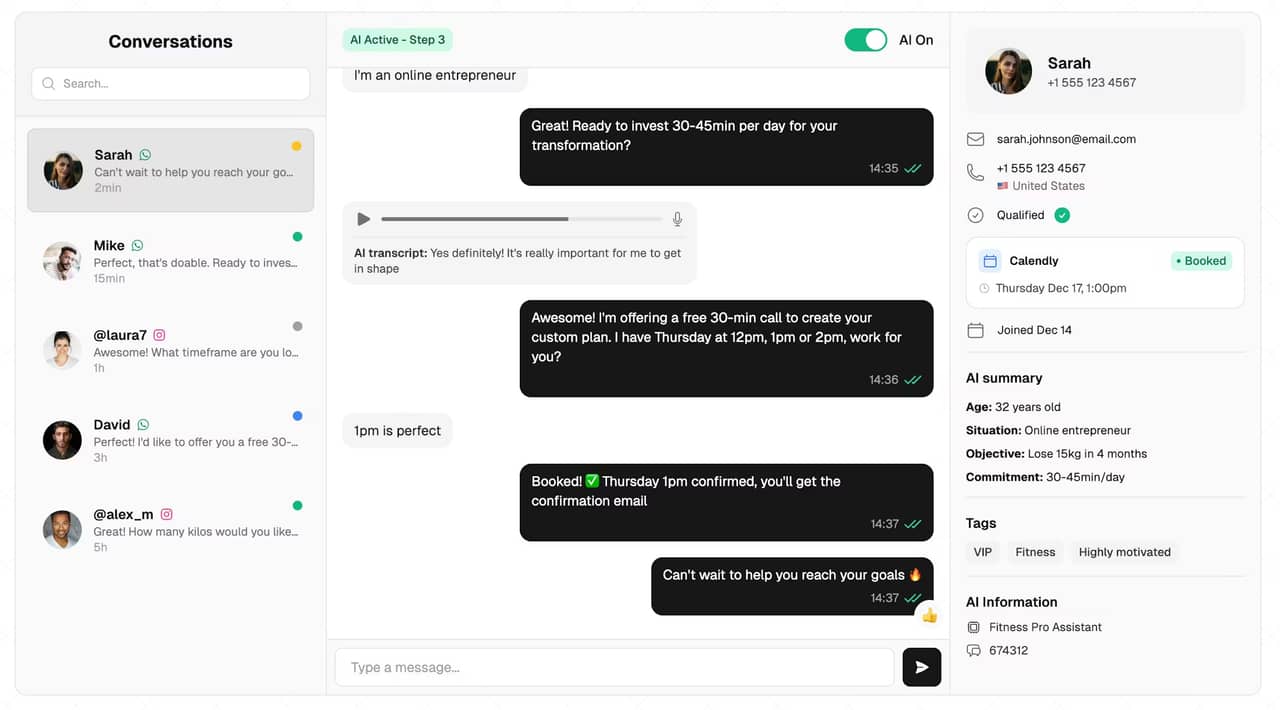
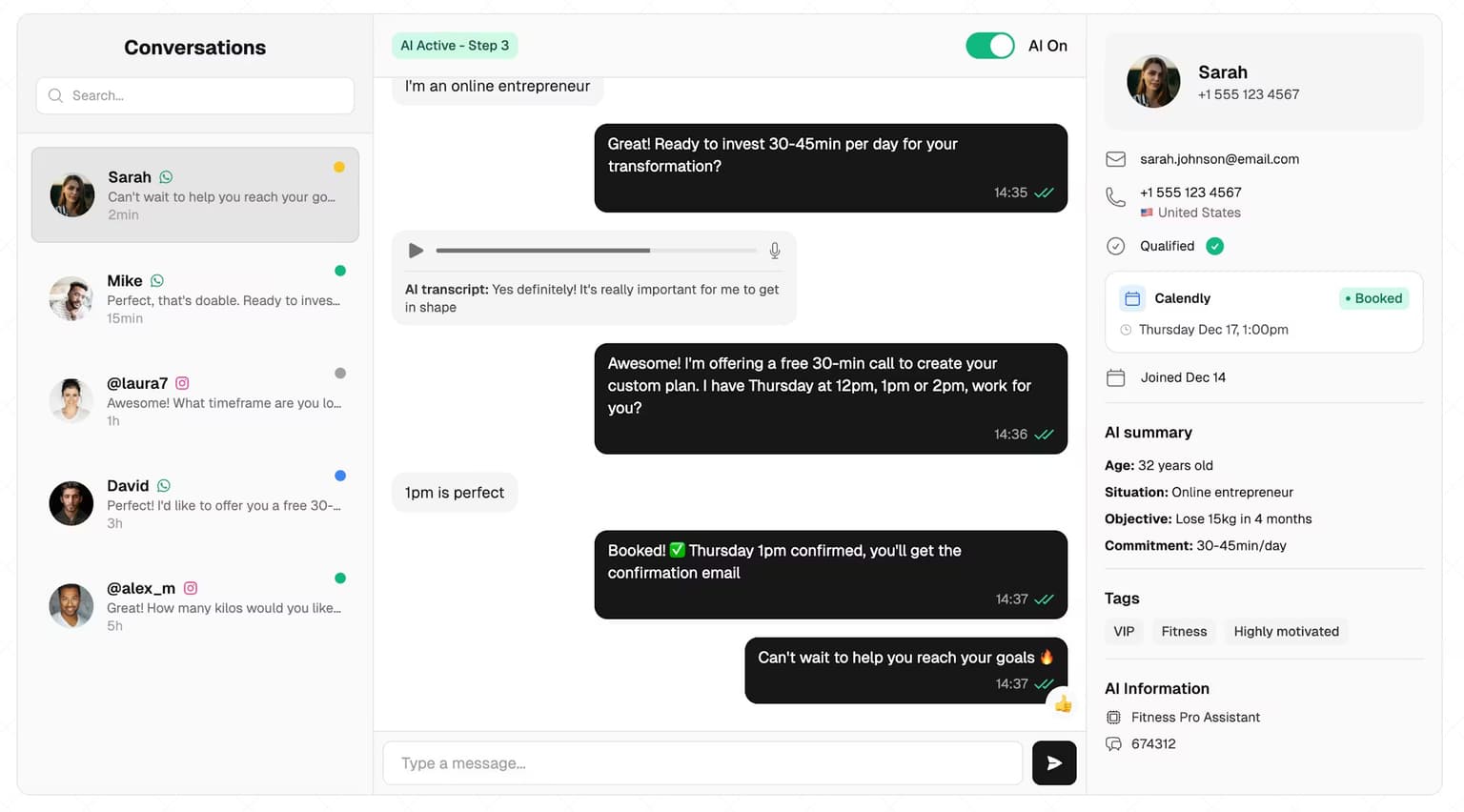
The problem is speed and consistency. Leads go cold in minutes, and no human can answer every DM in seconds, all day, without dropping follow-ups. This is exactly what an AI DM setter is built for: it holds the qualifying conversation in natural language, replies instantly around the clock, and never forgets to follow up. In our analysis of 828K Instagram and WhatsApp DM conversations, a single follow-up message more than doubled booked calls (+106% among engaged leads), and more than half of conversations die before the third message. An automated setter closes both gaps by responding fast and following up every time. If you are new to the concept, what is a DM setter explains the role, and our Instagram DM automation guide shows the mechanics.
Stage 4: Book the sales call (BOFU)
A qualified lead who never books is a wasted qualification. The bottom of the funnel is about removing every ounce of friction between "I'm interested" and "I'm on the calendar." The classic mistake is to qualify a lead and then paste a raw Calendly link and hope. Most people do not click, do not choose a time, and drift.
The higher-converting approach is to book inside the conversation. Instead of handing over a link, you offer two or three specific times ("I've got Tuesday at 2pm or Wednesday at 10am, which works?") and confirm the slot right there in the chat. This is where a modern AI setter earns its keep: it proposes calendar slots in the DM, confirms the booking against your real calendar (Calendly or GoHighLevel), and chases the lead with automatic follow-ups if they go quiet. The tools that do this best are ranked in our best AI setters roundup.
Booking is also where your Instagram CRM matters. Knowing which leads are qualified, booked, or waiting on a reply stops good conversations from slipping through the cracks. The outcome of Stage 4 is concrete and countable: a qualified lead with a confirmed time on your calendar.
Stage 5: Close on the call (BOFU)
The last stage happens off Instagram, on the sales call itself. This matters because it corrects a myth worth killing: your DMs do not, and should not, close a high-ticket offer. Trying to sell a $3,000 coaching program over text is how deals die. The DM funnel exists to book the call; the human conversation on that call is where the offer is presented and the client says yes.
This is the honest division of labor. The funnel automates attracting, capturing, qualifying, and booking, which are the repetitive, time-sensitive steps that do not need you personally. The sales call itself, where you handle real objections and make the pitch, stays human. If you want to sharpen that final step, our high-ticket closing guide covers the call, and discovery call walks through the structure of that first conversation.
Frame your whole funnel around this and the strategy gets simple: fill your calendar with qualified sales calls, then close them on the call. Everything upstream exists to make that calendar fuller and the leads on it warmer.
Common Instagram sales funnel mistakes
Even creators who understand the stages leak leads by making a few predictable errors. Watch for these:
- No bridge from content to DM. Great Reels, no comment-to-DM or clear call to action. The audience has nowhere to go, so they stay passive followers forever.
- Qualifying too slowly. Replying to DMs once a day means most leads have already cooled off. Speed is a conversion lever, not a nicety.
- Handing over a link instead of booking. A calendar link is friction. Offering specific times in the chat converts far more of the same qualified leads.
- No follow-up. The majority of conversations stall before they go anywhere, and one good follow-up recovers a huge share of them. Doing this manually at scale is impossible, which is why it gets skipped.
- Trying to close in the DM. For high-ticket offers, pushing for the sale over text lowers your close rate and your price. Book the call and close there.
- Treating every follower the same. A funnel sorts people by intent. Skipping qualification means you spend your energy on browsers and starve the buyers of attention.
Most of these come down to the middle of the funnel being manual. Automate the capture, qualification, and booking, and the leaks close on their own.
Tools you need to run an Instagram sales funnel
You can start a funnel with nothing but content and a bio link, but a few tools make it scalable:
- A comment-to-DM and DM automation tool to bridge content into conversations and deliver lead magnets instantly.
- An AI setter to qualify leads, book calls, and follow up automatically, so the middle of the funnel runs without you glued to your phone.
- A calendar (Calendly or GoHighLevel) connected to your booking step so slots are confirmed in real time.
- A CRM view of your leads so you know who is qualified, booked, or waiting. An Instagram CRM does this without a separate spreadsheet.
- A broadcast channel to nurture the followers who are not ready yet. An Instagram broadcast channel keeps warm leads engaged until they are.
SetSmart combines the qualifying, booking, and follow-up steps into one AI setter that runs across Instagram, WhatsApp, and Messenger. It is a free 7-day trial, then $97/month including 1,000 messages, so you can wire the middle of your funnel to an AI and get your DMs back. It is an Official Meta Business Partner, so it runs on the official API rather than risky automation. Pair it with your content engine at the top and a strong close on the call, and you have a complete funnel.
FAQ
What is an Instagram sales funnel?
An Instagram sales funnel is the repeatable path a follower takes from discovering your content to becoming a client. It has three core jobs: attract the right people with content, capture them into a DM conversation, and qualify and book them onto a sales call. For coaches and creators, the funnel ends at a booked call, and the sale is closed on that call rather than in the chat.
How do you build a sales funnel on Instagram?
Start by posting content aimed at your ideal client's problem so you attract qualified attention. Add a bridge (comment-to-DM triggers, a lead magnet, a clear link in bio) to move followers into the DM. Then qualify each lead with a short conversation, book them onto a call with specific times, and close on the call. Automating the qualifying and booking steps with an AI setter keeps the funnel running without you answering every DM by hand.
What are the stages of an Instagram sales funnel?
The five stages are attract (get discovered by the right people), capture (move followers into the DM), qualify (separate buyers from browsers), book (get the call on the calendar), and close (turn the call into a client). The first stage is content, the middle three happen in the DM, and the last happens on a human sales call.
Do you need paid ads for an Instagram sales funnel?
No. A funnel works on organic content alone if your posts attract the right audience and you have a clear path from content to DM to call. Ads can accelerate the top of the funnel by putting your content in front of more of the right people, but they are an amplifier, not a requirement. Many coaches run a full funnel with zero ad spend.
What is the best tool for an Instagram sales funnel?
The middle of the funnel (qualifying and booking) is the part worth automating, so an AI DM setter is the highest-leverage tool. It replies instantly, qualifies leads in natural language, books calls in the chat, and follows up automatically. See our best AI setters roundup for a ranked comparison, and pair it with a comment-to-DM tool for the capture step.
Can you close high-ticket clients in the Instagram DM?
You should not try to. For a high-ticket coaching offer, the DM funnel exists to qualify the lead and book a sales call, not to close the deal over text. The close happens on the human call, where you handle objections and present the offer. Framing your funnel around booking calls (not closing in chat) both converts better and protects your price.
Ready to automate your DMs?
Start your free 7-day trial and let AI handle your lead qualification 24/7.
Try SetSmart free