Sales Funnel for Coaches: Fill Your Calendar (2026)

Most coaches do not have a marketing problem. They have a funnel problem. Leads come in from a reel, a story, or an ad, and then they leak out everywhere: the DM sits unread for six hours, the tire-kickers get the same attention as the buyers, and the person who was ready to enroll drifts off before anyone books a call.
A sales funnel for coaches is the system that stops the leak. It takes the attention you already earn on Instagram, WhatsApp, and Messenger and turns it into a predictable calendar of qualified sales calls. Not more followers. Not more content for the sake of content. A repeatable path from "who is this person" to "they are on your calendar Thursday at 2pm."
This guide walks through what a coaching sales funnel actually is in 2026, the five stages every version shares, the funnel types that fit different offers, the tools you need, and the one shift that separates coaches who scale from coaches who stay stuck on the content treadmill.
What a sales funnel for coaches actually is
A sales funnel for coaches is the step-by-step journey a stranger takes from first noticing you to becoming a paying client. Each stage filters out the wrong people and moves the right ones closer to a decision, which for most coaches means a booked and attended sales call.
It helps to name the two jobs your funnel does, because coaches constantly blur them:
- Appointment setting. Attract, capture, qualify, and book. This is the top and middle of the funnel, and today it happens mostly in the DM.
- Closing. Present the offer, handle objections, and enroll the client. This happens live, on the call, run by you or a high-ticket closer.
Keep those separate and everything gets simpler. The DM is your appointment-setting layer, not your sales floor. Your inbox exists to fill the calendar with people who fit your offer. The close happens on the call. Coaches who try to "sell in the DM" burn leads; coaches who use the DM to book the right calls sell far more, with less effort. If you have never formalized this, start with what a DM setter does and build the funnel around it.
The 5 stages of a coaching sales funnel
Almost every framework you have seen, from AIDA to a full value ladder, collapses into five stages a coach can actually run. Learn these and you can diagnose any leak in minutes.
- Awareness. A stranger discovers you through a reel, a Story, a podcast, a referral, or a paid ad. The only goal here is a first impression that earns a second look.
- Interest. They engage: a follow, a comment, a saved post, a Story reply. They are raising a hand, but quietly. Your content has to give them a reason to raise it higher.
- Capture. The vague interest becomes a real conversation. They comment a keyword, tap "send message" on an ad, download a lead magnet, or reply to a Story. Now you have a thread you can work.
- Qualification. You ask fit questions in the chat: their goal, their situation, their timeline, and whether your offer matches. This is where a browser gets separated from a buyer.
- Booking and close. A qualified lead gets calendar slots in the DM, books a call, shows up, and enrolls on the call.
Notice that stages three, four, and five all happen inside the DM. That is the big change from the old landing-page funnel: your audience no longer fills in a web form, they reply to a message. Your funnel has to live where the conversation already is.
Why most coaching funnels leak (and where)
If your funnel feels busy but your calendar is empty, you have a leak. In practice, coaching funnels almost always break in the same three places.
Leak 1: slow response. Interest is perishable. A lead who messaged you at 9pm and hears back at noon the next day has already cooled, googled three competitors, or forgotten why they reached out. Speed is the single most controllable lever in the whole funnel; the data on lead response time is brutal, with the average business taking dozens of hours to reply while the window to qualify a lead is measured in minutes.
Leak 2: no qualification. When every DM gets the same generic "hey thanks for reaching out," you spend your best hours on people who will never buy and rush the ones who would. A funnel without a qualification step is just a busy inbox. Structured lead qualification by message is what turns volume into booked calls.
Leak 3: no follow-up. Most conversations die young. Someone asks about your program, gets distracted, and never hears from you again. A single, well-timed follow-up recovers a huge share of those threads. In our analysis of 828K real DM conversations, one follow-up alone was enough to roughly double the number of booked calls, yet most coaches send zero.
Plug those three leaks and you often do not need more traffic at all. You just stop wasting the traffic you already have.
Build your coaching sales funnel step by step
Here is how to assemble the funnel end to end. Do it in this order, because each stage only matters if the one before it works.
Step 1: Attract with a clear reason to reply
Content and ads have one job at the top of the funnel: give an ideal client a specific reason to open a DM, not just to double-tap. That means posts and reels that end with a concrete next step ("comment PLAN and I'll send the framework"), Stories with a poll or question sticker, and ads built to start a chat. If you are still figuring out organic reach, the tactics in how to sell on Instagram and the wider coaching marketing playbook cover the attract layer in depth.
Step 2: Capture the interest into a conversation
Move that interest off the feed and into a thread. The cleanest capture mechanisms for coaches are keyword triggers (comment-to-DM automation), a lead magnet delivered in the chat, and click-to-message ads that open Instagram, Messenger, or WhatsApp directly. The moment they are in your inbox, the funnel is yours to run.
Step 3: Qualify every lead by message
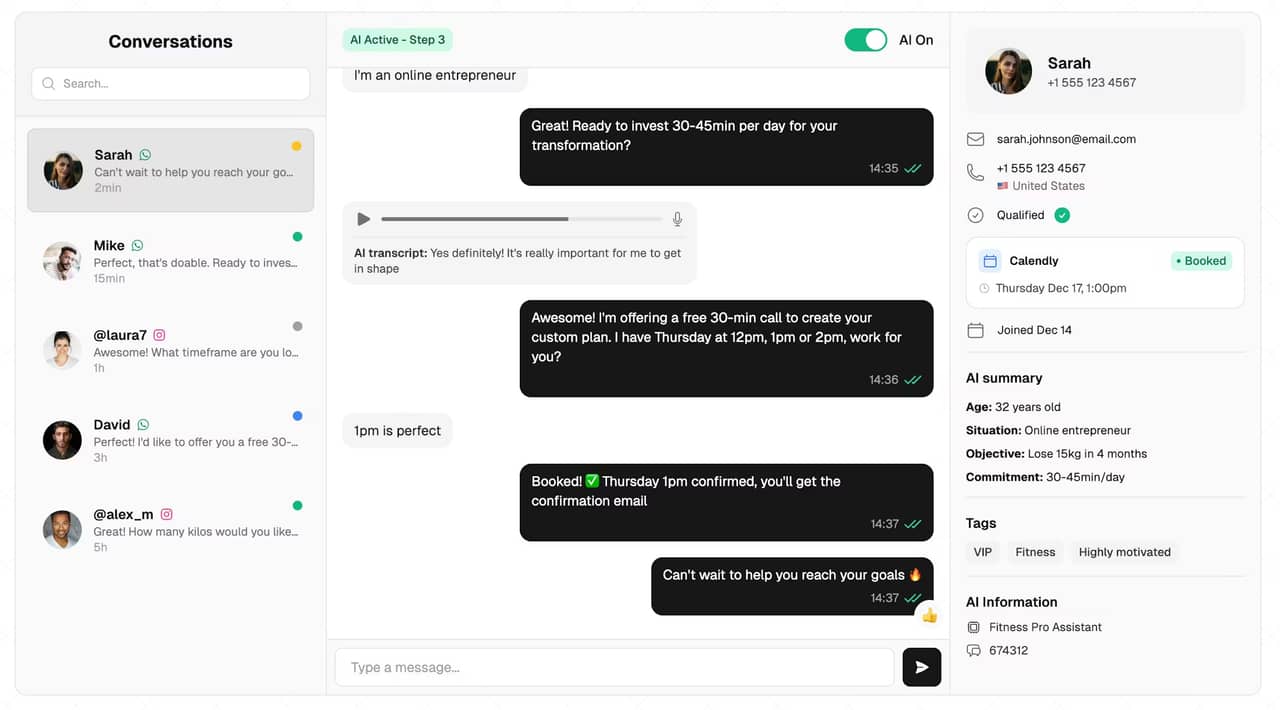
This is the stage coaches skip and then wonder why their calls are full of people who cannot afford the program. Ask three or four fit questions inside the chat before you ever offer a slot: what they want, where they are now, their timeline, and whether the investment works for them. Good lead qualification questions do the sorting for you, so only real prospects reach your calendar.
Step 4: Book the call in the chat
Never send a qualified lead to "DM me and we'll figure it out." Offer calendar slots right there in the conversation and confirm the booking automatically. This is the exact job of an appointment setter, and it is where a manual process falls apart at scale, because a human cannot answer every DM in seconds at 11pm.
Step 5: Close on the call, then deliver
The booked call is where you enroll. Run a real discovery call, present your high-ticket offer, and close. Then deliver the result and turn happy clients into referrals and testimonials that feed the top of your funnel again. The funnel is a loop, not a line.
Funnel types: which one fits your coaching offer
"Sales funnel for coaches" is not one shape. The right structure depends on your price point, your audience temperature, and how much you enjoy being on camera. Here are the four that actually work for coaches, and who each one fits.
| Funnel type | Best for | How leads convert |
|---|---|---|
| DM / organic funnel | Coaches with an engaged Instagram or WhatsApp audience | Content triggers a DM, AI qualifies and books the call |
| Webinar funnel | Group programs and mid-ticket offers | Registration, live or automated webinar, then a DM to book |
| Quiz / application funnel | High-ticket coaching that needs strong filtering | A quiz or application pre-qualifies before a call |
| Ad-to-DM funnel | Coaches ready to spend on paid reach | Click-to-message ad opens a chat, AI setter qualifies and books |
Most coaches over-engineer this. If you already have an audience, start with the DM/organic funnel; it has the fewest moving parts and the shortest path from attention to booked call. Layer a quiz funnel or webinar on top only when volume justifies the extra complexity. The full Instagram sales funnel breakdown shows how the DM version runs end to end.
Tools you need to run a coaching sales funnel
You need far less software than the gurus sell you. A working coaching funnel usually comes down to four building blocks.
- A capture layer. Comment-to-DM triggers and click-to-message ads to start conversations. Basic Instagram DM automation and WhatsApp automation cover this.
- A qualifier and booker. The piece that reads each conversation, asks fit questions, and drops calendar slots in the chat. This is the AI setter layer, and it is what makes the funnel run without you glued to your phone.
- A calendar. Calendly or GoHighLevel, connected so the booking is confirmed inside the DM.
- A place to close. A simple call framework and your offer. No fancy sales page required to book high-ticket coaching calls.
Notice what is missing: you do not strictly need a website, a landing-page builder, or a bloated CRM to start. For most coaches the DM is the funnel, and the tool that matters most is the one that qualifies and books while you sleep. If you want to compare options, the best AI setters breaks down the tools built for exactly this job.
Where the AI setter fits: your appointment-setting layer
Here is the shift that makes a coaching funnel actually scale. The three DM stages, capture, qualification, and booking, are repetitive, time-sensitive, and identical every time. That is precisely the work software should do so you can focus on delivery and closing.
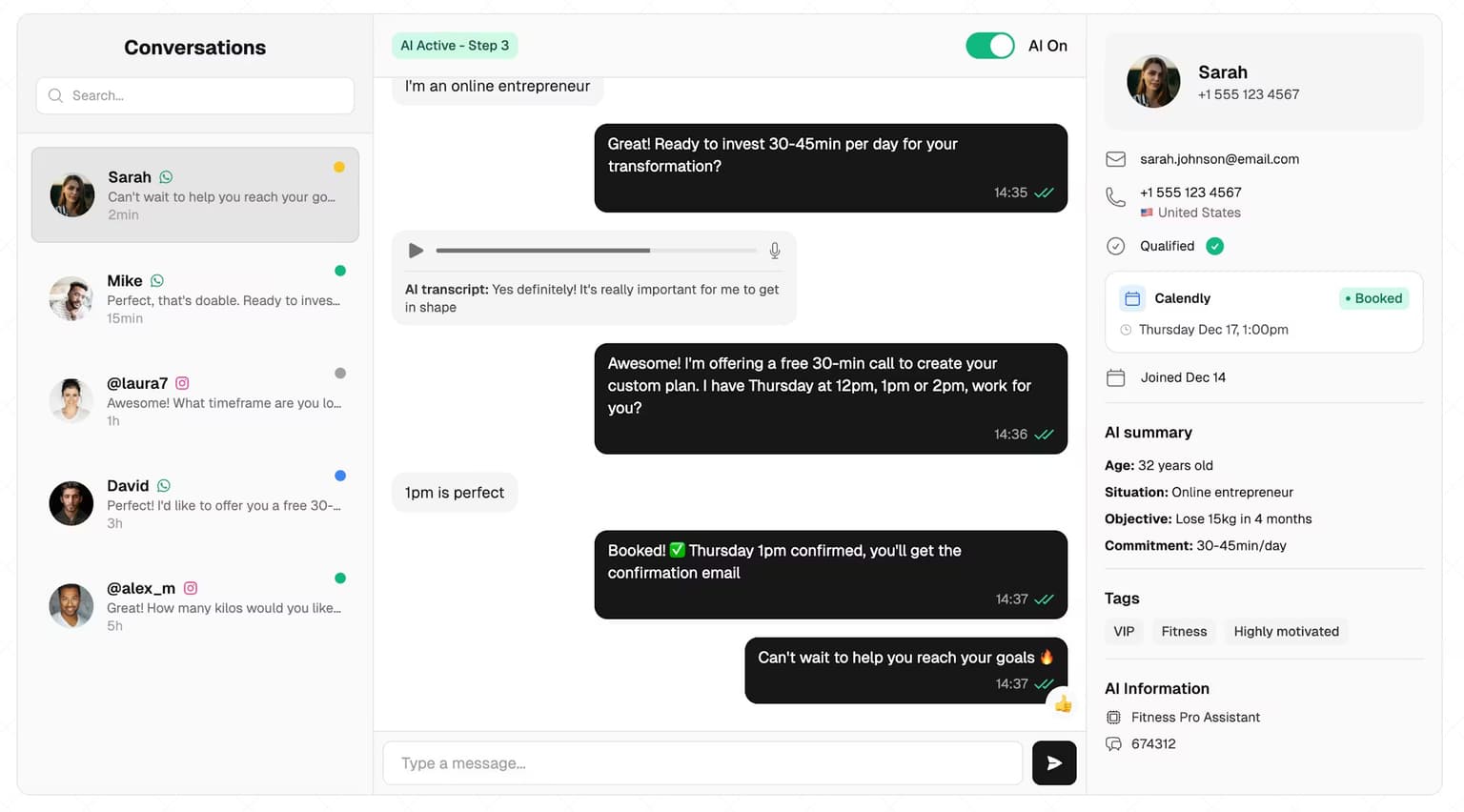
An AI DM setter sits on your Instagram, WhatsApp, and Messenger inbox and runs those three stages automatically. It replies in seconds instead of hours, asks your qualification questions in a natural conversation, follows up on the leads who go quiet, and books qualified prospects straight into your calendar. It does not close in the DM, and it should not, because your coaching sells on a call, not in a chat window. What it does is guarantee that the call actually gets booked with the right person while the interest is still hot.
This is the difference between a funnel that depends on your energy and one that runs on a system. You still show up on the call and enroll the client. Everything upstream, the part that eats your evenings and leaks your best leads, becomes a reliable machine that fills the calendar for you.
Common mistakes coaches make with their funnel
Even coaches with great content sabotage their own funnel in predictable ways. Avoid these and you are ahead of most of your market.
- Skipping qualification to look "not salesy." Asking fit questions is a service, not a pitch. It protects your calendar and their time.
- Manual replies as a badge of honor. Answering every DM yourself feels authentic until you miss the 9pm buyer because you were asleep. Systems do not make you less personal; they make you reachable.
- No follow-up sequence. One or two well-timed messages recover a large share of stalled conversations. Set them up once. See AI lead follow-up for the timing.
- Selling the price before the fit. Talking money before a lead is qualified kills the thread. Qualify first, book the call, and let the offer land live where you can frame the value.
- Chasing new traffic to fix a conversion leak. More reach into a leaky funnel just wastes more attention. Plug the leaks first, then scale the traffic.
If you are still building the audience side, pair this with how to get coaching clients so the top of your funnel stays full while the middle does its job.
FAQ
What are the 5 stages of a sales funnel?
For coaches, the five stages are awareness, interest, capture, qualification, and booking/close. A stranger discovers you, engages with your content, starts a DM conversation, gets qualified with fit questions, and then books and attends a sales call where you enroll them. The first two stages happen in public; the last three happen in the DM.
What is the best sales funnel for coaches?
For most coaches, the best starting funnel is the DM/organic funnel: content triggers a conversation, an AI setter qualifies and books the call, and you close live. It has the fewest moving parts and the shortest path from attention to a booked call. Add a webinar or quiz funnel only once volume justifies the extra complexity.
How much does a coaching sales funnel cost to run?
Less than most coaches expect. You need a way to capture DMs, a tool to qualify and book, and a calendar. An AI setter like SetSmart starts with a free 7-day trial, then from $97/month including 1,000 messages, which for many coaches replaces both a virtual assistant and a manual setter. You do not need an expensive website or funnel-builder subscription to begin.
Do I need a website or funnel builder for a coaching funnel?
No. In 2026 most coaching sales happen inside Instagram, WhatsApp, and Messenger, so the DM is your funnel. A landing page or funnel builder can help for ads or webinars, but you can book high-ticket calls with nothing more than content, a capture trigger, and an AI setter that qualifies and books in the chat.
What is the 70/30 rule in coaching?
The 70/30 rule usually refers to talk time: the client should speak roughly 70% of the time and the coach about 30%. It applies on the coaching call and the sales call, where listening reveals the real goal and objection. Your funnel supports it by only sending you calls with qualified, high-intent people, so you can spend that call listening instead of convincing.
How do I fill my coaching funnel from Instagram?
Post content that ends with a clear DM trigger, use comment-to-DM automation to start conversations at scale, and let an AI setter qualify and book from there. The goal is to move public interest into a private conversation fast, then qualify and book before the lead cools. The lead generation for coaches guide details nine of these systems.
Ready to automate your DMs?
Start your free 7-day trial and let AI handle your lead qualification 24/7.
Try SetSmart free