Best Scheduling App for Coaches: 7 Compared (2026)

The best scheduling app for coaches in 2026 depends on how you sell. Calendly is the safest all-rounder, Cal.com has the most generous free plan, iClosed is built for high-ticket sales calls, Acuity Scheduling is the best fit if you sell session packages, GoHighLevel makes sense if your whole funnel already lives there, TidyCal is the budget pick, and Zoho Bookings is the cheapest per user for small teams.
But here is the part most "best scheduling software" lists skip. A calendar only fills if someone gets the lead to book. For the coaches we work with, mostly solo online fitness, nutrition and business coaches selling a high-ticket offer through Instagram DMs, the booking link is not the bottleneck. The conversation before it is. A lead replies to your story, asks "how much?", gets a link, and disappears.
So this comparison does two jobs. First, it ranks the 7 best coaching scheduling software options on what actually matters to a coach: price, reminders, payments, intake questions, and team routing. Second, it shows how to plug that calendar into your Instagram and WhatsApp DM automation so qualified leads book a sales call inside the chat, and you (or your closer) handle the close on the call.
All prices below were checked on each vendor's official pricing page in October 2026. Annual billing is cheaper on most tools, so we note which price is which.
Quick answer: the best scheduling apps for coaches in 2026
| # | App | Best for | Free plan | Paid entry price |
|---|---|---|---|---|
| 1 | Calendly | Solo coaches who want the standard everyone recognizes | Yes (1 event type) | $10 per seat per month, billed yearly |
| 2 | Cal.com | Coaches who want a strong free plan | Yes (unlimited event types) | $12 per user per month, billed yearly (Teams) |
| 3 | iClosed | High-ticket coaches running sales calls with closers | No (7-day trial) | $24 per seat per month ($19 billed yearly) |
| 4 | Acuity Scheduling | Coaches selling session packages and memberships | No (7-day trial) | $20 per month ($16 billed yearly) |
| 5 | GoHighLevel | Coaches whose funnel, CRM and emails already run in GHL | No (14-day trial) | $97 per month (Starter) |
| 6 | TidyCal | New coaches on a tight budget | Yes (1% fee on paid bookings) | $29 one-time lifetime deal |
| 7 | Zoho Bookings | Small coaching teams on the Zoho stack | Yes (1 user) | $8 per user per month ($6 billed yearly) |
If you only read one line: start on Cal.com or Calendly while you are solo, move to iClosed once you have a closer and need to qualify and route sales calls, and stay on GoHighLevel only if the rest of your business already runs there.
What coaching scheduling software actually needs to do
A coaching business does not need the same scheduling tool as a dentist or a hair salon. Most of your calls are either discovery calls (free, sales-focused) or client sessions (paid, delivery-focused), and the two have different jobs. Before comparing apps, here are the five criteria we used.
1. Discovery-call flow with intake questions
Your booking form is your first filter. A good scheduling app lets you ask two or three short questions before the slot is confirmed: what the person wants, by when, and whether they are ready to invest. That is the difference between a calendar full of tire kickers and a calendar full of real discovery calls. Every app in this list supports custom questions; iClosed goes furthest by capturing contact details before showing slots and disqualifying leads that do not fit.
2. Reminders that protect your show rate
No-shows are the silent killer of a high-ticket coaching business. Email reminders are standard everywhere. SMS reminders are where plans split: Cal.com includes email and SMS notifications on its free plan, Acuity adds text reminders from its Standard plan, and iClosed includes SMS and email reminders from its first paid tier. Zoho Bookings also lists WhatsApp notifications among its integrations, which matters if your clients live on WhatsApp.
3. Payments and packages
If you sell paid sessions, check payments carefully. Calendly connects Stripe and PayPal from its Standard plan. Cal.com and TidyCal accept Stripe and PayPal on their free plans (TidyCal charges a 1% platform fee on the free and lifetime plans). Acuity is the strongest for session bundles, memberships and gift certificates. If you sell a high-ticket program on a call, you usually take payment after the call anyway, so this matters less. And if you already deliver your program on one of the best online coaching platforms, check whether its built-in booking is enough before adding another tool.
4. Team routing for closers
The moment you hire a closer or a second coach, you need round-robin (leads spread across calendars) and routing (the right lead goes to the right person). Calendly reserves this for its Teams plan, Cal.com for its Teams plan, and iClosed builds its whole product around it.
5. A way to connect your DM channel
This is the criterion nobody lists. If most of your leads start in Instagram or WhatsApp DMs, your scheduling app needs to connect to whatever answers those DMs, through a native integration, an API, or Zapier and Make. Otherwise every lead gets a cold link, and a cold link is where most leads drop.
The 7 best scheduling apps for coaches, reviewed
1. Calendly: the safe all-rounder
Calendly is the scheduling app most of your leads already recognize, which quietly helps: nobody hesitates in front of a Calendly page.
Pricing (October 2026): Free plan with one event type and one calendar connection. Standard is $10 per seat per month billed yearly and unlocks unlimited event types, multiple calendars, automations and reminders, and Stripe and PayPal payments. Teams is $16 per seat per month billed yearly and adds round-robin, team scheduling, and lead routing ("qualify, route and schedule leads"). Enterprise starts at $15k per year.
Where it wins: reliability, a clean booking page, a huge integration list, and routing forms on Teams that work well for a coach with one or two closers.
Where it falls short: the free plan is too limited for a coach (one event type means you cannot separate discovery calls from client sessions), and SMS-style reminders and routing sit behind paid tiers.
Best for: solo coaches who want the default option and plan to grow into a small sales team.
2. Cal.com: the best free scheduling software for coaches
Cal.com is open source and has the most generous free plan in this list, which makes it the natural pick for a coach who is just getting started.
Pricing: Free forever for one user, with unlimited event types and calendars, email and SMS notifications, Stripe and PayPal payments, and 100+ app integrations. Teams is $12 per user per month billed yearly and adds round-robin, routing forms, recurring events, booking analytics, and removes Cal.com branding. Organizations is $28 per user per month billed yearly.
Where it wins: you get almost everything a solo coach needs for free, including paid bookings and SMS notifications. It also imports Calendly event types in one click if you are switching.
Where it falls short: the free plan keeps Cal.com branding, and the interface has more options than a non-technical coach needs.
Best for: new and solo coaches who want a professional booking page without a monthly bill.
3. iClosed: built for high-ticket sales calls
iClosed is the only app here designed specifically for the way high-ticket coaches sell: a qualified lead books a sales call, a closer takes the call, and the team tracks the pipeline.
Pricing: Startup is $24 per seat per month ($19 billed yearly) and includes unlimited leads and events, a 2-step scheduler, SMS and email reminders, country disqualification, and a one-click Calendly import. Growth is $59 per seat per month ($47 billed yearly) and adds advanced sales tracking, appointment-setting features and workflow automations. Business is $120 per seat per month ($96 billed yearly) with advanced disqualification and conditional routing. All plans start with a 7-day trial.
Where it wins: the 2-step scheduler captures the lead's details before showing slots, so even people who abandon the form become follow-up opportunities. Disqualification and routing protect your closers' time, which is exactly what you want when each call is worth thousands.
Where it falls short: there is no free plan, and it is overkill for a coach who still takes every call personally.
Best for: coaches doing high-ticket offers with a closer or a small sales team. If you are new to that model, our guide to high-ticket closing covers what happens on the call itself.
4. Acuity Scheduling: best for session packages
Acuity (owned by Squarespace) shines when you sell sessions rather than one big program: 5-packs, monthly memberships, or gift certificates.
Pricing: Starter is $20 per month ($16 billed yearly) with one calendar, payments via Stripe, Square, PayPal and Venmo, email reminders, intake forms and automatic time zones. Standard is $34 per month ($27 billed yearly) with up to six calendars, text reminders, waitlists, and the ability to sell memberships, packages and gift certificates. Premium is $61 per month ($49 billed yearly) for up to 36 calendars. A 7-day trial is available.
Where it wins: the best package and membership features in this list, solid intake forms, and payments that support Venmo for US clients.
Where it falls short: the booking page feels dated next to Calendly or Cal.com, and the sales-call features (routing, disqualification) are thin.
Best for: fitness, nutrition and wellness coaches who sell recurring sessions. If you are still deciding how to package your offer, see our breakdown of coaching packages.
5. GoHighLevel: best if your funnel already lives there
GoHighLevel is not a scheduling app; it is an all-in-one marketing platform with calendars built in. That is its strength and its weakness.
Pricing: Starter is $97 per month with three sub-accounts, unlimited contacts and users. Unlimited is $297 per month and Agency Pro is $497 per month. Every plan comes with a 14-day trial.
Where it wins: calendars, CRM, pipelines, email and SMS sequences, and funnels in one place, so a booked call can trigger an automation without any Zapier glue.
Where it falls short: it is a lot of software (and money) if all you need is a booking page, and the learning curve is real. Our GoHighLevel review covers the trade-offs in depth.
Best for: coaches who already run their funnels, CRM and follow-up emails inside GHL.
6. TidyCal: the budget pick
TidyCal is the AppSumo-backed scheduling tool, and its pricing model is unusual: you can pay once and keep it.
Pricing: the Free plan includes unlimited bookings and booking types, paid bookings through Stripe and PayPal, recurring and package bookings, and one calendar connection, with a 1% platform fee on payments. Individual Lifetime is a one-time $29 payment, Agency Lifetime is a one-time $79 payment (adds round-robin, collective meetings and SMS reminders in the US and Canada), and Pro is $12 per month or $99 per year with no platform fees and a custom domain.
Where it wins: unbeatable price, and package bookings are included even on the free plan.
Where it falls short: fewer integrations than Calendly or Cal.com, and the team features are basic.
Best for: new coaches who want to start taking paid sessions this week without another subscription.
7. Zoho Bookings: cheapest per user for small teams
Zoho Bookings is the quiet value pick, especially if you already use Zoho CRM or Zoho Mail.
Pricing: a Forever Free plan for one user with online meetings, email notifications and reminders, and two-way sync with Zoho, Google and Microsoft calendars. Basic is $8 per user per month ($6 billed yearly) and Premium is $12 per user per month ($9 billed yearly).
Where it wins: low per-user pricing, tight integration with the rest of the Zoho suite, and WhatsApp notification options.
Where it falls short: less polished booking pages and a smaller third-party ecosystem than the leaders.
Best for: coaching teams of two to five people already on Zoho.
Coaching scheduling software side by side
| App | Intake questions | SMS reminders | Payments | Round-robin | Lead disqualification |
|---|---|---|---|---|---|
| Calendly | Yes | Paid plans (workflows) | Standard and up | Teams | Routing on Teams |
| Cal.com | Yes | Free plan | Free plan | Teams | Routing forms on Teams |
| iClosed | Yes (2-step) | All plans | Via integrations | Yes | Built in |
| Acuity | Yes | Standard and up | All plans, plus packages | Multi-calendar | No |
| GoHighLevel | Yes | Yes (workflows) | Yes | Yes | Via workflows |
| TidyCal | Yes | Agency Lifetime (US and Canada) | Free plan (1% fee) | Agency Lifetime | No |
| Zoho Bookings | Yes | Paid plans | Paid plans | Paid plans | No |
Feature availability changes often, so double-check the exact plan on the vendor's pricing page before you commit, especially for SMS reminders, which depend on the country.
Which scheduling app fits your coaching business?
The right tool depends less on features and more on where you are in your business. Here is how we would choose.
You are a solo coach just starting out
Pick Cal.com (free, unlimited event types, SMS notifications) or TidyCal (free or $29 once). Create two event types: a free discovery call and a paid session. Do not spend money on scheduling until your calendar is actually full. Your time is better spent on getting coaching clients in the first place.
You sell a high-ticket program on sales calls
Pick iClosed if you have, or plan to hire, a closer. Its disqualification and 2-step scheduler stop unqualified leads from eating your call slots. If you are still taking every call yourself, Calendly Standard with good intake questions does the job for less.
You sell recurring sessions or packages
Pick Acuity Scheduling Standard. Packages, memberships and text reminders are exactly what a fitness or nutrition coach selling weekly sessions needs.
Your funnel already runs on GoHighLevel
Stay on GoHighLevel calendars. Adding a second scheduling tool on top of GHL creates sync problems for no real gain.
You have a small team on Zoho
Pick Zoho Bookings and keep everything in one ecosystem. It pairs naturally with the CRM options for coaches built on the same stack.
The gap no scheduling app fills: getting the lead to book
Every app above solves the same problem: once a lead decides to book, the slot lands on your calendar without email ping-pong. None of them solves the problem before that: getting the lead from "how much is coaching?" in your Instagram DMs to a confirmed sales call.
That gap is bigger than most coaches realize. In our analysis of 828K AI DM conversations, 53% of conversations die before message 3, and a single follow-up doubles booked calls. In other words, the lead rarely leaves because your scheduling app was wrong. The lead leaves because nobody answered fast enough, nobody asked the right question, or nobody followed up after the link was sent.
This is the job of an appointment setter: qualify the lead, handle the first objections, and book the call. Coaches used to hire a human appointment setter for it. Today, an AI setter can do the same job inside your DMs, around the clock.
How SetSmart connects to your scheduling app
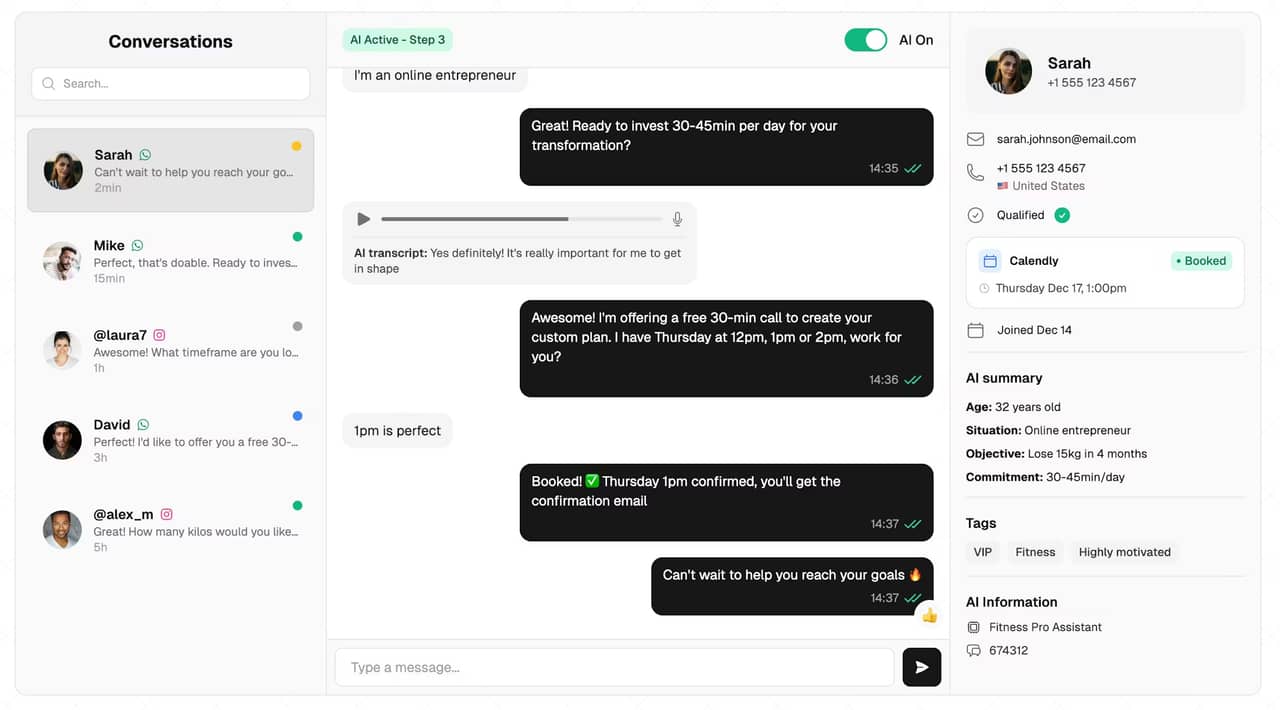
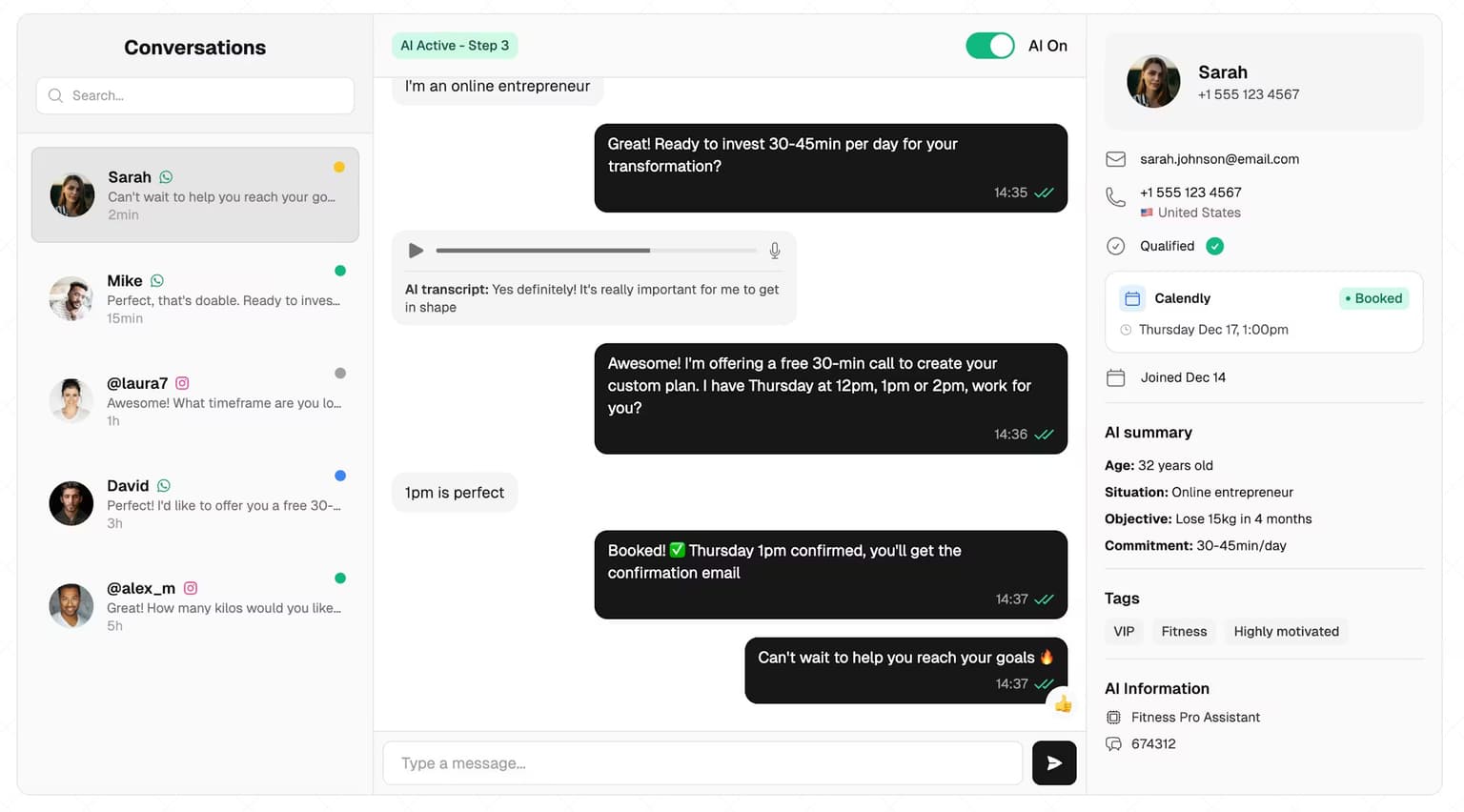
SetSmart answers your Instagram, WhatsApp and Messenger DMs, qualifies the lead with your own questions, and books the sales call directly inside the conversation. The lead never has to open a link and pick from a calendar on their own; they confirm a real slot in the chat, and the appointment lands on your calendar.
| Scheduling app | How SetSmart books into it |
|---|---|
| Calendly | Native integration (automatic booking sync needs Calendly Standard or above) |
| Cal.com | Native integration (Cal.com API key) |
| iClosed | Native integration (iClosed API key) |
| GoHighLevel | Native integration (GHL calendars) |
| Acuity, TidyCal, Zoho Bookings | No native booking integration; connect other tools through Zapier, Make or the SetSmart API |
So if DMs are your main lead source, that table is a practical tie-breaker: Calendly, Cal.com, iClosed and GoHighLevel let the AI book real slots in the chat. The close still happens on the call, with you or your closer. SetSmart's job stops at a qualified lead on your calendar.
"I book 15 to 25 calls per week... without managing a single setter." Mathis Ladoué, Online Fitness Coach, 22.4K followers
How to set up your discovery-call booking flow
Whatever app you choose, the setup that fills a coaching calendar looks the same. Here is the five-step version.
Step 1: one app, one discovery call event
Resist the urge to create ten event types. Start with a single discovery call, named after the outcome ("Strategy call: lose 10 kg before summer"), not after you ("Call with Sarah"). Keep it between 20 and 45 minutes.
Step 2: two or three qualifying questions
Ask what the lead wants, by when, and whether they are ready to invest in coaching. Three questions is the ceiling; every extra field lowers completion. If the answers do not fit, route the lead to a free resource instead of your calendar.
Step 3: reminders and buffers
Send an email confirmation immediately, an email reminder the day before, and an SMS or WhatsApp reminder shortly before the call. Add 10 to 15 minute buffers so a call that runs long never makes you late for the next one.
Step 4: connect the calendar to your DMs
This is the step that moves the needle. Connect your scheduling app to the tool that answers your Instagram and WhatsApp DMs, so a qualified lead books inside the conversation. If you run your own funnel, map where the call sits in your sales funnel for coaches so every channel points to the same calendar.
Step 5: review the numbers every week
Track two ratios: conversations to booked calls, and booked calls to calls that actually show up. If the first ratio is low, the problem is your DM conversation. If the second is low, the problem is your reminders or the quality of the leads you let through.
Mistakes coaches make with their scheduling setup
Sending the booking link too early. A link dropped as the first reply feels like a brush-off. Ask one or two questions first, then offer the call.
Paying for features you do not use. A solo coach does not need round-robin or routing. Start free and upgrade when the calendar is full.
Letting everyone book. Without intake questions, your calendar fills with people who cannot afford your program. Qualification belongs before the booking, not on the call.
No follow-up after the link. Many leads open the link, get distracted and never book. A short check-in message the same day recovers a meaningful share of them, and it can be automated without sounding pushy.
Two calendars that do not sync. Using one tool for discovery calls and another for client sessions without connecting both to the same Google or Outlook calendar is how double bookings happen.
FAQ
What is the best scheduling app for coaches?
For most solo coaches, Calendly or Cal.com is the best scheduling app: both are reliable, easy for clients to use, and handle discovery calls and paid sessions. High-ticket coaches with a closer get more from iClosed, and coaches who sell session packages are better served by Acuity Scheduling.
What is the best free scheduling software for coaches?
Cal.com has the strongest free plan for coaches in 2026: unlimited event types and calendars, email and SMS notifications, and Stripe and PayPal payments for one user. TidyCal's free plan is a close second and includes package bookings, with a 1% fee on paid bookings.
Is Calendly good for coaches?
Yes, Calendly is good for coaches once you are on the Standard plan ($10 per seat per month billed yearly), which unlocks unlimited event types, reminders and payments. The free plan only allows one event type, which is too limited if you want to separate discovery calls from client sessions.
Do coaches need a booking app or a CRM?
Most coaches need both, but at different stages. A booking app handles the slot; a CRM tracks the lead and the client relationship over time. All-in-one tools like GoHighLevel combine the two, while lighter setups pair a scheduling app with a dedicated CRM for coaches.
How do I stop no-shows on discovery calls?
Qualify leads before they book, send an email reminder the day before and an SMS or WhatsApp reminder shortly before the call, and confirm the slot in a real conversation rather than through a cold link. Leads who chose the time in a conversation with you are more committed than leads who clicked a link.
Can an AI book calls into my coaching calendar from Instagram DMs?
Yes. An AI setter like SetSmart qualifies leads in your Instagram, WhatsApp and Messenger DMs and books the call directly into Calendly, Cal.com, iClosed or GoHighLevel inside the conversation. The AI handles qualification and booking; the close still happens on the call with you or your closer.
Ready to automate your DMs?
Start your free 7-day trial and let AI handle your lead qualification 24/7.
Try SetSmart free