CRM for Coaches: 9 Best Tools Ranked (2026)

The best CRM for coaches in 2026 is not one tool, it is the right tool for the specific job you are trying to fix. Every coaching CRM does one of two jobs: it either helps you win new clients (a sales pipeline that captures leads and books calls) or it helps you serve the clients you already have (contracts, invoices, session notes, and delivery). A handful of tools try to do both, and they are usually great at one side and thin on the other.
This guide ranks nine of the CRMs coaches actually use, splits them by which job they do best, and shows exactly where an AI setter that lives in your DMs fits into the picture. Every price here was checked against the vendor's own site, and where a tool genuinely wins, we say so, even when it is not us.
What a CRM for coaches actually needs to do
A CRM (customer relationship management) tool is just a system of record for the people in your business. For a solo coach or a small coaching team, that record splits cleanly into two jobs, and confusing them is the single most common buying mistake.
Job one: the sales pipeline. This is everything before someone becomes a paying client. A lead comments on your post, replies to a story, or clicks an ad, and lands in your DMs. Your sales CRM has to capture that conversation, track where the lead is (new, qualified, call booked, closed), remind you to follow up, and ideally book the discovery call without ten back-and-forth messages. If you sell high-ticket coaching, this is where most of your revenue leaks, because you close on a booked call, not in the chat.
Job two: client delivery. This is everything after the sale. Contracts, invoices and payment plans, scheduling, session notes, homework, progress tracking, and the client portal that makes you look organised. Delivery CRMs are what most "coaching CRM" listicles actually rank, because that market is crowded and mature.
Here is the trap: most coaches search for a CRM because their sales side is broken (leads going cold in the DMs), then they buy a delivery tool because that is what ranks, and they wonder why their calendar is still empty. Before you buy anything, decide which job hurts more. If you are drowning in unanswered Instagram DMs, a beautiful invoicing tool will not save you. If you are closing clients fine but chasing payments on sticky notes, you do not need another lead tool.
How we picked these tools
We looked at the CRMs coaches genuinely evaluate, not a generic B2B list. Each tool was scored on five things a coaching business cares about:
- Lead capture from DMs — can it pull conversations from Instagram, WhatsApp, and Messenger, or only from typed-in contacts and web forms?
- Pipeline and follow-up — does it track deal stages and automate the follow-ups that actually book calls?
- Booking — can a lead book a call inside the flow, or do you bolt on a separate scheduler?
- Client delivery — contracts, payments, portals, and session management.
- Real price — the all-in monthly cost including usage and add-ons, checked against the vendor site (last verified September 2026).
The 9 best CRMs for coaches in 2026
1. SetSmart: the DM setter that fills the sales side
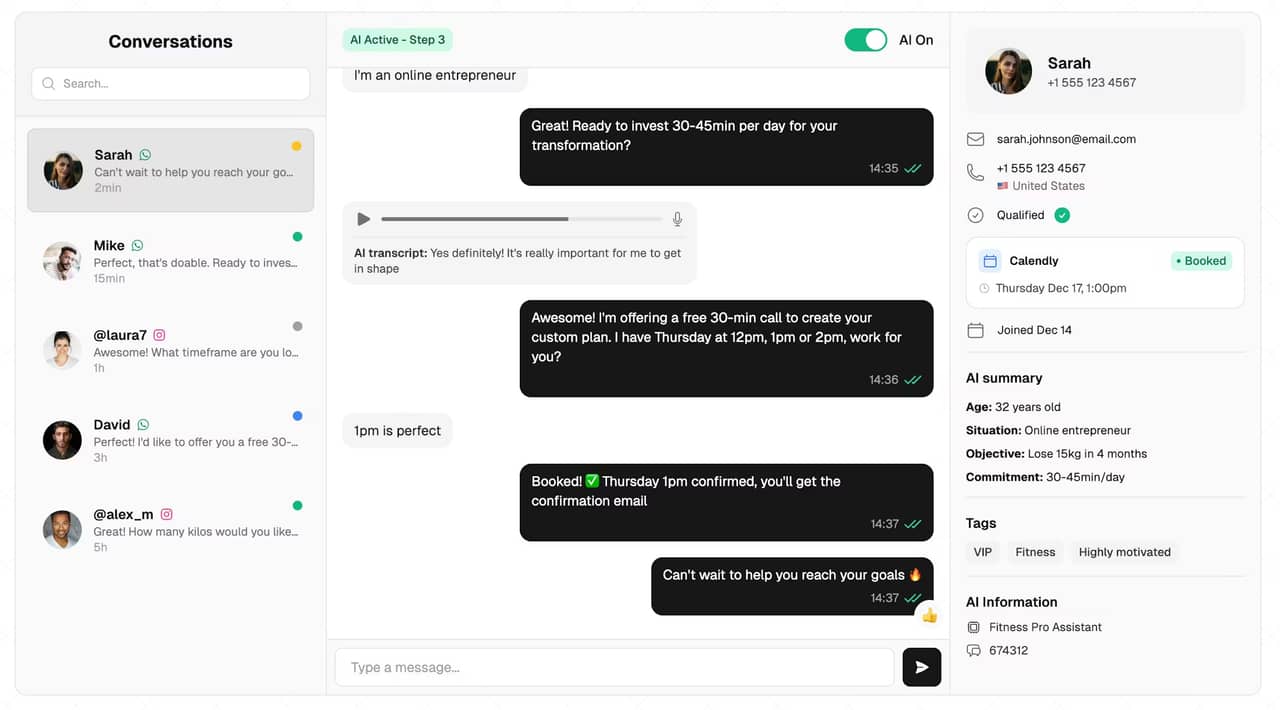
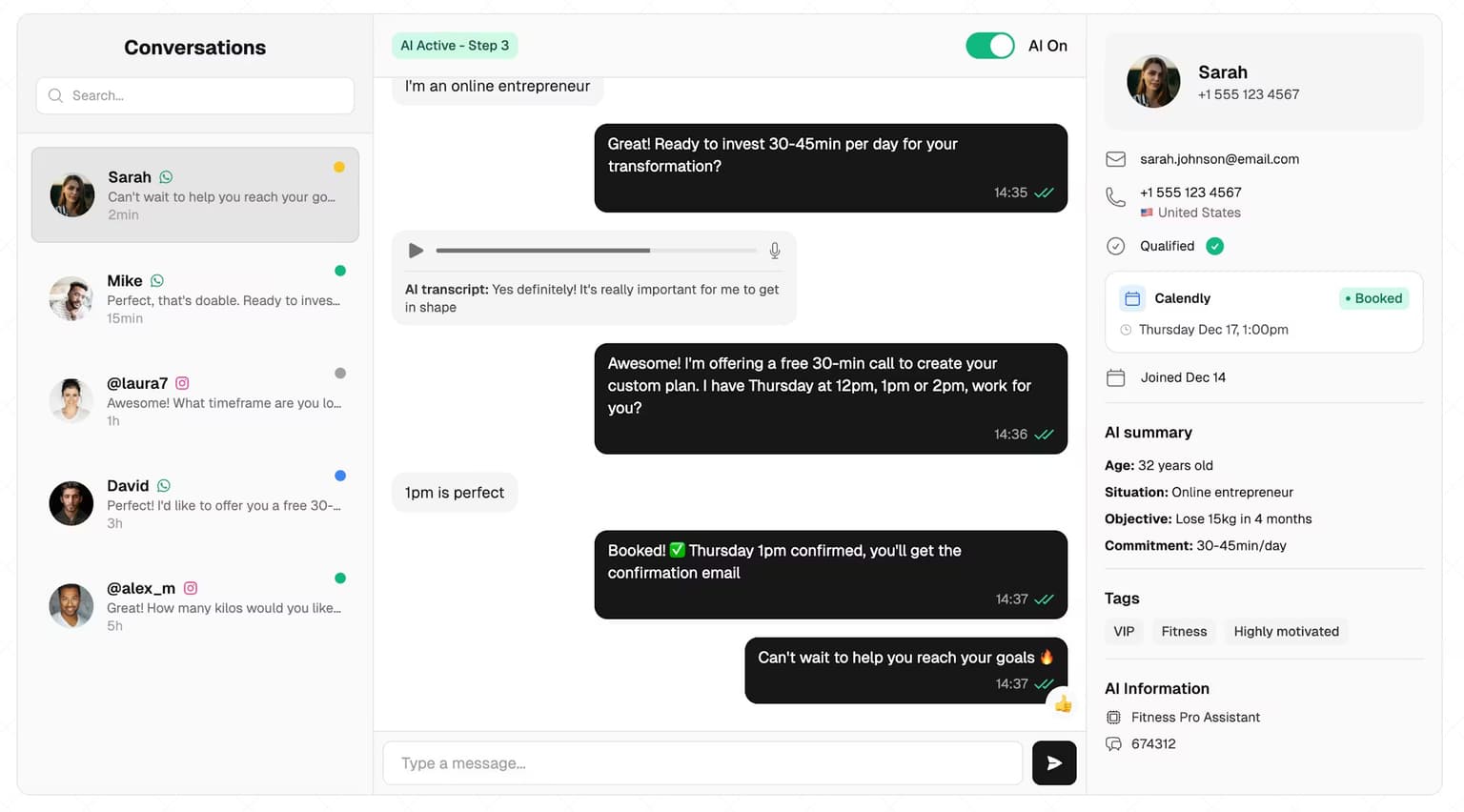
SetSmart is not a full delivery CRM, and we will not pretend otherwise. It is the acquisition layer: an AI setter that lives inside your Instagram, WhatsApp, and Messenger DMs, holds a real conversation, qualifies the lead against your criteria, and books the sales call straight into your calendar. It then logs every lead in an Instagram CRM view so you can see who is new, who is qualified, and who booked.
Where it wins: the sales job that most coaching CRMs barely touch. If your leads come from content and ads that land in the DMs, this is the tool that stops them going cold. It responds in seconds, follows up on a schedule, and hands you a calendar of qualified calls instead of a full inbox. It is an AI setter, so it books the call, it does not replace the call.
Where it falls short: it is not where you send contracts, invoices, or session notes. You still need a delivery tool from the list below to run the client relationship after the sale.
Pricing: free 7-day trial, then $97 per month with 1,000 messages included; Scale is $297 per month.
2. GoHighLevel: the all-in-one for coaches who also run an agency
GoHighLevel is the closest thing to a true all-in-one on this list: pipelines, a unified inbox that connects Instagram, WhatsApp, SMS and email, funnels, calendars, automations, and email marketing in one platform.
Where it wins: breadth. If you want one login for sales and delivery and marketing, and you are comfortable with a steep learning curve, it covers more ground than anything else here. It shines for coaches who are becoming a small agency.
Where it falls short: complexity and the real bill. The AI conversation features and WhatsApp are paid add-ons on top of the base plan, so the headline price undersells your actual cost. For a solo coach it is often more platform than you will ever switch on. Our GoHighLevel pricing breakdown and GoHighLevel alternatives guide go deeper.
Pricing: GoHighLevel (from $97 per month for Starter, $297 per month for Unlimited, $497 per month for Agency Pro), plus usage-based add-ons.
3. HoneyBook: client management for the polished solo coach
HoneyBook is a client-experience platform built for creatives, consultants, and coaches. Interactive proposals, contracts, invoices, scheduling, and a client portal that makes onboarding feel premium.
Where it wins: delivery and getting paid. The booked-to-paid flow is genuinely slick, and clients notice the branded files. Great for 1:1 coaches who want everything after the sale in one place.
Where it falls short: it is a delivery tool, not a DM lead engine. It captures leads through its own forms, not by qualifying Instagram or WhatsApp conversations, so the top of your funnel is still on you.
Pricing: HoneyBook (from $29 per month for Starter, $49 per month for Essentials, $109 per month for Premium), with a free trial.
4. Paperbell: the simplest CRM built only for coaches
Paperbell is purpose-built for coaches and nobody else. Packages, scheduling, contracts, payments, and a client portal in one flat-priced tool with no upsells.
Where it wins: simplicity and price clarity. One plan, unlimited clients, everything included. If you are a solo coach who wants to sell packages and manage clients without assembling a stack, it is hard to beat.
Where it falls short: it is deliberately lean on marketing and sales automation, and it does not qualify DM conversations. It manages clients beautifully; it does not go and find them.
Pricing: Paperbell (a flat $57 per month, or $570 per year).
5. Dubsado: deep client workflows for the systems-minded coach
Dubsado is a client-management CRM loved by coaches and service providers who want to automate their onboarding and delivery in detail. Forms, canned emails, workflows, invoicing, and client portals.
Where it wins: customisation. If you like building repeatable workflows and want fine control over your onboarding sequence, Dubsado rewards the effort.
Where it falls short: the learning curve, and, like the others in this section, it is a delivery tool, not a DM acquisition layer. Scheduling and automated workflows are on the higher tier.
Pricing: Dubsado (from $335 per year for Starter, $525 per year for Premier), with a 21-day trial.
6. Practice: 1:1 client management done cleanly
Practice is a modern client-management tool for coaches and small teams: scheduling, invoicing, client notes, forms, and a tidy client space, without the bloat of an agency platform.
Where it wins: a clean, coach-first delivery experience for 1:1 work. It is a strong middle ground between Paperbell's simplicity and Dubsado's depth. We cover it in our best online coaching platforms roundup too.
Where it falls short: it is not a marketing or lead tool, so getting the client in the door is entirely on you.
Pricing: Practice (from around $48 per month).
7. HubSpot free: the generic sales CRM on a budget
HubSpot's free tier is the default answer when a coach searches "free CRM." Contacts, deal pipelines, email tracking, and forms at no cost, with paid tiers when you outgrow it.
Where it wins: it is free, familiar, and a genuinely capable pipeline for tracking deals if you are comfortable entering leads and moving stages yourself. Good for a coach who wants a clean pipeline without paying.
Where it falls short: it is built for classic sales teams, not DM-native coaching. It will not hold a qualification conversation in your Instagram DMs, and the features that matter to a coach (packages, session delivery) are not its focus. The free plan is generous; the paid plans get expensive fast.
Pricing: free CRM tier; paid marketing and sales tiers add up quickly.
8. CoachAccountable: accountability between sessions
CoachAccountable is narrow on purpose. It is built around what happens between sessions: client actions, worksheets, metrics, and accountability tracking, plus billing and scheduling.
Where it wins: client results. If your coaching lives or dies on homework and accountability, nothing here tracks it better.
Where it falls short: a dated interface and a narrow focus. It is not a funnel builder, a course host, or a lead tool.
Pricing: CoachAccountable (from around $20 per month, scaling with active clients).
9. Notion: the DIY CRM for coaches who like to build
Notion is not a CRM out of the box, but plenty of coaches run a lightweight pipeline and client database on it using a template. Total flexibility, near-zero cost.
Where it wins: it is cheap, endlessly customisable, and fine for a coach with a handful of clients who wants full control.
Where it falls short: everything is manual. No lead capture from DMs, no automated follow-up, no booking, no payments. It is a database, not a system that does work for you. Most coaches outgrow a Notion CRM the moment their lead volume climbs.
Pricing: Notion (free for individuals, paid team plans from around $10 per month).
CRM for coaches comparison table
| Tool | Best job | Captures DMs? | Books calls? | Entry price |
|---|---|---|---|---|
| SetSmart | Sales / acquisition | Yes, IG + WA + Messenger | Yes, in-chat | $97 per month |
| GoHighLevel | All-in-one / agency | Yes, via inbox | Yes | From $97 per month |
| HoneyBook | Client delivery | No, forms only | Scheduler | From $29 per month |
| Paperbell | Coach delivery | No | Scheduler | $57 per month flat |
| Dubsado | Client workflows | No | Higher tier | From $335 per year |
| Practice | 1:1 delivery | No | Yes | From $48 per month |
| HubSpot free | Generic pipeline | No | Add-on | Free tier |
| CoachAccountable | Accountability | No | Yes | From $20 per month |
| Notion | DIY database | No | No | Free / low |
Prices verified against each vendor's pricing page in September 2026. Always check the current page before you buy, because tiers change.
How to choose the right CRM for your coaching business
Match the tool to the job that hurts, not to the longest feature list.
If leads go cold in your DMs, your problem is speed and follow-up, not filing. You need something that captures and qualifies conversations from Instagram and WhatsApp and books the call before the lead loses interest. A DM setter plus your calendar solves this. Filing the contact neatly after the fact does nothing if the lead already ghosted. This is the same reason lead generation for coaches increasingly runs through the inbox rather than through a form.
If you close fine but delivery is chaos, buy a client-delivery CRM. Paperbell if you want simple and flat-priced, HoneyBook if you want a polished client experience, Dubsado if you love building workflows, Practice or CoachAccountable if 1:1 accountability is the core of your work.
If you are becoming an agency, GoHighLevel earns its complexity, especially if you will resell the platform to clients. For a solo coach, it is usually overkill.
If you are just starting and broke, run a free HubSpot pipeline or a Notion template for the sales side and add a delivery tool once you have paying clients. Then add a setter once your lead volume justifies it.
Most established coaches end up with a two-tool stack: one tool for acquisition (the DM setter) and one for delivery (Paperbell, HoneyBook, or similar). That is not a failure to find "the one CRM." It is the correct architecture, because the two jobs are genuinely different.
Where an AI DM setter fits into your coaching CRM
Whatever delivery CRM you land on, the leak most coaches never fix is the gap between a lead's first DM and a booked call. That is where a setter sits, and it is worth understanding why it matters so much.
Coaches sell high-ticket offers on a call, so the DM's only job is to qualify the lead and book that call. Do it fast, follow up when they go quiet, and you fill the calendar. Miss the window and the lead is gone. In our analysis of 828K DM conversations, a single follow-up more than doubled booked calls, a +106% lift among engaged leads. Most coaches never send that follow-up because they are asleep, in a session, or buried in the inbox. Speed matters just as much; the lead response time statistics are brutal on slow replies.
An appointment setter that runs on AI closes both gaps automatically. It answers in seconds, asks your qualification questions in a natural conversation, and proposes calendar slots in the thread. Then it logs the lead into a pipeline so you keep the same clean record a CRM gives you, without typing in a single contact. For the channel mechanics, our guides to Instagram DM automation and WhatsApp automation show how the capture works, and the WhatsApp CRM piece covers the delivery-side overlap.
The important boundary: a setter books the call, it does not replace it. You (or your closer) still run the human sales conversation. It also does not deliver the coaching. So a setter plus a delivery CRM, not a setter instead of one, is the pattern that works.
Common CRM mistakes coaches make
- Buying a delivery tool to fix a sales problem. A gorgeous invoicing platform will not fill an empty calendar. Diagnose the leak first.
- Ignoring usage and add-on costs. A "cheap" contact-metered plan can cost more than a flat plan once your list grows, and the AI or WhatsApp features you actually want are often paid extras.
- Manual follow-up. If your follow-up depends on you remembering, it will not happen at scale. Automate the one follow-up that doubles your booked calls, or read our AI lead follow-up playbook.
- Letting DMs live outside the system. If your Instagram and WhatsApp conversations never touch your CRM, half your pipeline is invisible. Capture them.
- Over-building. A solo coach with fifteen clients does not need an agency platform. Start lean, add tools when the pain is real. Our guides on how to get coaching clients, building a sales funnel for coaches, and how to market your coaching business cover the growth side without a heavy stack.
FAQ
What is the best CRM for coaches in 2026?
There is no single winner, because coaching CRMs split into two jobs. For the sales side (capturing and booking leads from Instagram and WhatsApp DMs), SetSmart is the strongest fit. For client delivery (contracts, payments, sessions), Paperbell and HoneyBook lead for solo coaches. Most coaches run one tool for each.
What is the best free CRM for coaches?
HubSpot's free tier is the most capable no-cost pipeline, and a Notion template works if you have only a handful of clients and do not mind manual entry. Both are fine for tracking deals, but neither captures or qualifies DM conversations, so you will still handle the top of the funnel yourself.
Do life coaches need a CRM?
Yes, once you have more than a few active clients or a steady flow of leads. A life coach juggling discovery calls, packages, and follow-ups will lose revenue to cold leads and missed admin without a system. Start with whichever side hurts more: acquisition or delivery.
Is GoHighLevel good for coaches?
It can be, if you want an all-in-one and are willing to learn it, or if you are growing into an agency. For a solo coach it is often too complex and the real bill (with AI and WhatsApp add-ons) is higher than the headline. Read our GoHighLevel review before committing.
What is the difference between a coaching CRM and a DM setter?
A coaching CRM stores and manages relationships (pipeline or client delivery). A DM setter is the active layer that qualifies incoming conversations and books calls for you. A setter feeds the CRM; it does not replace the record-keeping, and the CRM does not do the conversation. Our guide to what a DM setter is explains the split.
Can a CRM help me book more high-ticket coaching calls?
Only the sales-side of your CRM can, and only if it captures leads fast and follows up automatically. A delivery CRM will not book calls for you. Pair a setter that qualifies DMs and proposes calendar slots with your delivery tool, and keep the human close on the call itself, as our high-ticket coaching playbook lays out.
Whatever delivery CRM you pick, plug the leak at the top of the funnel first. SetSmart qualifies your Instagram and WhatsApp DMs and books the sales calls straight into your calendar, so your CRM fills itself with qualified leads instead of cold ones. Free 7-day trial, then from $97 per month.
Ready to automate your DMs?
Start your free 7-day trial and let AI handle your lead qualification 24/7.
Try SetSmart free