Coaching Intake Form: 30 Questions + Template (2026)

Most coaches build their intake form the night before their first client starts. They search for a template, copy 40 questions from three different blogs, and send a form so long that the client fills half of it on their phone in a parking lot. Then session one starts with "so, tell me about yourself," and the form was pointless.
A good coaching intake form does one job: it lets you walk into the first session already knowing what your client wants, what has stopped them before, and how they like to be coached. This guide gives you a 30-question template you can copy, extra questions for fitness, nutrition, life, and business coaches, what not to ask, and the part most templates skip: the difference between an intake form and an application form, and how online coaches now run the application step inside Instagram and WhatsApp DMs before anyone books a sales call.
What is a coaching intake form?
Direct answer: a coaching intake form is a questionnaire a new client fills out after they sign up and before your first session. It collects their contact details, goals, current situation, past attempts, obstacles, readiness, and coaching preferences, so you can plan session one around their answers instead of spending it on basic questions.
The Co-Active Training Institute describes its coaching intake form as "a structured document that gathers information from new clients before your initial session," and a foundation for setting expectations. Luisa Zhou, who teaches coaches to build their business, makes a sharper point in her own intake form guide: the value is not in how many questions you ask, but in how you use the answers.
That is the right way to think about it. An intake form is not paperwork for its own sake. It is prep work for a better first session, and a signal to the client that you are paying attention before you have even met.
An intake form is also not:
- A contract. The coaching agreement covers fees, cancellations, confidentiality, and what coaching is and is not. The intake form can link to it, but it does not replace it.
- A medical assessment. Fitness and nutrition coaches should include a health screening, but a form does not make you qualified to diagnose or treat anything. More on that below.
- An application form. This is the one coaches confuse most often, so it gets its own comparison.
Intake form vs application form vs coaching agreement
Online coaches who sell programs over a sales call usually need three different documents at three different moments. Mixing them up is how you end up with a 40-question "application" that scares off good leads, or an intake form that asks about budget after someone has already paid.
| Application form | Coaching agreement | Intake form | |
|---|---|---|---|
| When | Before the sales call | After the client says yes | After signing, before session one |
| Purpose | Check fit, timing, and readiness to invest | Set terms, fees, confidentiality, boundaries | Prepare a personalized first session |
| Length | 5 to 8 questions | 1 to 4 pages | 20 to 30 questions |
| Typical questions | Goal, timeline, what they tried, can they start | None, it is a document to sign | Goals by timeframe, history, obstacles, coaching style |
The International Coaching Federation's Code of Ethics asks coaches to explain the nature of coaching before it begins and to "co-create a coaching agreement regarding roles, responsibilities, confidentiality, financial arrangements, and other aspects of the coaching engagement." The intake form sits right after that agreement in your onboarding, and it works best when the two are sent together.
When to send your coaching intake form
Direct answer: send the intake form right after the client signs the agreement and pays, ideally in the same message, and ask them to complete it at least two days before the first session. That gives you time to read the answers and plan, instead of skimming them five minutes before the call.
That two-day buffer is the rule Luisa Zhou uses in her guide, and it holds up well in practice. Here is how the full client journey usually looks for an online coach who sells through Instagram:
| Step | What happens | Document or tool |
|---|---|---|
| 1. First contact | A follower comments a keyword, replies to a story, or sends a DM | Instagram or WhatsApp |
| 2. Qualification | You check goal, timing, and fit | Application form or a qualifying DM conversation |
| 3. Sales call | You diagnose, present the offer, and the client decides | Calendar booking link |
| 4. Onboarding | Agreement, payment, intake form, first session booking | Contract, payment link, intake form |
| 5. Session one | You arrive with a plan built from the intake answers | Your coaching platform or app |
Notice where the intake form sits: after the money. That matters. A client who has just paid is motivated, which is why they will happily spend 15 minutes on thoughtful answers. Ask the same 30 questions to a stranger who has not booked a call yet and most of them will never finish.
If the client books session one through a scheduling tool, you can attach the form to the booking confirmation so it arrives automatically. Our comparison of scheduling software for coaches covers custom booking questions and intake forms in each tool.
The coaching intake form template (copy and paste)
Direct answer: a strong coaching intake form has seven sections: contact and logistics, goals, current situation, obstacles and strengths, readiness and commitment, coaching style, and boundaries and consent. Thirty questions is a sensible ceiling. Keep the ones you will actually use in session one and delete the rest.
Co-Active suggests keeping intake forms to one to three pages, so clients can complete them in 10 to 20 minutes. The template below fits that range if most answers are a few sentences long. Copy it into your form tool, then cut anything that does not apply to your niche.
Section 1: Contact and logistics
- Full name, and the name you prefer to be called.
- Email address and phone number. What is the best way to reach you between sessions (WhatsApp, email, Instagram DM)?
- Your time zone, and the days and times that work best for sessions.
- How did you hear about me?
- Emergency contact name and phone number (for in-person or physical training clients).
Section 2: Goals
- What made you decide to start coaching now, rather than six months ago or six months from now?
- What do you want to have achieved in 1 month, 3 months, and 6 months?
- How will you know this coaching worked? What will be different in your daily life?
- Why does this goal matter to you personally?
- If we could only solve one thing together, which one should it be?
Question 7 is borrowed from Luisa Zhou's guide, and it is the single most useful question on the form. Asking for goals at three time horizons forces a concrete answer instead of a vague wish like "get healthier" or "be more confident."
Section 3: Current situation
- Describe where you are today with this goal, in a few sentences.
- What does a typical week look like for you (work, family, energy levels)?
- What have you already tried to reach this goal, and what happened?
- What has worked for you before, even for a short time?
- On a scale of 1 to 10, how satisfied are you with this area of your life today?
Section 4: Obstacles and strengths
- What do you expect will be your biggest obstacle?
- What usually derails you when life gets busy or stressful?
- What strengths or past wins will help you succeed this time?
- Who in your life supports this goal, and who might make it harder?
Section 5: Readiness and commitment
- On a scale of 1 to 10, how ready are you to make changes right now? Why that number and not a lower one?
- How much time per week can you realistically commit outside our sessions?
- What are you willing to change, or stop doing, to reach this goal?
- Do you have any concerns or doubts about coaching?
The "why not a lower number" follow-up on question 20 comes from motivational interviewing. It makes the client argue for their own readiness instead of defending their doubts, and their answer often becomes the first thing you reflect back in session one.
Section 6: Coaching style
- How do you like to receive feedback: very direct, gentle, or somewhere in between?
- How do you want to be held accountable between sessions (check-in messages, weekly forms, a shared tracker)?
- Have you worked with a coach, trainer, or therapist before? What worked, and what did not?
- What do you need from me to get the most out of our work together?
Section 7: Boundaries, consent, and anything else
- Are there any topics you would prefer not to discuss?
- Is there anything else I should know before our first session?
- Checkbox: "I have read the coaching agreement and privacy note, and I understand that coaching is not therapy, medical care, or a substitute for professional advice."
That last checkbox is not legal protection on its own, but it confirms the client saw your agreement and understood the scope of coaching. If you work in a regulated area or across borders, have a lawyer review your agreement once. It is a one-time cost that you will reuse with every client.
How many questions should a coaching intake form have?
There is no magic number. Twenty to thirty questions is a practical range for 1:1 coaching. Fewer than ten and you will spend session one filling the gaps; more than thirty and completion drops, answers get shorter, and the client starts the relationship tired. If you run a group program, cut the form to 10 to 15 questions and focus on goals, obstacles, and logistics, because you will not personalize as deeply. The same logic applies across tiers: a premium 1:1 package earns a deeper intake than a lighter group tier, and our guide to coaching packages shows how coaches structure those tiers.
Coaching intake form questions by niche
Direct answer: keep the core template, then add five to ten niche questions. Fitness coaches add a health screening, injury history, training background, and equipment. Nutrition and weight-loss coaches add eating patterns, diet history, food preferences, and a medical and referral question. Life, business, and executive coaches add values, numbers, and stakeholder questions.
Fitness coaching intake form
Online fitness coaches and personal trainers need two things the generic template does not cover: a safety screen and enough training detail to write a first program.
For the safety screen, many trainers use the PAR-Q+ (Physical Activity Readiness Questionnaire for Everyone). It is a free, evidence-based pre-participation screening tool maintained by the PAR-Q+ Collaboration, designed for people of any age, sex, or health status, and it tells you when someone should get clearance from a health professional before increasing their activity. Ask clients to complete it as part of intake, and do not start programming until any "yes" answers are resolved.
Add these questions on top of the core template:
- Do you have any current injuries, pain, or past surgeries I should know about?
- What does your current activity look like (type of training, days per week, session length)?
- What is your training history? Have you followed a structured program before?
- Where will you train (commercial gym, home gym, outdoors), and what equipment do you have?
- How many days per week, and how many minutes per session, can you train consistently?
- How are your sleep and stress levels on a typical week?
- Which numbers do you want to track (body weight, measurements, strength, steps)? Are you comfortable sending progress photos?
If you are still setting up your offer, our guide to how to start online fitness coaching covers the delivery side: programming apps, check-ins, and pricing.
Nutrition and weight-loss coaching intake form
Weight-loss and nutrition coaches need the most careful intake of any niche, because food is tied to health, habits, and emotions at the same time. Add these questions:
- What is your weight history over the last few years, and what is your goal?
- Walk me through a typical day of eating, from waking up to going to bed.
- Which diets or programs have you tried before, and what happened when they ended?
- Do you have any food allergies, intolerances, or foods you do not eat for cultural, religious, or personal reasons?
- Who does the grocery shopping and cooking in your household?
- How often do you eat out, drink alcohol, or order takeaway in a typical week?
- How do you feel about tracking food (an app, photos, a simple checklist, or nothing at all)?
- Do you have any medical conditions or take medication that affects your diet? Have you ever been diagnosed with, or treated for, an eating disorder?
That last question matters. A coach is not a clinician, so if a client discloses a current or past eating disorder, a condition like diabetes, or medication that changes how they should eat, the safe move is to refer them to a registered dietitian or their doctor, or to work alongside one with the client's consent. Know your scope before you need it. Our guide on how to become a nutrition coach covers what nutrition coaches can and cannot do depending on certification.
Life coach intake form
Life coaching goals are broader, so the intake needs to narrow them down. Add:
- What do you value most in your life right now?
- Rate these areas from 1 to 10: health, relationships, career, finances, personal growth, fun.
- Is there a recent change or transition (a move, a breakup, a new job) that led you to coaching?
- What would a great year look like, twelve months from today?
Business coaching intake form
Business coaches need numbers, or the first session turns into guesswork. Add:
- What does your business sell, and to whom?
- What is your current monthly revenue range, and your target in 12 months?
- Where do most of your clients come from today?
- What is the biggest bottleneck right now: getting leads, converting them, delivering, or your own time?
- Who else works in the business, and what do they handle?
Executive coaching intake form
Executive coaching often involves a sponsor, usually the client's employer, who pays for the engagement. Add questions about the client's role, team size, key stakeholders, and what success looks like to both the client and the sponsor. Agree in writing what the sponsor will and will not see from the intake answers before you send the form. The ICF Code of Ethics asks coaches to have "a clear agreement about what information is exchanged and how it is exchanged among all parties involved."
What not to ask on a coaching intake form
Direct answer: leave out anything you will not use in the first few sessions, deep trauma or personal history the client has not chosen to share, payment details, and questions that only make sense for a different niche. Every unnecessary question lowers the quality of the answers you actually need.
Co-Active's guide lists several things to avoid on the first form, including personal or sensitive questions beyond the scope of coaching and questions that push clients to reveal trauma or deep vulnerabilities before trust is built. A few more to cut:
- Payment information. Card numbers belong in your payment processor, not in a form response that sits in your inbox.
- Questions you already asked. If the client answered a question on the application form or in your DMs, do not ask it again. Pre-fill it or skip it.
- Yes or no questions about goals. "Do you want to lose weight?" tells you nothing. "What would losing 10 pounds change for you?" tells you a lot.
- Copy-pasted niche questions. A business coach asking about sleep quality, or a fitness coach asking about revenue, makes the form feel generic.
- Diagnostic questions. Unless you are licensed, do not ask questions that only a clinician could interpret.
Keep the answers private
Intake answers often include health information, family details, and money. Treat them that way. The ICF Code of Ethics asks coaches to "maintain, store, and dispose of any records, including electronic files and communications, in a manner that promotes confidentiality, security, and privacy, and complies with applicable laws and agreements." In practice: use a form tool with a proper account and access controls, do not download responses to a shared computer, delete what you no longer need, and tell clients in your privacy note where their answers are stored. Health information can fall under stricter privacy rules depending on where you and your clients live, so check what applies to you.
How to build your intake form and use the answers
Direct answer: build the form in a tool you already use (Google Forms, Jotform, Typeform, or the forms feature in your coaching platform), test it on yourself, attach it to your onboarding message, and read the answers two days before session one to plan the first call.
Pick a tool
You do not need anything special. A few practical options:
- Google Forms. Free, fast, and familiar to almost every client. Responses land in a spreadsheet.
- Jotform or Typeform. More design control, conditional logic (show the fitness questions only to fitness clients), and ready-made templates. Jotform publishes a life coach intake form template you can adapt.
- Your coaching platform. If you already deliver your program on a platform, check whether it has a built-in forms or questionnaire feature before adding another tool, so everything stays in one place. Our ranking of the best online coaching platforms compares the main options.
Whatever you choose, test the form on your own phone before sending it. Most clients will open it from a WhatsApp message or an email on mobile. Long text boxes, tiny checkboxes, and forms that do not save progress are where people give up.
Turn the answers into a session one plan
Read the form with three questions in mind:
- What do they want most? Usually the answer to question 10 ("If we could only solve one thing"). That is your session one focus.
- What has stopped them before? Questions 13, 16, and 17 tell you which obstacles to plan for in the first two weeks.
- How should you talk to them? Questions 24 and 25 tell you whether to be direct or gentle, and how to set up accountability.
Write three bullet points before the call: their main goal in their own words, the obstacle you expect first, and one small action they could take this week. Open session one by reading their goal back to them. It takes ten seconds and instantly shows you did the work.
The coaching application form: qualifying before the sales call
Direct answer: a coaching application form is a short questionnaire leads fill out before they can book a sales call. It checks whether they have a real goal, a reason to start now, and the means to invest, so you only spend call time with people who could become clients. Keep it to five to eight questions.
This is where high-ticket coaches put most of their energy, because a calendar full of the wrong calls is expensive. If your programs cost a few thousand dollars, every unqualified call is an hour you could have spent coaching or creating content. Our guide to high ticket coaching explains why premium programs are almost always sold on a call, not through a checkout page.
Application form questions that qualify
Here is a short coaching application form you can adapt:
- What result do you want to achieve in the next 90 days?
- Where are you today? (For a weight-loss coach: current weight and goal weight. For a business coach: current monthly revenue.)
- What have you already tried, and why do you think it did not work?
- Why is now the right time to fix this?
- If we decide it is a good fit, could you start within the next two weeks?
- My coaching programs are an investment, starting at your entry price. If it is the right fit, are you in a position to invest in yourself? (Yes / Yes, with a payment plan / Not right now)
- Your Instagram handle or WhatsApp number, so I can confirm your call.
Question 6 does the heavy lifting. Say the price range plainly and give respectful options. People who choose "not right now" are not bad leads; send them to free content or a lower-priced offer instead of a sales call. For a deeper bank of questions on goals, timing, and budget, see our list of lead qualification questions, which includes a section on coaching and high-ticket offers.
Many coaches put the application behind a quiz or a short sales page instead of a plain form, so leads get some value before they apply. Our guide to the quiz funnel covers that format. Once someone passes, the application answers become your prep notes for the call itself, and our discovery call guide shows how to structure that conversation.
The DM alternative: qualify in the conversation, then book the call
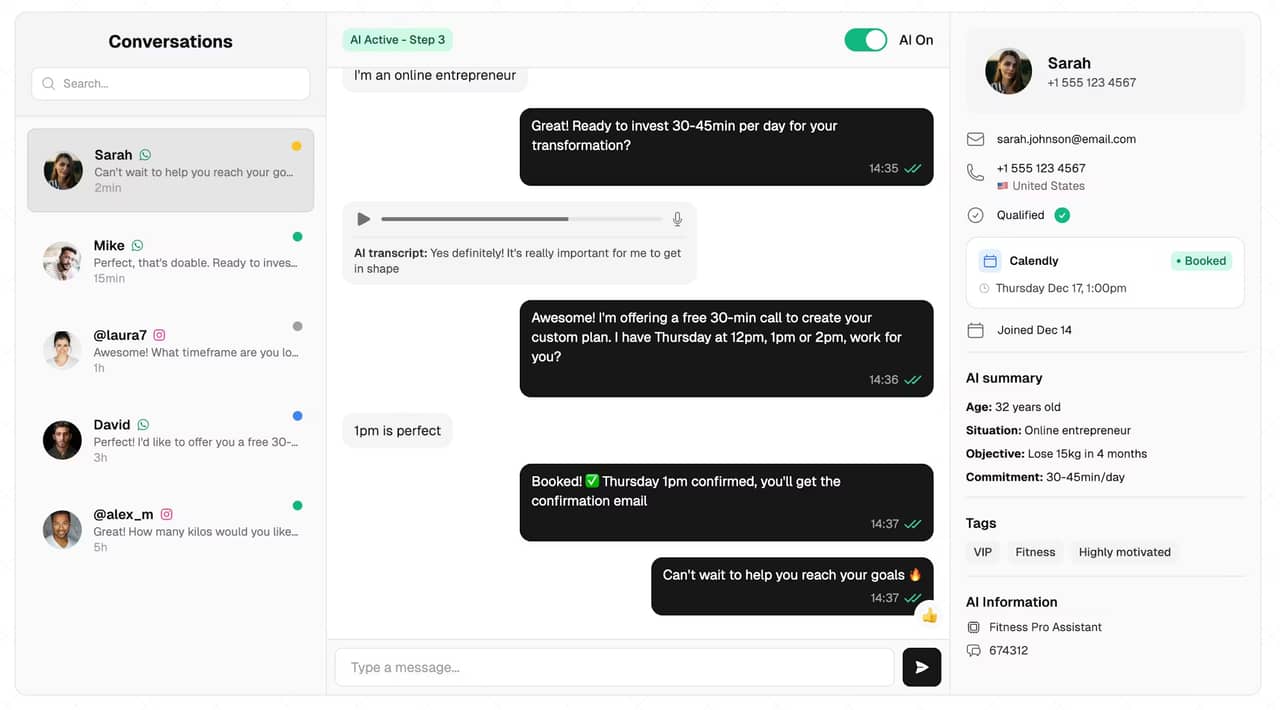
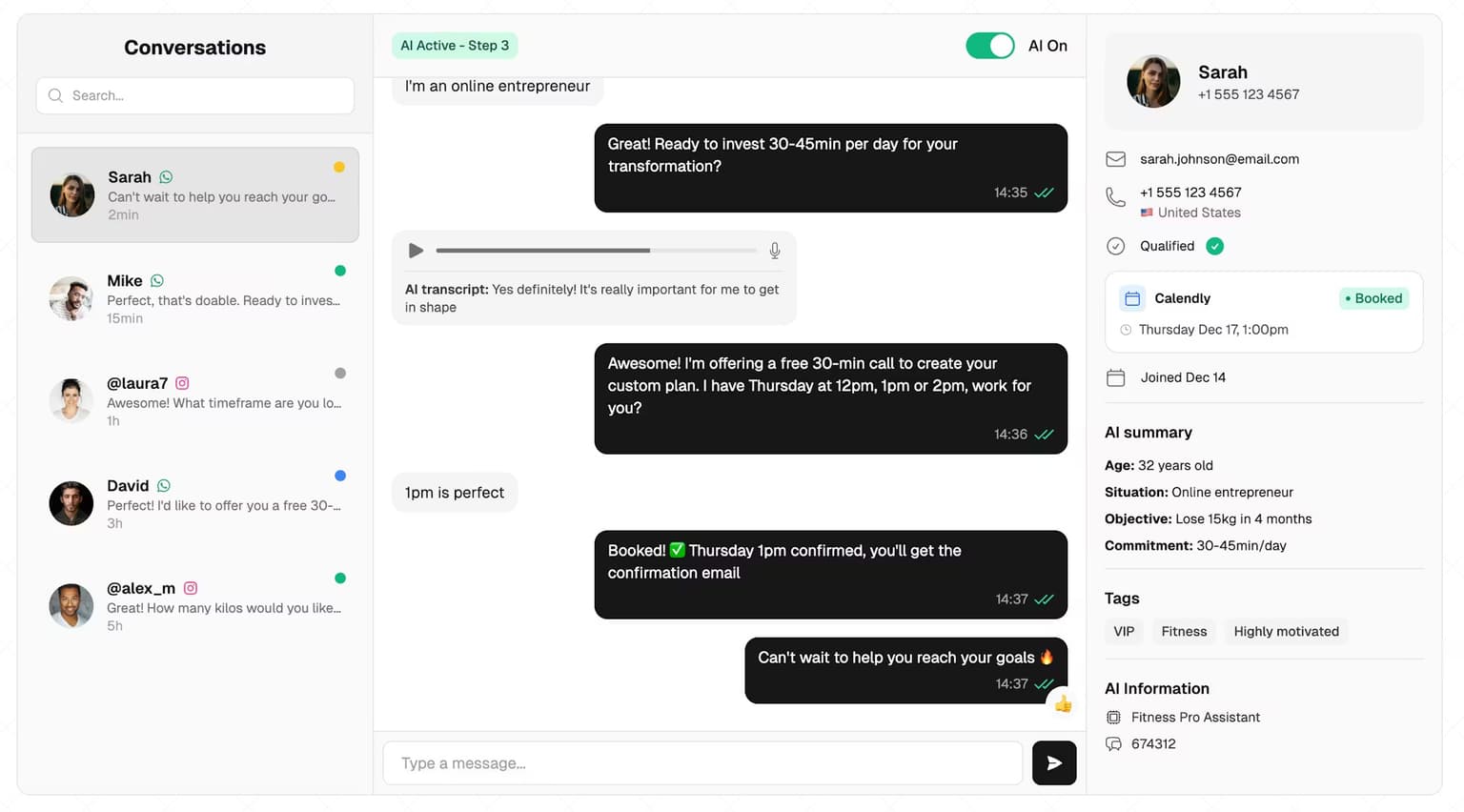
Direct answer: for coaches who get their leads from Instagram or WhatsApp, the application step increasingly happens inside the DM. Instead of sending a link to a form, the coach (or a setter, or an AI setter) asks the same qualifying questions one at a time in the chat, then sends a booking link only to people who fit.
Forms were built for website traffic. But for most online fitness, nutrition, and weight-loss coaches, leads do not come from a website. They come from a Reel, a story reply, or a comment like "PLAN" under a post, and they are on their phone, inside Instagram. Sending them to an external form asks them to leave the app, open a browser, and type long answers on a small keyboard. Plenty of interested people simply do not.
A conversation feels different. One question at a time, in the same thread they started, is closer to how people already talk. And the length of that conversation matters: in our analysis of 828K AI DM conversations, 1 in 3 leads booked a call once the chat reached 21 or more messages, roughly ten exchanges back and forth. That is about the length of a seven-question application, asked naturally, with a reply to each answer.
The catch is time. Running every application by hand means answering DMs all day, following up with people who went quiet, and sending booking links at 11pm. That is the gap an AI setter fills.
SetSmart answers every Instagram and WhatsApp DM in seconds, including keyword comment replies and story replies, and asks your application questions in your tone of voice. It follows up with leads who stop replying, and books qualified leads straight into your calendar through Calendly, Cal.com, iClosed, or GoHighLevel. Each conversation keeps an AI lead summary of what the assistant learned (situation, goal, qualification), so you can read it before the call the same way you would read an application form, and GoHighLevel users can push that summary into the contact's notes automatically. If you want to set up the keyword triggers that start these conversations, our guide to Instagram DM automation walks through it.
"I book 15 to 25 calls per week... without managing a single setter." Mathis Ladoué, Online Fitness Coach, 22.4K followers
To be clear about where the line is: the AI qualifies the lead and books the call. It does not sell your program in the DM. The decision happens on the sales call, coach to client. And once the client says yes, your intake form still has a job to do: everything above about preparing session one still applies. The DM conversation replaces the application form, not the intake form.
Common coaching intake form mistakes
- Sending the intake form before the sale. A 30-question form is onboarding, not qualification. Before the call, use a short application or a qualifying conversation.
- Asking everything. Every question you will not use dilutes the answers you need. If you cannot say what you will do with an answer, cut the question.
- One form for every client. Use conditional logic or separate versions for each niche or program. A group client does not need the same depth as a 1:1 client.
- No deadline. Without "please complete this two days before our first session," many clients fill it in the morning of the call, or not at all.
- Not reading it properly. Clients notice when you ask something they already answered. Read the form, write your three bullet points, and reference their words.
- Skipping the health screen. Fitness and nutrition coaches who skip a screening question are taking a risk they do not need to take. Add the PAR-Q+ or an equivalent and a referral rule.
FAQ
What should be included in a coaching intake form?
A coaching intake form should include contact details and logistics, the client's goals at different time horizons, their current situation, what they have already tried, expected obstacles, readiness to change, preferred coaching style, and a consent section linking to your coaching agreement. Fitness and nutrition coaches should also add a health screening and a referral question.
How long should a coaching intake form be?
Most coaches use 20 to 30 questions for 1:1 clients. Co-Active recommends keeping intake forms to one to three pages, which clients can complete in about 10 to 20 minutes. Group programs can use a shorter form of 10 to 15 questions.
When should I send a coaching intake form?
Send it right after the client signs the coaching agreement and pays, ideally in the same onboarding message. Ask them to complete it at least two days before the first session so you have time to read the answers and plan.
What is the difference between a coaching intake form and a coaching application form?
An application form comes before the sales call and checks whether a lead is a fit, with five to eight questions about their goal, timing, and readiness to invest. An intake form comes after the client has signed up and prepares the first session, with deeper questions about history, obstacles, and coaching style.
Do fitness and nutrition coaches need a health screening on their intake form?
It is strongly recommended. Many fitness coaches use the PAR-Q+, a free pre-participation screening questionnaire, to spot when a client should get medical clearance before training harder. Nutrition and weight-loss coaches should ask about medical conditions, medication, and eating disorder history, and refer to a dietitian or doctor when needed.
Is there a free coaching intake form template?
Yes. You can copy the 30-question template in this guide into Google Forms for free, or adapt a ready-made template from tools like Jotform. Co-Active and several coaching educators also publish free downloadable templates. Whichever you use, cut it down to the questions you will actually use in session one.
Your intake form makes session one great. Getting the right people to session one is the harder part. SetSmart answers your Instagram and WhatsApp DMs in seconds, asks your application questions the way you would, and books qualified leads straight onto your calendar. Free 7-day trial, then from $97/month, or see the full pricing.
Ready to automate your DMs?
Start your free 7-day trial and let AI handle your lead qualification 24/7.
Try SetSmart free