Coaching Packages: Build, Price & Sell (2026)

Direct answer: a coaching package is a fixed, outcome-based program you sell for one price instead of charging per session. The packages that actually sell in 2026 share five things: one clear outcome, a defined timeline, specific deliverables, a named process, and a price anchored to the transformation. Build two or three tiers so clients self-select, then use your Instagram DMs to qualify interest and book the sales calls where premium packages are actually sold.
Most coaches lose money not because they lack clients, but because they sell their time by the hour or bury a vague "package" in a link-in-bio nobody reads. Well-built coaching packages fix the math: clearer value, higher prices, fewer clients to manage, and a much easier conversation on the sales call. This guide covers what a coaching package is, real examples with price ranges by niche, the five elements every package needs, how to structure and price your tiers, and how to sell them without pitching in the DM. For the wider picture, see how to market your coaching business.
TL;DR: how to build a coaching package that sells
- One outcome, one client. A package that promises everything to everyone sells to no one. Pick a single transformation for one specific person.
- Sell the result, not the hours. Bundle your coaching into a program with a start, a finish, and a defined outcome, priced as one number.
- Use five core elements. Every strong package has a clear outcome, a timeline, specific deliverables, a named process, and a price that matches the result.
- Offer two or three tiers. A good-better-best set lets buyers choose their level of support instead of deciding whether to buy at all.
- Price for the transformation. Anchor on the value of the outcome and the depth of access, not on an hourly rate or a competitor's menu.
- Sell on a call, not in chat. Use Instagram and WhatsApp DMs to qualify and book the call. Premium packages are closed in conversation, not from a caption.
A coaching package is not a discount for buying more sessions. It is a promise, packaged so well that the price feels obvious to the right client.
What is a coaching package?
A coaching package is a defined program that bundles your coaching, support, and resources into a single offer with one price and one outcome. Instead of selling a loose hour of your time, you sell a journey: a set number of weeks, a specific result, and everything the client needs to get there.
The shift from sessions to packages is the moment most coaches start earning a real living. Hourly pricing caps your income at the number of hours in your week and trains clients to think in minutes instead of results. A package reframes the purchase around the transformation, which is what people actually pay for. A "12-week fat-loss coaching package" is far easier to sell, and far more valuable, than "a coaching call whenever you want one."
Packages also make your business easier to run. You know how many clients you can serve, when each program ends, and how much revenue is coming. That predictability is exactly what makes the leap from side hustle to real income possible, which is why packaging sits at the heart of any serious online coaching business.
Coaching package examples (with real price ranges)
The fastest way to design your own is to see what packages look like across niches. These are representative ranges for coaches and creators who run inbound DMs, not fixed prices. Your number depends on your proof, your delivery, and your market.
| Niche | Entry package | Signature package | Typical range |
|---|---|---|---|
| Weight loss / nutrition | 8-week group reset | 12-week 1:1 transformation with weekly check-ins | $1,200 to $6,000 |
| Online fitness coaching | 12-week app-based programming | 16-week hybrid coaching with custom plans | $1,500 to $5,000 |
| Life / mindset | 6-week group container | 3-month 1:1 coaching container | $900 to $4,500 |
| Business / money | 4-week intensive | 6-month mentorship with calls and accountability | $2,000 to $15,000 |
| Agency / SMMA | 90-day sprint | Done-with-you growth retainer | $3,000 to $10,000 |
Notice the pattern. The entry package sells a lighter, often group-based version of the outcome. The signature package sells deep, guided support with you in the loop. That difference in access is what justifies the jump in price, and it is the same logic behind any high ticket offer. If you coach movement or body composition specifically, the structure in our guide to starting online fitness coaching maps cleanly onto these tiers.
The 5 elements of a coaching package that sells
Direct answer: every coaching package that converts has the same five parts. Miss one and the offer feels vague, which pushes the price conversation into a tug-of-war. Nail all five and the value becomes obvious before you ever say a number.
1. One clear outcome
The package needs a sharp, specific promise. "I help people feel better" is not sellable. "I help busy professionals drop 8kg in 12 weeks without giving up their social life" is. The narrower the outcome, the easier everything downstream becomes, because your content, your DMs, and your pitch all speak to the same person. If you are still refining who you serve, our piece on how to get coaching clients covers choosing a niche that actually buys.
2. A defined timeline
Buyers want to know how long the journey takes. A fixed length, say 8, 12, or 16 weeks, or a 6-month container, gives the client a container to commit to and gives you a natural point to renew or graduate them. Open-ended coaching feels risky to buy and impossible to price.
3. Specific deliverables
Spell out exactly what is inside: the number of calls, the messaging support, the custom plans, the resources, the community. Vague deliverables make the client imagine the smallest possible version. Concrete ones let them picture the full value. This is also where you decide how much direct access to you the package includes, which is the single biggest driver of price.
4. A named process
People pay premium prices for a path, not a promise. Give your method a name and a simple structure, for example a three-phase framework, so the buyer can picture how they get from where they are to the outcome. A named process also makes your coaching feel like a system rather than improvisation.
5. A price anchored to the result
The number should reflect the value of the transformation and the depth of support, not your hourly rate. We cover pricing in detail below, but the rule is simple: if you can confidently explain why the package is worth the price on a call, the price is right.
How to structure your coaching package tiers
Direct answer: offer two or three tiers in a good-better-best structure so buyers decide which level of support they want, not whether to buy at all. Most coaches over-complicate this with five options; two or three is plenty.
| Tier | Format | Access to you | Best for |
|---|---|---|---|
| Good (entry) | Group or self-paced | Light, async support | Budget-aware, self-driven clients |
| Better (signature) | Hybrid: group + 1:1 calls | Regular calls + messaging | Most clients, your default |
| Best (premium) | 1:1, high touch | Direct access, priority support | Clients who want the fastest result |
A few rules make tiers work. Make the middle tier the obvious best value, because that is where most buyers land. Keep the difference between tiers about access and speed, not about whether they get the core outcome. And resist the urge to bolt on random features to justify a higher price; more access to you is almost always the cleanest upgrade. For premium coaches, the top tier often mirrors a full high ticket coaching program with deep 1:1 support.
If you only have the appetite to launch one package, launch the middle tier first. You can add the entry and premium options later once you see what clients ask for.
How to price your coaching packages
Direct answer: price for the value of the outcome and the depth of support you provide, not for your time or what cheaper coaches charge. Start at a number that feels slightly uncomfortable, prove it with results, and raise it as your proof stacks up.
Three anchors help you set the number:
- The value of the result. What is solving this problem worth to the client? A package that helps someone add real income, get out of pain, or finally hit a goal they have chased for years can command several thousand dollars and still be a bargain.
- The depth of support. More access to you (1:1 calls, daily messaging, custom plans) justifies a higher price than a light-touch group container. Price the access, not the hours.
- Your proof and positioning. Strong testimonials and a clear niche let you charge more than a generalist with no track record. If you are early, coach your first few clients at a lower rate in exchange for results and testimonials, then raise the price.
Most coaches under-price out of fear, and a too-cheap package often converts worse, because a low price signals low value for a serious transformation. It also forces you to take on more clients than you can serve well, which hurts results and referrals. A smaller number of premium clients, served deeply, is almost always a better business than a crowd of cheap ones.
Two practical patterns worth knowing. First, package pricing beats session pricing for almost every coach; charging per hour caps your income and reframes you as a cost. Second, offering a payment plan (for example three or four monthly payments) removes the sticker-shock objection without discounting the package. The right online coaching platform makes billing and delivery easy once a client signs.
How to sell your coaching packages (without pitching in the DM)
Direct answer: use your content and DMs to start conversations and book sales calls, then present the package on the call. Premium packages are bought through a real conversation, so the DM is for qualifying and booking, not for pitching a price.
This is the mistake that kills more coaching sales than any other: sending a $3,000 package into a cold text thread and watching the conversation go quiet. A package priced for a transformation is presented on a call, where you can understand the person, handle objections, and match the right tier to their situation. The DM exists to get the right people onto that call.
Here is the motion that works:
- Create demand with content. Post content tied to the one outcome your package delivers, and add a single clear call to action that moves interested people into your DMs. This is the same engine described in our Instagram lead generation guide.
- Reply fast and qualify. Open the conversation quickly and ask a few questions to find out if they have the problem you solve, the desire to fix it, and the means to invest. This is exactly the DM setter role: separate the serious from the curious. Proven openers and qualifying lines live in our Instagram DM scripts.
- Book the call. Move qualified leads straight onto your calendar rather than pitching a price in chat.
- Present the package on the call. Match their situation to the right tier, explain the value, and ask for the decision. This human step is where premium packages are actually sold, the same setter-to-closer flow covered in our high ticket closing guide.
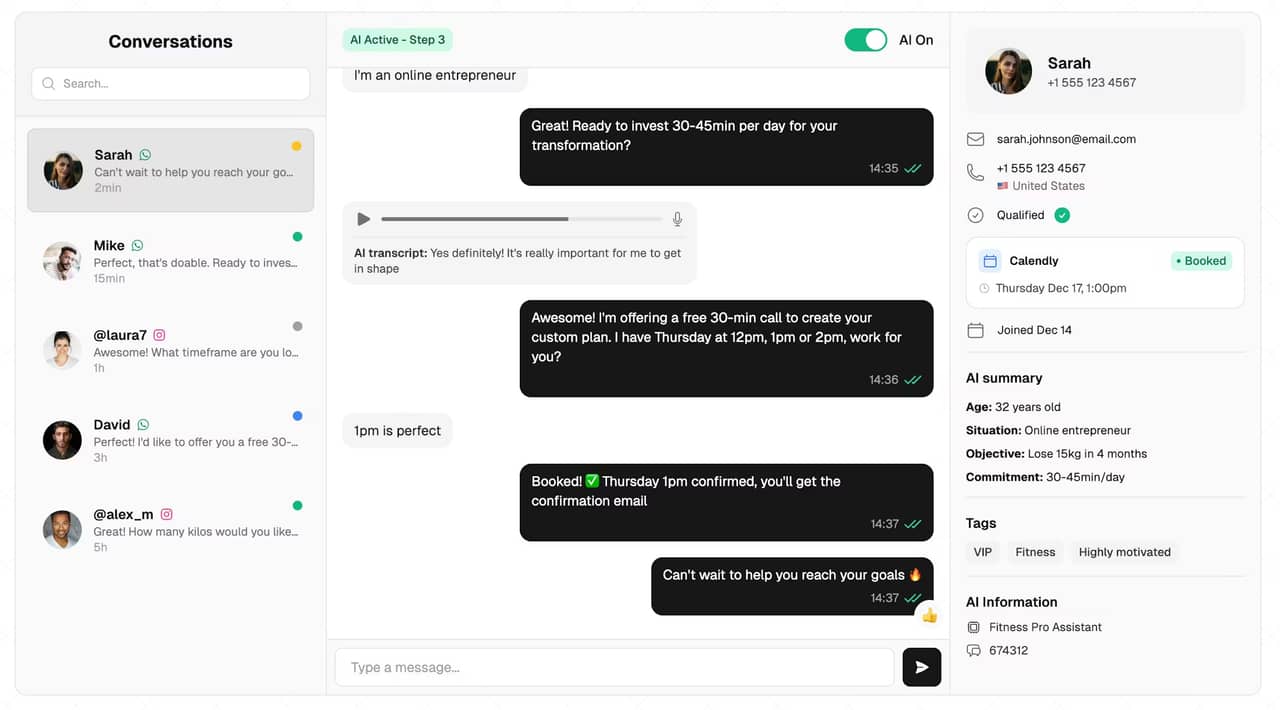
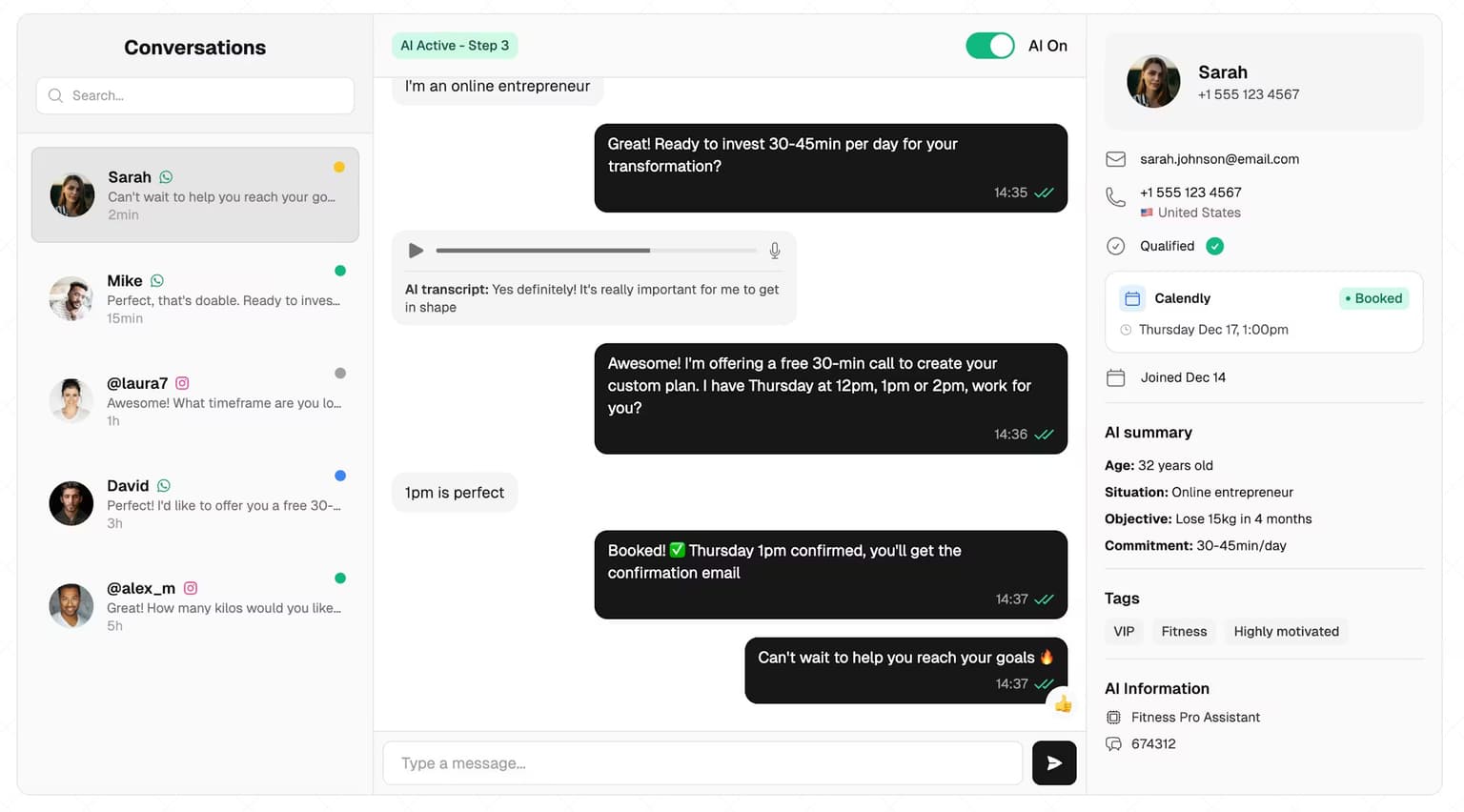
The hard part is doing this consistently while you also coach. Replying fast to every lead, qualifying properly, and following up with quiet threads is close to a full-time job, which is why most coaches leak calls. This is where an AI setter earns its place: it answers instantly, qualifies every lead in your DMs, and books the genuinely interested ones onto your calendar, so you spend your time on calls instead of triage. It plays the same appointment setter role a human would, at the speed the DM demands.
Speed and follow-up are not small details. Across our analysis of 828K DM conversations, a single follow-up to an engaged lead more than doubled booked calls (+106%). For a coaching package where each booked call can be worth thousands, recovering those quiet conversations is the difference between a full calendar and an empty one. If lead flow is the bottleneck, our guide to lead generation for coaches covers filling the top of the funnel.
Coaching package mistakes to avoid
- Too broad. A package that serves everyone is sellable to no one at a premium. Niche the outcome down until it feels almost uncomfortable.
- Pricing by the hour. Hourly rates cap your income and frame you as a cost, not an investment. Sell the program and the outcome.
- Too many tiers. Five options create decision paralysis. Two or three is plenty; make the middle one the obvious choice.
- Vague deliverables. "Ongoing support" means nothing. Spell out the calls, the messaging, and the resources so the value is concrete.
- Pitching the price in the DM. Sending a package price into a text thread kills momentum. Qualify in the DM, present on the call.
- Leaking leads. Slow replies and no follow-up waste the attention your content earned. Automate the first reply and the nudges so no interested person slips away.
"I stopped selling random calls and packaged everything into three tiers. Signing fewer, better clients at a higher price was the shift, and treating my DMs as a booking system instead of an inbox is what filled the calendar." (Théo Riffault)
Whether you coach nutrition, movement, business, or mindset, the packaging principles are the same, and they pair naturally with the client-acquisition tactics in our guides for nutrition coaches, personal trainers, life coaches, and weight loss coaches.
FAQ
How do I build a coaching package?
Start with one specific outcome for one type of client, then define the timeline, the deliverables, and a named process to get there. Bundle it all into a single price anchored to the value of the transformation, not your hourly rate. Offer two or three tiers so buyers choose their level of support, and plan to present the package on a booked sales call rather than in the DM.
How much should coaching packages cost?
There is no fixed number, but most coaching packages land between roughly $900 for a short group program and $15,000 or more for a deep, long-term 1:1 mentorship. Price for the value of the outcome and the depth of access you provide, not for your time. Start at a number you can confidently defend on a call, then raise it as your proof stacks up.
What should a coaching package include?
A strong package includes a clear outcome, a defined length in weeks or months, specific deliverables (calls, messaging support, plans, and resources), a named process or framework, and a single price. The exact mix depends on the tier, but access to you is the biggest driver of both value and price.
What are some online fitness coaching package examples?
Common examples include a 12-week app-based programming package, a 16-week hybrid coaching package with custom plans and check-ins, and a premium 1:1 transformation package with weekly calls. Ranges typically run from around $1,500 for lighter programs to $5,000 or more for high-touch 1:1 coaching, depending on your proof and market.
How many tiers should a coaching package have?
Two or three tiers is ideal. A good-better-best structure lets buyers self-select based on how much support and speed they want, while more than three options tends to cause decision paralysis. Make the middle tier the obvious best value, since that is where most clients land.
How do I sell coaching packages on Instagram?
Use your content to start conversations and your DMs to qualify interest and book sales calls, then present the package on the call. Do not pitch a package price over text. Post content tied to one outcome, move interested people into the DMs, ask a few qualifying questions, and book the serious leads onto a call where premium packages are actually sold.
Ready to automate your DMs?
Start your free 7-day trial and let AI handle your lead qualification 24/7.
Try SetSmart free