Weight Loss Coach Certification: 2026 Guide

If you want to coach people to lose weight for a living, a weight loss coach certification is the fastest way to build the knowledge, credibility, and confidence to charge real money. But here is the part nobody tells you before you swipe your card: the certificate is the easy step. The hard step, the one that actually pays your bills, is getting a steady stream of paying clients into your calendar. Most new online weight loss coaches get certified, post a few reels, and then wait for DMs that never come.
This guide fixes both halves. First, we compare the top weight loss coach certifications in 2026, what they cost, and who each one is for, so you do not overpay for a credential you do not need. Then we walk through the exact system online coaches use to turn an Instagram profile into a pipeline of qualified sales calls, without living in your inbox 12 hours a day.
The short version: pick one accredited certification, niche down hard, package a high-ticket transformation offer, and let an Instagram DM funnel do the heavy lifting of qualifying leads and booking calls. A certification proves you can coach. A client-acquisition system proves you can run a business. You need both, and this article gives you a clear plan for each.
What a weight loss coach actually does in 2026
A weight loss coach helps clients change the daily habits that drive their weight: nutrition, movement, sleep, stress, and accountability. You are not prescribing medication or treating disease (that is a registered dietitian or physician's role). You are the accountability partner and behavior-change expert who turns "I know what to do but I never do it" into consistent action.
In practice, the modern online weight loss coach:
- Builds simple, sustainable nutrition and training frameworks clients can actually follow.
- Runs weekly or biweekly check-ins (often by voice note, video, or DM).
- Keeps clients accountable between check-ins so they do not quietly quit.
- Sells the program through conversations, usually on Instagram or WhatsApp, then a booked call.
That last point matters. The best coaches in 2026 are not necessarily the most credentialed, they are the ones with a reliable way to start conversations with the right people. Certification gives you the "what." The rest of this guide gives you the "who pays you."
Do you need a certification to be a weight loss coach?
Direct answer: in most places, you are not legally required to hold a certification to call yourself a weight loss coach, but you absolutely should get one. There is no single government license for "weight loss coach" the way there is for a doctor or a dietitian. That is exactly why a certification matters: it separates you from the crowd of unqualified people giving out advice.
A certification gives you three things that translate directly into revenue:
- Knowledge that gets results. Clients who get results refer friends and post testimonials. Testimonials are the cheapest marketing you will ever run.
- Credibility on your profile. "Certified weight loss coach" in your bio lowers the resistance a stranger feels before booking a call.
- Scope awareness. A good program teaches you what you can and cannot claim, which protects you legally and keeps clients safe.
What a certification will not do is hand you clients. Plenty of certified coaches are broke, and plenty of uncertified ones are booked out, because client acquisition is a separate skill. If you are still deciding whether coaching is the right path at all, our guide on how to start an online coaching business is a good reality check before you spend on a credential.
The best weight loss coach certifications compared (2026)
There is no single "best" weight loss coach certification, only the best one for your budget, background, and the type of client you want. Some certifications sit under a fitness/personal-training umbrella, some under nutrition, and some under health coaching. Weight loss lives at the intersection of all three, so most reputable coaches hold a nutrition or health coaching credential and add a weight-management focus.
Here is how the most recognized options compare. Prices are approximate and change often, so always confirm the current cost and any bundle discounts on the provider's site before you buy.
| Certification | Focus | Accreditation | Approx. cost | Best for |
|---|---|---|---|---|
| Precision Nutrition (PN Level 1) | Nutrition coaching + behavior change | Widely respected industry standard | $$ (mid) | Coaches who want deep nutrition + coaching skills |
| NASM CNC + Weight Loss Specialization | Nutrition + weight-management add-on | NCCA-accredited body | $$ (mid) | Trainers already in the NASM ecosystem |
| ISSA Nutritionist / Weight Management | Nutrition + fitness bundles | NCCA / DEAC accredited | $$ (often discounted) | Bundle hunters who want fitness + nutrition together |
| ACE Weight Management Specialist | Behavior change + weight management | NCCA-accredited body | $ to $$ | Coaches who want a targeted specialist course |
| NESTA Lifestyle & Weight Management | Lifestyle + weight coaching | Industry recognized | $ (budget) | New coaches on a tight budget |
| NCI (Nutrition Coaching Institute) | Nutrition coaching + business | Industry recognized | $$$ (premium) | Coaches who want business training baked in |
| AFPA Weight Management | Nutrition + wellness | Industry recognized | $ to $$ | Self-paced, flexible online learners |
A few honest notes. If you want the single most respected pure coaching credential, Precision Nutrition is the safe default and doubles as a superb behavior-change education. If you already train clients and live inside a fitness certifier's ecosystem, adding that certifier's weight-management specialization is cheaper and faster than starting fresh. And if money is tight, a budget option that teaches sound behavior change will serve you fine, because clients hire outcomes and trust, not the logo on your certificate. For a broader look at the nutrition side specifically, see our walkthrough on how to become a nutrition coach.
How much does a weight loss coach certification cost?
Most reputable weight loss, nutrition, or health coaching certifications run somewhere between a few hundred and a couple thousand dollars, with the majority landing in the middle of that band. Premium programs that bundle business coaching cost more; lean, self-paced specialist courses cost less. Many providers offer monthly payment plans, seasonal discounts, and bundle pricing, so the sticker price is rarely the price you actually pay.
Do not over-index on cost. A $1,500 certification that you finish and apply is infinitely more valuable than a $400 one that sits half-done in a tab. And neither one matters if you never learn to fill your calendar. Think of the certification as a one-time investment in credibility, and your client-acquisition system as the engine that pays it back every month. If you want to compare the software and platforms that run a coaching business, our roundup of the best online coaching platforms breaks down the options.
Certification is step one, getting clients is the real job
Here is the uncomfortable truth: the market is full of certified weight loss coaches who cannot get clients. Certification teaches you to coach. It does not teach you to sell, to niche, to price, or to run the daily conversations that turn a stranger into a paying client. That is a completely different skill set, and it is the one that determines whether you have a hobby or a business.
The good news is that client acquisition for online coaches has become a repeatable system. You do not need to go viral, run a big ad budget, or cold-message hundreds of strangers a day. You need a niche, an offer worth paying for, content that starts conversations, and a way to qualify and book calls without burning out. The rest of this guide is that system. If you want the deeper client-acquisition playbook after this, our guide on how to get coaching clients goes further.
Step 1: Pick a niche and a transformation you can sell
The biggest mistake new weight loss coaches make is trying to help everyone. "I help people lose weight" is invisible. "I help busy moms lose the last 20 pounds without giving up dinner with their family" is a magnet. A tight niche makes your content sharper, your DMs easier, and your price higher, because you become the obvious choice for a specific person.
Pick your niche along three lines: who the person is (busy professionals, postpartum moms, men over 40, brides-to-be), the specific outcome (drop 20 pounds, build a sustainable routine, break a plateau), and the method you are known for (habit-based, high-protein, walking-first, no crash diets). You can always broaden later. Early on, narrow wins.
Step 2: Package a high-ticket offer, not hourly check-ins
Do not sell your time by the hour. Sell a transformation over a set period, usually 12 to 16 weeks, with a clear promise, a structure, and accountability built in. A packaged program lets you charge a premium, sets client expectations, and gives you the margin to actually serve people well. This is the difference between scraping by at $50 an hour and running a real business.
Price it as a high-ticket program, not a cheap subscription. High-ticket does not mean overpriced, it means the price matches the value of the outcome and filters for committed clients. Our guides on building a high-ticket offer and structuring coaching packages walk through exactly how to design and price one. Committed clients get better results, which gets you better testimonials, which gets you more clients. It compounds.
Step 3: Turn your Instagram into a client source
Most weight loss coaches live on Instagram, and for good reason: it is where your future clients already scroll for transformation content. But posting alone does not create clients. Conversations do. Your job is to turn passive viewers into DM conversations, because that is where trust is built and offers are made.
The mechanics are simple:
- Post content that invites a reply. Reels and stories that end with "comment WORD and I'll send it" or "reply to this story" give people an easy reason to open a chat.
- Automate the first reply. When someone comments your keyword, an Instagram comment-to-DM automation sends them the promised resource instantly, so no warm lead slips through while you sleep.
- Use auto-DM the right way. A well-built Instagram auto DM opens the conversation naturally instead of blasting a spammy link.
If you are still building the content engine behind this, our fitness marketing playbook and the guide on how to start online fitness coaching cover the content-to-DM funnel in depth. The principle is the same for weight loss: content earns attention, the DM earns the client.
Step 4: Qualify the lead and book the sales call in the DM
Once a conversation starts, resist the urge to pitch immediately. The coaches who book the most calls ask a few simple qualifying questions first: what the person is struggling with, what they have already tried, and how ready they are to invest in a change. This does two things: it makes the lead feel understood, and it filters out people who will never buy so you only spend call time on real prospects.
Then, and this is the key, you book a sales call. You do not close a high-ticket weight loss program in a text thread. The DM's job is to qualify and book the call; the actual enrollment happens on a short discovery call where you can hear the person's story and present your program properly. Treat the DM as your appointment-setting layer, not your closing floor.
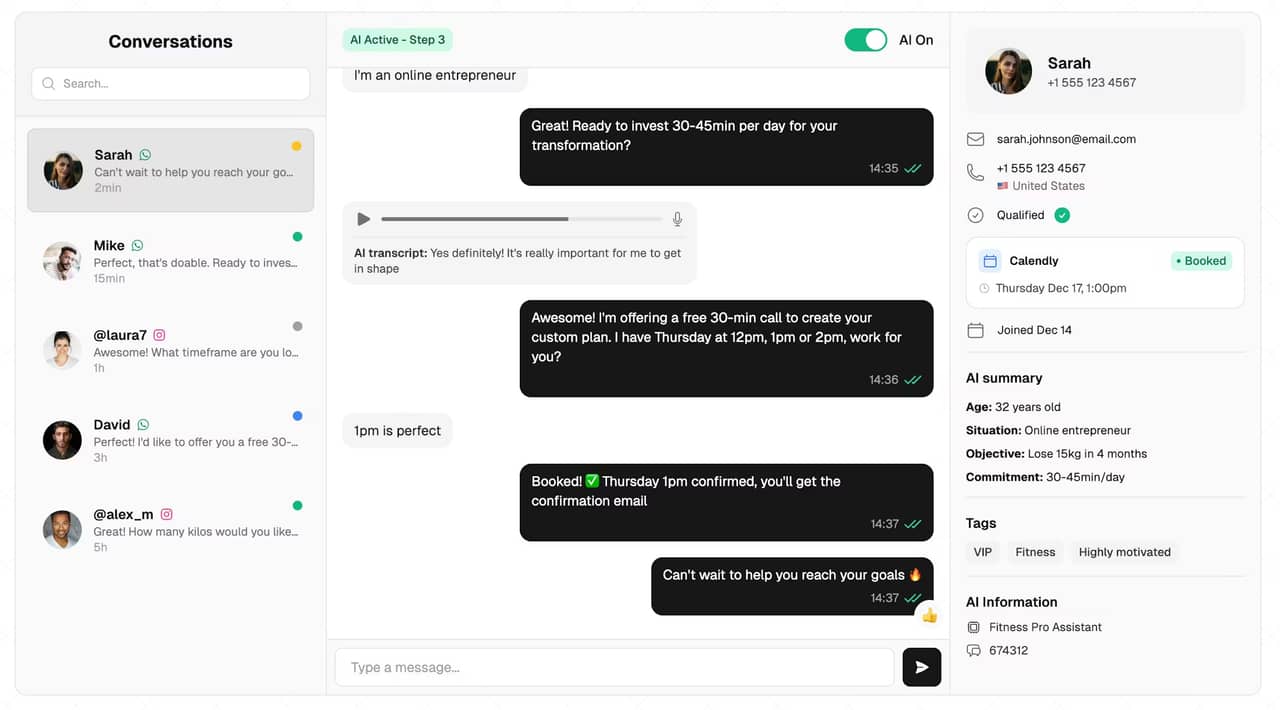
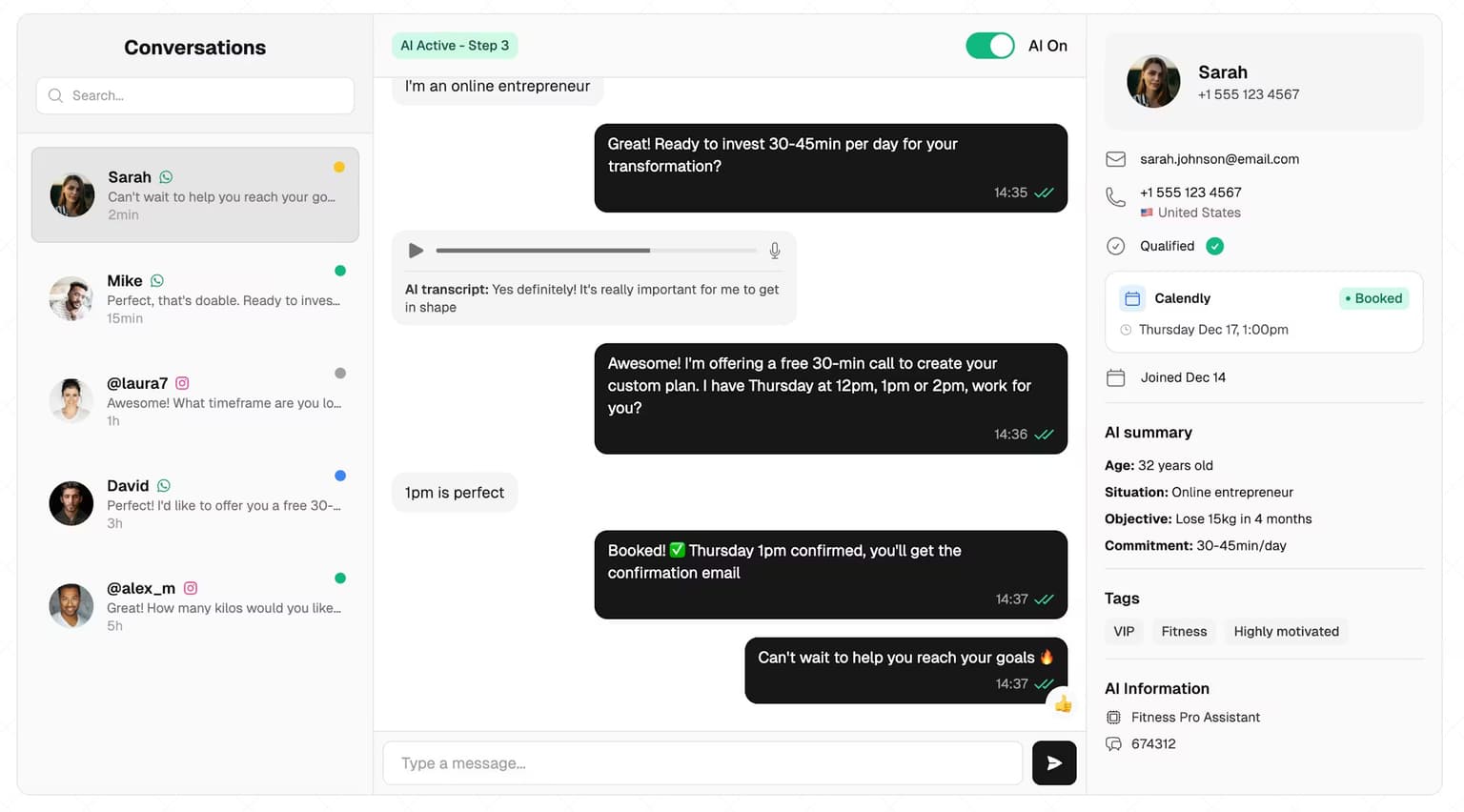
The problem is volume. If you are getting even 20 to 30 conversations a day, keeping up manually is impossible, and slow replies quietly kill deals. In our data from 828K DM conversations, a single follow-up message more than doubles booked calls, yet most coaches never send it because they are drowning. This is where an AI DM setter earns its keep: it answers instantly, asks your qualifying questions, follows up with the leads who go quiet, and books the fit ones straight into your calendar. If you would rather outsource the mechanics entirely, an appointment setter can play the same role, but AI does it around the clock without a salary.
How much do weight loss coaches make?
Income for weight loss coaches ranges widely, from a few hundred dollars a month as a side hustle to well into six figures for established online coaches with a full roster. The variable is almost never the certification, it is the client-acquisition system and the price of the offer.
Run the math. Ten clients on a $1,500 twelve-week program is $15,000 per cohort. Fill two cohorts a quarter and you are running a healthy full-time business, all from conversations that start in the DMs. The coaches who hit those numbers are not the most certified, they are the ones who consistently start conversations and book calls. For the full breakdown of building demand, see our guide on lead generation for coaches.
The tools you need to run an online weight loss coaching business
You need fewer tools than you think. A messy stack of ten apps is how coaches burn out. Keep it lean:
- A coaching/delivery platform to house programs, check-ins, and progress. Compare options in our best online coaching platforms roundup.
- A DM automation and setter tool to start, qualify, and book conversations on Instagram and WhatsApp. This is the growth engine.
- A simple booking calendar so qualified leads can grab a sales-call slot without back-and-forth.
- A lightweight CRM view so no lead falls through the cracks.
If you also run WhatsApp automation for check-ins and reminders, you can keep clients accountable between sessions with far less manual effort. The goal is a stack where content feeds the DMs, the DMs feed your calendar, and you spend your energy coaching, not chasing. For a broader marketing view, see how to market your coaching business.
Mistakes new weight loss coaches make
- Collecting certifications instead of clients. One good certification plus a client system beats three certifications and an empty calendar.
- Coaching everyone. A vague niche makes weak content and awkward DMs. Narrow down.
- Selling hours, not outcomes. Package a transformation and price it as a program.
- Pitching in the first message. Qualify first, book the call second, enroll on the call.
- Ignoring follow-up. Most leads never reply to the first message; the money is in the second and third touch, which is exactly where automation shines.
- Living in the inbox. Manual DMs do not scale. Let a DM setter handle the repetitive first replies so you can coach.
FAQ
What qualifications do you need to be a weight loss coach?
In most regions there is no legal license required to work as a weight loss coach, but a recognized nutrition, health, or weight-management certification is strongly recommended. It builds the knowledge to get clients results and the credibility to charge premium prices. You are coaching behavior change, not diagnosing or treating medical conditions, which is a dietitian's or doctor's role.
How much does a weight loss coach certification cost?
Most reputable programs run from a few hundred to a couple thousand dollars, with mid-range options being the most common. Many offer payment plans, bundles, and seasonal discounts, so confirm the current price on the provider's site. Treat it as a one-time credibility investment and put your ongoing energy into client acquisition.
What is the best weight loss coach certification?
There is no universal best. Precision Nutrition is a widely respected default for nutrition and behavior-change coaching, while NASM, ISSA, ACE, and others offer strong weight-management specializations. The right choice depends on your budget, background, and whether you want business training bundled in. Clients hire outcomes and trust, not the logo on your certificate.
Is there a free weight loss coach certification?
Genuinely accredited certifications are rarely free, though some platforms offer free short courses or trials. Be cautious with "free certifications" that carry no recognition, as they add little credibility. A modestly priced accredited program is a better investment than a free certificate no one respects.
How long does it take to become a weight loss coach?
Most online certifications take a few weeks to a few months of part-time study, and many are self-paced so you can move faster. You can start building your niche, content, and Instagram DM funnel in parallel, so you are ready to enroll clients the moment you finish.
How do weight loss coaches get clients without a big following?
You do not need a large audience, you need conversations with the right people. Post content that invites replies, use comment-to-DM automation to open chats, qualify leads with a few questions, and book sales calls with the ones who fit. A small, engaged Instagram presence with a solid DM system out-earns a big account with no funnel every time.
Ready to automate your DMs?
Start your free 7-day trial and let AI handle your lead qualification 24/7.
Try SetSmart free