How to Start an Online Coaching Business (2026)

If you search "how to start an online coaching business," you will find a hundred guides that all say the same five things: pick a niche, build an offer, choose a platform, post content, sell. None of that is wrong. It is just missing the one step that actually decides whether you get clients or stay stuck at zero: what happens in your DMs after someone shows interest.
Here is the truth from working with hundreds of online coaches. Most people who want to start an online coaching business do not fail because their program is bad or their niche is too small. They fail because interested people slide into their Instagram DMs, ask a question, and then disappear before a sales call is ever booked, the same leak that sinks most coaches trying to get clients as a life coach. The content works. The conversation layer leaks. The same inbound system, sold to other businesses, is the basis of our guide on how to start an AI agency.
So this guide covers the full arc, from picking a niche to landing your first paying clients, but it spends real time on the part everyone else skips: the inbound conversation engine that turns followers into booked sales calls. One thing to set straight before we start, because it shapes every step below: in a high-ticket coaching model, the DM does not close the sale. It qualifies the lead and books the call. You still sell your program on a real conversation. Get that distinction right and starting an online coaching business gets a lot less mysterious.
How to start an online coaching business in 7 steps
Here is the whole path in one view. Each step exists to move you closer to a calendar full of qualified sales calls with the right people.
| Step | What you decide | The output |
|---|---|---|
| 1. Niche | Who you help and the result you get them | A one-sentence positioning statement |
| 2. Offer | One high-ticket program, one price | A package people can say yes to |
| 3. Tech stack | Delivery, booking, payment, DM setter | A system you can run solo |
| 4. Instagram | Content that starts conversations | Inbound DMs every week |
| 5. DM funnel | How a DM becomes a booked call | Sales calls on your calendar |
| 6. Follow-up | How silent leads get re-engaged | Recovered conversations |
| 7. Deliver & scale | Results, referrals, and systems | A business, not a side hustle |
The first three steps are about clarity. The last four are about getting clients. Most new coaches over-invest in the first three (logo, website, the "perfect" course) and under-invest in the last four. Flip that and you will start an online coaching business that actually pays.
Step 1: Pick a niche you can get results in
Start with the person and the result, not the topic. "Online fitness coaching" is a topic. "Helping busy dads over 35 lose 20 pounds without giving up weekends" is a niche. The narrower and more specific you are, the easier every later step becomes: your content writes itself, your DMs convert better, and your price can go up because you are clearly the specialist.
The most reliable niches for a new online coaching business are ones where the outcome is concrete and emotionally charged. That is why online weight-loss coaching, nutrition coaching, and body transformation dominate the space, followed by life coaching, health coaching, career coaching, and business coaching. People pay premium prices to solve problems that keep them up at night, and if fitness is your niche, our guide on how to start online fitness coaching drills into that exact path.
A simple test before you commit: can you point to three results you have already created, for yourself or for others? If yes, that is your proof. If not, get a handful of clients at a lower price first, document the transformations, and then raise your rate. You do not need a certification to start, but you do need evidence you can deliver. For a deeper breakdown of finding and reaching your ideal client, our guide on how to get coaching clients walks through the acquisition side in detail.
Step 2: Build one high-ticket offer, not a menu
The single fastest way to slow down a new coaching business is to offer too many things. A 6-week program, a monthly membership, a one-off call, an ebook, a group cohort. Each option you add forces the prospect to make a decision, and confused prospects do not buy.
Instead, build one core offer that delivers your niche's promised outcome. Give it a clear scope (what is included), a clear timeline (how long it takes), and a clear price. High-ticket simply means priced to reflect the value of the transformation, usually a few hundred to a few thousand dollars, paid for the result rather than the hours.
Why high-ticket and not a cheap subscription? Because as a solo coach your time is the constraint. Ten clients at $2,000 is a real business you can deliver well. Two hundred clients at $20 is a customer-service job you will burn out on. A higher price also changes how you sell: instead of trying to convince hundreds of people in the DMs, you only need a steady flow of qualified conversations that lead to a few good sales calls each week. That is a far more achievable goal for someone just starting out.
Step 3: Set up a lean online coaching tech stack
You can start an online coaching business with surprisingly little software. Resist the urge to buy everything. You need four things, and one of them is the part most new coaches forget.
| Layer | Job | Examples |
|---|---|---|
| Delivery | Host your program, calls, and content | Course/coaching platforms, Zoom, a shared doc |
| Booking | Let leads grab a call slot | Calendly, GoHighLevel |
| Payment | Take money, including plans | Stripe, PayPal |
| DM setter | Qualify leads and book calls from your DMs | An AI setter on Instagram and WhatsApp |
Most "best online coaching platform" roundups stop at the first three layers, because they assume your only problem is hosting content. But hosting was never the bottleneck. The bottleneck is the conversation that happens before someone ever becomes a client, and that lives in your Instagram DMs, not in your course platform.
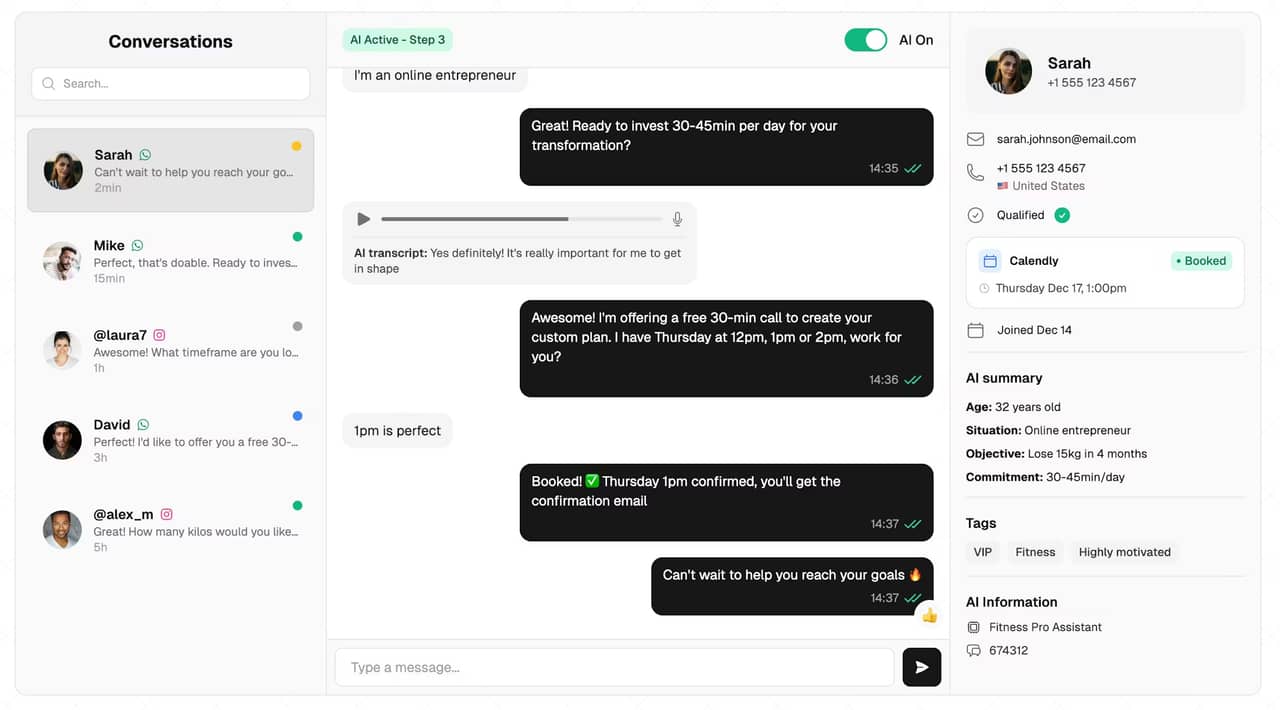
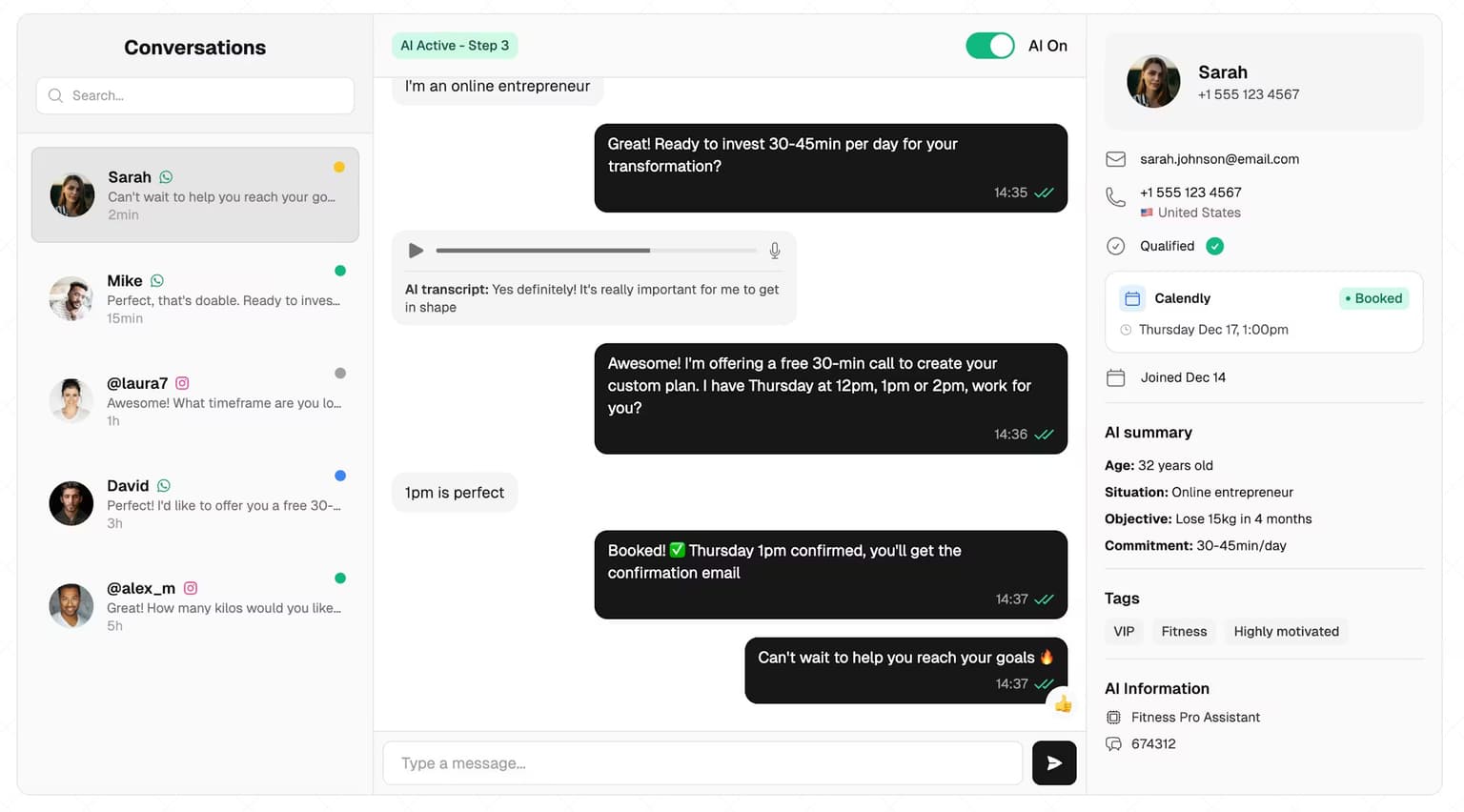
That fourth layer, the DM setter, is where a tool like SetSmart fits. It is not a course host. It sits in front of your delivery stack and handles the inbound conversation: answering the first message in seconds, qualifying whether the person is a fit, and booking a sales call directly in the chat. SetSmart runs on a free 7-day trial, then $97/month, and connects to Instagram, WhatsApp, and Messenger. If you want to understand the category before choosing, see our comparison of the best AI setters and the broader AI setter concept.
Step 4: Turn your Instagram into a lead engine
For a new online coaching business in 2026, Instagram is the engine. Not because other channels do not work, but because that is where your future clients already scroll, and because the platform makes it easy to turn a piece of content into a private conversation.
The mistake new coaches make is treating Instagram like a billboard. They post tips, chase follower counts, and wait. The coaches who actually book calls treat every post as a conversation starter. The format matters less than the intent: each reel, story, or carousel should end with a reason to reply, comment, or DM.
The mechanic that makes this scale is comment-to-DM. You post a reel, invite people to comment a keyword like "START," and a trigger automatically opens a DM with everyone who did. It is the "DM the keyword" funnel you have seen big creators run, and it works just as well at a small scale. Our guides on Instagram comment-to-DM automation and Instagram DM automation cover the exact setup, and Instagram lead generation maps the whole content-to-conversation funnel.
You do not need to go viral. You need a repeatable way to turn a modest amount of attention into DMs from people who raised their hand. A handful of qualified conversations a week is enough to fill a starting coach's calendar.
Step 5: Run the DM funnel that books sales calls
Once someone is in your DMs, you have a narrow window to be helpful, build trust, and move toward a booked call before they get distracted and vanish. This is the step that separates coaches who get clients from coaches who just get followers.
A good DM funnel does four things in order:
- Respond fast. Speed is the single biggest lever. A reply within seconds keeps the conversation alive; a reply hours later usually finds a cold lead. Most coaches cannot answer instantly between sessions, which is exactly why an AI DM setter earns its place here.
- Qualify gently. Ask a couple of natural questions to understand their situation, goal, and whether your program fits. You are not interrogating; you are finding out if a call is worth both your time.
- Book the call. When there is a fit, propose specific calendar slots right in the chat. The goal of the DM is the booking, not the sale.
- Confirm and remind. Reduce no-shows with a clear confirmation and a reminder before the call.
Notice what the DM does not do: it does not try to close a high-ticket program in the inbox. The DM's only job is to qualify and book. You (or a closer) sell on the call, where a real conversation can handle the price, the objections, and the commitment. If you want scripts to model, our Instagram DM scripts cover qualification and booking language you can adapt.
"Before, I was answering DMs between coaching sessions and losing half of them. Now every lead gets an instant reply, gets qualified, and books a call without me touching my phone. I just show up to the calls." — Mathis Ladoué, online coach
Step 6: Qualify and follow up so leads don't vanish
Most interested leads do not go silent because they lost interest. They go silent because life happened: they got pulled into a meeting, put the kids to bed, or meant to reply later and forgot. The conversation is not dead. It is just paused, and almost nobody nudges it back to life.
This is the most under-used lever in a new coaching business. In our analysis of 828,761 DM conversations, a single well-timed follow-up message more than doubled booked calls (+106% among engaged leads). One message. The coaches who follow up consistently book dramatically more calls than the ones who send a single message and hope, yet following up is exactly the task a busy solo coach drops first. You can see the full breakdown in our AI DM conversation study.
The practical fix is to make follow-up automatic rather than relying on willpower. A timed nudge a few hours later and another the next day recovers a large share of paused threads, and it is the kind of repetitive, easy-to-forget work that an AI sales assistant handles without complaint. Whether you do it manually or automate it, build follow-up into your funnel from day one. It is free leverage on leads you already earned.
Step 7: Deliver results, get referrals, and scale
Getting the first clients is the hard part. Keeping a coaching business alive is about results. Deliver the transformation you promised, document it, and your business compounds: happy clients refer friends, give testimonials, and become proof that powers your next round of content.
As you grow, the same conversation system that got your first clients lets you handle more volume without hiring. A solo coach can only manually answer so many DMs and book so many calls. With an AI setter qualifying and booking around the clock, the constraint shifts from "how many DMs can I answer" to "how many calls do I want on my calendar." That is when an online coaching business stops feeling like a hustle and starts feeling like a company. If you coach in the fitness space specifically, our fitness marketing playbook goes deeper on the content side of this engine, and the AI DM setter for fitness coaches page shows the conversation side. For the full promotion playbook, see how to market your coaching business.
The order matters. Get a niche, an offer, and a working DM funnel first. Add scale once the engine is proven. Trying to scale a leaky funnel just means losing more leads faster. When you reach that stage, here is how to grow your online coaching business.
How much does it cost to start an online coaching business?
Less than most people think. You can start an online coaching business for close to $0 in upfront cost if you lean on free content and a single channel. Your real costs are a booking calendar (free tiers exist), a payment processor (pay per transaction), and optionally a delivery platform once you have clients to deliver to.
The one paid tool worth adding early is the conversation layer, because it directly protects the leads your content earns. SetSmart, for example, is a free 7-day trial, then $97/month, and it replaces the manual DM-answering and follow-up work that otherwise eats your evenings. Compared to the cost of losing half your inbound leads to slow replies, it usually pays for itself with a single booked client. You do not need a website, a logo, or a course built in advance. You need a clear offer and a funnel that turns attention into booked calls.
Common mistakes when starting an online coaching business
A few patterns sink new coaches over and over:
- Building the course before getting clients. Pre-sell the transformation, then build the materials as you deliver. Do not spend three months on content nobody has paid for yet.
- Offering too many things. One offer, one price. Choice kills conversion.
- Treating Instagram as a billboard. Posts should start conversations, not just collect likes.
- Answering DMs slowly and inconsistently. Speed and consistency win the conversation. This is the single biggest leak, and the easiest to fix with automation.
- Trying to close in the DM. The DM books the call. The call sells the program. Skipping the call to "close in chat" usually scares off serious high-ticket buyers.
- Never following up. Most leads need a second touch. Skipping it leaves money on the table.
Avoid those six and you are already ahead of most people trying to start an online coaching business this year.
FAQ
Can you start an online coaching business for free?
Yes. You can start with free Instagram content, a free booking calendar, and a payment processor that only charges per transaction. The one paid tool worth adding early is a conversation layer that qualifies and books your leads, because slow or missed DM replies are where most free-but-failing coaching businesses leak their clients.
How do I start an online coaching business from home with no experience?
Start by getting a few results, even unpaid, so you have proof you can deliver. Then pick one specific niche, build one offer, and run an Instagram DM funnel to book sales calls. You do not need a certification or an office. You need evidence of a transformation and a repeatable way to turn content into qualified conversations.
What is the best platform for an online coaching business in 2026?
It depends on what you mean by platform. For delivering programs, course and coaching platforms all work fine. But the layer most coaches actually need first is the conversation layer that qualifies and books leads from Instagram and WhatsApp DMs, which sits in front of any delivery tool. Compare options in our guide to the best AI setters.
Will online coaching be replaced by AI?
No. AI is replacing the repetitive parts, like answering first messages, qualifying leads, and following up, not the coaching itself. Clients still pay for a human expert who can guide their transformation and sell on a real call. AI handles the conversation layer so coaches spend their time coaching and closing, not chasing DMs. Learn what a DM setter actually does.
How do online coaches get their first clients?
They turn content into conversations. A reel earns a comment, a comment-to-DM trigger opens a thread, a short qualification flow confirms fit, and a sales call gets booked. The close happens on the call, not in the DM. Speed and follow-up matter more than follower count for landing those first few clients.
How long does it take to make money from an online coaching business?
Faster than building a course suggests, because you can pre-sell your offer before building anything. With a clear niche, one offer, and a working DM funnel, many new coaches book their first sales calls within weeks. The timeline depends far more on how consistently you start conversations and follow up than on how polished your materials are.
Is an online coaching business profitable in 2026?
Yes, when the model is high-ticket and the funnel converts. A coach selling a $2,000 program only needs a handful of clients a month to clear a full-time income, and the delivery costs are close to zero. The profitability killer is not demand. It is leads leaking out of the DMs before a call gets booked, which is why the conversation layer matters more than any other tool you buy.
Do I need a certification to start an online coaching business?
Legally, in most niches, no. Practically, what sells is proof: real transformations, testimonials, and content that demonstrates you know your subject. A certification can add trust in regulated or health-adjacent niches, but clients book calls because of results you can show, not letters after your name. Start with proof, add credentials later if your niche expects them.
Ready to automate your DMs?
Start your free 7-day trial and let AI handle your lead qualification 24/7.
Try SetSmart free