How to Start a Health Coaching Business (2026)
Direct answer: to start a health coaching business in 2026, pick one transformation you can deliver online, package it as a high-ticket program instead of hourly sessions, and build an Instagram DM funnel that turns content into qualified sales calls. The coaching part you already know. The part that decides whether you have a business or an expensive hobby is how you turn attention into booked calls.
Most guides on how to start a health coaching business stop at "get certified, pick a niche, build a website." Useful, but none of that puts a paying client in front of you. The coaches who actually fill their calendars treat client acquisition as a system: a steady source of attention, a way to capture interested people into DMs, and a fast, consistent process that qualifies them and books a call. This guide walks through that whole system, with the lead-generation engine that the generic guides skip.
TL;DR: how to start a health coaching business
- Pick a niche and a transformation. One outcome, one person. "I help busy professionals lose 10kg without giving up their social life" beats "I help people get healthy."
- Build a high-ticket offer. A multi-week program with a defined result and a single price, not a stack of hourly sessions.
- Use Instagram as your lead source. Content that speaks to one problem, with one clear call to action that moves people into the DMs.
- Automate the first DM. A comment-to-DM trigger replies in seconds so no interested person slips through.
- Qualify, then book the call. Ask a few questions in the DM, and book the serious leads onto a sales call where the real selling happens.
- Follow up. One nudge to a quiet lead recovers a surprising number of booked calls.
You do not need a huge audience or a fancy funnel to start. You need one offer, one channel, and a reliable way to convert conversations into calls.
What a health coaching business actually is in 2026
A health coaching business sells outcomes, not appointments. You help clients change a specific area of their health (weight, nutrition, energy, sleep, gut health, hormones, habits) over a defined period, and you charge for the transformation. The most common and most profitable model in 2026 is online, high-ticket, and one-to-one or small-group, sold through a booked call rather than a checkout button.
That matters because it changes everything downstream. If you are selling a 12-week program for a meaningful price, people will not buy it from an Instagram caption. They want a conversation first. So your job is not to "post and hope." Your job is to start conversations with the right people and book them onto a call. Everything in this guide is built around that single goal.
Health coaching overlaps with getting your first coaching clients in general and with the wider playbook for starting an online coaching business. The mechanics are the same. What is specific to health is the trust bar: people are cautious about who they let guide their body, so proof, specificity, and a real conversation matter more than in most niches. The same funnel works in adjacent niches, including how to get clients as a life coach.
Do you need a certification to start a health coaching business?
Direct answer: in most places you do not legally need a certification to coach on general wellness, habits, and fitness, but you do need to stay in your lane and not give medical or clinical advice. A recognised certification builds trust and protects you, and many successful coaches start while studying for one.
What actually wins clients is not the certificate on your wall. It is a clear niche, visible proof that you get results, and the ability to have a confident conversation about their situation. If you already have results (your own transformation, or a handful of people you have helped), you can start now and add credentials as you grow. Do not let "I am not certified enough yet" become the reason you never start.
A practical rule: coach on lifestyle, nutrition habits, training, and accountability. Refer anything clinical (eating disorders, medication, diagnosed conditions) to a doctor or registered dietitian. Say this clearly on your profile and in your conversations. It protects you and it signals professionalism.
Step 1: Pick a niche and a transformation you can sell
Direct answer: choose one specific outcome for one specific person. The narrower your niche, the easier every other step becomes, because your content, your offer, and your DMs all speak to the same person.
"Health coach" is too broad to sell. Compare these:
- Weak: "I help people live healthier."
- Strong: "I help women over 40 lose weight without restrictive diets."
- Strong: "I help busy founders fix their energy and sleep in 8 weeks."
A sharp niche does three things. It makes your content stop the right person mid-scroll. It lets you charge more, because specialists out-earn generalists. And it makes qualifying obvious, because you know exactly who is a fit and who is not.
If you are unsure which niche to pick, look at where you already have proof or genuine interest. Nutrition and weight loss are the largest, most competitive corners. Energy, sleep, hormones, gut health, and habit change are smaller and often easier to own. Pick the one you can talk about for an hour without notes.
Step 2: Package a high-ticket offer, not hourly sessions
Direct answer: bundle your coaching into a multi-week program with a clear outcome and a single price. Hourly pricing caps your income at the hours in your day and trains clients to think in transactions instead of transformations.
A few principles that hold up no matter the niche:
- Anchor on the outcome. A "12-week metabolic reset" is worth far more than "12 calls." Sell the destination, not the meetings.
- Offer one or two packages, not a menu. Choice paralysis kills sales. A flagship program plus an optional premium tier is plenty when you start.
- Raise prices as proof grows. Your first few clients can come in lower in exchange for testimonials. Once you have before-and-afters, your prices climb.
- Confirm budget fit in the DM, close on the call. Use the conversation to check someone can actually invest before you book, so your calls are with serious buyers.
How much should a health coach charge?
It depends on your niche, your proof, and your delivery, but the trap is charging too little. New coaches often price an entire transformation like a gym membership and then burn out serving too many low-paying clients. A defined multi-week program priced as a single investment is almost always healthier for your business and your clients' commitment than a cheap per-session rate. Once you have results to show, your prices should rise with them.
Step 3: Turn your Instagram into a client source
Direct answer: post content that speaks to one transformation, and give every piece a single clear call to action that moves people into your DMs. Instagram is where most online health coaches find clients, because it lets you build trust at scale and start private conversations on the same platform.
Your profile should pass the three-second test: who you help, what outcome, and one action to take. Your content should do one job, make the right person think "that is me," and invite them to raise their hand. The cleanest call to action in 2026 is a keyword: "comment ENERGY and I will send you my 7-day plan." That single move turns a passive viewer into a DM you can actually have a conversation in.
This is the same engine covered in our fitness marketing playbook and our guide to getting personal training clients via Instagram. The format changes by niche; the mechanism does not. Content earns attention, a call to action captures it, and the DM is where the selling conversation happens.
Step 4: Open the first DM automatically
Direct answer: trigger the first DM the instant someone engages, because the lead you reach in seconds converts far better than the one you reach tomorrow. This is the single biggest leak for new health coaches.
Here is the failure mode. You post a reel, it does well, 60 people comment your keyword, and you spend two evenings manually replying. By the time you reach comment 40, that person has forgotten they ever asked. A comment-to-DM trigger fixes this. When someone comments your keyword, they instantly receive a DM with your freebie and a first question. Nobody waits. Nobody slips through.
You can read the full mechanics in our guide to Instagram comment-to-DM automation and the trigger-based Instagram auto DM setup, with the whole stack covered in our Instagram DM automation walkthrough.
Speed is not optional. According to lead response time statistics, the average business takes around 42 hours to respond, while a strong AI setter replies in under five seconds, and leads contacted within five minutes qualify at many times the rate of those reached half an hour later. An automated first message means you answer instantly, every time, even while you are coaching a client or asleep.
| Approach | First reply time | Leads lost |
|---|---|---|
| Manual DM replies | Hours to days | Most |
| Saved-reply batches | A few hours | Many |
| Comment-to-DM trigger | Seconds | Few |
Step 5: Qualify the lead and book the sales call
Direct answer: qualify before you pitch, then book a call instead of selling in the DM. A call with the wrong person wastes 30 minutes. A DM that qualifies first protects your calendar.
Before you mention price, you want to know four things:
- Goal: what are they actually trying to change?
- Situation: where are they now, and what have they tried?
- Timeline: do they want to start this month or "someday"?
- Budget fit: can they invest in coaching, or are they hunting for free tips?
Ask these one at a time, conversationally, the way a coach would, not as a survey. Our library of Instagram DM scripts has openers and qualifying questions you can adapt. The people who answer with a clear goal and a near-term timeline are your buyers. The ones who vanish after "what is your goal?" were never going to pay.
Why an AI setter does the qualifying for you
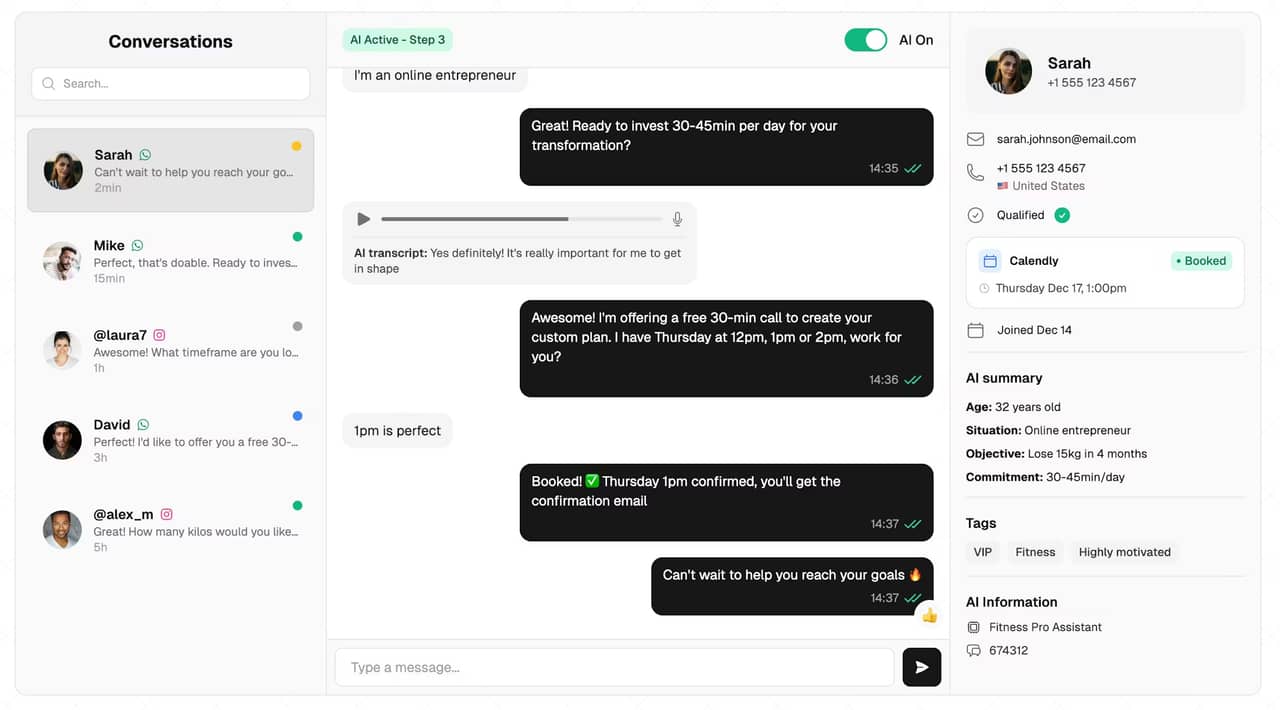
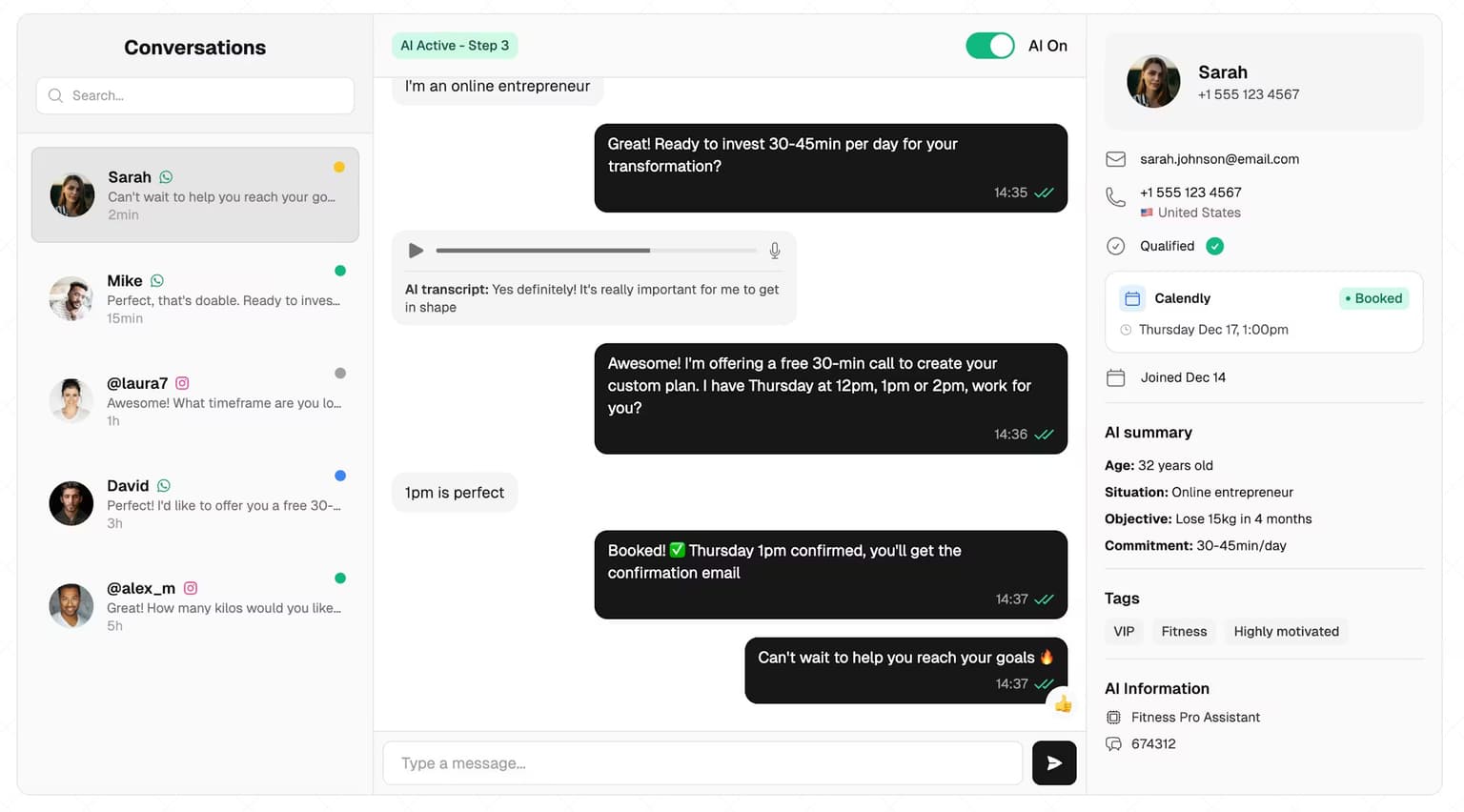
You cannot hold 60 simultaneous qualifying conversations and still coach. This is where an AI DM setter earns its place. It answers every new DM in seconds, asks your qualifying questions in natural language, handles the back-and-forth, and only flags the leads worth your time. Think of it as an AI setter that runs your inbox while you run sessions. For a side-by-side of the tools that do this, see our roundup of the best AI setters and the full Instagram DM automation with AI setup.
Then book the call, do not close in the chat. Once someone is qualified, propose two specific time slots and drop your booking link right in the DM. The actual sale happens live, where you can handle objections and tailor the offer, which is the same reason high-ticket closing happens on a call rather than over text. SetSmart, the AI DM setter built for fitness and health coaches, qualifies the lead and books the call straight into your calendar, then hands the conversation back to you for the sale. The goal is to fill your calendar with qualified sales calls, not to win a price debate by message.
The follow-up almost no coach uses
Most conversations die early. People get distracted, a notification buries your message, life happens. In our analysis of 828K DM conversations, a single follow-up message roughly doubled the number of booked calls. One message. It is the cheapest growth lever you have, and almost no new coach uses it consistently because doing it by hand is tedious. Set a simple rhythm: if a lead goes quiet, send one light nudge a few hours later and one more the next day.
The tools you actually need
Direct answer: you need three layers, a way to deliver coaching, a way to convert DMs into booked calls, and yourself on the calls. New coaches over-invest in the first and ignore the second, which is backwards, because the conversion layer is what pays for everything else.
| Job | Tool type | What it does |
|---|---|---|
| Deliver coaching | Coaching platform | Hosts plans, check-ins, and habit tracking |
| Trigger the DM | Comment-to-DM automation | Sends the first message instantly when someone comments your keyword |
| Qualify and book | AI DM setter (SetSmart) | Holds the conversation, qualifies, and books the call into your calendar |
| Run the calls | You | Close the sale and coach the client |
For the delivery side, our comparison of the best online coaching platforms ranks the main options. The conversion side is where SetSmart sits: it qualifies and books, then gets out of the way. If WhatsApp is a big channel for your audience, our WhatsApp automation guide covers that path too.
Pricing: SetSmart is a Free 7-day trial, then $97/month (1,000 messages included), so it pays for itself the moment it books a single client you would otherwise have missed.
How health coaches get clients without a big audience
Direct answer: you do not need tens of thousands of followers, you need to start more of the right conversations and convert them well. A coach with 1,200 engaged followers and a tight DM system out-earns a coach with 30,000 followers and no funnel.
Three levers move the needle when your audience is small:
- Post for the DM, not the like. Every piece of content should aim to start a conversation, not chase reach for its own sake.
- Treat every comment and story reply as a lead. A "this is so me" reply to your story is an opening. Answer fast and move it into a real conversation.
- Be relentless about speed and follow-up. This is where small accounts win, because they can actually reply in minutes and follow up consistently, especially with an AI setter handling the front end.
"The biggest change was not getting more followers, it was finally replying to everyone in seconds and following up. My calendar filled up before my audience did." (Mathis Ladoué)
A 30-day plan to launch
You do not need to build everything at once. Run this for one month:
- Week 1: Lock your niche and write your one-line promise. Define one offer and a starting price. Rewrite your Instagram bio to pass the three-second test.
- Week 2: Create a simple freebie tied to your niche. Set up a comment-to-DM trigger and your qualifying questions. Start posting content with one clear call to action.
- Week 3: Have real conversations. Reply fast, qualify, and book your first calls, even if they are free at first to gather proof and practice your pitch.
- Week 4: Run your calls, sign your first clients, and ask for testimonials. Turn on follow-ups for quiet leads so nothing leaks.
By the end of the month you have an offer, a lead source, a DM system, and ideally your first paying client. That is a business, not a hobby.
Mistakes that stall new health coaches
- Staying too broad. "I help people get healthy" attracts no one. Niche down until it feels almost uncomfortable.
- Selling in the DM. Trying to close a high-ticket coaching program over text kills momentum. Qualify in the DM, sell on the call.
- Pricing like a gym session. Per-hour pricing caps your income and undersells the transformation.
- Replying slowly. A lead reached in two days is mostly gone. Speed is a feature, not a nice-to-have.
- Skipping follow-up. One nudge recovers calls you would otherwise lose. Doing it by hand is why most coaches skip it.
- Building everything before talking to anyone. You learn more from ten real DM conversations than from a month of perfecting your website.
"I spent three months building courses nobody bought before I focused on conversations. Once I treated my DMs as the business, I signed clients in weeks." (Edouard Clerc)
FAQ
How do I start a health coaching business with no money?
Start with what you already have: your knowledge, a free Instagram account, and a simple freebie you can make yourself. Coach your first few clients at a lower rate in exchange for testimonials, then reinvest that income into the tools that save you time, like a coaching platform and an AI setter to handle your DMs. You do not need paid ads to get your first clients, you need conversations.
Do I need a certification to start a health coaching business?
In most places you can legally coach on general wellness, habits, nutrition basics, and fitness without a clinical license, as long as you do not give medical advice or treat diagnosed conditions. A recognised certification builds trust and is worth pursuing, but many coaches start while studying for one. Refer anything clinical to a doctor or registered dietitian and say so clearly.
How much should a health coach charge?
Price for the transformation, not the hour. A defined multi-week program sold as a single investment almost always beats a cheap per-session rate, both for your income and for client commitment. New coaches tend to under-price, so start at a fair rate, gather proof, and raise prices as your results stack up.
How do health coaches get clients?
Most online health coaches get clients through Instagram: content that speaks to one transformation, a clear call to action that moves people into the DMs, and a fast, consistent process that qualifies them and books a call. Speed and follow-up matter more than audience size. A small account with a tight DM system beats a large one with none.
Can I start a health coaching business from home?
Yes. Online health coaching is built to run from home with nothing more than a phone, Instagram, a way to deliver your program, and a system to convert DMs into booked calls. Your clients can be anywhere, which removes the local cap that limits in-person coaches.
How long does it take to get my first health coaching client?
With a clear niche, one offer, and an active DM funnel, many coaches land their first client within a few weeks. The bottleneck is rarely the coaching, it is how many qualifying conversations you start and how fast you reply. Automating the first DM and the follow-ups shortens that timeline considerably.
Ready to automate your DMs?
Start your free 7-day trial and let AI handle your lead qualification 24/7.
Try SetSmart free