High Ticket Offer: How Coaches Build One (2026)

Direct answer: a high ticket offer is a premium, outcome-based program (usually $2,000 and up) that you sell through a conversation and a booked call, not a checkout button. To build one as a coach or creator in 2026, pick one specific transformation, package it as a multi-week program instead of hourly sessions, price it for the result, and use your Instagram DMs to fill your calendar with qualified sales calls where the offer is actually sold.
Most coaches do not have a traffic problem or a content problem. They have an offer problem. They sell hourly sessions, low-priced challenges, or a vague "coaching package" that forces them to chase dozens of small sales just to make a living. A high ticket offer flips that math: fewer clients, deeper work, and a price that lets you actually deliver. This playbook covers what a high ticket offer is, real examples by niche, how to build and price one, and how to sell it without trying to close in the DM.
TL;DR: building a high ticket offer
- One outcome, one buyer. A premium offer that tries to serve everyone serves no one. Pick a single transformation for one specific person.
- Sell the result, not your time. Package a multi-week program with a defined outcome and a single price. Hourly pricing caps your income and undersells the change you create.
- Price for the transformation. Anchor on the value of the result and the support you include, not on an hourly rate or what cheaper coaches charge.
- Make it safe to buy. Proof, a clear method, and a concrete promise are what justify a premium price.
- Sell on a call, not in chat. Use Instagram and WhatsApp DMs to qualify interest and book the call. High-ticket buyers say yes on a conversation, not from a caption.
- Feed it with a DM funnel. A steady flow of qualified sales calls is what turns a great offer into a real business.
A high ticket offer is not about charging more for the same thing. It is about packaging a real outcome so well that a premium price feels obvious to the right buyer.
What is a high ticket offer?
A high ticket offer is a high-priced product or service, typically sold for $2,000 or more, that delivers a significant, specific outcome and is bought after a real conversation rather than an impulse click. For coaches, consultants, and course creators, it usually takes the shape of a multi-week or multi-month program that combines a method, coaching or support, and a clear promise.
The word "high ticket" describes the price and the buying process, not the niche. A $5,000 weight-loss program, a $3,000 done-with-you Instagram growth sprint, and a $12,000 business mentorship are all high ticket offers. What they share is that nobody buys them on a whim. The buyer wants to understand the outcome, trust the person delivering it, and feel that the price is fair for the result. That is why high ticket offers are sold on a booked call, where you can answer objections and tailor the offer to the person in front of you.
There is no universal price line that separates "high ticket" from everything else. As a rough guide, many creators treat anything under a few hundred dollars as low ticket (sold directly), the few-hundred-to-low-thousands range as mid ticket, and $2,000 and up as high ticket (sold through a conversation). The exact number matters less than the buying behaviour: if the price is high enough that people need to talk to you before they commit, you are selling a high ticket offer.
High ticket offer examples by niche
The fastest way to understand a high ticket offer is to see what one looks like in your niche. These are representative examples for the kinds of coaches and creators who run inbound DMs, not fixed prices. Your number depends on your proof, your delivery, and your market.
| Niche | Low ticket version | High ticket offer | Typical range |
|---|---|---|---|
| Weight loss / nutrition | $29 meal-plan ebook | 12-week 1:1 transformation with weekly check-ins | $2,000 to $6,000 |
| Online fitness coaching | $49/mo app subscription | 16-week hybrid coaching with custom programming | $2,500 to $5,000 |
| Business / money | $99 course | 6-month mentorship with calls and accountability | $5,000 to $15,000 |
| Agency / SMMA | $200 audit | Done-with-you growth retainer or 90-day sprint | $3,000 to $10,000 |
| Mindset / life | $19 workbook | 3-month 1:1 coaching container | $2,000 to $4,500 |
Notice the pattern. The low ticket version sells information. The high ticket offer sells a guided outcome with you in the loop. That is the difference buyers pay a premium for, and it is the same shift covered in our guide to starting an online coaching business.
How to create a high ticket offer step by step
Direct answer: build your offer backwards from the outcome. Decide who you help and what changes for them, package the path to that change into a defined program, then add the proof and support that make a premium price feel safe.
Step 1: Pick one outcome and one buyer
A high ticket offer needs a sharp edge. "I help people get fit" is not sellable at a premium. "I help busy dads lose 10kg in 12 weeks without giving up weekends" is. The narrower your promise, the easier everything downstream becomes, because your content, your DMs, and your pitch all speak to the same person. If you are still finding that person, our piece on how to get coaching clients walks through choosing a niche that actually buys, and for the mindset and life niche specifically there is how to get clients as a life coach.
Step 2: Package the result, not your hours
Stop selling sessions. Bundle your coaching into a program with a start, a finish, and a defined result. Hourly pricing punishes you for getting efficient and trains clients to think in minutes instead of outcomes. A program lets you charge for the transformation and gives the client a clear container to commit to. Decide what is inside: the duration, the calls, the messaging support, the resources, and the one promise that ties it together.
Step 3: Build the path and the proof
People do not pay premium prices for a vague promise. Give your offer a named method or a simple framework so the buyer can picture the journey. Then stack proof: testimonials, before-and-after results, screenshots, and your own story. Even a handful of strong results changes how the price lands. If you are early and short on proof, coach your first few clients at a lower rate in exchange for testimonials, then raise the price.
Step 4: Wrap it in a clear promise and a guarantee
Reduce the risk of saying yes. A specific promise ("you will lose at least X" or "you will book your first clients in 90 days") and a fair guarantee make a high ticket offer far easier to sell, because the buyer is no longer betting blind. Keep the promise honest and tied to the work they put in, not a magic-pill claim.
Step 5: Decide how you sell it
A high ticket offer is sold on a booked call, almost never in the DM. Your job in chat is to qualify interest and book the call, not to send a price and hope. We will cover the selling motion in detail below, but build the offer knowing the close happens on a conversation with a human, the same setter-to-closer flow described in our high ticket closing guide.
How to price a high ticket offer
Direct answer: price for the value of the outcome and the depth of support you provide, not for your time or what cheaper coaches charge. Start at a number that feels slightly uncomfortable, prove it with results, and raise it as your proof stacks up.
Three anchors help you set a number:
- The value of the result. What is solving this problem worth to the buyer? A program that helps a coach add $50,000 in revenue can command several thousand dollars and still be a bargain.
- The depth of support. More access to you (1:1 calls, daily messaging, custom plans) justifies a higher price than a group container with light touch.
- Your proof and positioning. Strong testimonials and a clear niche let you charge more than a generalist with no track record.
Most coaches under-price out of fear. The irony is that a too-cheap high ticket offer often converts worse, because the low price signals low value for a serious transformation. It also forces you to take on more clients than you can serve well, which hurts results and referrals. A smaller number of premium clients, served deeply, is almost always a better business than a crowd of cheap ones.
One practical rule: pick a price, then make sure you can confidently describe why it is worth it on a call. If you cannot defend the number out loud, the problem is usually the offer or the proof, not the price.
How to sell a high ticket offer (without closing in the DM)
Direct answer: use your content and DMs to start conversations and book sales calls, then make the offer on the call. High-ticket buyers commit through a real conversation, so the DM is for qualifying and booking, not for closing.
This is the single biggest mistake coaches make. They try to pitch a $4,000 program over text, send a price into a cold thread, and watch the conversation die. A high ticket offer is closed on a call, where you can understand the person, handle objections, and tailor the pitch. The DM exists to get the right people onto that call.
Here is the motion that works:
- Create demand with content. Post content that speaks to the one transformation your offer delivers, and add a single clear call to action that moves interested people into the DMs. This is the same engine described in our Instagram lead generation funnel.
- Open the conversation fast. Reply in seconds, not hours. A comment-to-DM trigger or auto-reply makes sure no interested person waits, a tactic covered in Instagram DM automation.
- Qualify with a few questions. Find out if they have the problem you solve, the desire to fix it, and the means to invest. This is exactly the DM setter role: separate the serious from the curious.
- Book the call. Move qualified leads straight onto your calendar. Borrow proven openers and qualifying lines from our Instagram DM scripts.
- Sell on the call. Make the offer, answer objections, and ask for the decision. This human step is where high-ticket sales actually happen.
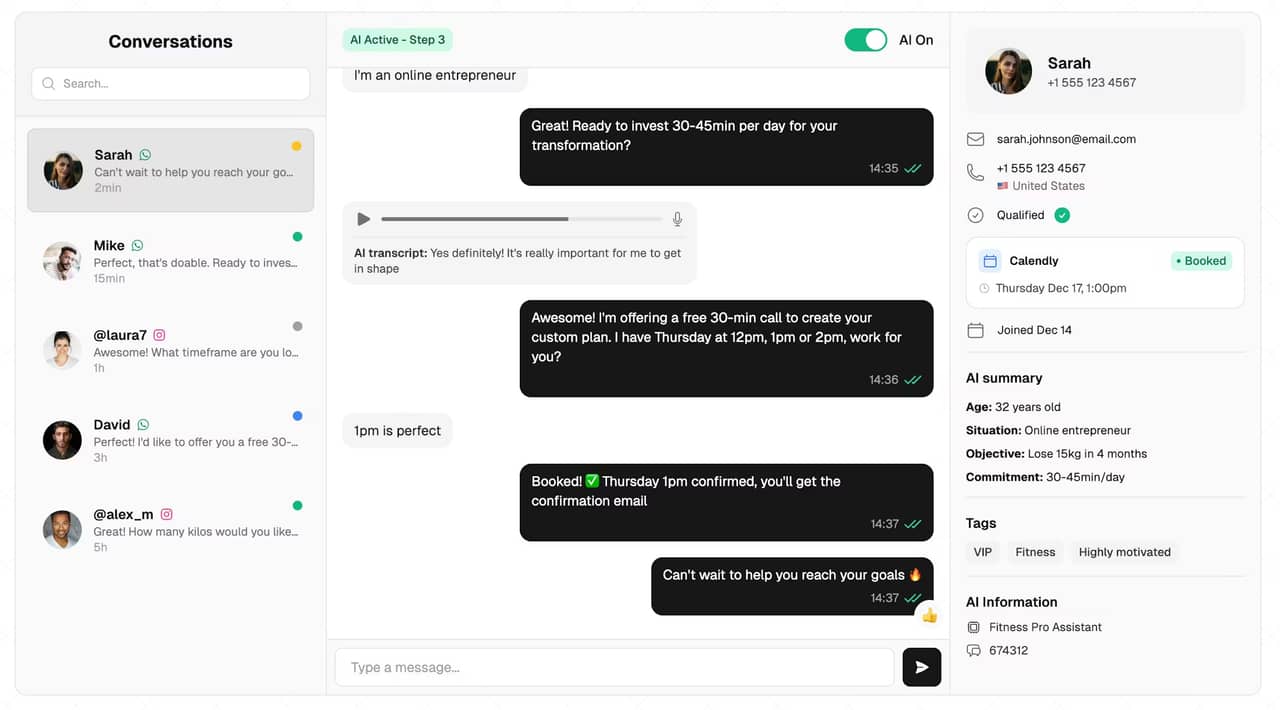
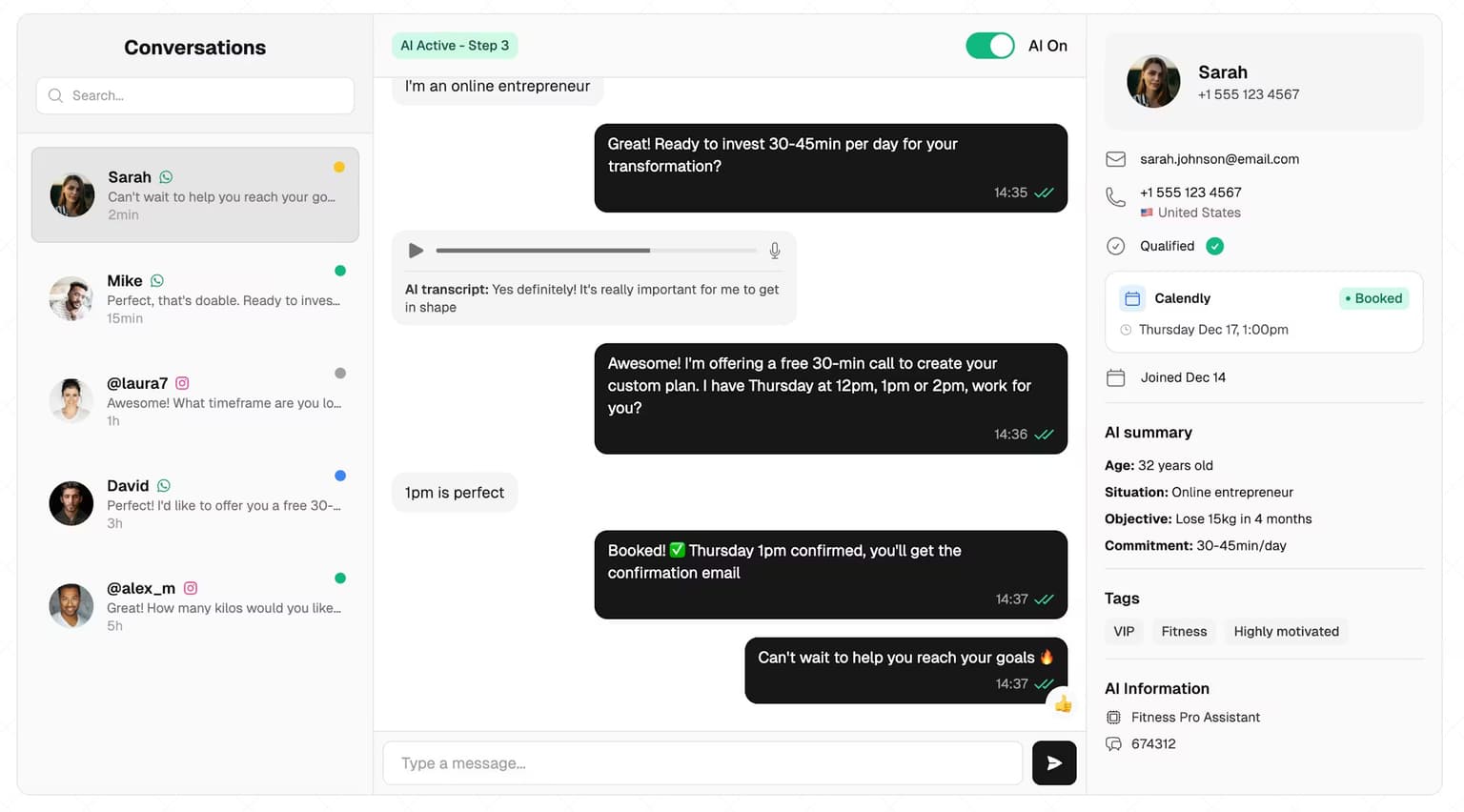
The hard part is doing this consistently while you also coach. Replying fast to every lead, asking the right questions, and following up with quiet threads is a full-time job, which is why most coaches leak calls. This is where an AI setter earns its place: it answers instantly, qualifies every lead in your DMs, and books the genuinely interested ones onto your calendar, so you spend your time on calls instead of triage.
Speed and follow-up are not small details. Across 828K DM conversations, a single follow-up to an engaged lead more than doubled booked calls (+106%). For a high ticket offer where each booked call can be worth thousands, recovering those conversations is the difference between a full calendar and an empty one.
High ticket vs low ticket offers
You do not have to choose one forever, but you should know which game you are playing. Low ticket offers win on volume and automation. High ticket offers win on margin and depth.
| Factor | Low ticket | High ticket offer |
|---|---|---|
| Price | Under a few hundred dollars | $2,000 and up |
| How it sells | Checkout button, impulse | Booked call, conversation |
| Clients needed | Hundreds for a living | A handful per month |
| Delivery | Self-serve, light support | Deep, guided, accountable |
| Best for | Audience-building, lead magnets | Real income from a small audience |
Many successful coaches use both: a low ticket product to capture and warm up an audience, and a high ticket offer that pays the bills. If you are just starting and want income fast, lead with the high ticket offer. You can build a profitable coaching business from a small, engaged following long before you have a big one, as long as you can turn conversations into calls. The right online coaching platform makes delivery easy once those clients are signed.
Common high ticket offer mistakes
- Too broad. An offer that serves everyone is sellable to no one at a premium. Niche down until it feels almost uncomfortable.
- Pricing by the hour. Hourly rates cap your income and frame you as a cost, not an investment. Sell the program and the outcome.
- Selling in the DM. Sending a $4,000 price into a text thread kills momentum. Qualify in the DM, sell on the call.
- No proof. A premium price without testimonials or results feels like a gamble. Stack proof before you raise prices.
- Vague promise. "I will help you grow" does not move anyone. Name the outcome and the timeframe.
- Leaking leads. Slow replies and no follow-up waste the attention your content earned. Automate the first reply and the nudges so nothing slips.
"I doubled my prices and signed fewer but better clients. The shift was not the price, it was finally treating my DMs as a booking system instead of an inbox." (Théo Riffault)
FAQ
What is a high ticket offer?
A high ticket offer is a premium, outcome-based product or service, usually sold for $2,000 or more, that buyers commit to after a real conversation rather than an impulse purchase. For coaches and creators it is typically a multi-week program that bundles a method, coaching or support, and a clear promise, sold through a booked sales call.
How much should a high ticket offer cost?
There is no fixed number, but most coaches treat $2,000 and up as high ticket, with many premium coaching and mentorship offers landing between $3,000 and $15,000. Price for the value of the outcome and the depth of support you provide, not for your time. Start at a number you can confidently defend on a call and raise it as your proof stacks up.
What are some high ticket offer examples?
Common examples include a 12-week 1:1 weight-loss transformation ($2,000 to $6,000), a 6-month business mentorship with calls and accountability ($5,000 to $15,000), a done-with-you agency growth retainer ($3,000 to $10,000), and a hybrid fitness coaching program with custom programming ($2,500 to $5,000). Each sells a guided outcome with you in the loop, not just information.
How do I sell a high ticket offer on Instagram?
Use your content to start conversations and your DMs to qualify and book sales calls, then make the offer on the call. Do not try to close a premium offer over text. Post content tied to one transformation, move interested people into the DMs, ask a few qualifying questions, and book the serious leads onto a call where high-ticket buyers actually decide.
Should I start with a high ticket or low ticket offer?
If you want income fast from a small audience, start with a high ticket offer, because a handful of premium clients can fund your business while a low ticket product needs hundreds of sales. Many coaches add a low ticket product later to capture and warm up an audience that feeds the high ticket offer.
How do I get more sales calls for my high ticket offer?
Drive interested people into your DMs with clear calls to action, reply instantly, qualify every lead, and follow up with quiet conversations. Doing this by hand while coaching is why most calendars stay half empty. An AI setter answers in seconds, qualifies leads, and books calls automatically, so you spend your time selling on calls instead of chasing replies.
Ready to automate your DMs?
Start your free 7-day trial and let AI handle your lead qualification 24/7.
Try SetSmart free