Social Media Management Pricing: SMMA Rate Card 2026

Social media management pricing in 2026 usually lands between $500 and $5,000 a month per client for an agency or an experienced freelancer, with hourly work billed at roughly $35 to $150 an hour for freelancers and $75 to $300 an hour for agencies. Basic posting packages sit at the bottom of that range, full-service retainers with ads, community management and video sit at the top, and enterprise accounts go well past $10,000 a month.
That range is real, but it is too wide to be useful when you are an SMMA owner writing a proposal tonight. This guide turns it into something you can actually send: the five pricing models agencies use, a simple formula for how much to charge for social media management per month, a three-tier rate card you can copy, the factors that push your price up or down, and the one service most agencies underprice: handling the Instagram and WhatsApp DMs that content and ads produce. If your clients are coaches, creators or local businesses that sell through conversations, that last part is where the margin is.
If you are still deciding whether to start, our explainer on what an SMMA is and how the model works covers the basics first.
Social media management pricing at a glance (2026 benchmarks)
The quickest way to sanity-check your prices is to compare them with what the agencies ranking for this exact question publish. The figures below come from public pricing guides by agencies and software vendors, so treat them as market signals, not laws.
| What is being priced | Typical 2026 range | Source |
|---|---|---|
| Monthly management, agency or freelancer | $500 to $5,000 a month | WebFX, Planable |
| Basic package | $500 to $2,000 a month | Cloud Campaign |
| Mid-tier retainer | $2,000 to $5,000 a month | Cloud Campaign |
| Full-service or enterprise | $5,000 to $15,000+ a month | Cloud Campaign |
| Freelancer hourly rate | $35 to $150 an hour | WebFX, Cloud Campaign |
| Agency hourly rate | $75 to $300+ an hour | Cloud Campaign |
| Marketplace median (Upwork) | $14 to $35 an hour | Upwork |
| Content creation, per post | $40 to $150 a post | WebFX |
| Paid social management fee | 10% to 20% of ad spend, or a flat add-on from about $750 a month | LYFE Marketing |
A few details behind those numbers are worth knowing before you quote:
- WebFX's 2026 pricing guide puts management at $500 to $5,000 a month, hourly work at $35 to $150, and multi-platform management at $500 to $5,000 a month per platform.
- LYFE Marketing says agencies charge $1,000 to $10,000+ a month, a full-time in-house social media manager costs $3,500 to $5,500 a month, and offshore providers can go as low as $5 to $15 an hour.
- Cloud Campaign's guide splits the market into basic, mid-tier and full-service bands and adds a useful policy: a 25% to 50% surcharge for rush requests with less than 24 to 48 hours of notice.
- Upwork's cost page shows median hourly rates of $14 to $35 on its marketplace, and estimates $400 to $2,000 a month for intermediate US specialists managing two channels for a small business, plus $200 to $1,500 for each extra channel.
The takeaway: the low end of the market is crowded with freelancers competing on hourly price. An SMMA wins by pricing a package and a result, not an hour.
The 5 pricing models SMMAs use
Almost every agency price list is one of five models, or a blend of two. Pick the model first, then the number.
| Model | How it works | Best for | Main risk |
|---|---|---|---|
| Hourly | Bill every hour worked at a set rate | Audits, strategy sessions, one-off fixes | Caps your income and punishes efficiency |
| Monthly retainer | Flat fee for a fixed scope every month | Ongoing management, the SMMA default | Scope creep if deliverables are vague |
| Per platform | A base price per channel managed | Clients who want to start on one channel | Encourages spreading thin across channels |
| Per project | One price for a launch, campaign or setup | Launches, rebrands, account setup | No recurring revenue after delivery |
| Performance or hybrid | Smaller base plus a fee per lead, booked call or sale | Clients who sell through calls, like coaches | Needs clean tracking both sides agree on |
Hourly pricing
Hourly is honest and simple, which is why most freelancers start there. The problem is that the better you get, the less you earn: a caption that took you an hour in year one takes ten minutes in year three. Keep hourly for work that genuinely has no fixed scope, such as an account audit or a strategy workshop, and quote it at agency rates rather than marketplace rates.
Monthly retainers
The retainer is the backbone of an SMMA. The client pays the same amount every month for a defined list of deliverables: a number of posts, platforms, stories, reports and response times. Retainers make cash flow predictable and let you plan team capacity. They only fail when the scope is fuzzy, so write it down in the proposal and the contract.
Per-platform pricing
Some agencies price each channel separately, for example a base for Instagram and an add-on for TikTok or Facebook. It helps a hesitant client start small. The trap is that clients then ask for five channels at half the effort each. LYFE Marketing notes that an Instagram-only package usually costs 40% to 60% less than one covering four platforms, which is a good reminder that each platform adds real work.
Per-project pricing
Projects cover anything with a start and an end: an account setup, a product launch, a 30-day content sprint. Charge them as a fixed fee with a clear finish line, and use them as a paid trial that converts into a retainer.
Performance and hybrid pricing
Performance pricing ties part of your fee to a result: leads, booked calls or sales. Pure performance deals are risky for a new agency, but a hybrid of a lower base fee plus a bonus per booked call is one of the easiest ways to land a first client who does not trust you yet. It works best when the client sells through a call, because "booked sales calls" is a number both sides can count. Our guide on how to start a social media marketing agency shows how to use this model for your first three clients.
How much to charge for social media management per month
You can work out a defensible monthly price in four steps. Do it once per package, not per client.
Step 1: find your cost floor
List everything one client costs you in a month:
- Hours: planning, content creation, posting, replying to comments and DMs, reporting, calls and revisions. Be honest, then add 20% for admin you forget about.
- Loaded hourly cost: what an hour of work costs you or your contractor, including taxes and unpaid time.
- Tools: scheduling, design, analytics, automation and any per-client software.
Example: a client needs 20 hours a month, your loaded cost is $35 an hour, and the tools on that account cost $100. Your cost floor is $800 a month. Never price below that number.
Step 2: apply your target margin
Divide the cost floor by one minus your target margin. Pick a margin that leaves room to pay for sales, overhead and growth. Here is the same client at three margins:
- At a 40% margin: $800 / 0.6 = about $1,330 a month
- At a 50% margin: $800 / 0.5 = $1,600 a month
- At a 60% margin: $800 / 0.4 = $2,000 a month
Step 3: check the number against the market
Compare the result with the benchmarks above. $1,600 a month for one or two platforms with daily stories and community management is comfortably inside the mid-market range. If your formula gives you $400, either your scope is tiny or you are underestimating hours. If it gives you $9,000 for a single Instagram account, your scope needs trimming or your niche needs to justify premium pricing.
Step 4: anchor the price to the result
A client does not compare your retainer with your hours. They compare it with what it brings in. If you manage a fitness coach who sells a $2,000 program, one extra client a month covers a $1,600 retainer. That is the sentence that belongs in your proposal, not your hourly rate.
Social media management packages: a 3-tier rate card you can copy
Clients decide faster with three clear options than with a custom quote. Below is an example rate card for an SMMA serving coaches and creator-led businesses on Instagram. The prices are an illustration built from the formula above, so adjust them to your hours, your market and your proof.
| Package | Foundation | Growth | Revenue |
|---|---|---|---|
| Example price | $1,200 a month | $2,500 a month | $4,000+ a month |
| Platforms | Instagram + one more | Instagram + WhatsApp + one more | |
| Content | 12 posts or reels, weekly stories | 16 to 20 posts or reels, daily stories | 20+ posts or reels, daily stories, lead magnet posts |
| Community | Comment replies on business days | Comment replies daily | Comments + DMs answered in seconds, 7 days a week |
| Lead handling | Not included | Comment-to-DM keyword funnel | DM qualification and booked sales calls |
| Reporting | Monthly | Bi-weekly | Weekly, with booked calls as the headline metric |
| Minimum term | 3 months | 3 months | 3 to 6 months |
A few rules make a rate card like this work:
- Name packages by outcome, not by size. "Revenue" sells a result. "Premium" sells a bigger pile of posts.
- Make the middle tier the obvious choice. Design it to be clearly better value than the first tier and clearly cheaper than the third, so the decision feels easy.
- Put lead handling in the top tier. It is the line item that ties your retainer to money, and it is what makes the top tier worth its price. The Growth tier can include a comment-to-DM automation so the jump to full DM qualification feels natural.
- Add a setup fee. A one-time onboarding fee covers the account audit, brand voice work and automation setup, and it filters out clients who are not serious.
- Keep a PDF version. "Social media management pricing packages pdf" is a search clients actually make. A one-page rate card you can attach to a DM or email shortens the sales cycle.
If you serve coaches specifically, align your packages with how they sell. Our guide to coaching packages explains how coaches structure their own offers, which helps you speak their language in a proposal.
What drives social media management pricing up or down
Two agencies can quote $800 and $4,000 for "Instagram management" and both be fair. These are the factors that explain the gap.
Number of platforms
Every channel has its own formats, posting rhythm, audience and reporting. LYFE Marketing describes the bill as growing almost linearly with each platform added, so either charge per extra channel or cap the number in each tier.
Content format and volume
Static graphics are the cheapest to produce, carousels sit in the middle, and short-form video is the most expensive because it needs scripting, filming and editing. LYFE Marketing estimates that switching from weekly graphics to daily video can double or triple the content budget, so price video separately or only in the higher tiers.
Community management and response time
Replying to comments once a day is very different from answering every DM within minutes, seven days a week. Fast response is where the money is for clients who sell through conversations, and it is also the hardest thing to staff manually. Price it explicitly, with a stated response window, instead of burying it in "engagement".
Paid social
Ads add campaign setup, audience testing, creative production and budget management. Agencies typically charge a percentage of ad spend or a flat add-on on top of the organic retainer. Keep ad spend itself off your invoice or on a separate line so the client sees the management fee clearly.
Niche and proof
A generalist "we do social for everyone" agency competes on price. A specialist with case studies in one niche, such as online fitness coaches or real estate teams, can charge more because the risk for the client is lower. Our SMMA marketing guide covers how to pick and win a niche through DMs.
Experience and location
Rates follow experience and geography. A first-year freelancer can sit near marketplace medians, while a senior strategist or an established agency can charge several times more. US and Western European providers sit at the top of the range, offshore providers at the bottom. Do not race the offshore floor: compete on niche expertise, speed and results.
Price the DM layer: the most underpriced service in an SMMA
Here is the gap in most social media management packages. The agency creates content and runs ads that generate comments, story replies and DMs. Then the leads land in an inbox that the client checks twice a day, and most of them go cold. The agency gets blamed for "no results" even though the content did its job.
The numbers explain why. Across 828K AI DM conversations on Instagram and WhatsApp, 53% of conversations die before message 3, which means the first replies decide whether a lead ever reaches a sales call. Speed matters just as much: the data in our lead response time statistics shows how quickly interest decays when an inbound lead waits hours for an answer.
That is why "we handle your DMs and book your sales calls" is worth more than "we post five times a week". It is also why this layer belongs in your pricing as its own line, priced on results.
How to price DM appointment setting
A simple structure works well for coaches and creator-led clients:
- Setup fee: covers mapping the client's offer, writing the qualifying questions, connecting Instagram and WhatsApp, and setting up the booking link.
- Monthly management fee: covers monitoring conversations, improving the scripts and weekly reporting.
- Optional bonus per booked call: a fixed amount for every qualified sales call that lands on the client's calendar.
The client still closes on the call. Your job, and the AI's, is to qualify the lead in the DM and book the call, which is exactly the role a human appointment setter plays. Framing it this way keeps expectations honest and makes the value easy to measure: booked calls in, sales calls held, revenue from those calls.
What the DM layer costs you to deliver
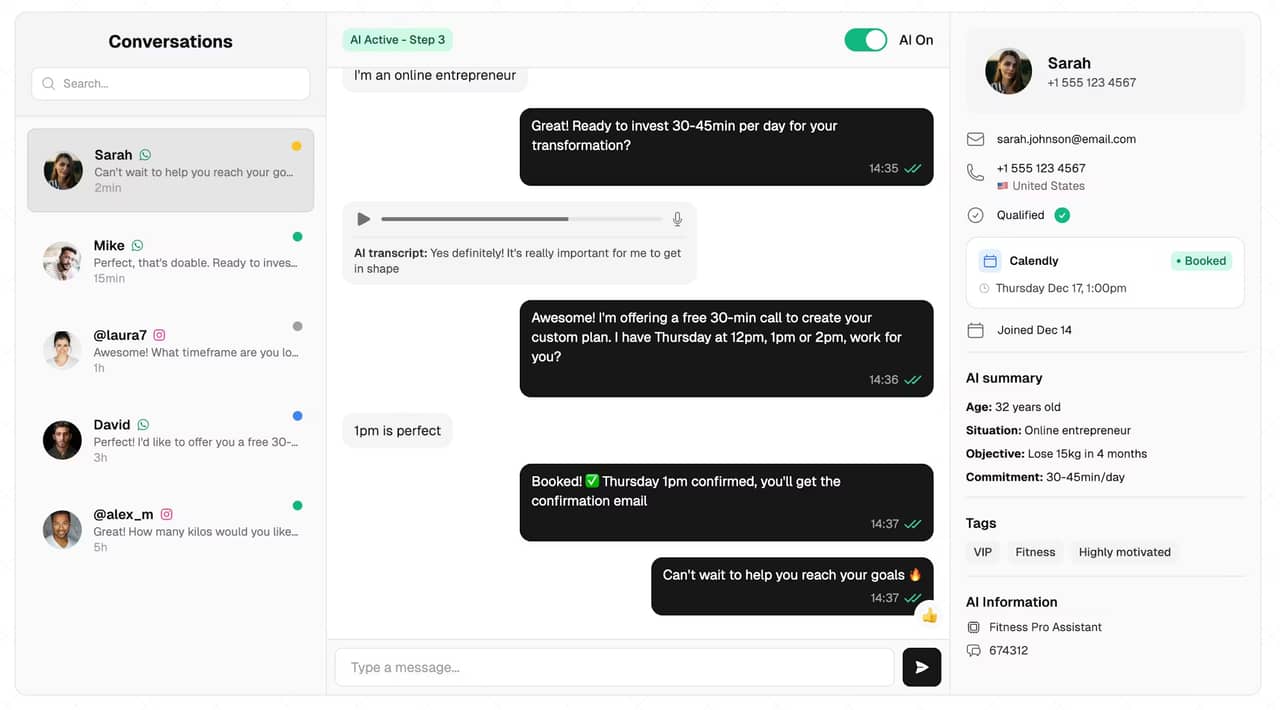
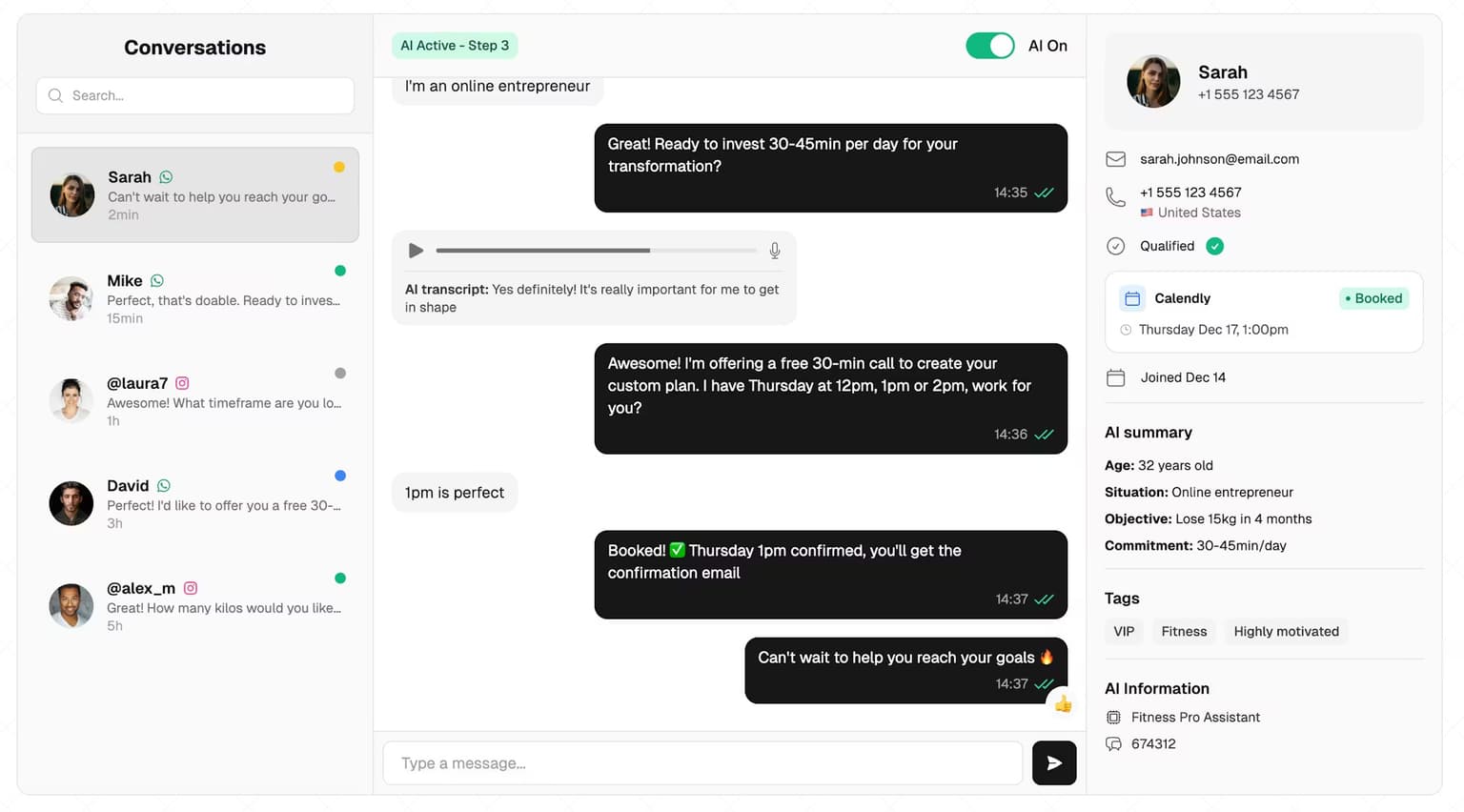
You can deliver this manually with human setters, but your margin shrinks fast as you add clients, because every inbox needs someone watching it. The scalable option is an AI setter. With SetSmart, for example, the AI answers Instagram, WhatsApp and Messenger DMs in seconds, asks the qualifying questions, follows up automatically and books the call into the client's calendar. The Pro plan is $97 a month with 1,000 messages included and a 7-day free trial, and busier accounts can move to Scale at $297 a month with 4,000 messages. On Pro and above, white-label mode lets you run client workspaces and a client portal on your own domain, so the service is sold under your agency brand. See the white-label page for how that works.
Compare that tool cost with a top-tier retainer and the margin is obvious. If you want to go deeper on reselling, our roundup of white-label AI chatbot platforms compares the options, and how to start an AI agency shows how some SMMAs turn DM appointment setting into the whole business.
Here is what that outcome looks like from the client's side. Mathis Ladoue, an online fitness coach with 22.4K Instagram followers, describes it simply: "I book 15 to 25 calls per week... without managing a single setter." That is the kind of result that makes a retainer hard to cancel.
Freelancer vs agency rates: where should you sit?
Freelancers and agencies sell the same tasks at very different prices because they sell different things.
| Freelance social media manager | SMMA | |
|---|---|---|
| Typical pricing | Hourly or small monthly packages | Retainers and hybrid deals |
| What the client buys | Time and execution | A system and a result |
| Capacity | Limited by one person's hours | Team, contractors and automation |
| Coverage | Business hours, one time zone | Can cover DMs around the clock with AI |
| Price pressure | High, competes with marketplaces | Lower when niche and proof are clear |
If you are a solo operator today, you do not need to call yourself an agency to price like one. Package your work, sell a result, and use automation to cover the hours you cannot work. The day you can show a case study of booked calls, you can move from freelancer rates to agency rates.
When to raise your prices
Raise prices when any of these is true:
- You are fully booked and turning down work.
- You have two or more case studies with hard numbers in the same niche.
- Clients sign without negotiating at all, which usually means you are cheap.
- You added a results-based layer such as DM appointment setting.
Raise prices for new clients first, then move existing clients at renewal with 30 to 60 days of notice and a clear reason, such as new deliverables or better reporting.
How to present your pricing (proposal, contract and onboarding)
Good pricing can still lose the deal if it is presented badly. A clean process makes your price feel safe.
- Diagnose before you quote. Ask about the client's offer, their average sale, how leads reach them today and what happens to DMs. You cannot price a result you do not understand.
- Send a short proposal. One page with the problem, the plan, the three packages and the expected outcome. Lead with the result, then the deliverables, then the price.
- Put the scope in a contract. List platforms, content volume, response windows, revision rounds, reporting cadence, minimum term and notice period. Add a rush-fee clause so last-minute requests are paid.
- Bill in advance. Retainers are paid at the start of each month. Projects take a deposit.
- Onboard fast. Collect logins, brand assets and the booking link in one form. A slow first week costs you the client's trust before you start.
For a deeper look at the client acquisition side, the ManyChat alternative for agencies guide explains why agencies are moving from button flows to conversational AI when they sell lead handling to clients.
Common social media management pricing mistakes
These are the mistakes that keep SMMAs stuck at low retainers:
- Pricing by the post. It invites clients to compare you with a $5 template. Sell packages and results.
- Unlimited anything. "Unlimited revisions" or "unlimited platforms" destroys your margin. Put a number on everything.
- No minimum term. Social results take time. A one-month deal sets you up to be fired before the work pays off.
- Ignoring the inbox. If the client's DMs are not answered quickly, your content looks like it does not work. Either sell the DM layer or state clearly that lead handling is out of scope.
- Discounting to close. Offer a smaller package instead of a lower price for the same package.
- Never reviewing prices. Revisit your rate card every six months as your proof and your costs change.
Putting it together
Social media management pricing is not about finding the "right" number in a benchmark table. It is about building a package where your cost floor, your margin and the client's expected return all make sense at once. Start from your hours and tools, add a healthy margin, check it against the $500 to $5,000 a month market range, and package it into three clear tiers.
Then add the piece most agencies skip: answering and qualifying the DMs your content and ads produce, and booking the sales calls. It is the line item that turns "social media management" into revenue your client can count, and it is the clearest path from freelancer pricing to agency pricing. To see how an AI setter fits into that system end to end, start with our pillar guide.
FAQ
How much should I charge for social media management?
Most freelancers and agencies charge between $500 and $5,000 a month per client in 2026. A basic package for one or two platforms usually sits between $500 and $2,000 a month, while full-service retainers with video, ads and community management run from $2,000 to $5,000 or more. Work out your own price from your hours, tools and target margin, then check it against that range.
How much does it cost to hire someone to manage your social media?
Expect roughly $650 to $10,000 a month depending on who you hire and the scope. Marketplace freelancers can cost far less per hour, agencies cost more but bring a team and a system, and a full-time in-house social media manager costs about $3,500 to $5,500 a month according to LYFE Marketing.
What is a fair price for social media management for a small business?
For a small business on one or two platforms, $500 to $2,000 a month is a fair range for consistent posting, basic community management and monthly reporting. Upwork estimates $400 to $2,000 a month for an intermediate US specialist managing two channels. Prices above that should include more content, video, ads or lead handling.
Should I charge per platform or per package?
Packages are usually better because they sell an outcome and protect your margin. Per-platform pricing can work as an entry point for a hesitant client, but cap the number of channels in each tier and charge clearly for every extra one.
How much do freelance social media managers charge per month?
Planable puts freelance monthly packages at roughly $500 up to $2,500 a month, with a standard package around $700. Hourly rates range from marketplace medians of $14 to $35 an hour on Upwork up to about $150 an hour for experienced specialists.
Should an SMMA offer performance-based pricing?
A hybrid model works well when the client sells through sales calls, such as coaches and consultants: a smaller base fee plus a bonus per qualified booked call. Avoid pure commission deals on sales you do not control, because the client closes on the call, not you.
SetSmart's AI answers your clients' Instagram, WhatsApp and Messenger DMs in seconds, qualifies every lead, follows up automatically and books the sales call into their calendar. Free 7-day trial, then $97/month with 1,000 messages included.
Ready to automate your DMs?
Start your free 7-day trial and let AI handle your lead qualification 24/7.
Try SetSmart free