SMMA Meaning: What It Is + Client Playbook (2026)

SMMA is one of the most searched business acronyms of the last few years, and also one of the most misunderstood. If a YouTube ad, a Reddit thread, or a friend keeps saying "SMMA" and you are not sure what it actually means, this guide clears it up in plain English.
Short version: SMMA stands for Social Media Marketing Agency. It is a business that gets paid, usually a monthly retainer, to run social media, ads, or messaging for other companies. The model became famous through creators like Iman Gadzhi, and it is still very much alive in 2026, but the way successful agencies win clients has changed. The agencies growing today do not chase strangers. They build inbound attention on Instagram and WhatsApp, then use automation to qualify those conversations and book calls. Agencies that sell DM setting as a service can deliver it under their own brand with SetSmart's white-label mode, one plan with every client's messages billed on it.
This article covers the real SMMA meaning, what an agency actually does day to day, how the business model makes money, whether SMMA is dead in 2026, how to start one, and the exact client-acquisition system the best agencies run through their DMs.
What does SMMA stand for?
SMMA stands for Social Media Marketing Agency. It is a service business that manages some part of another company's social media presence in exchange for a fee. That fee is usually a recurring monthly retainer, which is what makes the model attractive: predictable revenue instead of one-off projects.
An SMMA is not a single fixed service. Under the same acronym you will find agencies that only run Facebook and Instagram ads, agencies that only produce content, agencies that handle direct-message sales conversations, and full-service shops that do all of it. The common thread is simple: a business owner would rather pay someone else to handle social media than learn it themselves.
A quick note on a confusing search result. If you searched "SMMA meaning" and saw finance or trading pages, that is a different acronym. In trading, SMMA can mean Smoothed Moving Average, a technical indicator used to filter price noise on a chart. The two have nothing to do with each other. For the rest of this guide, SMMA means the agency business model, not the trading indicator.
What an SMMA actually does
The best way to understand the SMMA meaning is to look at what an agency delivers. Most agencies pick one or two of these services rather than trying to do everything:
- Paid advertising: running and optimizing Meta (Facebook and Instagram), TikTok, or Google ads to generate leads or sales for the client.
- Content creation: producing reels, posts, and short-form video so the client stays visible without doing it themselves.
- Community and DM management: replying to comments and direct messages, answering questions, and turning followers into leads. This is where a lot of revenue hides, because most businesses ignore their inbox.
- Lead qualification and booking: filtering inbound interest and getting qualified prospects onto a sales call. This is increasingly handled by an AI setter rather than a human.
- Strategy and reporting: deciding what to post, what to run ads on, and proving results with a monthly report.
The agencies that grow fastest tend to specialize. A niche like "Instagram growth and DM booking for online fitness coaches" is far easier to sell than "marketing for everyone." Specializing also makes your Instagram lead generation predictable, because you learn exactly what content and offers work for one type of buyer.
The SMMA business model: how agencies make money
The SMMA business model is built on retainers. Instead of charging once for a project, you charge a recurring monthly fee for an ongoing service. Ten clients at a few thousand dollars a month each is a real business with predictable cash flow.
There are three common ways SMMAs price their work:
| Pricing model | How it works | Best for |
|---|---|---|
| Flat retainer | Fixed monthly fee for a defined scope of work | Content, DM management, and social management |
| Ad spend percentage | A management fee plus a percentage of the client's ad budget | Paid advertising accounts |
| Performance / per-result | Payment tied to leads booked or sales generated | Confident agencies with proven systems |
Retainers in the wider market commonly range from around one thousand dollars a month for a lean content package to five thousand dollars a month or more for full ad management, depending on niche and results. Newer agencies often start lower to build case studies, then raise prices once they can prove return on investment. The exact number matters less than the math: your costs are mostly time and tools, so once your client-acquisition system runs, margins are high.
The hidden lever most beginners miss is retention. Landing a client is only half the job. Keeping them for twelve months instead of two is what turns an SMMA from a hustle into a business. Retention comes from clear reporting, fast communication, and results, which is why so many agencies now automate the parts of the workflow that used to cause dropped balls, like slow replies and missed follow-ups.
Is SMMA dead in 2026?
You will find plenty of "SMMA is dead" videos and Reddit threads. The honest answer: the old SMMA playbook is dying, but the model itself is not.
What is genuinely harder in 2026:
- Mass cold outreach is saturated. Sending hundreds of identical pitches no longer works because everyone tried it. Prospects are numb to it.
- Generic offers do not convert. "I do social media marketing" competes with a million others, including AI tools that clients can use themselves.
- Content-only agencies are commoditized. If all you sell is posts, you are competing with cheap freelancers and templates.
What still works, and works better than ever:
- Specialized offers tied to a clear result (booked calls, qualified leads, sales), not vanity metrics.
- Inbound client acquisition, where your own content and your clients' content pull people into the DMs.
- Speed and systems. Agencies that answer every inquiry in seconds and never miss a follow-up win the deals that slower competitors lose.
So SMMA is not dead. The agencies quitting are usually the ones who copied a 2020 script. The ones thriving rebuilt their client acquisition around inbound conversations and automation. That shift is exactly what our full SMMA marketing guide breaks down step by step.
How to start an SMMA
Starting an SMMA does not require a big budget. It requires a niche, one strong offer, and a repeatable way to book calls. Here is the sequence that works in 2026:
- Pick one niche and one service. Resist the urge to serve everyone. Pick a type of business you understand (local gyms, online coaches, real estate agents) and one service you can deliver well.
- Get a result you can show. Land your first client, even at a discount or for free, and turn the outcome into a concrete case study. Proof beats promises.
- Build an inbound content engine. Post content that pulls prospects into your DMs, and add a clear "reply to this to learn more" call to action. Study proven Instagram DM scripts so your openers do not feel salesy.
- Set up DM qualification and booking. This is where most beginners leak money. Every inbound DM should be answered fast, qualified, and turned into a booked call. Automating this with Instagram DM automation means you never lose a lead to a slow reply.
- Deliver, report, and retain. Onboard cleanly, report results monthly, and keep clients on retainer by continually proving ROI.
The difference between an agency that struggles and one that scales is rarely the service quality. It is almost always the front end: how consistently they turn attention into booked calls. That is a systems problem, and systems can be automated.
How SMMAs get clients in 2026
Client acquisition is the make-or-break skill for any SMMA. The modern motion has three layers.
1. Attention. You create content, or run ads, that reaches business owners in your niche. The goal is not to go viral. It is to get the right people to raise their hand by commenting, replying to a story, or sending a DM.
2. Conversation. When someone shows interest, the conversation moves to the DMs on Instagram, WhatsApp, or Messenger. This is the highest-intent moment in the whole funnel, and it is where most agencies fail. They reply hours later, ask one generic question, or forget to follow up. Building a proper Instagram DM marketing system fixes that leak.
3. Booking. The point of the conversation is to book a qualified discovery call. Not to sell in the chat, and not to send a wall of text. Just to qualify the person and get them onto your calendar. Learning how to automate Instagram DMs with AI lets you do this at scale without hiring a team of setters.
The agencies winning in 2026 treat their DMs like a pipeline, not an afterthought. Every inbound message is a potential retainer, and the speed and quality of the first reply decides whether that message turns into a call or dies unread.
Where an AI setter fits in an SMMA
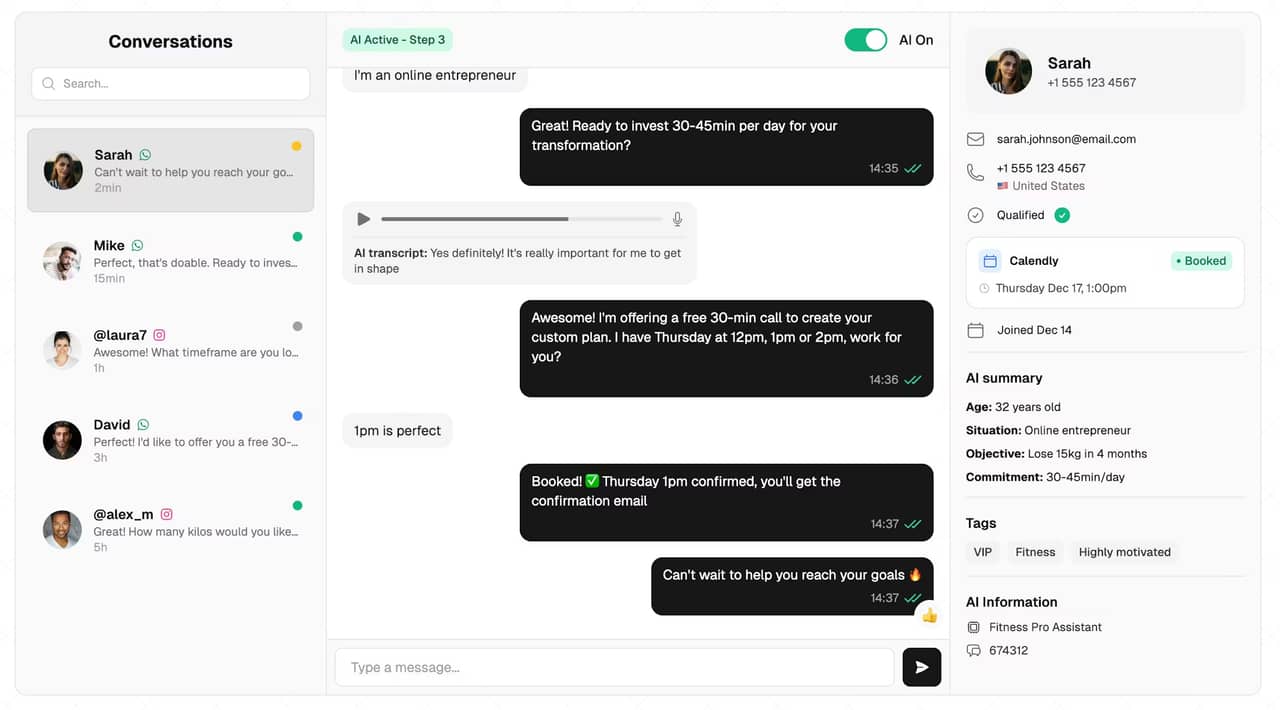
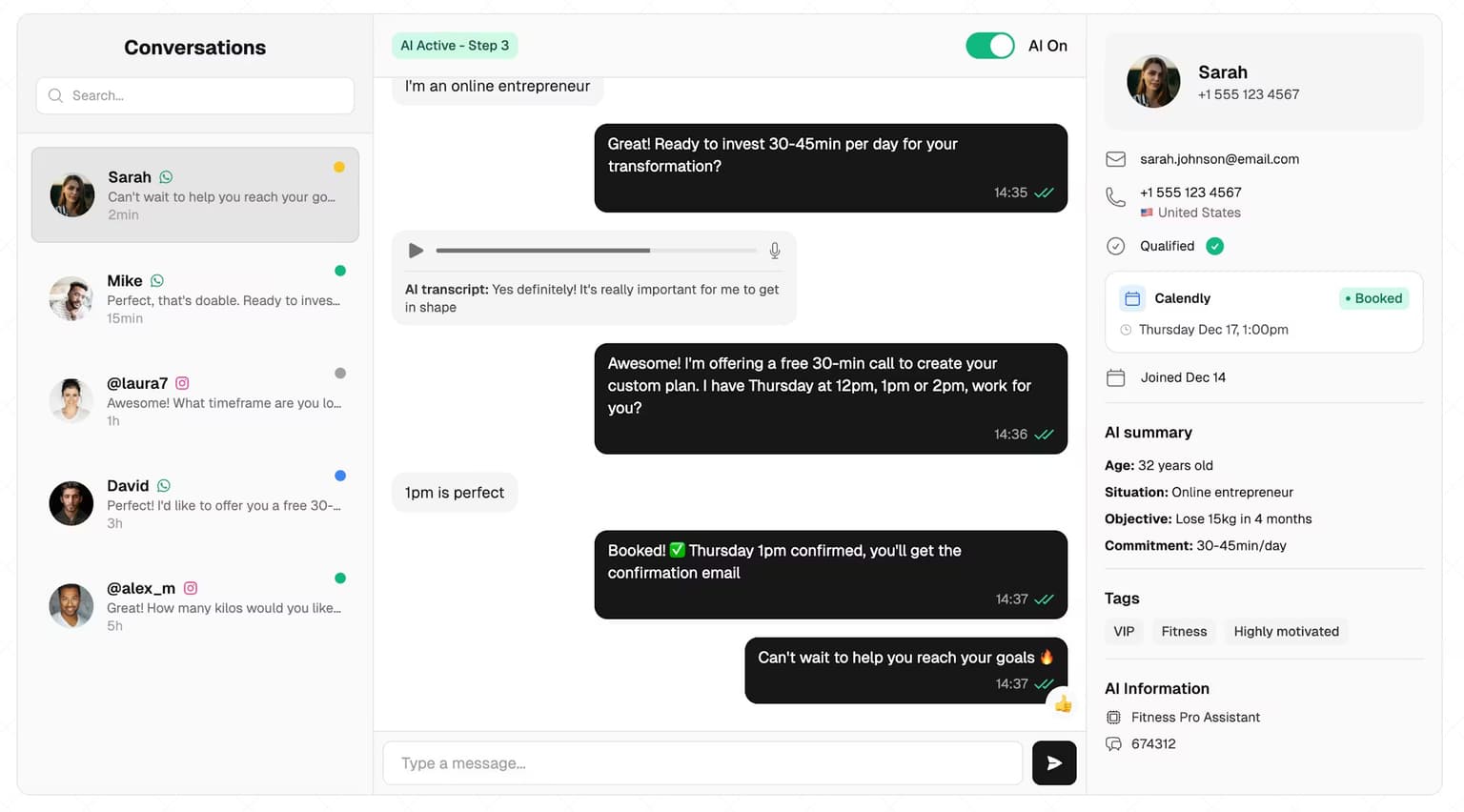
An AI setter is software that reads an incoming DM, holds a natural conversation, qualifies the lead against your criteria, and books a call, all automatically. For an SMMA, it solves the exact bottleneck that kills most agencies: the gap between someone showing interest and someone getting on a call.
The role is often called a DM setter, and it is not the same as a closer. The setter's only job is to fill your calendar with qualified sales calls. The actual close still happens on the call, run by you or a human closer. In other words, the AI handles appointment setting, not the sale itself.
Why speed and follow-up matter so much: in an analysis of 828K real DM conversations, a single follow-up message more than doubled booked calls, a +106% lift among engaged leads. Most agency owners simply cannot reply in seconds and follow up on time across every channel while also delivering client work. Automation can.
For an SMMA, an AI setter does three things at once:
- Instant replies. Every DM gets answered in seconds, day or night, so no hot lead cools off.
- Consistent qualification. The AI asks the same smart questions every time and only books people who fit, so your calendar fills with real prospects.
- Automatic follow-up. Leads who go quiet get a well-timed nudge instead of being forgotten.
You can run the same system for your clients too. An agency that offers "we will qualify and book your inbound leads automatically" has a far stickier, higher-value offer than one that only posts content. If you also run WhatsApp for clients, the same logic applies to WhatsApp automation, where response rates are even higher.
If you want to see which tools handle this well, our roundup of the best AI setters compares the main options for agencies and creators, and our ManyChat alternative for agencies adds the margin math for running client inboxes on retainer.
SMMA vs freelancing vs a personal brand
People often confuse an SMMA with adjacent models. Here is the quick distinction:
- Freelancer: you sell your own hours for one skill (editing, copy, ads). Simple to start, hard to scale beyond yourself.
- SMMA: you package a service, charge a retainer, and can eventually deliver with a team or software instead of your own hands. Built to scale.
- Personal brand / creator: you monetize an audience directly through offers, courses, or sponsorships. Many successful agency owners build a personal brand as the top of their SMMA funnel, because it feeds inbound leads for free.
The lines blur in practice. A common 2026 path is to build a small personal brand, use it to attract inbound DMs, and run an SMMA on the back of it. The same client-acquisition system that helps coaches works for agencies, which is why the tactics overlap heavily with guides like how to get coaching clients and building a high-ticket offer.
FAQ
What does SMMA stand for?
SMMA stands for Social Media Marketing Agency: a business that gets paid a recurring fee to manage social media, ads, content, or messaging for other companies. It is usually structured around monthly retainers so revenue is predictable.
What is SMMA in finance or trading?
That is a different acronym. In trading, SMMA usually means Smoothed Moving Average, a technical indicator that smooths price data to reduce noise. It has no connection to the Social Media Marketing Agency business model this guide covers.
How much does an SMMA pay or make?
It varies widely. Agency retainers commonly range from around one thousand dollars a month for a lean content package to five thousand a month or more for full ad management, with earnings driven by how many clients you retain and your margins. New agencies often start lower to build case studies, then raise prices once they can prove results.
Is SMMA legit or just a scam?
The business model is completely legitimate: businesses genuinely pay agencies to run their marketing. The "scam" reputation comes from courses that oversell easy money. A real SMMA requires delivering results, which is why specialization and a reliable client-acquisition system matter more than any course.
How much money do you need to start an SMMA?
Very little. You can start with a phone, a niche, and one service. The main investment early on is time spent creating content and having conversations, plus low-cost tools for scheduling and DM automation. You do not need paid ads to land your first few clients if your inbound content works.
How do SMMAs get their first client?
Usually through inbound conversations, not mass cold outreach. Post content that speaks to one niche, invite interested people into your DMs, qualify them, and book a call. Offering the first result at a discount to build a case study is a common and effective way to break in.
Start booking qualified calls from your DMs
Whether you are launching your first SMMA or scaling an existing one, the bottleneck is almost always the same: turning inbound DMs into booked calls fast enough. SetSmart's AI qualifies every conversation on Instagram, WhatsApp, and Messenger and books calls on your calendar automatically. Free 7-day trial, then $97/month.
Ready to automate your DMs?
Start your free 7-day trial and let AI handle your lead qualification 24/7.
Try SetSmart free