ManyChat Alternative for Agencies: 4 Best (2026)

Agencies do not buy DM automation for themselves. They buy it to run someone else's inbox, prove a number at the end of the month, and keep the retainer. That changes the shortlist completely, and it is why so many agency owners eventually search for a ManyChat alternative even though ManyChat is the category default.
This guide compares the four tools worth considering when you manage DMs for clients in 2026, with pricing re-verified in July 2026, plus the margin math that decides whether AI beats a human setter on your P&L. For the general roundup, see our 7 best ManyChat alternatives. If you are the coach or the creator rather than the agency, we have breakdowns for coaches and course creators.
Why Agencies Outgrow ManyChat
You are maintaining flows in accounts you do not control
One client changes their offer, another launches a new Reel angle, a third rebrands. With a flow builder, every change means opening the client's account and rewiring branches. Ten clients means ten flow trees to keep in sync. That work is invisible to the client and it eats your delivery hours.
Flows break in public
When a prospect types something off-script, a flow sends a fallback message. In your own account that is annoying. In a client's account it is a screenshot in your Slack channel at 9pm. Flow-based tools fail loudly on exactly the leads your client cares about most.
Your client judges you on booked calls, not on automation uptime
Nobody renews a retainer because the bot replied fast. They renew because their calendar filled. ManyChat cannot book inside the conversation: it sends a scheduling link and hopes. Every handoff is a place where your reported number gets smaller. Read our ManyChat review for how far its AI Step feature actually goes.
Human setters are the real cost center
Most SMMA operators discover the same thing: the tool is cheap, the setter is not. A trained setter working DMs is a salary or a commission, plus hiring, plus training, plus the churn when they leave. The tool line on your P&L is noise next to that. Which means the right question is not "what is cheaper than ManyChat," it is "what reduces setter hours per booked call." If you are still setting up the agency itself, our guide on how to start an AI agency covers the offer and the delivery stack.
Contact-based pricing makes your costs move with your client's virality
ManyChat rebuilt its pricing on March 2, 2026: Free (25 active contacts), Essential $14/mo (250), Pro $29/mo (2,500), Business $69/mo (7,500), with per-contact overages above Business. When a client's Reel takes off, their automation silently caps or their bill jumps, and you are the one explaining it. Full numbers in our ManyChat pricing breakdown.
The Margin Math Agencies Actually Care About
Work it backwards from the retainer, not from the tool price.
If you charge a client a monthly retainer for appointment setting, your cost per account is roughly: tool subscription + setter hours + your account management time. Tools in this category run from about $14 to $97 per client per month. Human setter time is the variable that decides your margin, and it scales linearly with DM volume.
An AI setter changes the shape of that cost: the conversation happens without a human, and your team moves from "answer every DM" to "review edge cases and close the booked calls." The tool price goes up, the labor line goes down, and the margin math usually improves once a client's DM volume is high enough that a human could not keep up anyway.
Two numbers worth stress-testing with your own data. In our analysis of 828K AI DM conversations, adding automated follow-ups moved qualification rates from 19.17% to 40.65% and booked rates from 8.66% to 17.84%. If your reported metric is booked calls per 100 DMs, follow-up discipline is where most agencies leave money on the table, and it is the first thing a human setter drops when the queue gets long.
The 4 Best ManyChat Alternatives for Agencies in 2026
1. SetSmart: best when you sell appointment setting as a service
Best for: Agencies whose deliverable is qualified booked calls on a client's calendar.
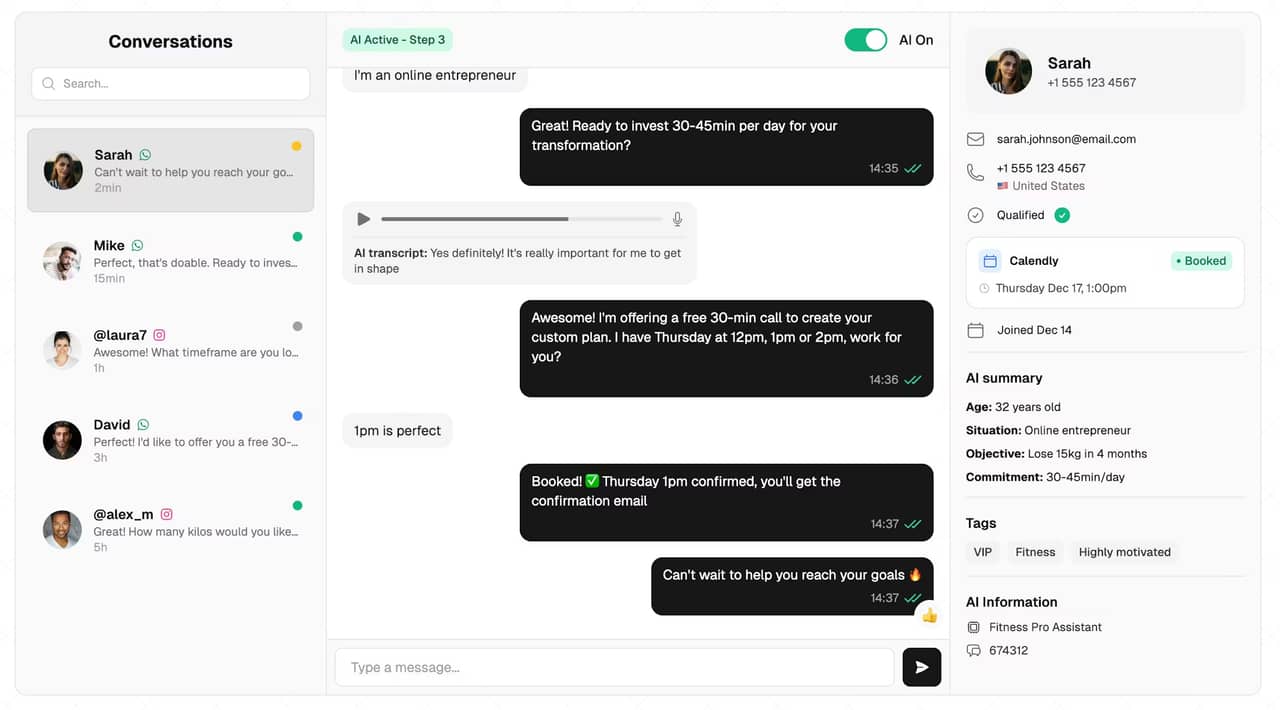
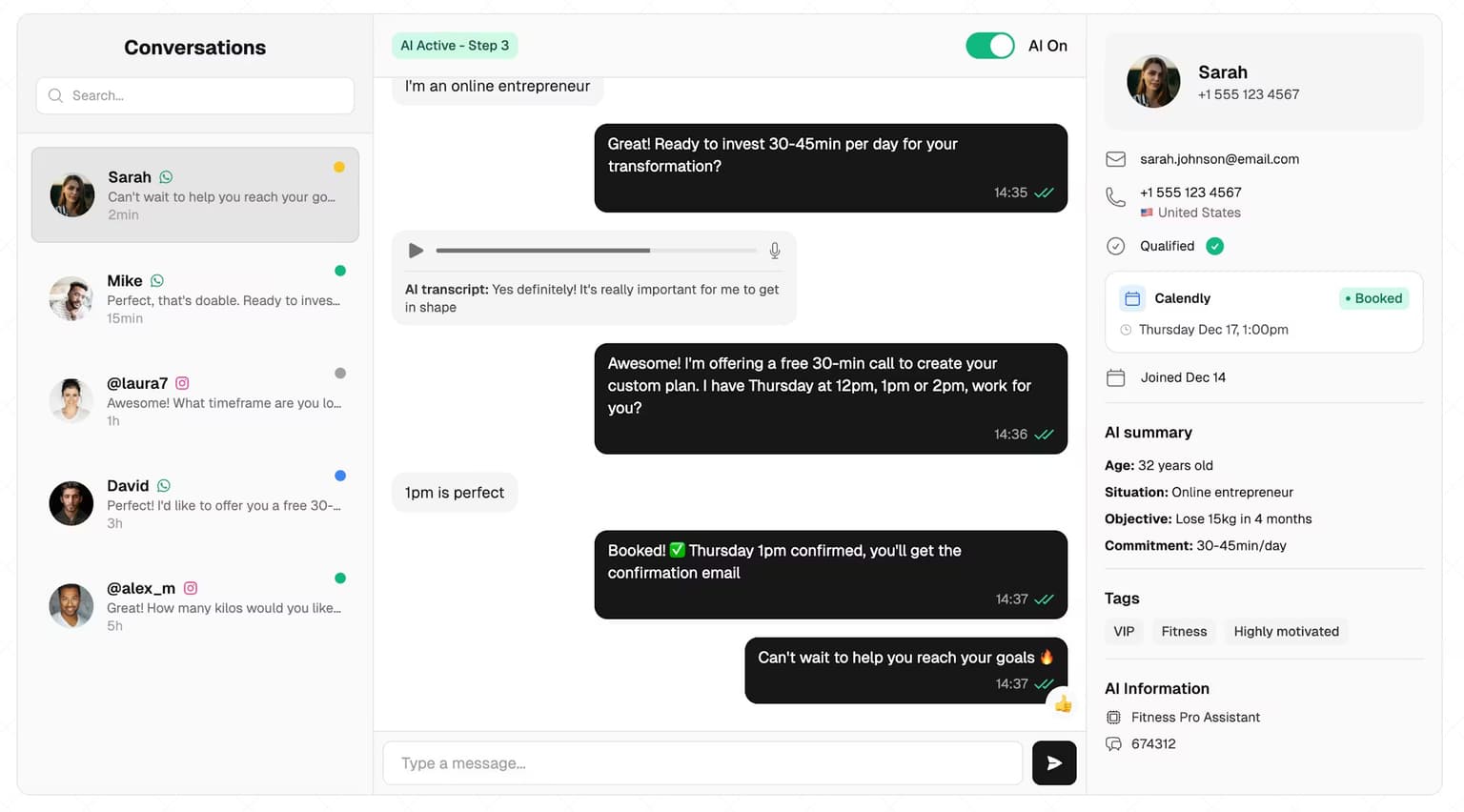
SetSmart is an AI setter rather than a flow builder. You describe the client's offer, ideal customer, and disqualifiers, and the AI runs the conversation from first reply to booked appointment. Agencies can also run it as a white-label AI setter under their own brand and domain.
What matters for agency delivery:
- Setup is a briefing, not a build. No branch mapping per client. Onboarding a new account is a description of the offer plus a calendar connection, so you are live in minutes instead of a delivery sprint.
- In-chat booking. The AI checks the client's live availability and confirms the call inside the DM, which removes the biggest drop-off in the funnel you are being paid to fix.
- Automatic follow-ups. Two context-aware follow-ups per lead, optionally as voice notes, running on every conversation without a human remembering to do it.
- Team seats with roles. Owner, admin, and member roles so your account managers and setters share one inbox and you keep control of what they can change.
- Instagram CRM built in. Every lead, qualification status, and booked call in one pipeline you can screenshot into a client report.
- Instagram, WhatsApp, and Messenger in a single dashboard, on official Meta APIs.
Pricing: Pro is $97/month per account, including 1,000 messages, with a 7-day free trial. Scale is $297/month with 4,000 messages for high-volume clients running paid traffic. Light is €25/month with 250 messages for small accounts, billed immediately with no trial. Pro and Scale run the SetSmart Pro 3.1 engine.
Where it is not the answer: if your clients are ecommerce brands who need abandoned-cart flows and order updates, this is the wrong shape of tool.
2. GoHighLevel: best if you need a full client operating system
Best for: Agencies that want CRM, funnels, email, SMS, calendars, and client sub-accounts under one login.
GoHighLevel is the default agency platform for a reason: sub-accounts, white-label, snapshots, and a booking calendar in the same product. If you are already rebuilding your whole client stack, it consolidates a lot of line items. Our GoHighLevel white label guide breaks down what each plan actually rebrands and what SaaS Mode costs.
Pros: unlimited contacts, sub-accounts per client, white-label and SaaS mode, native calendar, huge community and template ecosystem.
Cons: DM automation is a small part of a very large platform; Instagram DM handling needs add-ons; conversational AI is an extra cost, roughly $50 to $97/month per sub-account plus usage; WhatsApp is a $10/month per sub-account add-on plus Meta's own fees; the learning curve is real.
Pricing: Starter $97/month (3 sub-accounts), Unlimited $297/month, Agency Pro $497/month, with a 14-day trial. Details in our GoHighLevel review and the SetSmart vs GoHighLevel comparison.
Verdict for agencies: excellent as an operating system, mediocre as a DM setter. Plenty of agencies run GoHighLevel for CRM and a dedicated tool for DMs.
3. Chatfuel: the closest flow-builder swap
Best for: Agencies with working flows who simply want off ManyChat.
Chatfuel is a mature visual builder with an AI assistant included on both tiers. If your delivery is built around flows and templates you already trust, this is the least disruptive migration.
Pros: clean builder, strong Messenger support, AI assistant on every plan, reusable templates across client accounts.
Cons: still flow-based, so it fails on off-script replies the same way; Instagram is thinner than Messenger; no free plan since the 2026 revamp; AI replies run on a fair use allowance, so a client's viral post can pause their bot.
Pricing: Business $20/month ($18/month billed yearly) with unlimited contacts and US$20 of AI credits a month; Agency S $100/month ($90 billed yearly) for 3 businesses. Free trial, no free plan. See our Chatfuel pricing breakdown.
Verdict for agencies: a lateral move at a higher entry price. Worth it only if the specific reason you are leaving ManyChat is the vendor, not the model.
4. Respond.io: best for shared inbox and larger teams
Best for: Agencies running a real setter team across many channels who need assignment, notes, and supervision.
Respond.io is a multi-channel team inbox with workflow automation. It is built for people managing conversations at volume rather than for AI-first selling.
Pros: unified inbox across WhatsApp, Instagram, Messenger, and more; assignment, internal notes, and supervisor views; workflow builder; API access.
Cons: the tier that unlocks automation and AI starts at $159/month; contact overages are billed in blocks; extra seats cost $12 to $24 each per month; AI is mostly rule-based; no in-chat appointment booking.
Pricing: Starter $79/month, Growth $159/month, Advanced $279/month, metered by monthly active contacts. See our Respond.io review.
Verdict for agencies: the right call if your model is human setters at scale and you need supervision tooling. The wrong call if you are trying to remove setter hours.
Agency Comparison: ManyChat vs the Alternatives
| Agency requirement | ManyChat | SetSmart | GoHighLevel | Respond.io |
|---|---|---|---|---|
| Time to onboard a client | Hours of flow building | Minutes, describe the offer | Days, full stack setup | Hours, workflows + seats |
| Qualifies leads without a human | No, forms only | Yes, in conversation | Paid AI add-on | Rule-based only |
| Books calls in-chat | No, external link | Yes | Native calendar, link-based | No |
| Team roles and shared inbox | Seats by plan tier | Owner, admin, member roles | Yes, per sub-account | Best in class |
| Reporting a client understands | Automation metrics | Qualified leads and booked calls | Full CRM pipeline | Conversation volume |
| Cost per client account | $14 to $69 per month | €25 Light, $97 Pro, $297 Scale | $97 to $497 plus add-ons | $79 to $279 plus seats |
| Cost predictability | Moves with client virality | Flat plus included messages | Usage-based add-ons | Contact overages |
Head-to-head against the incumbent: SetSmart vs ManyChat. And if you sell setting as a productized offer, our guide to appointment setting services covers how agencies package it.
Where ManyChat Still Wins for Agencies
Say this out loud before you migrate a client roster.
- Cost per client is unbeatable. At $14 to $29 per account, ManyChat is the cheapest way to put automation in ten client inboxes.
- The agency partner ecosystem is huge. Certified agency directories, partner programs, and inbound referrals exist for ManyChat and for almost nothing else in this category.
- Template marketplace. You can deploy a proven lead magnet funnel in a client account the same afternoon without designing anything.
- Ecommerce clients. Shopify flows, abandoned cart, and order updates are natively supported and predictable, which is exactly where flow logic shines.
- Client familiarity. Many clients have already heard of it, which removes a sales objection you would otherwise have to handle.
Keep ManyChat when the deliverable is lead magnet distribution, list growth, or ecommerce recovery flows at the lowest possible cost per account. Move when the deliverable is qualified booked calls and your margin is being eaten by setter hours. Our SMMA marketing guide has more on choosing which service to sell.
How to Roll It Out Across a Client Roster
- Pick one client, not the whole roster. Ideally the one with the highest DM volume and the clearest offer.
- Write their qualification criteria in plain language. What makes a lead worth a call, what disqualifies one, what the AI must never promise.
- Connect Instagram or WhatsApp and the client's calendar through the official Meta integration, so booking uses live availability.
- Run it in parallel for a week against the existing flows on a single traffic source, then compare booked calls from the same volume.
- Standardize the briefing document so every future client onboarding is a form your account manager fills in, not a build.
- Report booked calls, not messages sent. It is the only number that renews a retainer.
For the platform-specific view, see the SetSmart for agencies page.
FAQ
What is the best ManyChat alternative for agencies?
It depends on the deliverable. If you sell qualified booked calls, SetSmart because it qualifies and books without a human in the loop. If you need a full client operating system with CRM, funnels, and sub-accounts, GoHighLevel. If you run a human setter team and need supervision tooling, Respond.io. If you just want a different flow builder, Chatfuel.
Is an AI setter cheaper than a human setter for an agency?
The tool line is almost always smaller than the labor line. A setter is a salary or commission plus hiring, training, and churn; DM tools in this category run roughly $14 to $97 per client account per month. The honest answer is that AI removes setter hours rather than removing setters: most agencies keep a human to close and to handle edge cases, and stop paying humans to type the first ten messages.
Can I manage several client accounts with these tools?
ManyChat, Chatfuel, and Respond.io are account-based, so each client typically needs their own subscription or seat allocation. GoHighLevel is the exception, with sub-accounts designed for agency use. SetSmart supports team members with owner, admin, and member roles so your account managers and setters can work a shared inbox with controlled permissions.
Does switching from ManyChat put a client's Instagram account at risk?
Not if you stay on official Meta APIs. ManyChat, Chatfuel, Respond.io, and SetSmart all connect through the official Instagram integration, which is what keeps automated DMs inside Meta's rules. The real risk is any tool that asks for a client's password or automates through an unofficial layer.
What should an agency charge for AI DM setting?
Price on the outcome, not on the tool. Agencies typically bill a monthly retainer, sometimes with a performance component tied to booked calls or closed deals. Whatever structure you choose, model your cost per client as tool subscription plus account management time, then check that a single closed client covers several months of retainer for your customer. That ratio is what makes the offer easy to sell and easy to renew.
Ready to automate your DMs?
Start your free 7-day trial and let AI handle your lead qualification 24/7.
Try SetSmart free