ManyChat vs UChat for Instagram DMs (2026)

ManyChat and UChat are two of the most common tools a coach or creator lands on when they decide to automate Instagram and WhatsApp DMs. ManyChat is the category leader with a huge community and best-in-class comment-to-DM. UChat is the scrappy omnichannel challenger, usually pitched on YouTube and AppSumo as a cheaper, more flexible ManyChat that runs on a dozen channels.
Both are legitimate, both are official Meta partners, and both can automate your inbound DMs safely on the sanctioned APIs. But they are not the same tool, and for a coach whose real goal is a calendar full of qualified sales calls, the differences that matter are not the ones the marketing pages lead with.
This is a hands-on 2026 comparison written from the angle our audience cares about: turning inbound Instagram and WhatsApp DMs into booked calls. We will break down pricing (with the real numbers), channels, AI, Instagram support, where each tool genuinely wins, and the honest limitation both share. If you want the single-tool deep dives first, we have a full UChat review and a ManyChat review too.
What ManyChat and UChat actually are
Direct answer: both are no-code flow builders. You assemble a bot from triggers, conditions, and message blocks in a visual editor, then deploy it to your channels. Neither is an AI that holds a real conversation out of the box.
ManyChat is the most popular chatbot platform for Instagram and Messenger. Its DNA is social: comment-to-DM triggers, story-reply automation, and lead magnets. It added WhatsApp and SMS over time, but Instagram is where it shines, and its comment-to-DM tooling is the best in the category. The trade-off, as we cover in our ManyChat alternative breakdown, is that its pricing now meters on active contacts.
UChat is a no-code omnichannel builder that leans wide rather than deep. One flow can deploy across 12+ channels, including Instagram, WhatsApp, Messenger, Telegram, Google Business Messages, a website widget, and SMS. It adds an agency white-label tier and an "AI hub" that lets you bolt a large language model onto flows. It sits in the same bucket as Chatfuel and other multi-channel builders like BotPenguin (see ManyChat vs BotPenguin) and Respond.io.
The mental model to hold: ManyChat is a focused Instagram-first builder with the biggest ecosystem, and UChat is a broad omnichannel builder that trades polish for reach and price. Everything below flows from that.
ManyChat vs UChat: quick comparison
| Feature | ManyChat | UChat |
|---|---|---|
| Free plan | Yes (25 contacts) | Yes (200 contacts) |
| Cheapest paid plan | from $14/mo (Essential) | from $15/mo annual (Business) |
| Channels | IG, WhatsApp, Messenger, SMS, Telegram | 12+ channels |
| Instagram support | Excellent (core focus) | Good |
| Comment-to-DM | Best-in-class | Supported |
| AI | Add-on AI Step | Bring-your-own API key |
| White label | No | Yes (Partner plan) |
| Community / templates | Much larger | Smaller |
| Pricing meter | Per active contact | Per contact (bot users) |
| Books calls in chat | External link | External link |
The short answer: ManyChat wins on Instagram polish, comment-to-DM, and community. UChat wins on raw channel count, a slightly cheaper entry, and an agency white-label plan. Both meter on contacts, and neither holds a natural qualifying conversation or books the call itself. More on that below.
Pricing: ManyChat vs UChat
This is where most people start, so let us put the real numbers side by side. Both tools moved to contact-based pricing, which means the cheap headline climbs as your audience grows.
| Plan | ManyChat | UChat |
|---|---|---|
| Free | $0 (25 contacts, 2 channels) | $0 (200 contacts, 1 bot) |
| Entry paid | Essential $14/mo (250 contacts) | Business from $15/mo annual (1,000 contacts) |
| Mid tier | Pro $29/mo (2,500 contacts) | Business ~$29/mo monthly billing |
| Higher tier | Business $69/mo (7,500 contacts) | Add-ons per extra 1,000 contacts |
| Agency / white label | Not offered | Partner from $199/mo |
A few things to understand before you budget:
- ManyChat meters on active contacts. Since its March 2026 pricing change, plans scale on active contacts per month: Free (25), Essential (250), Pro (2,500), and Business (7,500). WhatsApp requires the Pro plan or above. The full breakdown, including overages, is in our ManyChat pricing guide.
- UChat meters on total bot users. UChat counts every contact your bot has ever talked to, and the Business plan includes 1,000. Above that you pay a small add-on per extra 1,000 contacts, plus extras for additional bots and team members. Full detail sits in our UChat review.
- The billing toggle matters for UChat. UChat's Business plan is advertised near the lower annual figure and closer to the higher number on monthly billing, with roughly a month free on the yearly plan.
- Phone channels cost extra on both. SMS, WhatsApp, and voice carry Meta or telecom per-message fees on top of your subscription. That is normal for the WhatsApp Business API, not a quirk of either tool.
- UChat's AI is bring-your-own-key. Its AI features run on your own model API key, so that usage is billed by your provider, not folded into the plan.
The honest read: at the very bottom, the two are close, and UChat edges ManyChat on channel breadth per dollar. But for a solo Instagram-first coach who mostly needs comment-to-DM and a clean inbox, ManyChat's ecosystem is often worth more than UChat's extra channels. For a wider price map, see ManyChat vs Chatfuel and Chatfuel pricing.
Channels and AI
Channels: UChat wins on breadth. Twelve-plus channels from one builder is more than ManyChat's core five (Instagram, WhatsApp, Messenger, SMS, Telegram). If your audience is genuinely spread across Telegram, Google Business Messages, and a website widget as well as the Meta apps, UChat consolidates that into one place. If you live on Instagram and WhatsApp, that breadth is mostly unused capacity.
AI: different flavours of bolt-on. ManyChat has an "AI Step" that drops a single AI-generated reply into a flow before handing back to buttons. UChat's AI hub lets you attach a full LLM through your own API key to answer freeform questions or route conversations. UChat's version is more flexible, but it means extra setup, prompt engineering, and a second bill from your model provider.
Here is the key point both marketing pages blur: in both tools the AI enhances a flow, it does not replace it. You are still designing the decision tree, and the AI answers a question or two inside it. That is very different from a purpose-built AI DM setter where the conversational model is the product, tuned to qualify a lead and steer toward a booking without you writing prompts. We draw that line clearly in what is a DM setter.
Instagram DMs: which wins for coaches
Direct answer: for Instagram specifically, ManyChat is the stronger tool, and it is not especially close.
- Comment-to-DM. ManyChat's comment-to-DM is best-in-class: more trigger options, more templates, and a smoother setup. It is the mechanic most coaches actually want, and we walk through it in our comment-to-DM automation guide.
- Ecosystem. ManyChat has a far larger community, more YouTube tutorials, and more Instagram-specific templates. When something breaks at 11pm, there is an answer already written.
- Instagram-native polish. Story replies, keyword triggers, and the inbox feel built for Instagram, because they were. See our ManyChat for Instagram review for the specifics.
UChat supports Instagram through the official API and does it competently, but Instagram is one of a dozen channels it serves rather than its heartland. For a coach running an Instagram-first funnel, that difference shows up in the small edges: fewer templates, less community, more configuration. If you are weighing builders purely on Instagram, our best Instagram automation tools roundup and Instagram chatbot guide put both in context.
Where UChat pulls ahead is the agency use case. Its Partner white-label plan lets a freelancer or SMMA rebrand the platform, set their own client pricing, and resell builds, the same reason agencies like the white-label side of GoHighLevel. ManyChat has no equivalent, and on the setter side SetSmart offers a white-label AI setter mode for agencies. If reselling is the goal, our roundup of white label AI chatbot platforms compares eight options on exactly that.
Where each tool falls short for booking calls
Now the honest limitation both share. If your goal is to qualify inbound DMs and fill your calendar with sales calls, three things get in the way with either builder.
1. They give you blocks, not a conversation
Both tools hand you triggers, conditions, and message blocks. You still have to design every branch: what happens when a lead asks "how much", what happens when they go quiet, when to ask for the booking, how to handle an objection. That is hours of building, testing, and maintenance, and a flow breaks the moment a real person answers in a way you did not anticipate.
2. The AI is a feature, not the worker
ManyChat's AI Step and UChat's AI hub both sprinkle AI onto a flow. Neither is a purpose-built qualification brain. A ManyChat alternative that is actually a setter treats the conversation as the whole product, not a widget inside a decision tree.
3. Neither books the call, and neither closes it
Both send an external link when it is time to book, rather than handling the booking in the thread. And to be clear about positioning: no DM tool "closes" a high-ticket coaching offer in chat. Your coaches still sell on a live call. The job of automation is to qualify the lead and fill the calendar with the right calls, and the close is a separate human step we cover in high-ticket closing and the discovery call. A flow builder can send a link and tag a contact, but it struggles to ask a natural follow-up, read a vague answer, and still steer toward a booked call.
That last gap is the expensive one. In our analysis of 828K real Instagram and WhatsApp DM conversations, the single biggest lever on booked calls was simply keeping the conversation alive: one follow-up message doubles booked calls. A rigid flow rarely survives long enough to do that.
When to skip both: an AI setter
If your goal is booked calls rather than button flows, the alternative to both ManyChat and UChat is a DM-native AI setter. Here is how the three approaches compare for a coach running inbound Instagram and WhatsApp DMs.
| Factor | ManyChat | UChat | SetSmart |
|---|---|---|---|
| Core model | Flow builder + AI Step | Omnichannel flow builder | AI conversation, no flows |
| Qualifies leads | Via forms and buttons | Via forms and buttons | Through real dialogue |
| Books the call | External link | External link | Native, in the chat |
| Setup effort | Medium to high | High (build every flow) | Low (describe your offer) |
| Pricing meter | Per contact | Per contact | Per message, flat plan |
| Best for | Instagram comment-to-DM | Agencies, many channels | Coaches booking sales calls |
The pattern is consistent: ManyChat and UChat are toolkits, and a setter is a finished worker. If you enjoy building, need many channels, or want a white-label layer to resell, the toolkit route makes sense. If you just want more qualified calls on your calendar without becoming a chatbot developer, a dedicated AI setter gets you there faster. For the full category, see our best AI setters roundup and the appointment setter explainer.
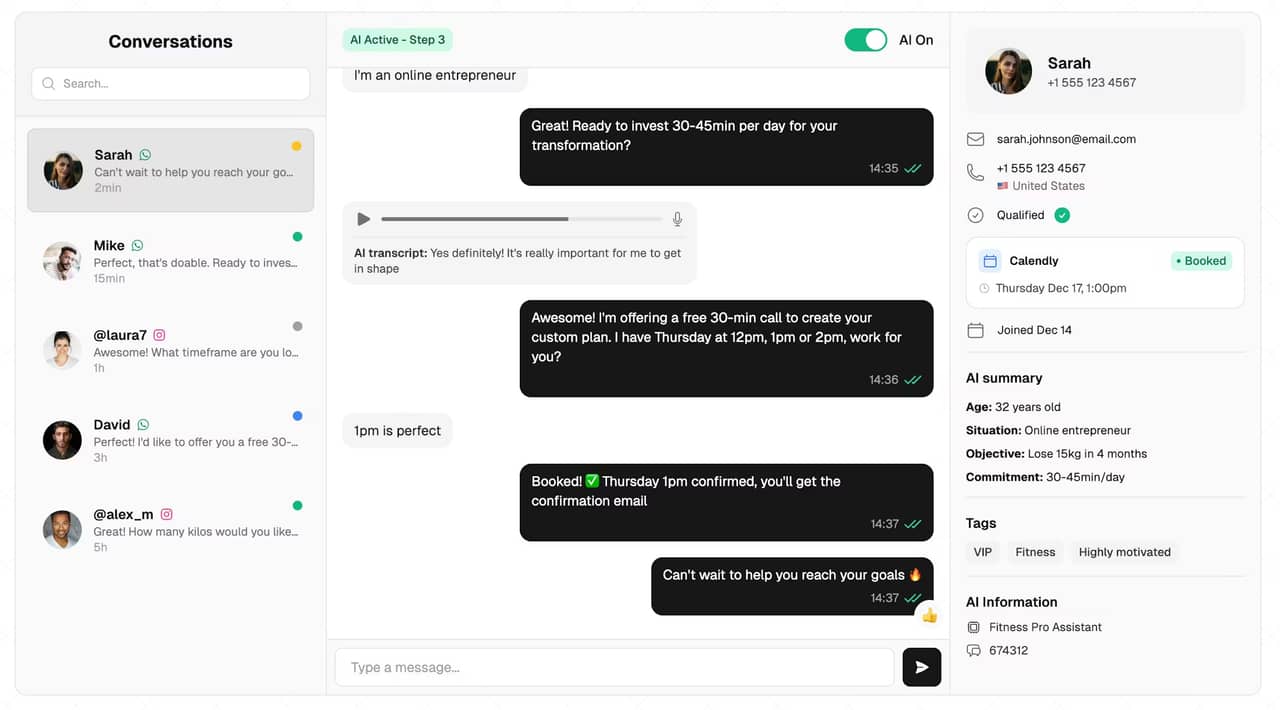
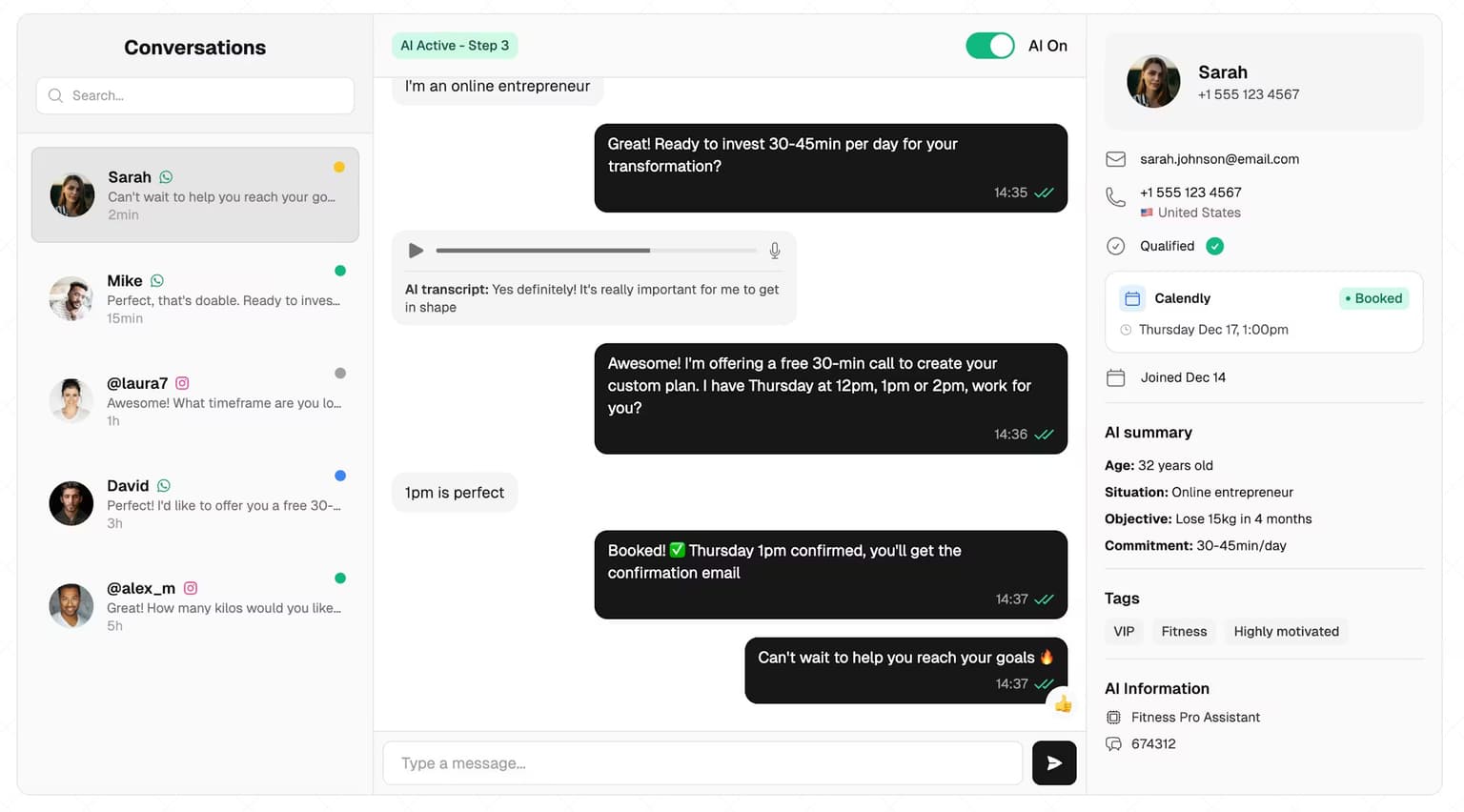
SetSmart is built for exactly this job. It is a DM-native AI setter for Instagram, WhatsApp, and Messenger that qualifies inbound leads through real conversation and books the call straight into your calendar, no flow-building required. You describe your offer and qualifying criteria, and the AI handles the back-and-forth and the follow-ups. Pricing is a free 7-day trial, then $97/month for the Pro plan with 1,000 messages included, on a flat plan rather than a per-contact meter.
"I book 15 to 25 calls per week... without managing a single setter." — Mathis Ladoué, Online Fitness Coach, 22.4K followers
Which should you choose?
Choose ManyChat if you are Instagram-first, want the best comment-to-DM tooling, and value the largest community and template library. For most coaches and creators evaluating the two, this is the default pick.
Choose UChat if you genuinely need many channels beyond the Meta apps, want the cheapest omnichannel entry, or you are an agency that wants a white-label platform to resell. It is the better fit for builders and multi-channel operators.
Choose neither if your real goal is a calendar full of qualified sales calls and you would rather not spend a weekend wiring decision trees. Both are flow builders that send links and collect data. A WhatsApp chatbot approach or a purpose-built setter that qualifies and books through natural conversation will get you to booked calls with far less overhead. Whichever you pick, the mechanics of DM conversion, depth and follow-up, matter more than the logo on the builder, and that is what a setter is built to protect.
FAQ
Is UChat better than ManyChat?
It depends on your goal. UChat offers more channels (12+ versus ManyChat's five), a slightly cheaper omnichannel entry, and an agency white-label plan. ManyChat has far better Instagram comment-to-DM tooling, a much larger community, and more templates. For an Instagram-first coach, ManyChat usually wins; for a multi-channel agency, UChat can make more sense. See our ManyChat alternative guide for the wider field.
Is UChat cheaper than ManyChat?
At the entry level they are close. ManyChat Essential is $14/month for 250 contacts, while UChat's Business plan starts near $15/month on annual billing for 1,000 contacts (closer to $29/month on monthly billing). Both meter on contacts, so the real cost depends on how large your audience grows. UChat's Partner white-label plan sits higher at around $199/month.
Does UChat or ManyChat have better AI?
UChat's AI is more flexible because you can attach a full model through your own API key, but that means extra setup and a separate usage bill. ManyChat's AI Step is simpler and self-contained but more limited. Crucially, both are AI bolted onto a flow, not a standalone conversational engine. For real qualifying dialogue you want an AI DM setter instead.
Can ManyChat and UChat both do Instagram and WhatsApp?
Yes. Both are official Meta partners and automate Instagram and WhatsApp through the sanctioned APIs, which keeps business accounts safe. ManyChat requires its Pro plan for WhatsApp; UChat includes WhatsApp on paid plans. Both add Meta per-conversation fees on top. Our WhatsApp automation guide covers the mechanics.
Do ManyChat or UChat book sales calls automatically?
Not on their own. Both send an external booking link (like Calendly) when the flow reaches that step, rather than booking inside the conversation. A dedicated setter books the call directly in the chat after qualifying the lead. Remember the positioning too: automation fills your calendar with qualified calls, and the actual close still happens live on the call.
Which is best for a coach selling a high-ticket offer?
If you only need comment-to-DM and lead magnets, ManyChat is the better value of the two. But if your goal is a steady flow of qualified sales calls without building and maintaining flows, neither builder is ideal. A DM-native AI setter that qualifies through conversation and books the call is a closer fit. Compare the options in our best AI setters roundup.
Ready to automate your DMs?
Start your free 7-day trial and let AI handle your lead qualification 24/7.
Try SetSmart free